
Introduction
The cybersecurity industry stands as one of the fastest-growing fields in today’s digital world, accompanied by a critical shortage of skilled talent. However, candidates aspiring to step into the sector frequently encounter a perplexing reality: job postings labeled as “Entry-Level” demand 3 to 5 years of experience, dozens of certifications, and nearly impossible lists of comprehensive competencies. This situation complicates the entry of qualified talent into the market and leads to a severe expectation mismatch. These inflated criteria set by organizations discourage passionate young talents and deepen the existing human resource crisis in the industry. In reality, field operations require minds that grasp fundamental computing logic and possess strong analytical thinking skills, rather than individuals holding theoretical certifications or memorized tool lists. This article aims to dispel this confusion, transparently unveil the true requirements behind job advertisements, and provide early-career specialists with a concrete, practical roadmap that holds direct value in real-world operations.
Learning Objectives
Upon completing this article, you will gain:
- Understanding Industry Dynamics: The ability to analyze expectation noise in entry-level job postings and filter out actual requirements.
- Recognizing Role Diversity: In-depth knowledge of 15 different entry-level cybersecurity roles, including their technical and operational responsibilities.
- Identifying Critical Skills: The skill to pinpoint real-world tools, protocols, and methodologies used in the field instead of paper requirements.
- Grasping Core Operational Logic: Internalizing the core mindsets and approaches essential for all cybersecurity professionals, regardless of their specific role.
What is Entry-Level Cyber Security Illusion?
The concept of “Entry-Level” in the cybersecurity domain carries a highly misleading nature for outsiders and beginners alike. In traditional software development or general Information Technology (IT) roles, entry-level positions are often viewed as starting points requiring “zero experience,” where fundamental training is completed on the job. However, cybersecurity is not an isolated, standalone domain by nature; it is a multi-layered specialty built directly upon computer science and network architecture. To secure a system, detect its vulnerabilities, or analyze an ongoing attack, one must first deeply understand how that system, network infrastructure, and operating system function. Right at this intersection emerges the largest point of confusion in the industry: the “Entry-Level Illusion.” Unrealistic job requirements published by human resources departments or employers—such as “3-5 years of experience,” “Senior-level certifications,” and “mastery over dozens of tools”—create an impression among candidates that the field is unreachable. In truth, the industry’s real expectation is not for candidates to memorize cybersecurity tools, but to possess a firm command over foundational IT infrastructure (Networking, Linux/Windows Administration, Network Protocols) and be ready to transition into the security layer using this core knowledge. The primary factor driving success in the field is not the sheer volume of tools listed in job ads, but problem-solving methodologies and practical intellect.
Accurately interpreting this illusion and shaping your career strategy accordingly prevents you from getting lost among unnecessary and exaggerated job requirements. The genuine qualities sought at the entry level are not fancy titles on paper or high-budget certifications, but analytical competencies that hold direct value in real-world operations.
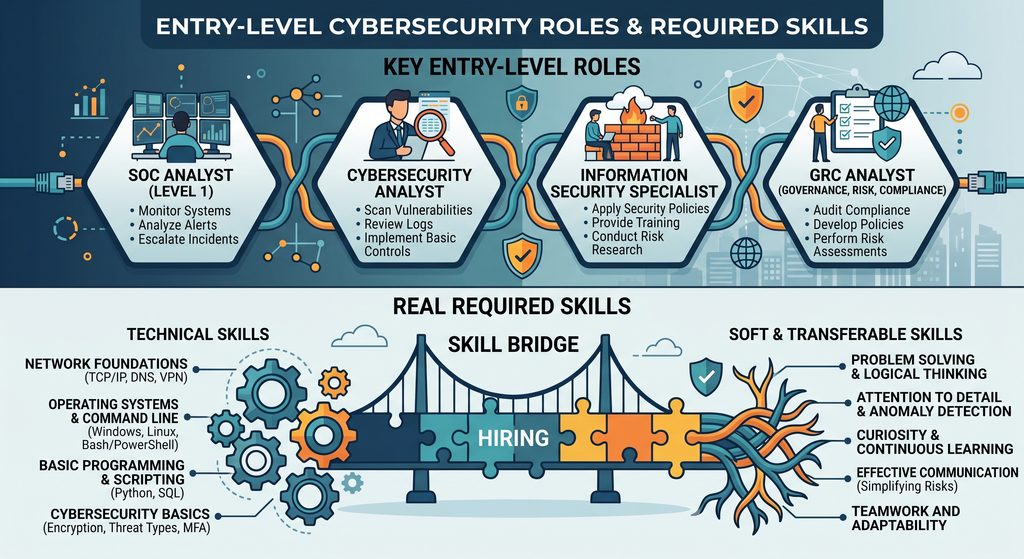
The 4 Key Elements to Overcoming the “Entry-Level Illusion”:
- Prioritizing a Solid Foundation: Fully comprehending TCP/IP, DNS, HTTP/HTTPS protocols, and operating system mechanics (Linux/Windows) before transitioning to the security layer.
- Breaking Tool Dependency: Understanding what automated security tools (Burp Suite, Nmap, Nessus, etc.) do in the background and interpreting their outputs rather than just pressing buttons.
- Skeptical & Analytical Approach: Investigating thousands of incoming security alerts with a skeptical analyst mindset focused on root cause analysis rather than a rigid rule-following approach.
- Continuous Practice & HomeLab Culture: Transforming theoretical knowledge into practical experience by testing real scenarios in self-built virtual laboratory environments (HomeLabs).
4 Key Logics That Make a Difference at Entry Level
In the cybersecurity industry, how you apply your skills and the perspectives you adopt are just as vital as your technical abilities. While many newcomers waste valuable time trying to memorize hundreds of different security tools, the professionals who truly stand out in the field are those who grasp the underlying mechanisms behind security events. Given the pace and complexity of security operations, individuals who merely execute pre-written commands or navigate dashboards offer limited contributions. The key to a sustainable career lies in looking beyond technical tools to cultivate a true analyst mindset and working discipline. These foundational approaches empower candidates during interviews and initial work experiences, directly feeding their capacity to accurately interpret and resolve complex cyber threats. Instead of relying solely on rote learning, a mindset centered on research, inquiry, and continuous experimentation must be built. In this regard, the 4 core logics that will distinguish you from competitors and enable you to generate real value early in your career are:
- 1. Deep Network and System Fundamentals (Fundamentals First): Security work conducted without understanding the operational principles of TCP/IP, DNS, HTTP/HTTPS protocols, and the kernel architecture of Windows/Linux operating systems remains inherently incomplete. The only way to filter out time-consuming false positives from genuine threats is to possess a flawless understanding of what “normal” data traffic and device behavior look like.
- 2. Skeptical Analysis and Root Cause Investigation: Security software and SIEM systems generate thousands of automated alerts daily. The true value of an entry-level specialist lies not in running tools or turning a blind eye to alerts, but in questioning incoming data. Uncovering the root cause of an alert, chronologically mapping events on a timeline, and properly prioritizing the potential impact area of a breach represent the most critical analytical skills.
- 3. Continuous Hands-On Learning & HomeLab Mindset: Cybersecurity cannot be learned purely by reading theoretical documentation or watching tutorials. Candidates who set up virtual laboratory environments (HomeLabs) on their own machines, work on vulnerable VMs, simulate SIEM and log analysis tools, and experience attack/defense scenarios firsthand consistently stay a step ahead due to their practical problem-solving abilities.
- 4. Clear Communication and Process Documentation: Cybersecurity operations are a team sport rather than a solo endeavor. Reporting an investigated incident or a discovered vulnerability in a clear, understandable manner without losing technical details is vital. At the entry level, the ability to express complex technical situations simply and document steps accurately directly boosts operational efficiency for the entire team.
Entry-Level Cybersecurity Roles and Real Required Skills
| Role | Official Description / Duties | Real Required Core Skills |
|---|---|---|
| 1. SOC Analyst (Tier 1) | Monitoring security alerts 24/7, performing initial analysis, and escalating incidents to higher tiers when necessary. | SIEM tools (Splunk, QRadar), log analysis, TCP/IP & packet inspection, quick decision-making. |
| 2. Cyber Threat Intelligence Analyst (Junior) | Collecting, analyzing, and reporting open-source (OSINT) and closed-source threat data. | OSINT techniques, basic Python scripting, CTI platforms, IoC tracking, strong research curiosity. |
| 3. Junior Penetration Tester | Conducting controlled attack simulations to identify vulnerabilities in systems and applications. | Basic Web/Network security, Linux/Windows administration, Burp Suite, Nmap, Metasploit. |
| 4. Security Operations Support Specialist | Tracking daily operations, licensing, and updates of security software suite. | Antivirus/EDR management, ticketing systems (Jira/ServiceNow), basic system administration. |
| 5. Vulnerability Management Analyst | Routinely scanning and prioritizing security vulnerabilities across enterprise systems. | Nessus/Qualys usage, CVSS scoring logic, patch management processes and coordination. |
| 6. Information Security / Compliance (GRC) Assistant | Tracking compliance processes with standards and regulations such as ISO 27001, GDPR, and NIST. | Risk assessment methodologies, documentation writing, regulatory and standard literacy. |
| 7. Junior Network Security Specialist | Configuring and maintaining core firewalls, VPNs, and IPS/IDS systems. | Routing & Switching, Firewall rule logic, deep packet analysis using Wireshark. |
| 8. Digital Forensics (DFIR) Assistant | Collecting, preserving, and conducting preliminary analysis on digital evidence post-security breaches. | File system mechanics, forensic imaging tools (FTK Imager), basic memory (RAM) analysis. |
| 9. Cloud Security Support Analyst | Monitoring basic security configurations and posture on AWS, Azure, or GCP. | Basic cloud architecture concepts, IAM (Identity and Access Management) logic, Linux configuration. |
| 10. Identity and Access Management (IAM) Analyst | Managing user account provisioning, entitlement grants, and de-provisioning workflows. | Active Directory / LDAP management, SSO/MFA systems, meticulous attention to detail. |
| 11. Application Security (AppSec) Assistant | Identifying fundamental security flaws in software development lifecycles (secure code review). | Proficiency in at least one language (Python/Java/JS), OWASP Top 10, SAST/DAST tools. |
| 12. Assistant System Security Administrator | Performing security hardening procedures on servers and operating systems. | Windows Server / Linux administration, PowerShell or Bash scripting, GPO management. |
| 13. Technical Support / Helpdesk (Security-Focused) | Assisting end-users with security-related issues (phishing reports, credential resets). | Communication skills, email header analysis, basic malware identification. |
| 14. Cybersecurity Sales / Presales Assistant | Communicating technical capabilities of security products to clients and assisting with PoCs. | Technical product knowledge, presentation skills, translating complex topics simply. |
| 15. Security Awareness Specialist | Organizing phishing simulations and security awareness training programs for employees. | Social engineering techniques, content creation, platform management, data analysis. |
Conclusion
Building a successful, sustainable, and prestigious career in cybersecurity requires focusing on fundamental principles and correct growth strategies rather than being intimidated by seemingly impossible job requirements. Given the industry’s expectation noise and exaggerated HR criteria, it is essential to remember that “entry-level” positions do not seek faultless, all-knowing experts; rather, they serve as initial stepping stones for professionals who grasp core network and system mechanics, possess high curiosity, think analytically, and remain problem-solving oriented. Fancy titles on paper or unreachable certification demands should not be seen as obstacles on your development path, but rather as guides helping you accurately analyze industry dynamics and focus on real operational needs. To chart a clear direction early in your career, you must first identify the role that best aligns with your personal interests, technical skills, and working style. Once your target is set, instead of getting lost in overwhelming training curricula attempting to superficially memorize hundreds of different tools, you should deeply focus on the practical tools, analysis methodologies, and core protocol knowledge that your chosen role directly demands in the field. Without waiting to feel “completely ready,” immediately putting theoretical knowledge into practice, personally experiencing every technical concept you learn, and documenting your progress step by step will multiply your learning pace. Furthermore, due to the dynamic nature of cybersecurity, you must always keep in mind that threat actors and defensive technologies evolve daily. This reality indicates that the learning process continues throughout your entire professional life, not just until you land a job. Every new vulnerability you encounter or log entry you analyze serves as a valuable brick added to your technical foundation. Therefore, establishing a disciplined learning routine and closely following current industry trends, threat intelligence reports, and next-generation attack vectors will consistently keep you a step ahead.
In conclusion, hands-on exercises conducted in self-built virtual laboratories, projects documented transparently and shared with the community, and your unrelenting passion for continuous learning will serve as your strongest references in interviews and professional life. Cybersecurity is a long-distance marathon with no shortcuts; what distinguishes you from competitors and leads to ultimate success in this marathon is not the quantity of tools or certifications, but the depth of your foundational knowledge, your inquisitive mindset, and a sense of curiosity that never fades.