
Introduction
As we navigate through 2026, the cybersecurity landscape has become more complex than ever. Ransomware has evolved from simple encryption scripts into highly sophisticated, AI-driven operations that target organizations of all sizes. Cybercriminals now leverage advanced automation, deepfakes, and triple-extortion tactics to maximize their impact. Staying ahead of these threats requires more than just basic antivirus software; it demands a comprehensive, proactive approach to digital security and data resilience. Today, a single breach can cripple global supply chains, paralyze critical infrastructure, and cause devastating financial and reputational ruin within hours. Security is no longer solely an IT department problem; it is a fundamental business imperative. Leaders must foster a culture of vigilance, continuously adapting their defenses to outsmart relentless digital adversaries.
Learning Objectives
By reading this article, you will be able to:
- Understand the core mechanics of a modern ransomware attack.
- Identify the different types and tactics used by cybercriminals in 2026.
- Execute an immediate incident response plan if your system is compromised.
- Implement robust, future-proof strategies to defend your data and infrastructure against future attacks.
What is a Ransomware Attack?
A ransomware attack is a highly disruptive form of malicious software (malware) deployment designed to block access to a computer system, network, or critical data until a sum of money—the ransom—is paid to the perpetrators. Attackers achieve this hostile takeover by utilizing advanced cryptographic algorithms to encrypt the victim’s files, rendering them completely unusable and inaccessible without a specific, attacker-controlled decryption key. What once began as opportunistic attacks on individual consumers has now transformed into a massive, organized criminal enterprise targeting corporations, hospitals, and government agencies. In recent years, the anatomy of these attacks has grown increasingly vicious. Beyond merely locking systems, modern threat actors now routinely exfiltrate (steal) vast amounts of sensitive data before triggering the encryption process. This tactic is leveraged to threaten victims with the public release of confidential client records, trade secrets, or embarrassing internal communications if their demands are ignored. Consequently, even organizations with perfect data backups are forced into a corner, as they must protect their reputation and avoid massive regulatory fines associated with data breaches. The deployment of ransomware often relies on exploiting human vulnerabilities or technical loopholes. Once inside a network, the malware stealthily moves laterally, seeking out vital servers and disabling security software before making its presence known. The resulting operational paralysis can bring business activities to a grinding halt, causing millions of dollars in downtime, lost revenue, and recovery costs, making it one of the most feared cyber threats of the modern era.
Key elements of a modern ransomware deployment include:
- Initial Compromise: The breach usually begins through deceptive phishing emails, stolen credentials, or unpatched software vulnerabilities.
- Lateral Movement: Attackers quietly navigate the compromised network to locate the most valuable data and disable backup systems.
- Encryption and Extortion: Files are locked with military-grade encryption, accompanied by a digital ransom note demanding payment, typically in cryptocurrency.
- Data Exfiltration: Sensitive information is secretly transferred to attacker-controlled servers to serve as leverage for secondary blackmail.
What Are the Types of Ransomware Attacks?
The landscape of ransomware is no longer defined by a single, predictable method of attack. Over the past decade, cybercriminals have heavily diversified their arsenals, transforming ransomware into a complex ecosystem of specialized threats designed to exploit different vulnerabilities. Attackers now carefully tailor their approaches based on their target’s industry, size, and specific security posture, moving far beyond the rudimentary “encrypt and demand” tactics of the early 2000s to maximize their leverage and payout potential. A major driver of this diversification is the rapid industrialization of cybercrime. The underground economy has matured into a highly structured environment, leading to sophisticated business models where malware development, initial network access, and attack execution are handled by entirely different criminal syndicates. This professionalization means that highly advanced, weaponized code is now accessible even to novice attackers, exponentially increasing the sheer volume, variety, and geographic spread of attacks that organizations face on a daily basis. In 2026, the most alarming shift is the integration of artificial intelligence and the aggressive expansion of the victim pool. Autonomous malware can now analyze network defenses in real-time and adapt its behavior to remain undetected, while ruthless extortion strategies have escalated to involve not just the breached company, but its entire supply chain and customer base. Understanding these distinct threat categories is the first crucial step in building a resilient, targeted defense strategy.
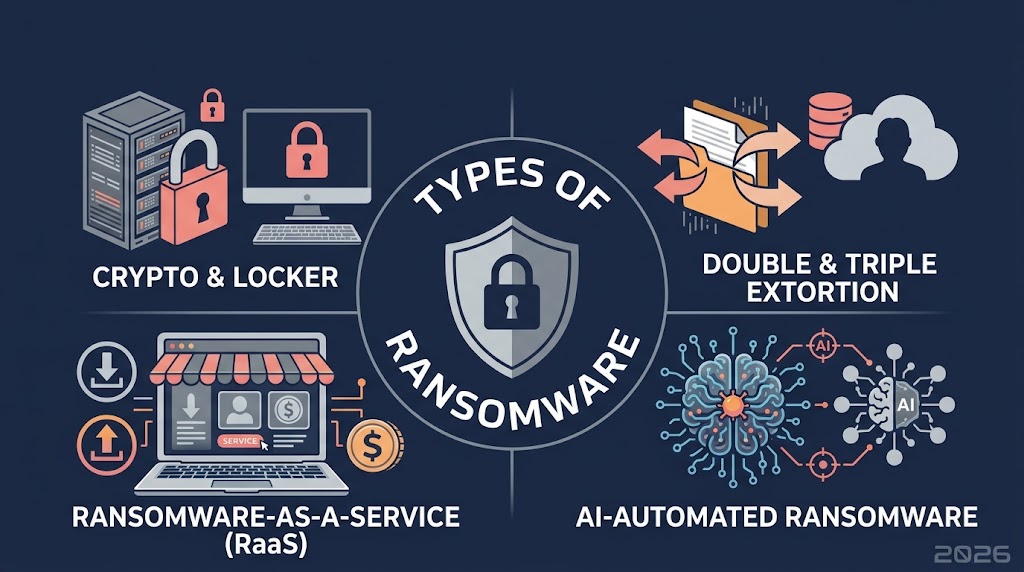
The primary categories of ransomware operating today include:
- Crypto and Locker Variants: The foundational forms of the threat. Crypto-ransomware selectively encrypts critical business files and databases while leaving the basic operating system running to display the ransom note. Locker ransomware, conversely, completely freezes the user out of the device’s interface, rendering the entire machine completely inaccessible.
- Double & Triple Extortion: A ruthless escalation tactic. Attackers first steal massive amounts of sensitive data before encrypting the local copies, threatening to leak the information on the dark web if unpaid (double extortion). In triple extortion campaigns, attackers actively harass and demand ransoms directly from the breached organization’s clients, business partners, or employees.
- Ransomware-as-a-Service (RaaS): A highly profitable franchising model for cybercrime. Elite developers create sophisticated ransomware variants and lease them out to “affiliates” on the dark web. The affiliates handle the actual hacking and deployment, and both parties split the resulting ransom profits, vastly lowering the barrier to entry for cybercrime.
- AI-Automated Ransomware: The latest and most advanced evolution in threat vectors. These autonomous, intelligent malware strains leverage machine learning to actively evade endpoint detection systems, identify the most critical data silos to target, and execute the encryption payload at speeds human defenders simply cannot manually counter.
What Should I Do If I Am Attacked?
Discovering that your systems have been compromised by ransomware is a high-stress scenario, but how you react in the first few minutes can dictate the entire outcome of the crisis. Panic and rash decisions often exacerbate the damage, allowing the malware to spread further or destroying crucial digital evidence. A calm, structured, and immediate response is absolutely critical to containing the blast radius and preventing a localized infection from turning into a catastrophic, company-wide blackout. The immediate aftermath of an attack is not the time for improvisation; it requires strict adherence to a pre-established incident response plan. Many victims make the fatal mistake of acting on instinct—such as rebooting infected servers in hopes of clearing the glitch, or immediately reaching out to the attackers to negotiate. These knee-jerk reactions almost always work in favor of the cybercriminals. Rebooting can trigger aggressive secondary encryption routines or wipe the volatile system memory that forensic experts desperately need to trace the attackers’ steps and identify the specific malware variant. Once the initial containment is achieved, the focus must shift to professional triage and secure recovery. Engaging specialized incident response teams, legal counsel, and law enforcement ensures that you are handling the extortion demands and data breach notifications in compliance with 2026’s strict regulatory frameworks. Recovery is a meticulous process of finding the initial entry point, eliminating the backdoor, and carefully rebuilding the environment so that the attackers cannot simply strike again the moment you bring your systems back online.
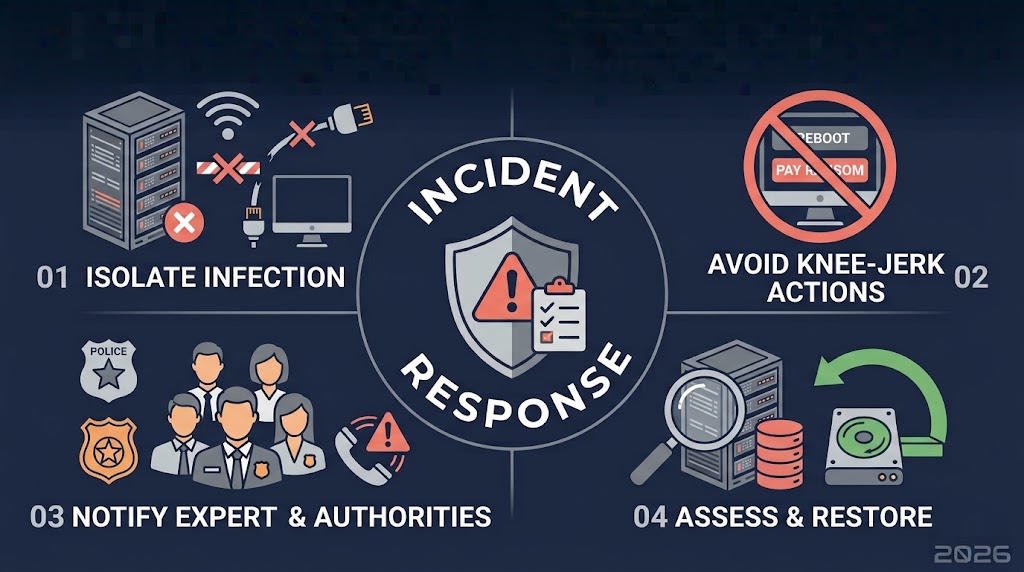
If you suspect an active ransomware infection, immediately follow these four critical steps:
- Isolate the Infection Immediately: Time is your most valuable asset. Instantly disconnect all affected devices and servers from the corporate network, Wi-Fi, internet, and any shared cloud storage to physically halt the malware from moving laterally to other systems.
- Avoid Destructive Knee-Jerk Reactions: Do not reboot or shut down the compromised machines, as this can accelerate encryption or destroy vital forensic evidence stored in the RAM. Furthermore, do not immediately pay the ransom; paying rarely guarantees full data recovery and instantly marks your organization as a lucrative, compliant target for future attacks.
- Engage Experts and Notify Authorities: Alert your internal security operations center (SOC) or external incident response providers immediately. Simultaneously, report the breach to relevant cyber law enforcement agencies, who may already have decryption keys for specific RaaS variants or intelligence on the threat actors.
- Assess, Clean, and Restore Safely: Work with forensics to identify exactly what data was compromised and how the attackers gained entry. Only after completely patching the vulnerabilities and purging the network of hidden backdoors should you begin restoring your systems from secure, immutable backups.
Effective Ransomware Protection Strategies for 2026
As ransomware tactics have evolved into multi-layered extortion campaigns driven by rapid automation, traditional perimeter-based security is no longer sufficient to protect an organization in 2026. The days of relying solely on basic antivirus software and standard firewalls are completely obsolete against modern adversaries who utilize artificial intelligence to bypass legacy systems. Today, defending a corporate network or personal infrastructure requires a proactive, dynamic approach that actively anticipates breaches rather than merely reacting to them after the damage is done. To effectively counter these sophisticated threats, organizations must transition to a comprehensive “defense-in-depth” methodology. This strategy operates on the realistic assumption that a network will eventually be breached, placing a heavy emphasis on containing the threat, severely restricting the malware’s lateral movement, and ensuring rapid, guaranteed recovery capabilities. It is about building an incredibly resilient environment where a single compromised credential or one vulnerable endpoint does not automatically result in a catastrophic, company-wide encryption event. Furthermore, true cyber resilience in 2026 seamlessly blends cutting-edge technological safeguards with a highly trained workforce. While autonomous AI defenses hunt for anomalous behavior at machine speed, human employees must serve as an alert and educated frontline against increasingly deceptive social engineering and deepfake attacks. By aligning advanced architecture with continuous operational vigilance, businesses can create an overwhelmingly hostile environment for cybercriminals, drastically reducing the likelihood of a successful extortion attempt.
To defend against the sophisticated threats of 2026, organizations and individuals must adopt these critical security measures:
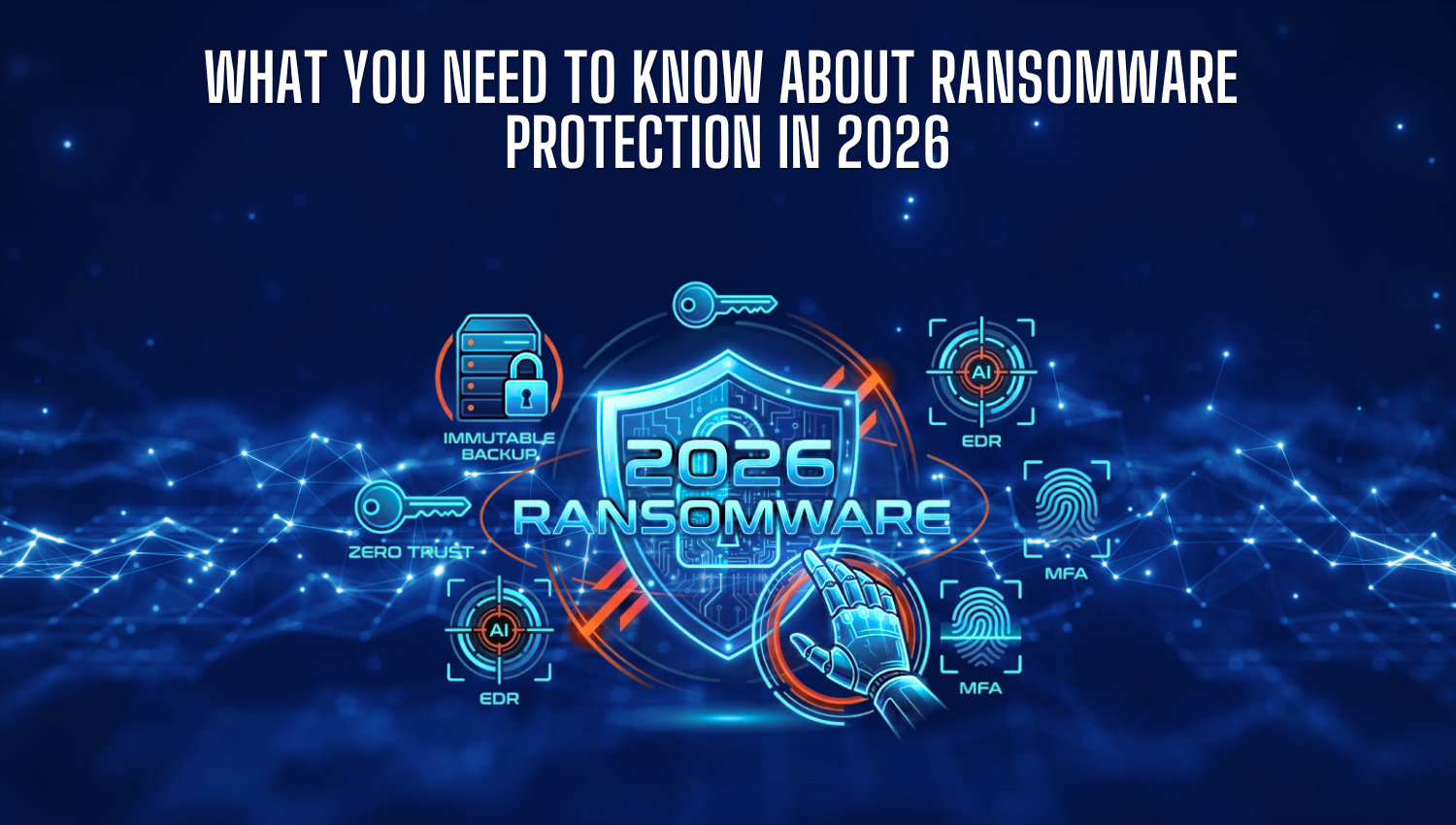
- Immutable Backups: Maintain specialized backups that cannot be altered, deleted, or encrypted by anyone—even by individuals possessing top-level administrative privileges. Ensure these critical data reserves are stored entirely offline or in a highly secure, logically isolated cloud vault.
- Zero Trust Architecture: Adopt a strict “never trust, always verify” approach across the entire digital infrastructure. Continuously authenticate users and limit access to only the specific data and systems absolutely necessary for their immediate role (the Least Privilege Principle).
- AI-Powered Endpoint Detection and Response (EDR): Utilize next-generation security platforms that rely on continuous behavioral analysis and machine learning, rather than outdated signature matching, to identify and automatically terminate ransomware before it can execute its encryption payload.
- Phishing-Resistant MFA: Enforce Multi-Factor Authentication (MFA) universally across all internal and external accounts. In 2026, organizations must pivot away from easily intercepted SMS codes and rely on physical hardware security keys (like FIDO2) or secure biometrics.
- Continuous Security Awareness Training: Human error remains the most exploited vulnerability in any network. Regularly and rigorously train employees to recognize AI-generated deepfakes, highly personalized spear-phishing emails, and the latest social engineering tactics designed to steal credentials.
Conclusion
Ransomware in 2026 has undeniably cemented itself as a formidable and relentless adversary, characterized by lightning-fast execution speeds and ruthlessly complex, multi-layered extortion tactics. The days of isolated, easily mitigated ransomware strains are long gone, replaced by highly orchestrated campaigns driven by artificial intelligence and sophisticated criminal syndicates. These modern attacks do not merely seek to temporarily disrupt operations; they aim to fundamentally paralyze entire organizations, compromise highly sensitive intellectual property, and extort maximum financial payouts by weaponizing both encrypted systems and stolen data simultaneously. However, despite the escalating sophistication of these threat actors, a catastrophic and successful attack is by no means inevitable. By deeply understanding the evolving nature of these digital threats and establishing exactly how to respond with clinical precision during a crisis, organizations can drastically minimize their exposure. The key to survival lies in shifting from a reactive mindset to a highly proactive one, implementing resilient, modern defense frameworks that anticipate failure. By embedding robust strategies such as truly immutable backups, stringent Zero Trust architectures, and AI-driven endpoint detection into the core of their operations, businesses can neutralize an attack long before the ransom note ever appears on a screen. Ultimately, achieving absolute security in an increasingly hyper-connected world is an illusion, but achieving profound resilience is an entirely realistic goal. Cybersecurity must be viewed not as a static destination or a simple checklist of software purchases, but rather as a continuous, dynamic journey of adaptation and improvement. As cybercriminals inevitably develop new tools and tactics to bypass contemporary defenses, organizations must remain equally committed to evolving their strategies and empowering their human workforce through relentless education. By staying comprehensively informed, culturally vigilant, and technologically prepared, you forge your strongest possible shield against the ransomware threats of tomorrow.