
Introduction
JFrog Artifactory serves as a central pillar in modern software engineering, providing universal artifact management across continuous integration and continuous delivery (CI/CD) pipelines. Given its privileged position—storing sensitive binaries, container images, AI models, and proprietary source code dependencies—a breach within Artifactory poses significant supply chain risks to global digital infrastructure. Disclosed in late August 2026, CVE-2026-82329 represents a critical security flaw rated 9.8 (Critical) under CVSS v3.1. Categorized under CWE-287 (Improper Authentication), this flaw allows remote, unauthenticated attackers to completely bypass authentication controls and grant themselves administrative privileges on vulnerable, self-hosted JFrog Artifactory instances. Left unpatched, adversaries can silently gain unrestricted access to compromise build artifacts, exfiltrate sensitive secrets, and execute arbitrary malicious code across enterprise networks.
Learning Objectives
After reading this technical deep dive, security professionals, system administrators, and DevOps engineers will be able to:
- Understand the Architecture: Comprehend the role of the JFrog Access microservice and service-to-service trust mechanisms.
- Identify the Vulnerability Chain: Analyze how missing join key configurations create a “phantom” or blank state that leads to authentication bypass.
- Assess Exposure: Identify affected self-hosted JFrog Artifactory release branches and contrast them with patched versions.
- Detect & Remediate: Implement detection strategies for rogue administrative token generation and apply vendor remediation guidance.
What is JFrog Artifactory Access Blank Join Key Authentication Bypass (CVE-2026-82329)
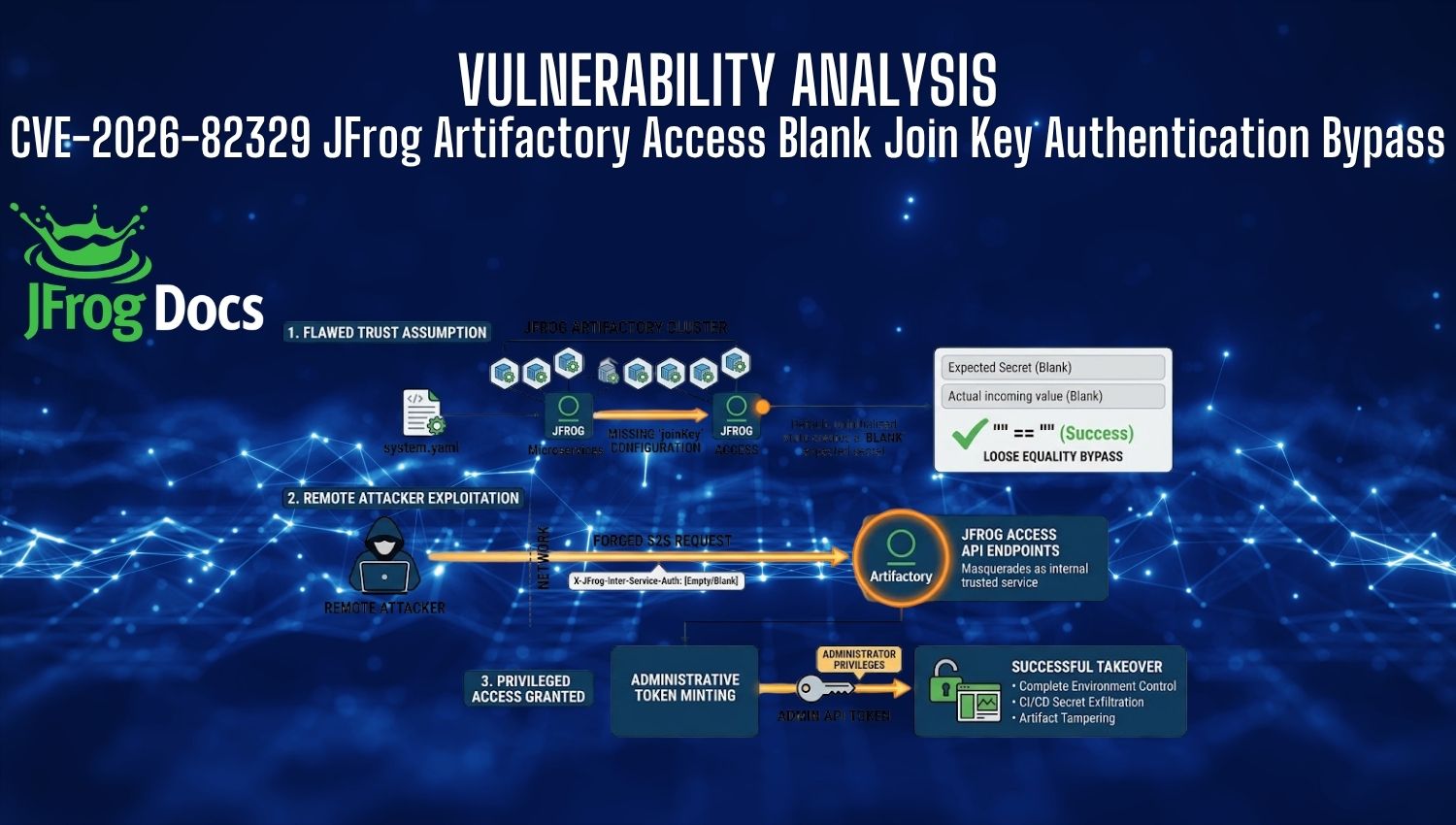
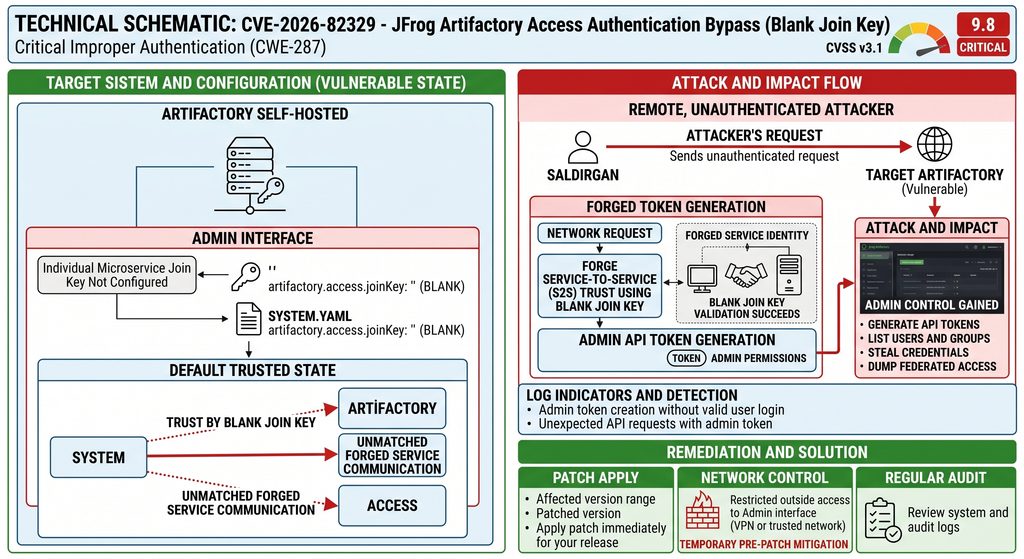
CVE-2026-82329 is a critical improper authentication vulnerability in JFrog Access—the foundational identity management and security microservice embedded within the JFrog Artifactory platform. Under normal operating conditions, JFrog Access regulates service-to-service communication, user authentication, and permission enforcement across the entire microservice architecture. However, an architectural oversight in how uninitialized configuration variables are evaluated opens a severe security vector in self-hosted deployments. In a default, out-of-the-box self-hosted Artifactory installation, internal microservices authenticate with one another using cryptographic shared secrets known as join keys. When individual microservice join keys are omitted or left undefined in central configuration files (such as system.yaml), the Access sub-system defaults to an empty string (“blank”) state rather than explicitly rejecting unauthenticated inter-service traffic. This missing validation creates a “phantom” secret state where empty or missing keys are implicitly accepted as valid trust identifiers within the cluster. Because the underlying service-to-service (S2S) validation logic fails to enforce strict non-empty checks for these trust tokens, remote attackers on the network can manipulate this vulnerability. By crafting malicious API requests that simulate internal microservice traffic matching the uninitialized blank join key state, the attacker bypasses all standard user authentication checks. This trickery enables the attacker to issue privileged administrative calls and directly mint full-scoped administrator API tokens, granting them complete control over the host environment without ever supplying valid user credentials.
Key characteristics and implications of this flaw include:
- Complete Authentication Bypass: Allows unauthenticated network attackers to entirely skip primary login mechanisms and gain initial access to the system.
- Direct Administrative Escalation: Enables immediate generation of full-privileged administrator API tokens via internal service endpoints without user interaction.
- Scope of Exposure: Exclusively impacts self-hosted (self-managed) Artifactory instances that rely on default microservice join key configurations, while managed SaaS environments remain unaffected.
- High Severity Classification: Designated with a CVSS v3.1 score of 9.8 (Critical) under CWE-287 (Improper Authentication) due to low attack complexity and severe impact on confidentiality, integrity, and availability.
+------------------+         Forged S2S Request         +-------------------+
|                  | ---------------------------------> |                   |
| Remote Attacker  |   (Matches Blank Join Key State)   |  JFrog Access     |
| (Unauthenticated)|                                    |  (Microservice)   |
|                  | <--------------------------------- |                   |
+------------------+     Returns Admin API Token        +-------------------+
                                                                  |
                                                                  v
                                                        +-------------------+
                                                        | Full Admin Access |
                                                        | to Artifactory    |
                                                        +-------------------+
Technical Detail: How the Vulnerability Works
The core of this vulnerability lies in the subtle failure of trust assumptions within the internal communication architecture of JFrog Access. In microservice ecosystems, component-to-component trust is typically maintained using shared cryptographic secrets passed via HTTP headers or gRPC metadata. When secondary microservices fail to explicitly declare a unique joinKey in the system.yaml configuration file, the central Access service falls back to evaluating the missing parameter against an empty configuration object, resulting in an uninitialized, blank string baseline. Because the underlying validation code evaluates an absent or empty incoming token against the uninitialized expected join key using loose equality logic (effectively executing a "" == "" comparison), the verification check succeeds. Attackers can leverage this logic flaw by crafting HTTP requests directly to the internal Access API endpoints, setting the service-to-service authorization headers to empty values or matching the uninitialized state. The service misinterprets these requests as originating from legitimate, trusted internal microservices operating inside the cluster boundary. Once this trust boundary is breached, the attacker interacts directly with internal administrative endpoints meant exclusively for internal microservice setup and token generation. By sending a payload requesting token minting with administrative capabilities, the Access service processes the forged inter-service call and signs a fully functional, high-privilege bearer token. The attacker can then use this token against the standard public REST APIs to execute complete environment takeovers, exfiltrate stored CI/CD secrets, or tamper with software build artifacts.
Key stages and impacts of the exploitation chain include:
- Uninitialized State Exploitation: Capitalizes on missing or default
artifactory.access.joinKeyvalues within configuration files to force an empty-string trust baseline. - Service-to-Service Forgery: Bypasses primary authentication gates by forging internal inter-service headers directly against exposed Access API endpoints.
- Privileged Token Minting: Issues requests to create persistent, high-privilege administrative tokens signed by the local Access authority without needing user credentials.
- Post-Exploitation Actions: Enables adversaries to enumerate internal user bases, exfiltrate CI/CD secrets, map federated instances, and manipulate software supply chain binaries.
# Example curl request demonstrating unauthenticated admin token minting via blank join key
curl -X POST "https://artifactory.example.com/access/api/v1/tokens" \
  -H "Content-Type: application/json" \
  -H "X-JFrog-Inter-Service-Auth: " \
  -d '{
        "grant_type": "client_credentials",
        "username": "admin-recovery",
        "scope": "applied-permissions/admin",
        "expires_in": 3600
      }'

HTTP/1.1 200 OK
Content-Type: application/json

{
  "token_id": "8f3a9e12-3b4c-4d5e-8f9a-0b1c2d3e4f5a",
  "access_token": "eyJhbGciOiJSUzI1NiIsInR5cCI6IkpXVCJ9.eyJzdWIiOiJqZmFjQDAxZXhhbXBsZS91c2Vycy9hZG1pbi1yZWNvdmVyeSIsInNjb3BlIjoiYXBwbGllZC1wZXJtaXNzaW9ucy9hZG1pbiIsImlzcyI6ImpmY3JhdEBmYWtlIiwiaWF0IjoxNzU2NDY3MjAwLCJleHAiOjE3NTY0NzA4MDB9.EXAMPLE_FORGED_SIGNATURE_DATA...",
  "expires_in": 3600,
  "scope": "applied-permissions/admin",
  "token_type": "Bearer"
}
Affected Software & Plugins
The scope of CVE-2026-82329 specifically centers on self-hosted (self-managed) JFrog Artifactory deployments where administrators maintain on-premises, hybrid, or custom cloud infrastructure control plane binaries. Because the vulnerability stems from default configuration behaviors during local installation setup, self-managed environments that lack explicitly defined microservice join keys in their global system.yaml files are directly vulnerable. Conversely, JFrog Cloud (SaaS) managed services were fully patched at the infrastructure level by the vendor and required no customer-side intervention. To evaluate organizational exposure, system administrators must verify the specific release branch and build version currently active across all self-hosted node clusters. Security teams operating older, legacy versions outside of the active maintenance tracks must prioritize immediate upgrades, as all unpatched versions prior to the designated security releases contain the uninitialized Access verification flaw.
| Release Branch | Vulnerable Version Range | Patched/Fixed Release |
|---|---|---|
| 7.161.x | 7.161.0 – 7.161.19 | 7.161.20 |
| 7.146.x | 7.146.0 – 7.146.37 | 7.146.38 |
| 7.133.x | 7.133.0 – 7.133.28 | 7.133.29 |
| 7.125.x | 7.125.0 – 7.125.19 | 7.125.20 |
| 7.117.x | 7.117.0 – 7.117.27 | 7.117.28 |
| Legacy (< 7.111.x) | All versions prior to 7.111.21 | 7.111.21 |
Conclusion
CVE-2026-82329 serves as a stark reminder of the fragile nature of internal microservice security architectures. While modern enterprise perimeter defenses heavily focus on safeguarding public-facing interfaces and validating end-user credentials, implicit trust assumptions between background services remain a significant blind spot. When inter-service authentication relies on default or uninitialized configuration states, the integrity of the entire application control plane is fundamentally undermined. The core issue behind this vulnerability goes beyond a simple software bug; it reflects a broader design challenge in distributed software systems. Failing to strictly validate non-empty trust identifiers allows an external actor to easily masquerade as an internal system component. In high-value software delivery infrastructure like JFrog Artifactory—which holds the keys to corporate intellectual property and distribution channels—such an oversight grants attackers direct administrative control over critical build artifacts and pipeline integrations. Moving forward, organizations must adopt a zero-trust posture not just at the network perimeter, but deep within the internal component communication flows. Relying on implicit microservice trust or assuming secondary microservices will always run in completely isolated environments leaves systems highly vulnerable to service-to-service forgery attacks. Security architectures must actively enforce explicit validation, ensuring missing configuration variables fail closed rather than falling back to permissive defaults.
Ultimately, addressing critical flaws like CVE-2026-82329 requires a combination of rapid patch management, continuous threat monitoring, and strict network segmentation. Defense teams should immediately upgrade self-hosted instances to the appropriate patched release branch to eliminate the underlying verification flaw. Additionally, administrative endpoints must be isolated behind secure VPN or zero-trust boundaries, access logs audited for unauthorized token creation, and stored integration credentials rotated on any system exposed prior to patching.