
Introduction
In modern web architectures, open-source cross-platform database administration tools like DbGate are widely adopted by DevOps teams and database administrators to streamline data visualization, schema editing, and multi-database query management. However, when these powerful administrative tools implement dynamic server-side script execution mechanisms without enforcing rigorous input sanitization, strict type validation, and robust context isolation, severe security vulnerabilities can easily emerge. This article explores CVE-2026-47670, a critical authenticated Remote Code Execution (RCE) vulnerability affecting DbGate versions up to v7.1.8. This specific flaw provides a profound look into ecosystem-specific threats, serving as an excellent case study on the dangers of relying on superficial code-level. Throughout this deep dive, we will analyze the underlying technical mechanics of the application’s template engine and demonstrate how a flawed, makeshift sandbox isolation method completely crumbles when confronted with native, unblockable Node.js runtime language features.
Learning Objectives
By the end of this article, you will understand:
- The input-handling logic of the vulnerable
/runners/load-readerendpoint within DbGate. - Why standard sandboxing attempts like
require = null;fail inherently inside Node.js environments. - The architectural distinction between traditional global functions and ECMAScript language keywords (
import()). - How string concatenation risks lead to structural code injection, and how to implement proper defense-in-depth remediation.
What is CVE-2026-47670 – DbGate – Remote Code Execution via Dynamic Import Bypass
CVE-2026-47670 is a critical authenticated Remote Code Execution (RCE) vulnerability residing in the backend JSON script compilation engine of DbGate. The structural flaw stems from a fundamental lack of input validation and strict character sanitization of the functionName parameter handled by the /runners/load-reader API endpoint. Because the application directly concatenates this user-supplied string into a dynamic JavaScript template before executing it server-side, a malicious user who possesses valid login credentials can effortlessly append newline characters (\n), statement terminators (;), and custom code blocks. This injection allows attackers to prematurely close out the intended internal logic, completely neutralize succeeding code strings, and break directly into the raw Node.js execution layer. Once escaped, the injected expressions run with the context and system permissions of the underlying application server. This security defect presents a massive risk to corporate data environments and was officially patched in v7.1.9 following coordinated vulnerability disclosures.
To better understand the immediate impact and characteristics of CVE-2026-47670, consider the following key operational parameters:
- Authentication Requirement: The flaw is classified as authenticated, meaning a threat actor must first obtain low-privilege access, valid session tokens, or active credentials to the DbGate dashboard to reach the vulnerable endpoint.
- Attack Vector and Complexity: The attack vector is strictly network-based (remote) and exhibits low complexity, requiring no user interaction other than transmitting a structured, malicious JSON payload to the application server.
- Privilege Escalation Potential: Because DbGate is heavily distributed via standard Docker container images that run their internal processes as the root user by default, successful exploitation yields immediate, unconstrained container root privileges.
- Impact on Confidentiality, Integrity, and Availability: This vulnerability carries a maximum impact rating across all three core security pillars, enabling total data exfiltration, arbitrary file modification, and complete operational disruption of the host infrastructure.
Technical Detail: How the Vulnerability Works
The root cause of this critical vulnerability lies in an architectural misconception regarding JavaScript scope execution, a deceptive security practice often referred to as “pseudo-sandboxing.” In a well-intentioned but fundamentally flawed earlier effort to mitigate server-side template injection (SSTI) risks, DbGate developers attempted to lock down the dynamic execution environment. They appended require = null; to the very top of the dynamically generated script context template. The engineering objective behind this structural control was straightforward: if a threat actor managed to inject characters into the script template, they would find that the standard Node.js module loader was destroyed, theoretically preventing them from importing dangerous, low-level internal core components like child_process, fs, or os to execute shell commands.
However, this implementation completely overlooks a core cryptographic and syntactic principle of modern JavaScript engine design, specifically regarding how V8 handles module resolution contexts. The sandbox collapses entirely due to the stark behavioral differences between two separate language components:
require()is a global function living on the scope chain. In the CommonJS module system,requireis injected into the module wrapper as a standard function argument or object variable. Because it acts as a regular, mutable identifier on the scope chain, its reference can be overwritten, reassigned, or nullified dynamically at runtime. When the application runsrequire = null;, the reference is successfully broken, rendering traditionalrequire('child_process')calls useless by throwing a standardTypeError.import(), conversely, is not a function—it is a native ECMAScript (ES6) language keyword and syntactic construct. It is processed and parsed directly by the V8 engine’s syntax analyzer at a fundamental level, operating identically to structural control keywords likeif,for,switch, orreturn. Because it is an immutable part of the ECMAScript specification syntax rather than a global object variable, redefining local scope variables, modifying the global context, or nullifying active objects has absolutely zero structural impact on the operational capabilities of a dynamicimport()expression.
To abuse this fundamental design oversight, an authenticated attacker crafts and issues a malicious POST request targeting the vulnerable /runners/load-reader backend API endpoint. The request features a payload structured precisely as follows:
{
  "functionName": "dummy;\nconst { execSync } = await import('child_process');\nexecSync('id');\n//"
}When the application’s backend template compiler processes this raw incoming parameter, it performs direct string concatenation into an internal evaluation string. Because it lacks character validation, it outputs syntactically flawless, linear JavaScript code that executes sequentially and completely circumvents the developer’s intended security restrictions:
const dbgateApi = require(process.env.DBGATE_API);
require = null; // The developer's defensive barrier, which only impacts CommonJS functions

async function run() {
    // 1. The engine processes the initial object property lookup (dummy)
    // 2. The newline character (\n) terminates the statement, transitioning to the injection
    const reader = await dbgateApi.dummy;

    // 3. V8 encounters the native ES keyword, bypassing the nullified require function entirely
    const { execSync } = await import('child_process');

    // 4. The system executes the arbitrary operating system command with server privileges
    execSync('id');

    // 5. The remaining portion of the application's original template code is neutralized
    //(//...);
}By leveraging the asynchronous nature of the engine’s dynamic importer within the async function run() wrapper, the attacker’s payload smoothly fulfills all lexical requirements of the host script. This results in immediate, reliable, and unconstrained command execution directly on the hosting operating system.
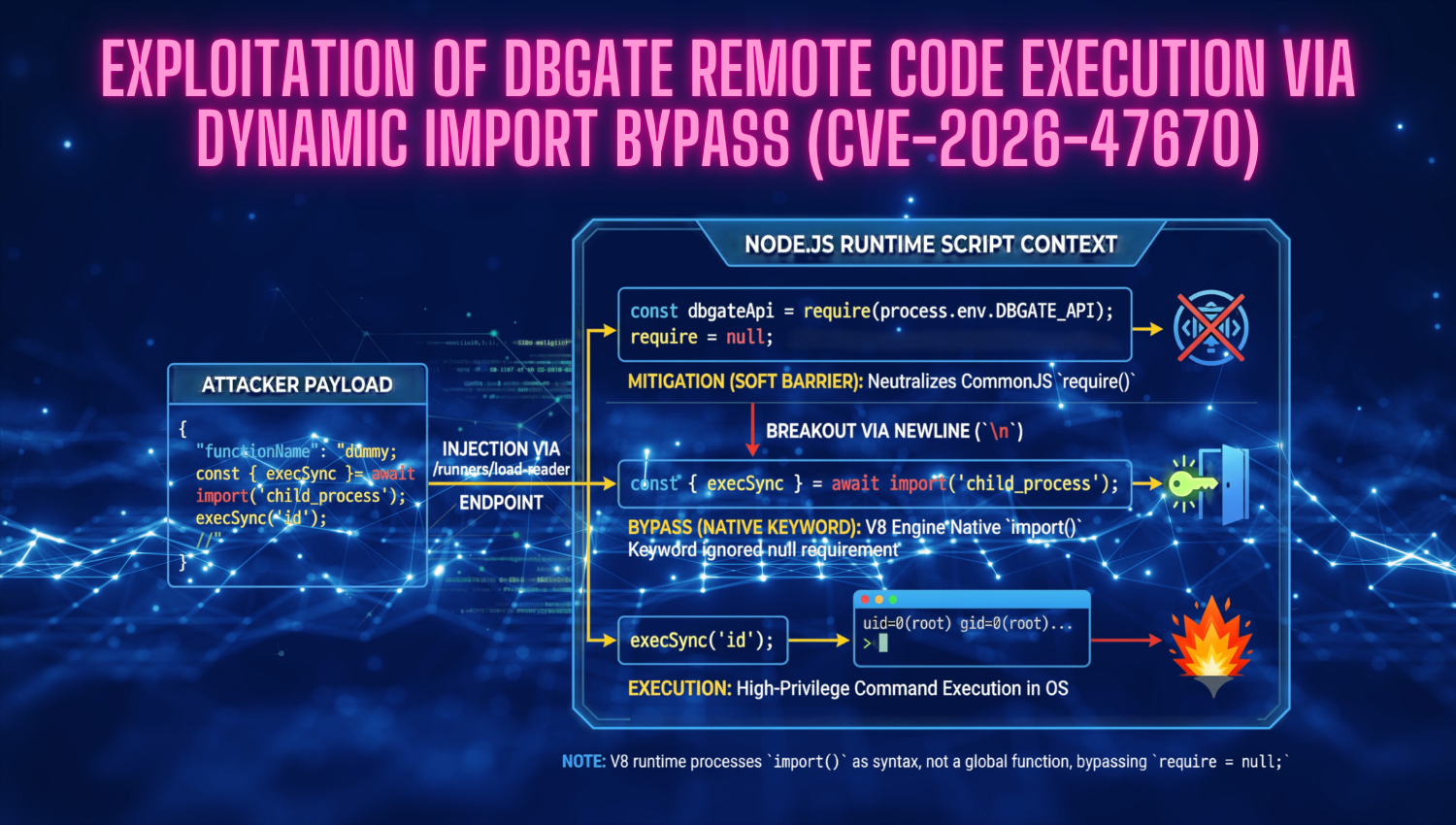
Conceptual Architecture of the Exploit
The exploit architecture relies heavily on exploiting the dual nature of module resolution inside modern JavaScript runtimes. The following diagram and detailed workflow illustrate how the malicious payload systematically circumvents the application’s weak variable-nullification barrier, flowing entirely unimpeded directly into the underlying host environment:
[Attacker Payload] ──> Injected into functionName Parameter
                                      │
┌─────────────────────── Node.js Runtime Script Context ────────────────────────┐
│                                                                               │
│  1. require = null;   ──> Blocks Traditional Loading: require(...)            │
│                                                                               │
│  2. Dynamic import()  ──> Native Language Feature: await import(...)          │
│                           (Barrier Bypassed! ⚡)                               │
│                                                                               │
│  3. Execution         ──> execSync('id') ──> High-Privilege OS RCE            │
└───────────────────────────────────────────────────────────────────────────────┘To break down this operational flow further, the exploitation lifecycle proceeds through four precise stages within the V8 runtime environment:
- Step 1: Context Breaking & Injection: The application reads the unsanitized string input from the HTTP request body and concatenates it. The inclusion of a statement terminator (
;) and a newline (\n) completely alters the abstract syntax tree (AST) generated by the compiler. It gracefully closes out the safe assignment statement of the original developer’s template and creates a completely clean structural plane for the attacker’s code to run next. - Step 2: The Soft Barrier Evaluation: As the runtime engine processes the instructions sequentially inside the
asyncwrapper, it first encounters the line containingrequire = null;. The pointer to the standard CommonJS loading utility is successfully destroyed at this stage. Any subsequent script attempts to callrequire('fs')orrequire('child_process')fail instantly, triggering a runtime exception that would safely halt execution. - Step 3: The Native Keyword Bypass: The engine’s execution pointer moves immediately to the attacker’s injected line. Instead of referencing a mutable scope variable, it runs
await import('child_process'). Because the V8 engine treatsimport()as an internal structural expression keyword, the compiler resolves the ES module asynchronously by pulling it directly from the runtime’s core binary bindings, entirely ignoring the fact that the localrequirevariable equalsnull. - Step 4: Arbitrary System Compromise: With the native binding to the internal
child_processbinary successfully established and destructured, the runtime executes theexecSync()function. This sends the raw system command payload directly out of the JavaScript runtime wrapper and directly into the underlying host operating system’s shell wrapper.
Because DbGate server instances are overwhelmingly deployed via pre-packaged Docker containerized images running internal processes with administrative root permissions by default, this bypass results in an immediate, high-privilege system compromise of the container infrastructure.
Conclusion
CVE-2026-47670 serves as a definitive, textbook example of why approaches and makeshift runtime variable nullification are highly fragile, anti-pattern defensive strategies in modern software engineering. Relying on superficial pseudo-sandboxing techniques to neutralize complex runtime environments invariably creates a false sense of security, especially when developers fail to distinguish between mutable global scope functions and native engine-level syntax rules. Any application architecture that feeds unvalidated, user-controlled inputs directly into runtime string evaluators remains fundamentally exposed to the inherent architectural flexibilities, legacy edge cases, and evolving features of the underlying programming language. Securing your operational infrastructure against this specific high-severity threat vector requires immediate, decisive remediation actions to prevent widespread exploitation. Production instances of DbGate must be upgraded to version v7.1.9 or higher without delay to completely eliminate the vulnerable API endpoint exposure from external access. Furthermore, when designing dynamic script generators or internal template evaluation mechanisms within your own engineering codebases, raw string concatenation must be completely abandoned. Instead, developers should implement a rigid, enterprise-grade defense-in-depth model utilizing an explicit, strict object lookup map, guaranteeing that incoming user strings are safely resolved against pre-defined, fully authorized internal function references rather than being dynamically compiled and interpreted as raw, executable server-side text.