
Introduction
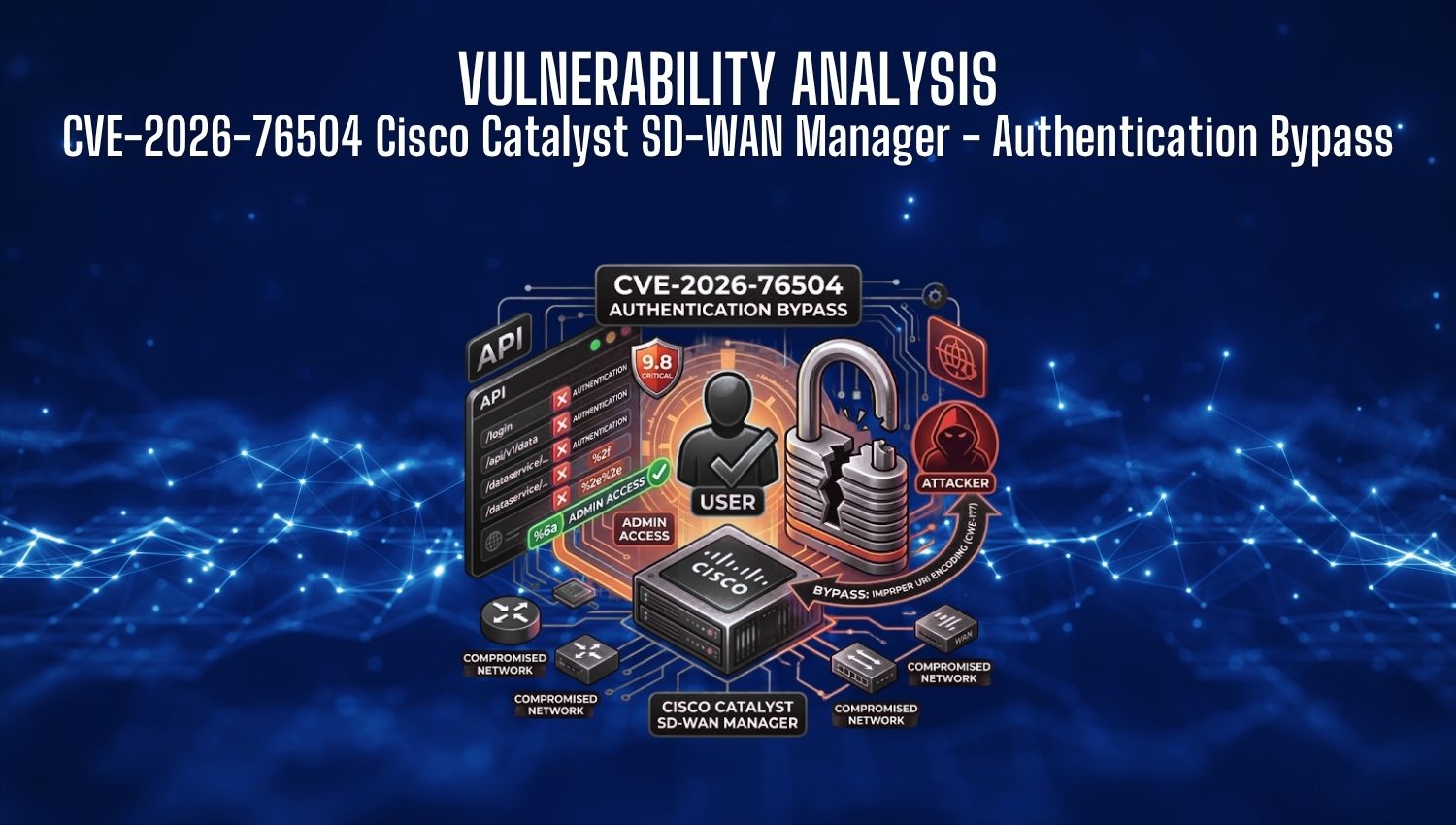
Centralized management platforms serve as the core control plane for modern enterprise network architectures, providing a single pane of glass for multi-cloud and wide-area network management. Cisco Catalyst SD-WAN Manager (formerly known as vManage) enables network administrators to configure, monitor, automate, and orchestrate complex enterprise wide-area networks across global deployments from a unified web interface. Because this platform possesses full administrative authority over connected WAN edge routers, control nodes, and security policies, any vulnerability compromising its authentication boundary places the entire enterprise infrastructure at severe risk. Tracked as CVE-2026-76504, this critical security flaw carries a Maximum Severity CVSS v3.1 score of 9.8. It enables remote, unauthenticated threat actors to entirely bypass web-based authentication mechanisms and acquire administrative control over affected SD-WAN Manager instances. Discovered during active exploitation in the wild, this vulnerability highlights the severe security implications of exposed API endpoints on core management software and underscores the critical necessity of rigorous request-handling security in software-defined network control planes.
Learning Objectives
After reading this technical deep dive, you will be able to:
- Understand the structural architecture of Cisco Catalyst SD-WAN Manager’s REST API endpoints and authentication flow.
- Analyze the root-cause mechanics of URI/URL parsing errors (CWE-177) that lead to authentication bypasses.
- Identify vulnerable system configurations, affected software release trains, and patched versions.
- Implement containment, detection, and remediation steps to secure affected network infrastructure.
What is Cisco Catalyst SD-WAN Manager – Authentication Bypass (CVE-2026-76504)
Cisco Catalyst SD-WAN Manager (CVE-2026-76504) represents a critical authentication bypass flaw located directly within the HTTP request processing logic of the application’s REST API gateway. Under normal operations, all incoming HTTP requests directed toward restricted administrative management endpoints must undergo strict credential validation via session tokens or authenticated cookies before being passed to internal execution handlers. However, due to improper URL path sanitization and parsing discrepancies, unauthenticated network traffic can bypass these perimeter security filters completely. The root cause of CVE-2026-76504 stems from an inconsistent handling of hexadecimal-encoded URI sequences between the reverse proxy/security filter layer and the underlying Java web application context. When an attacker crafts an HTTP request containing specific hex-encoded path parameters, the authentication middleware treats the URI path as an unauthenticated or public resource, allowing the request to pass without requiring valid user credentials. Once the request reaches the internal backend service, the application normalizes the path, mapping it directly to high-privilege administrative API endpoints. Because SD-WAN Manager is designed to manage edge routers, push configuration templates, and control data-plane security policies across an enterprise, gaining administrative access through this bypass grants attackers complete governance over the network fabric. Threat actors exploiting this flaw can modify routing tables, extract sensitive credentials, reconfigure firewall rules, or intercept data traffic passing through managed WAN nodes.
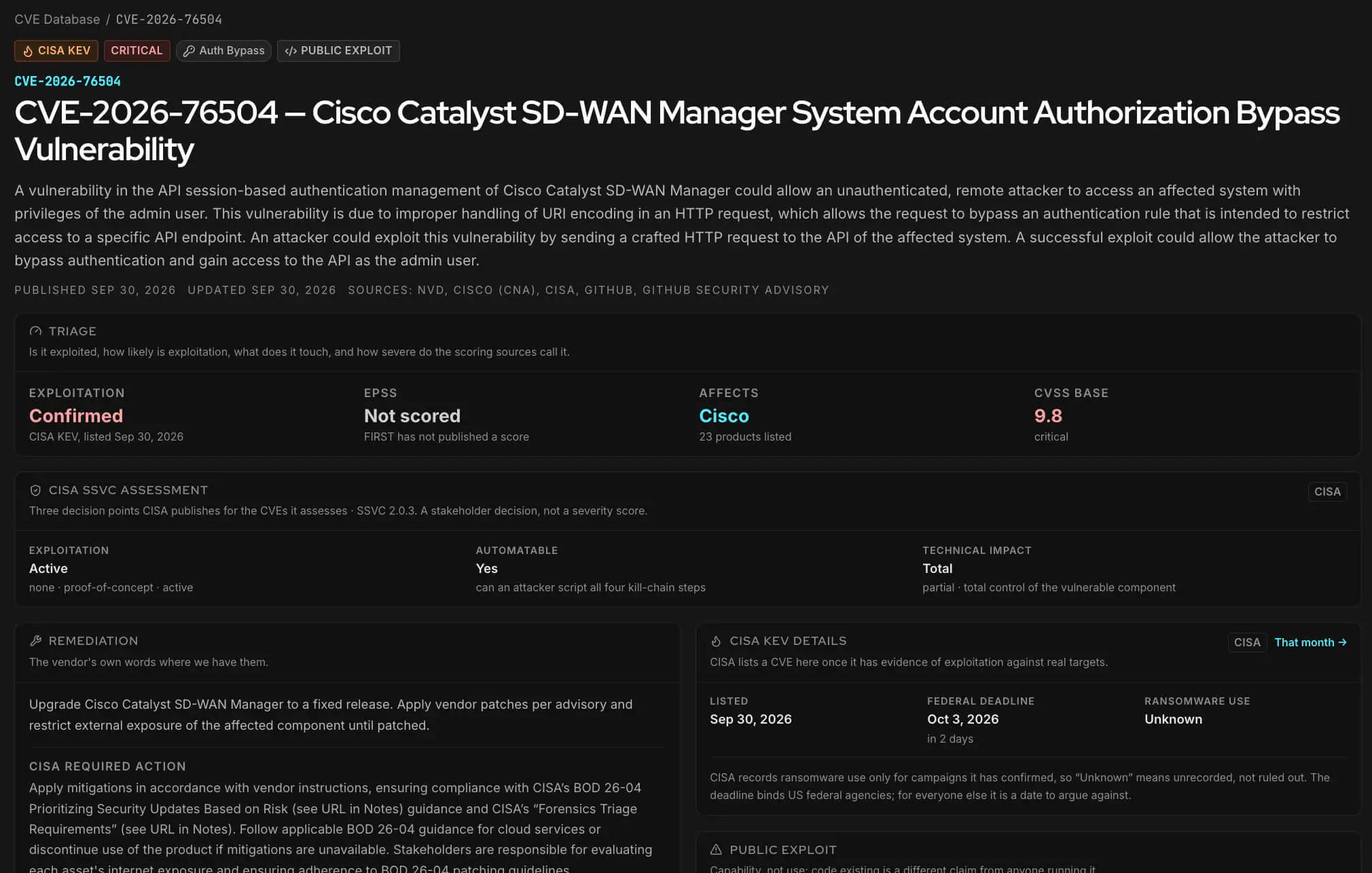
- Vulnerability Type: Authentication Bypass via Improper URI Path Normalization (CWE-177).
- CVSS v3.1 Vector:
CVSS:3.1/AV:N/AC:L/PR:N/UI:N/S:U/C:H/I:H/A:H(Score: 9.8 Critical). - Primary Impact: Unauthenticated administrative access (
netadminprivileges) across all exposed REST API endpoints and management capabilities. - Exploitation Status: Actively exploited in zero-day attack campaigns; cataloged by cybersecurity agencies (including CISA KEV) for immediate emergency mitigation.
Technical Detail: How the Vulnerability Works
The technical vulnerability relies on a fundamental architectural breakdown known as impedance mismatch or path parsing inconsistency between two processing layers in the web application pipeline. Cisco Catalyst SD-WAN Manager utilizes an API gateway/reverse proxy layer to inspect incoming requests and enforce authentication policies before delegating request processing to internal Java servlet containers. Under standard conditions, requests directed to management interfaces trigger an authentication filter block, forcing unauthenticated clients to authenticate through endpoints such as j_security_check. When an attacker constructs a request with strategically placed hexadecimal URL encodings (such as %2f for slashes or %2e%2e for directory traversal markers) within the path, the outer API security layer performs raw string comparisons against its access-control list (ACL) rules. Because the raw, encoded string does not strictly match the string patterns reserved for protected endpoints, the security filter evaluates the request as a non-restricted public asset. Consequently, the filter allows the payload to traverse the perimeter without prompting for valid session cookies or authorization bearer tokens. Once the request passes the security boundary and reaches the internal Java backend, the web server’s canonicalization engine automatically decodes the hexadecimal characters back into standard UTF-8 characters. The decoded URI path is then mapped directly to administrative REST API controllers (such as /dataservice/...), executing the requested administrative commands under the system’s default high-privilege service context.
                     [ Unauthenticated Attacker ]
                                  │
                                  │ Crafted HTTP Request
                                  │ (Hex-encoded URI Path)
                                  ▼
                ┌──────────────────────────────────┐
                │   API Gateway / Auth Middleware  │
                ├──────────────────────────────────┤
                │ - Evaluates raw string URI       │
                │ - Rule: Matches exact bypass path│
                │ - Decision: PASS (No Auth req.)  │
                └──────────────────────────────────┘
                                  │
                                  ▼
                ┌──────────────────────────────────┐
                │      Java Servlet / Backend      │
                ├──────────────────────────────────┤
                │ - Normalizes / Decodes Hex URI   │
                │ - Routes request to Admin Endpoint│
                │ - Executes API as 'netadmin'     │
                └──────────────────────────────────┘
- Crafted Request Generation: The threat actor sends an HTTP request containing hex-encoded characters embedded within restricted URI paths targeting the SD-WAN Manager web interface.
- Access Control Filter Evasion: The perimeter security middleware inspects the uncanonicalized request path, fails to match protected pattern signatures, and bypasses authentication requirements.
- Backend Path Normalization: The internal application container receives the payload, fully URL-decodes the path, and resolves it to restricted backend administrative endpoints.
- Privileged Command Execution: The backend executes the API call with full system privileges, enabling unauthorized network modification, data exfiltration, or complete device compromise.
Affected Software & Plugins
This security vulnerability impacts multiple release trains of Cisco Catalyst SD-WAN Manager software deployed in self-hosted, on-premises, or private cloud environments. Any installation exposing its web management interface or REST API to untrusted network segments is susceptible to unauthorized access and exploitation. Because SD-WAN Manager serves as the centralized controller, all management plugins, device configuration engines, and orchestration APIs integrated within the platform inherit this vulnerability. Systems configured with publicly accessible management ports (such as TCP 443) are at immediate risk of automated external scanning and exploitation.
- Impacted Release Trains: Cisco Catalyst SD-WAN Manager 20.15 (versions prior to 20.15.605), 20.13, 20.12, and 18.3 (versions 18.3.6, 18.3.7, and 18.3.8).
- Software Components & Plugins: All integrated REST API plugins, configuration template managers, device onboarding modules, and web console endpoints.
- Cisco Cloud Managed Instances: Instances hosted directly by Cisco Cloud Services are patched automatically; no manual software updates are required for cloud-hosted environments.
- On-Premises / Self-Hosted Installations: Requires immediate manual administrator intervention to deploy fixed software release builds (e.g., updating to version 20.15.605 or later).
Conclusion
CVE-2026-76504 serves as a stark reminder of the inherent security risks associated with centralized management architectures in modern software-defined enterprise networks. When a single control platform holds absolute authority over enterprise-wide routing and security policies, any vulnerability in its access control boundaries can result in complete infrastructure compromise. The flaw highlights how subtle discrepancies in URI path parsing between security gateways and backend application layers can completely undermine strong authentication controls. Organizations operating self-hosted Cisco Catalyst SD-WAN Manager instances must treat remediation as an emergency priority. In addition to immediately applying official vendor patches, security teams should implement defense-in-depth measures, such as restricting web interface exposure through strict IP allowlisting and enforcing perimeter VPN access. Continuous logging and monitoring of API access attempts remain vital for identifying potential exploitation artifacts early. Ultimately, securing critical network management infrastructure requires a proactive approach combining timely patch management, strict exposure control, and robust architectural validation. By addressing the root causes of path-parsing vulnerabilities and securing perimeter access, enterprises can effectively protect their software-defined WAN environments against advanced threat vectors.