
Introduction
In an increasingly interconnected digital world, cybersecurity has evolved from a niche IT discipline into a vital pillar of modern society. Organizations, governments, and individuals generate immense volumes of sensitive data daily, making robust security measures essential. Rapid digital transformation, remote work models, and cloud migration have exponentially expanded the global attack surface, leaving entities far more vulnerable to sophisticated threats. Consequently, securing this digital perimeter requires continuous vigilance, adaptive strategies, and specialized expertise. However, cybersecurity is not a single, monolithic field; it is a vast domain composed of distinct specializations. Understanding these core sub-fields is crucial for businesses aiming to secure their assets and for professionals navigating a career in digital defense.
Learning Objectives
After reading this article, you will be able to:
- Identify the primary sub-domains that constitute the cybersecurity ecosystem.
- Analyze the core functions and responsibilities of each cybersecurity specialization.
- Evaluate personal skills and interest areas to determine the ideal cybersecurity career path.
- Formulate a strategic framework for continuous skill development in digital security.
Cybersecurity in the Era of Emerging Technologies
Cybersecurity is undergoing a massive shift driven by rapid technological advances and the relentless evolution of the global digital ecosystem. As organizations rapidly accelerate their digital transformation initiatives, traditional security perimeters are dissolving. The widespread adoption of decentralized cloud environments, hybrid work arrangements, and interconnected global supply chains has significantly expanded the surface area vulnerable to cyber exploitation, rendering legacy security strategies fundamentally obsolete. The integration of Artificial Intelligence (AI) and Machine Learning (ML) has fundamentally reshaped the battleground for both defenders and adversary groups alike. Modern security teams leverage automated algorithms to process massive volumes of threat data, detect behavioral anomalies in real time, and execute immediate incident responses. Conversely, malicious actors harness these exact same technologies to automate sophisticated phishing campaigns, discover software vulnerabilities faster, and engineer evasive malware capable of bypassing traditional detection protocols.
As emerging paradigms redefine computing infrastructure, security strategies must proactively adapt to mitigate unprecedented risk vectors. The convergence of hyper-connected environments, edge computing, and future computational breakthroughs requires organizations to shift from reactive defense postures to continuous, intelligence-driven resilience models. Navigating this new era requires a sharp focus on four critical technological catalysts:
- Artificial Intelligence and Machine Learning: Powers predictive threat detection and automated anomaly analysis, while simultaneously enabling threat actors to craft hyper-targeted phishing schemes and polymorphic malware.
- Zero Trust Architecture (ZTA): Enforces a strict continuous verification policy (“never trust, always verify”), eliminating implicit trust for any user, device, or network flow regardless of location.
- Internet of Things (IoT) & Edge Security: Secures billions of low-power, interconnected hardware devices that often lack native defense capabilities and expand network access points.
- Quantum-Resistant Cryptography: Prepares organizations for post-quantum computing environments by developing advanced encryption standards capable of withstanding quantum-driven decryption attacks.
What Are the Most Important Domains of Cybersecurity?
Cybersecurity is not a singular discipline, but rather a sprawling ecosystem comprised of highly specialized sub-fields. As digital architectures grow more complex, single-layer defense approaches are no longer effective at preventing modern cyber threats. Organizations must adopt a holistic, multi-layered security strategy that shields every layer of the technology stack—from underlying network cables and cloud storage to custom application code and human endpoints. Each domain within cybersecurity targets a specific vector of the digital ecosystem, operating under distinct methodologies, frameworks, and operational goals. While some fields focus on real-time threat detection and active defense, others concentrate on proactive system hardening, regulatory compliance, or structural architecture design. Understanding how these specializations function individually and collectively is vital for establishing complete digital resilience across enterprise environments.
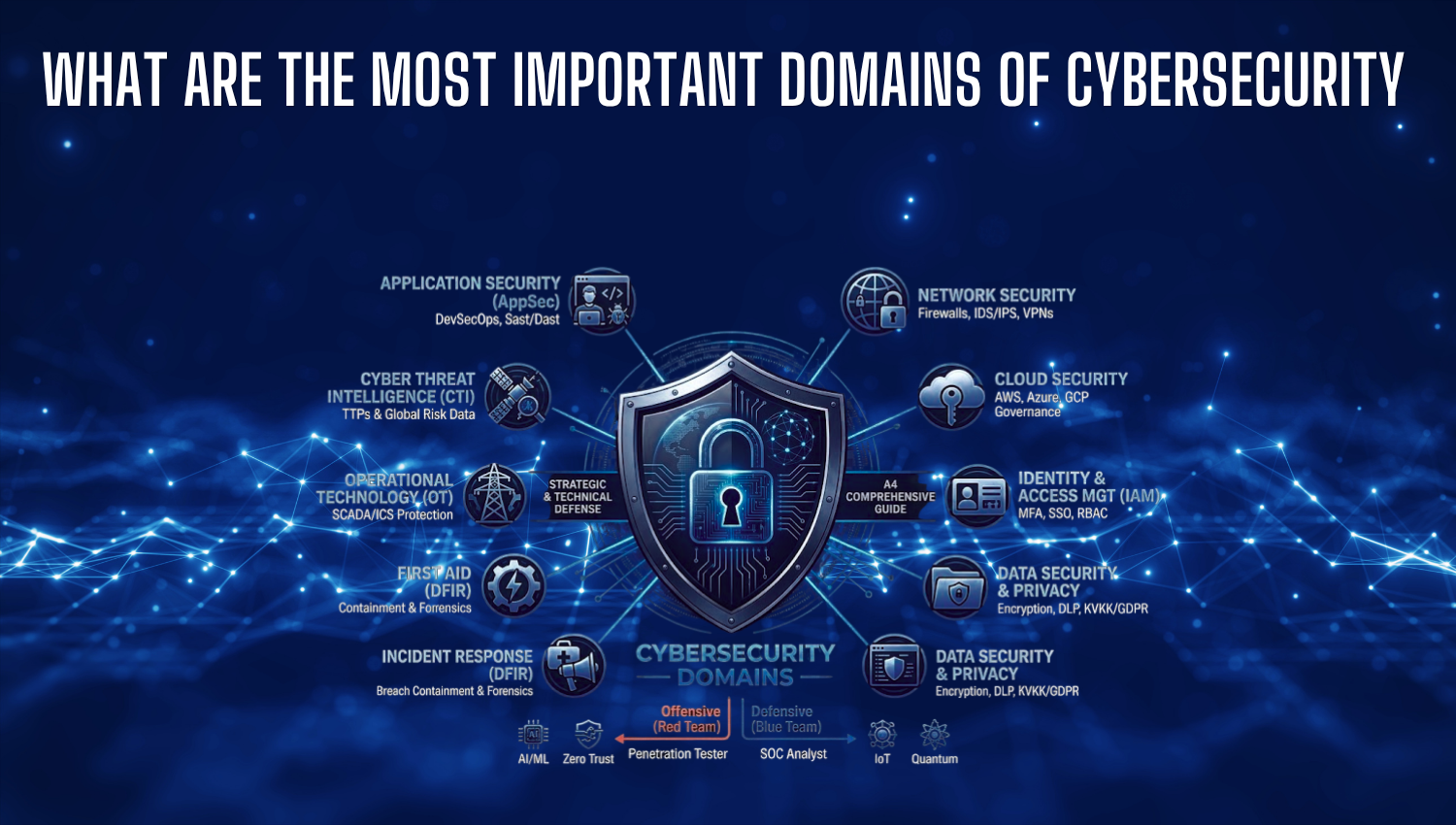
Together, these domains form a cohesive defense network where vulnerabilities in one area are compensated for by the strength of others. Achieving true operational resilience requires organizations to build technical depth across all eight fundamental branches of modern cybersecurity:
- Network Security: Protects computer networks, data channels, and communication infrastructure from unauthorized access, malicious intrusions, and data siphoning using advanced perimeter controls like Next-Generation Firewalls (NGFW), Intrusion Detection and Prevention Systems (IDS/IPS), and Virtual Private Networks (VPNs).
- Application Security (AppSec): Embeds security practices into every phase of the software development lifecycle (DevSecOps), utilizing static and dynamic code analysis, vulnerability scanning, and threat modeling to eliminate flaws before software reaches production.
- Cloud Security: Delivers specialized defense mechanisms tailored to multi-cloud and hybrid environments (e.g., AWS, Azure, GCP), focusing on cloud workload protection, misconfiguration management, robust data encryption, and cloud-native access governance.
- Identity and Access Management (IAM): Enforces strict authentication and authorization protocols across digital ecosystems, utilizing tools such as Multi-Factor Authentication (MFA), Single Sign-On (SSO), and Role-Based Access Control (RBAC) to ensure only authorized entities access critical resources.
- Data Security and Privacy: Safeguards sensitive enterprise data and personally identifiable information (PII) at rest, in transit, and in use through hardware encryption, Data Loss Prevention (DLP) policies, and strict compliance with legal frameworks like GDPR, HIPAA, and KVKK.
- Incident Response and Digital Forensics (DFIR): Acts as the rapid-reaction unit for cyber attacks, identifying active breaches, containing malicious activity, mitigating damages, and conducting detailed forensic investigations to determine the root cause and attackers’ tactics.
- Operational Technology (OT) & Industrial Security: Protects critical physical infrastructure—including energy grids, water plants, and automated industrial facilities (SCADA/ICS)—from cyber-physical attacks that could cause operational downtime or safety hazards.
- Cyber Threat Intelligence (CTI): Proactively gathers, processes, and analyzes raw threat data from global sources and dark web surveillance to understand threat actor motives, tactics, techniques, and procedures (TTPs), enabling defense teams to block attacks before they occur.
Which Branch of Cybersecurity Should I Pursue?
Navigating a career path in cybersecurity can be intimidating due to the sheer variety of specializations available. Because the field demands diverse technical skill sets, analytical capabilities, and psychological mindsets, there is no single “correct” starting point. Success in cybersecurity does not require knowing everything about every domain; rather, it hinges on identifying where your natural problem-solving style and existing technical foundation align with industry demands. Whether you excel at software engineering, system architecture, psychological analysis, or regulatory compliance, there is a dedicated branch within cybersecurity built around those strengths. Career paths generally fall along two primary spectrums: offensive versus defensive security, and deep technical execution versus strategic policy management. Understanding how your personal interests map to these operational categories is essential for building a sustainable, highly rewarding long-term career.
To help visualize how different personal strengths translate into professional roles, consider the decision framework below. Evaluating your core mindset will naturally guide you toward the sub-domains where you can deliver the highest value and achieve the fastest career growth:
                  +-----------------------------------+
                  |   What suits your mindset best?   |
                  +-----------------------------------+
                                    |
         +--------------------------+--------------------------+
         |                                                     |
  [Hands-on & Technical]                             [Strategic & Analytical]
         |                                                     |
   +-----+-----+                                         +-----+-----+
   |           |                                         |           |
 (Offense)  (Defense)                              (Data & Intelligence) (Governance & Process)
   |           |                                         |           |
 Penetration  SOC Analyst                              Threat       GRC Specialist
 Testing /    Incident Response                        Intelligence  Audit & Risk
 AppSec       Network Security                                      Compliance
- Offensive Security (Red Teaming & AppSec): Ideal for creative problem solvers and coders who enjoy thinking like an attacker to break down complex software, uncover hidden vulnerabilities, and execute ethical hacking simulations before malicious actors exploit them.
- Defensive Security (Blue Teaming & DFIR): Suited for analytical thinkers and rapid responders who thrive under pressure, monitoring network telemetry in SOC environments, hunting for active threats, and performing forensic investigations to neutralize cyber incidents.
- Infrastructure & Cloud Security: Perfect for systems engineers, network administrators, and DevOps specialists who want to design resilient network architectures, secure multi-cloud environments, and implement robust perimeter defenses across enterprise infrastructure.
- Governance, Risk, and Compliance (GRC): Best for strategic thinkers interested in policy, corporate governance, auditing, and law who prefer guiding organizational security strategy, conducting risk assessments, and ensuring compliance without daily hands-on coding.
- Cyber Threat Intelligence & IAM (Identity Security): Tailored for data analysts, research-driven professionals, and access management specialists who excel at tracking threat actor tactics, evaluating global risk trends, or designing enterprise access controls and identity frameworks.
Conclusion
Cybersecurity is a dynamic, multifaceted industry that requires diverse expertise to counter an ever-evolving threat landscape. As digital ecosystems become more complex and interconnected, the need for robust defense mechanisms across every layer of technology has never been more critical. Whether protecting core networks, securing cloud infrastructures, or responding to active breaches, every sub-domain plays a pivotal role in maintaining the integrity and trust of modern digital infrastructure. Building an effective security posture or advancing a career in this field demands a deep appreciation for its multi-layered nature. No single technology, framework, or professional can defend an entire organization in isolation; success relies on the seamless integration of offensive insights, defensive operations, strategic governance, and emerging technologies. As new threat vectors continue to materialize alongside artificial intelligence, cloud-native deployments, and post-quantum computing, adaptability and continuous learning remain the defining traits of successful security practices. Ultimately, navigating the world of cybersecurity begins with understanding its core pillars and recognizing where your organizational needs or personal strengths lie. By aligning technical skills, business strategies, and operational workflows with the appropriate domains, organizations can build resilient defense architectures capable of withstanding modern cyber attacks. For aspiring professionals, finding the right alignment unlocks a rewarding, high-impact career dedicated to safeguarding the critical assets of the global digital ecosystem.
I have been a bug hunter for a long time, and I really love what I do, and it pays well.