
Introduction
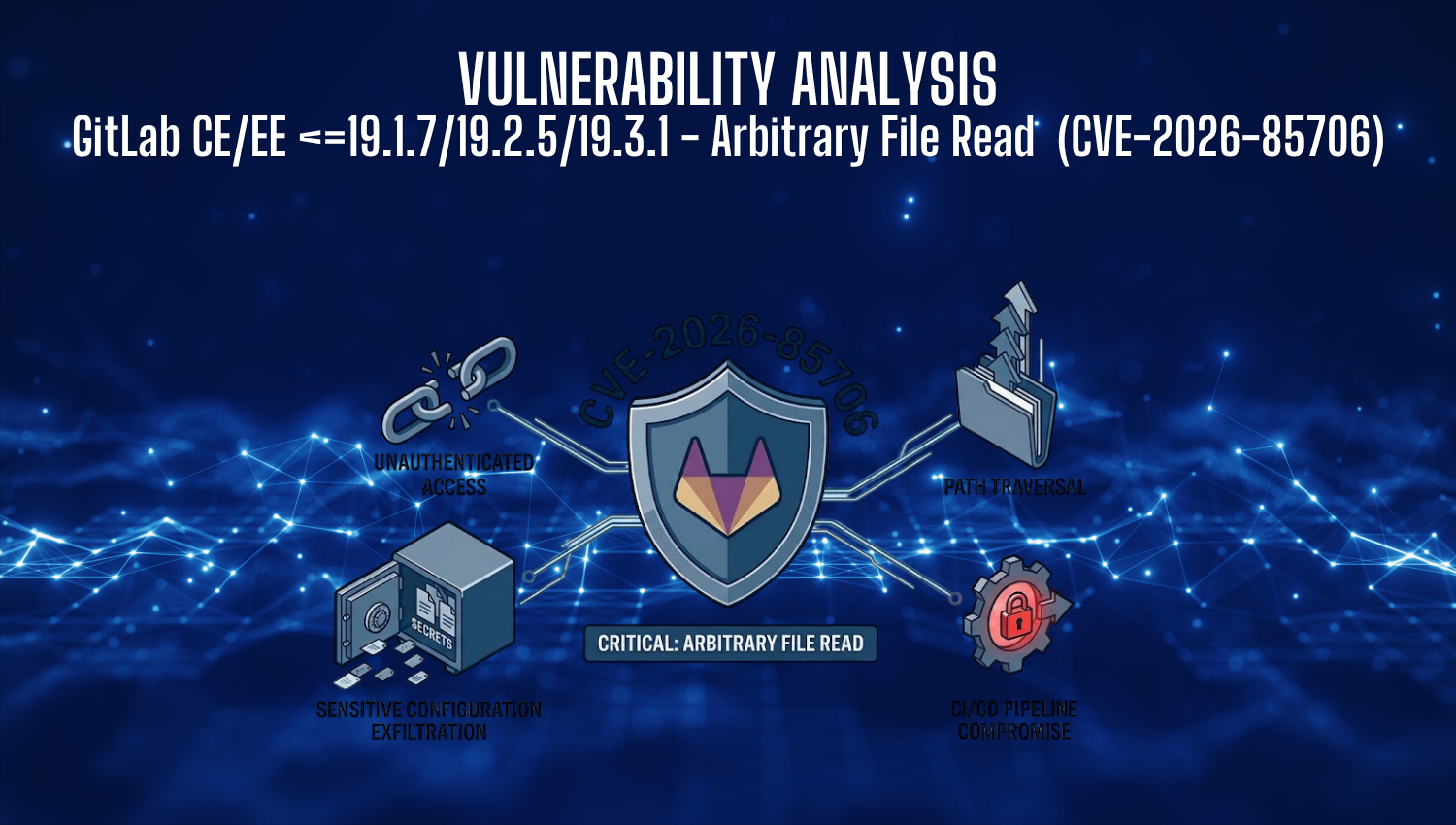
Security flaws in critical software development and deployment infrastructure pose a significant, far-reaching risk to modern organizational supply chains. GitLab, an open-source DevOps platform used worldwide for source code management and continuous integration/continuous deployment (CI/CD) pipelines, released emergency security updates addressing CVE-2026-85706. This maximum-severity vulnerability—rated at CVSS 10.0—allows unauthenticated remote attackers to read arbitrary files directly from the host file system of vulnerable GitLab Community Edition (CE) and Enterprise Edition (EE) instances. Because these systems store critical environment files, database secrets, and API tokens, exposure can quickly lead to complete platform compromise. Consequently, CISA added this flaw to its Known Exploited Vulnerabilities catalog following active in-the-wild exploitation. Understanding the underlying operational mechanisms and technical scope of this flaw is crucial for platform engineers, threat hunters, and security personnel defending hosted environments.
Learning Objectives
After reading this article, you will be able to:
- Identify the operational mechanics and root cause behind CVE-2026-85706.
- Comprehend the risk posed by unauthenticated file read flaws in source control systems.
- Recognize affected versus patched versions across different release channels.
- Implement effective remediation steps and post-exploitation response protocols.
What is GitLab CE/EE <=19.1.7/19.2.5/19.3.1 – Arbitrary File Read (CVE-2026-85706)
CVE-2026-85706 represents a critical security flaw categorized under path traversal (CWE-22) coupled with missing authentication controls in GitLab Community Edition (CE) and Enterprise Edition (EE). This vulnerability allows an external, unauthenticated attacker to bypass intended access restrictions and request arbitrary files residing anywhere on the host system’s local file system. The scope of readable files is bounded only by the operational privileges of the underlying system process running the GitLab service (typically the git user or root in containerized setups). Because modern GitLab instances manage sensitive core configurations, an unauthenticated single-request file disclosure carries catastrophic consequences. Core configuration files contain database credentials, application secrets, session encryption keys, personal access tokens, and private SSH keys. An attacker who successfully extracts these cryptographic assets can leverage them to forge session tokens, access private repositories, decrypt database content, or pivot directly into continuous integration/continuous deployment (CI/CD) pipelines to execute unauthorized code across target infrastructure.
Furthermore, the vulnerability does not require any prior interaction, valid user account, or social engineering. Because the flaw exists within public-facing API endpoints, automated scanners can easily discover vulnerable instances, craft the path traversal payload, and extract host files in bulk. This low barrier to entry led CISA to include CVE-2026-85706 in its Known Exploited Vulnerabilities catalog, signaling active, widespread threat actor activity targeting self-managed deployment instances globally.
- Unauthenticated Access: No session tokens, API keys, or user credentials are required to interact with the vulnerable endpoint and execute the exploit.
- Direct File System Disclosure: Attackers can retrieve system files outside the repository root, such as
/etc/gitlab/gitlab-secrets.jsonor more. - Zero-User Interaction: The exploitation process is entirely automated and executes remotely via a single crafted HTTP POST request.
- High Impact Chain Potential: Disclosed secrets and cryptographic keys provide the prerequisite foundation for downstream remote code execution (RCE) and full enterprise network takeover.
[ Unauthenticated Attacker ]
            │
            │  1. Send Crafted HTTP Request
            │     POST /api/v4/projects/.../commits
            │     Payload: path=../../../../etc/gitlab/gitlab-secrets.json
            ▼
┌──────────────────────────────────────────────────┐
│             Vulnerable GitLab Server             │
│                                                  │
│   ┌──────────────────────────────────────────┐   │
│   │          API Authorization Layer         │   │
│   │    (Missing Authentication Check)        │   │
│   └────────────────────┬─────────────────────┘   │
│                        │                         │
│                        ▼                         │
│   ┌──────────────────────────────────────────┐   │
│   │           File Handler Routine           │   │
│   │   (Insufficient Path Sanitization)       │   │
│   └────────────────────┬─────────────────────┘   │
│                        │                         │
└────────────────────────┼─────────────────────────┘
                         │
                         │  2. Read File System
                         ▼
┌──────────────────────────────────────────────────┐
│               Host OS File System                │
│   Extracts: Secret Keys, DB Passwords, Tokens    │
└────────────────────────┬─────────────────────────┘
                         │
                         │  3. Raw File Content Returned
                         ▼
[ Exfiltrated Sensitive System Data ]
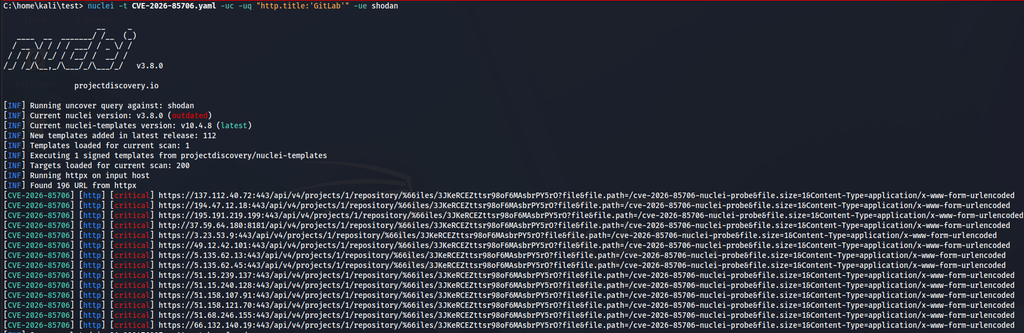
Technical Detail: How the Vulnerability Works
The root cause of CVE-2026-85706 stems from insufficient path validation combined with missing authorization logic in specific repository commit management API endpoints (/api/v4/projects/{id}/repository/commits/). Under normal operations, these endpoints are designed to accept file path attributes in order to reference, diff, or query specific files embedded within a target Git repository. However, the backend routing fails to validate whether the requesting user maintains proper authentication or repository access permissions prior to initiating file retrieval tasks. When an incoming API request includes file path parameters, the application processes these parameters directly within internal file system routines without stripping directory traversal sequences such as ../ or verifying path canonicalization. Because authentication enforcement is entirely absent on the affected endpoint, an external attacker can pass relative path traversal sequences to escape the boundary of the intended project repository directory. The operating system then resolves the constructed path relative to host storage, exposing system files accessible under the file permissions of the GitLab execution context (typically the git system user).
The severity escalates drastically because key configuration files—most notably /etc/gitlab/gitlab-secrets.json—reside on host disk storage with permissions readable by the GitLab daemon process. Extracting gitlab-secrets.json exposes raw cryptographic master keys, database encryption secrets, OTP keys, and runner registration tokens. Armed with these stolen keys, attackers can decrypt stored database credentials, forge active user session tokens, or establish unauthorized runner connections, effectively transforming an arbitrary file read into a complete, high-impact enterprise infrastructure takeover.
- Missing Authentication Middleware: The repository commits API endpoint processes incoming HTTP requests without verifying user session cookies, personal access tokens, or HTTP bearer headers.
- Improper Path Confinement: Input handling routines fail to sanitize path input, allowing directory traversal sequences (e.g.,
../../../../) to escape the repository working directory. - Single-Request Exploitation: The entire attack vector executes remotely through a single, standalone HTTP POST request without requiring pre-requisite actions or prior interaction.
- Privileged File Extraction: Any host file readable by the underlying
gitservice account—including environment files, SSH keys, and system configuration secrets—can be exfiltrated. - Credential Exfiltration & Pivoting: Disclosed secrets allow attackers to forge administrative tokens, access private repositories, or pivot into underlying CI/CD build environments.
POST /api/v4/projects/1/repository/commits HTTP/1.1
Host: gitlab.example.com
User-Agent: Mozilla/5.0
Content-Type: application/json
Accept: */*

{
  "branch": "main",
  "commit_message": "test",
  "actions": [
    {
      "action": "create",
      "file_path": "../../../../../etc/gitlab/gitlab-secrets.json"
    }
  ]
}


HTTP/1.1 200 OK
Content-Type: application/json
Server: nginx

{
  "secret_key_base": "a1b2c3d4e5f678901234567890abcdef1234567890abcdef1234567890abcdef",
  "db_key_base": "f6e5d4c3b2a109876543210987654321fedcba0987654321fedcba0987654321",
  "openid_connect_signing_key": "-----BEGIN RSA PRIVATE KEY-----\nMIIEowIBAAKCAQEA0Z...",
  "otp_key_base": "1234567890abcdef1234567890abcdef1234567890abcdef1234567890abcdef",
  "encrypted_ci_jwt_signing_key": "v1:gAAAAABk..."
}
Affected and Patch Versions
The vulnerability impacts a wide spectrum of self-managed deployments running GitLab Community Edition (CE) and Enterprise Edition (EE) across the 18.x and 19.x release channels. Specifically, installations spanning from version 18.7.0 up to 19.1.7 in the 19.1 series, 19.2.0 through 19.2.5 in the 19.2 series, and 19.3.0 through 19.3.1 in the 19.3 series are fully vulnerable to unauthenticated remote exploitation. Because the flaw resides within core API routing logic present across multiple minor version increments, any unpatched self-managed server accessible over the internet or exposed to untrusted internal networks remains at severe risk of data exfiltration. To remediate the vulnerability, administrators must immediately update their self-managed instances to the designated security releases: 19.1.8, 19.2.6, or 19.3.2. Organizations utilizing GitLab SaaS (GitLab.com) or GitLab Dedicated managed infrastructure do not require manual intervention, as vendor operations patched these environments prior to public disclosure. For self-managed environments where immediate patching cannot be executed, security teams should temporarily isolate the instance behind a strict WAF or perimeter VPN, block public access to the /api/v4/projects/{id}/repository/commits/ endpoint, and perform thorough threat hunting to detect potential compromised credentials.
| Branch | Affected Version Range | Patched Version |
|---|---|---|
| 19.1.x | 18.7.0 up to 19.1.7 | 19.1.8 |
| 19.2.x | 19.2.0 up to 19.2.5 | 19.2.6 |
| 19.3.x | 19.3.0 up to 19.3.1 | 19.3.2 |
Conclusion
CVE-2026-85706 highlights the critical importance of rigorous access control and input sanitization within central software development and deployment infrastructure. Because developer platforms like GitLab maintain centralized access to source code, production secrets, and automated build processes, vulnerabilities in these platforms carry exponential risk for organizational supply chains. A single unauthenticated HTTP request capable of bypassing access controls to read system files underscores how deeply a fundamental input validation failure can impact enterprise security. Organizations operating self-managed GitLab instances must prioritize immediate remediation by upgrading to patched versions (19.1.8, 19.2.6, 19.3.2, or later). If immediate patching is not possible due to operational constraints, security teams should implement strict perimeter protections, restrict public access to the affected API endpoints, and place vulnerable servers behind access-controlled networks or Web Application Firewalls (WAF) to block unauthorized traversal attempts. Finally, because CVE-2026-85706 has been targeted in the wild, updating the software is only the first step in a complete incident response lifecycle. Security operators should thoroughly review server access and reverse proxy logs for anomalous POST requests sent to /api/v4/projects/*/repository/commits containing path traversal patterns. If evidence of exploitation is detected, organizations must treat local configuration files as compromised and immediately rotate all database credentials, private SSH keys, runner tokens, and session secrets tied to the affected host.