
Introduction
Email remains one of the primary vectors for enterprise cyberattacks, making secure email gateways critical perimeter defenses. Recently, a severe security flaw identified as CVE-2026-76461 was discovered in Cisco Secure Email Gateway (formerly Cisco Email Security Appliance / ESA). Rated with a maximum-severity CVSS score of 9.8 (Critical), this vulnerability allows unauthenticated, remote attackers to execute arbitrary commands at the highest system privileges. Both Cisco and the Cybersecurity and Infrastructure Security Agency (CISA) have confirmed that threat actors are actively exploiting this flaw in targeted real-world campaigns.
Learning Objectives
After reading this vulnerability analysis, you will be able to:
- Understand the scope: Recognize the function of Cisco Secure Email Gateway and the risk profile associated with CVE-2026-76461.
- Analyze the root cause: Grasp the technical underlying mechanism—specifically how improperly sanitized inputs in email parsing lead to SQL Injection and command execution.
- Identify indicators of compromise (IoCs): Learn key detection strategies and log analysis techniques to spot potential post-exploitation activity.
- Implement remediation: Apply official vendor updates and patch strategies to secure vulnerable infrastructure effectively.
What is Critical Cisco Secure Email Gateway Vulnerability Exploited (CVE-2026-76461)
CVE-2026-76461 represents a critical zero-day vulnerability discovered in Cisco AsyncOS, the proprietary operating system powering Cisco Secure Email Gateway (SEG) hardware and virtual appliances. The underlying flaw stems from improper input validation within the gateway’s core email parsing engine, officially categorized under CWE-89: Improper Neutralization of Special Elements used in an SQL Command. Because secure email gateways serve as an organization’s primary line of defense at the network perimeter, they are configured to accept and inspect all incoming SMTP traffic from untrusted external sources prior to internal delivery. This architectural position makes CVE-2026-76461 exceptionally dangerous: any remote, unauthenticated attacker on the internet can trigger the vulnerability simply by transmitting a specially crafted email message to an organization protected by an affected appliance. The attack payload is embedded directly into parsed message attributes, bypassing standard boundary controls without requiring a valid user account, pre-existing access, or administrative privileges on the target network.
What elevates this vulnerability to a maximum-severity enterprise threat is its zero-click operational nature paired with immediate privilege escalation. Once the malicious payload reaches the parsing layer, the SQL injection condition allows an attacker to escape database restrictions and execute arbitrary operating system commands with full root privileges. Threat actors actively exploiting this flaw in the wild gain complete operational control over the appliance, enabling them to inspect or manipulate email traffic, disable security logs, or leverage the gateway as a trusted internal launchpad for lateral movement across the internal corporate network.
Key attributes of CVE-2026-76461 include:
- Severity Score: Maximum CVSS v3.1 Base Score of 9.8 (Critical) due to unauthenticated remote code execution capabilities.
- Vector: Remote and Unauthenticated (Accessible directly over public network interfaces via standard inbound SMTP traffic).
- User Interaction: Completely zero-click (Requires zero recipient engagement, attachment opens, or link clicks to achieve execution).
- Scope & Impact: Complete breach of Confidentiality, Integrity, and Availability leading to root-level appliance compromise.
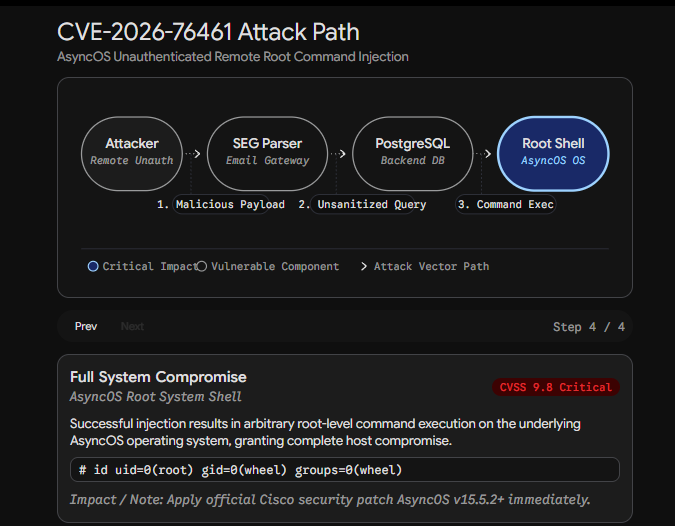
Exploitation Flow Diagram:
  [ External Attacker ]
           │
           │  1. Sends Malicious SMTP Mail
           ▼  (Crafted SQL Payload inside Email Header/MIME)
┌─────────────────────────────────────────────────────────┐
│              Cisco Secure Email Gateway                 │
│                                                         │
│   ┌─────────────────────────────────────────────────┐   │
│   │ 2. Email Content Analysis Engine                │   │
│   │    (Parses inbound mail parameters)             │   │
│   └────────────────────────┬────────────────────────┘   │
│                            │ Unsanitized Query          │
│                            ▼                            │
│   ┌─────────────────────────────────────────────────┐   │
│   │ 3. Local PostgreSQL Database                    │   │
│   │    (SQL Injection Triggered via CWE-89)         │   │
│   └────────────────────────┬────────────────────────┘   │
│                            │ COPY ... FROM PROGRAM      │
│                            ▼                            │
│   ┌─────────────────────────────────────────────────┐   │
│   │ 4. Underlying Cisco AsyncOS Shell               │   │
│   │    (Arbitrary OS Commands executed as ROOT)     │   │
│   └─────────────────────────────────────────────────┘   │
└────────────────────────────┬────────────────────────────┘
                             │
                             │  5. Post-Exploitation
                             ▼
              [ Total System Takeover / Lateral Movement ]
Technical Detail: How the Vulnerability Works
The failure occurs deep inside the underlying data extraction and processing pipeline of Cisco AsyncOS when parsing inbound Simple Mail Transfer Protocol (SMTP) traffic. As messages reach the gateway, the system automatically parses, extracts, and logs dynamic metadata—such as envelope headers, sender attributes, and specific MIME boundary parameters—to evaluate security policies and archive operational metrics. During this automated extraction process, the email content analysis engine accepts user-supplied data strings from the raw SMTP stream and passes them down to internal backend routines without performing adequate input sanitization or parameterized querying. Because these user-controlled parameters are concatenated directly into SQL statements executed against the local PostgreSQL database instance, an attacker can craft payloads containing malicious SQL control characters. When the mail daemon processes the incoming email, the database parser interprets the injected SQL commands as valid instruction syntax rather than inert string values (CWE-89: SQL Injection). This flaw completely circumvents expected boundary checks, enabling unauthenticated remote actors to manipulate database queries, query internal database tables, or execute arbitrary database commands directly within the appliance’s security context.
The most severe aspect of this flaw lies in how the database service interacts with the host operating system shell. Exploiting the SQL injection primitive allows the attacker to invoke advanced database functionalities, such as PostgreSQL’s COPY ... FROM PROGRAM command execution feature. Because the underlying database routines on Cisco AsyncOS execute with elevated administrative system privileges, escaping the database context instantly grants the attacker arbitrary command execution directly on the FreeBSD-based host system with full root privileges.
Key technical stages of the exploitation mechanics include:
- Vector Injection: The attacker transmits a specially crafted email message containing embedded SQL syntax within header fields or MIME parts parsed by the gateway.
- Sanitization Failure: The mail engine fails to sanitize or escape user-controlled parameters before dynamically inserting them into internal SQL queries.
- Database Escape: The injected SQL commands trigger administrative PostgreSQL features (such as
COPY ... FROM PROGRAM) to interact directly with the operating system shell. - Root Execution: Malicious OS commands execute under the elevated service privileges of AsyncOS, granting the attacker complete, unauthenticated root access to the appliance.
Remediation & Patch Information
There are no software workarounds or configuration changes available that can mitigate this vulnerability; applying Cisco’s official security updates is mandatory for protection. Because both Cisco and CISA have confirmed active exploitation of CVE-2026-76461 in the wild, the Cybersecurity and Infrastructure Security Agency added the vulnerability to its Known Exploited Vulnerabilities (KEV) catalog. Enterprise security administrators managing Cisco Secure Email Gateway (SEG) hardware or virtual instances must treat patch deployment as an emergency operational priority to eliminate the risk of unauthenticated remote root exploitation. Organizations running affected Cisco AsyncOS releases must immediately upgrade to the corresponding minimum fixed release versions. The update applies universally to both physical and virtual deployments regardless of operational feature configurations:
| Affected Release Line | Vulnerable Status | Minimum Fixed Release Version |
|---|---|---|
| 15.5 and earlier | Vulnerable | 15.5.5-0141 |
| 16.0 | Vulnerable | 16.0.4-302 |
| 16.5 | Vulnerable | 16.5.0-780 |
| Secure Email & Web Manager | Not Affected | No action required |
| Secure Web Appliance | Not Affected | No action required |
Threat Hunting & Incident Response
Because successful exploitation grants threat actors root privileges on the underlying operating system, attackers have the ability to tamper with, cover up, or delete local log entries to hide their activity. Consequently, incident response teams cannot rely exclusively on local system logs and must combine both internal host auditing and external network telemetry during threat hunting operations:
- Internal Log Analysis: Search the appliance’s
mail_logsand system audit files for anomalous SQL injection strings or unauthorized PostgreSQL sub-process calls (such as commands attemptingCOPY ... FROM PROGRAMfile writes or shell calls). - External Telemetry Verification: Review external SIEM, firewall, and egress network logs for unexpected outbound TCP connections initiated directly from the SEG management or mail interfaces to external, untrusted IP addresses.
- Cluster-Wide Auditing: If the Secure Email Gateway operates within a clustered environment, audit every individual cluster member independently, as a compromised node may be used as a pivot point within the internal cluster architecture.
- Centralized Security Logging: Ensure future management and mail logs are forwarded to an isolated, external syslog or SIEM server in real time so that historical log records remain tamper-proof even if an edge appliance is compromised.
- Centralized Security Logging: Ensure future management and mail logs are forwarded to an isolated, external syslog or SIEM server in real time so that historical log records remain tamper-proof even if an edge appliance is compromised.
# Search active mail logs for PostgreSQL command execution patterns (COPY ... FROM PROGRAM)
cisco-esa> grep -i "COPY.*FROM PROGRAM" mail_logs

# Query system logs for unauthorized shell executions or privilege escalation artifacts
cisco-esa> tail -n 500 mail_logs | grep -E "(pgsql|postgres).*sh"

# Inspect outbound network connections originating from the appliance CLI to identify active C2 traffic
cisco-esa> netstat -an | grep ESTABLISHED
Conclusion
CVE-2026-76461 underscores the critical operational risks inherent to perimeter security infrastructure. Because secure email gateways must maintain open public interfaces to accept inbound internet mail, zero-click vulnerabilities with root-level impact present an ideal high-value attack surface for threat actors. When an edge appliance designed to filter threats becomes the vector for unauthenticated system takeover, standard enterprise defense assumptions are immediately upended. The active exploitation of this zero-day vulnerability highlights the necessity of rapid response capabilities within modern cybersecurity operations. Relying solely on perimeter defenses is insufficient when those very devices can be compromised remotely before patches are deployed. Security teams must prioritize applying official vendor updates immediately while assuming a breach mindset, actively searching for subtle indicators of post-exploitation activity across both host appliances and adjacent internal systems. Ultimately, mitigating risks like CVE-2026-76461 requires a holistic defense-in-depth strategy. Enforcing strict egress network controls, isolating edge appliances within dedicated DMZ segments, and offloading audit logs to secure centralized SIEM platforms ensure that even if a gateway is compromised, lateral movement is constrained and malicious activity remains visible. Organizations must treat appliance management as a continuous cycle of rapid patching, rigorous threat hunting, and strict architectural segmentation.