
Introduction
MineAdmin is a popular open-source administrative framework built on the high-performance Hyperf PHP framework and Vue 3, widely adopted by enterprise developers for managing scalable microservices, backend control panels, and RESTful APIs. Despite its robust architectural design, versions prior to 3.2.0-alpha.2 suffer from a critical security flaw located within its App-Store plugin management service. By manipulating an unsanitized identifier parameter, authenticated attackers can bypass directory isolation mechanisms using malicious path traversal sequences. This technical deep-dive analyzes the underlying root cause of CVE-2026-55224, demonstrates how localized path traversal escalates directly into full Remote Code Execution (RCE) on the underlying server, and outlines concrete remediation strategies to effectively secure affected deployments.
Learning Objectives
- Understand the core concept of Path Traversal (CWE-22) in plugin management routines.
- Examine how unvalidated directory operations escalate into arbitrary file manipulation and code execution.
- Identify weak coding practices in path construction within PHP frameworks.
- Implement effective remediation techniques, including strict parameter validation and path canonicalization.
What is MineAdmin < 3.2.0-alpha.2 – Plugin Path Traversal to RCE (CVE-2026-55224)
CVE-2026-55224 (CVSS v3.1 Score: 7.5 High) represents a critical directory traversal vulnerability discovered within the App-Store plugin management ecosystem of MineAdmin. MineAdmin relies on a modular architecture where administrators can dynamically extend system functionality by installing, updating, or removing third-party plugins. However, implementations prior to version 3.2.0-alpha.2 fail to properly handle user-supplied metadata during these critical lifecycle events, leaving the host system exposed to high-impact exploitation. The core issue resides in how the backend processes incoming HTTP requests sent to the plugin installation and uninstallation endpoints. When an operator triggers an action on a plugin, the backend expects a standard string identifier representing the target module name. Because the application blindly trusts this input without applying proper sanitization or boundary checks, an attacker can supply malicious path manipulation vectors—such as dot-dot-slash (../) sequences—to escape the restricted plugin working directory.
By breaking out of the intended web root or application sandbox, an attacker gains the capability to reference arbitrary directory paths across the server’s local file system. When combined with MineAdmin’s internal module loader, this path traversal flaw escalates into Remote Code Execution (RCE). The application can be tricked into invoking system-level Composer operations, executing lifecycle hook scripts, or dynamically loading arbitrary PHP files located in attacker-controlled directories.
- Vulnerability Class: Improper Limitation of a Pathname to a Restricted Directory (CWE-22 / Path Traversal)
- Affected Feature: App-Store Plugin Management Service (Installation & Uninstallation Workflows)
- Exploitation Impact: Arbitrary File System Access leading to Full Remote Code Execution (RCE)
- Required Privileges: Authenticated user with administrative rights to access plugin management APIs
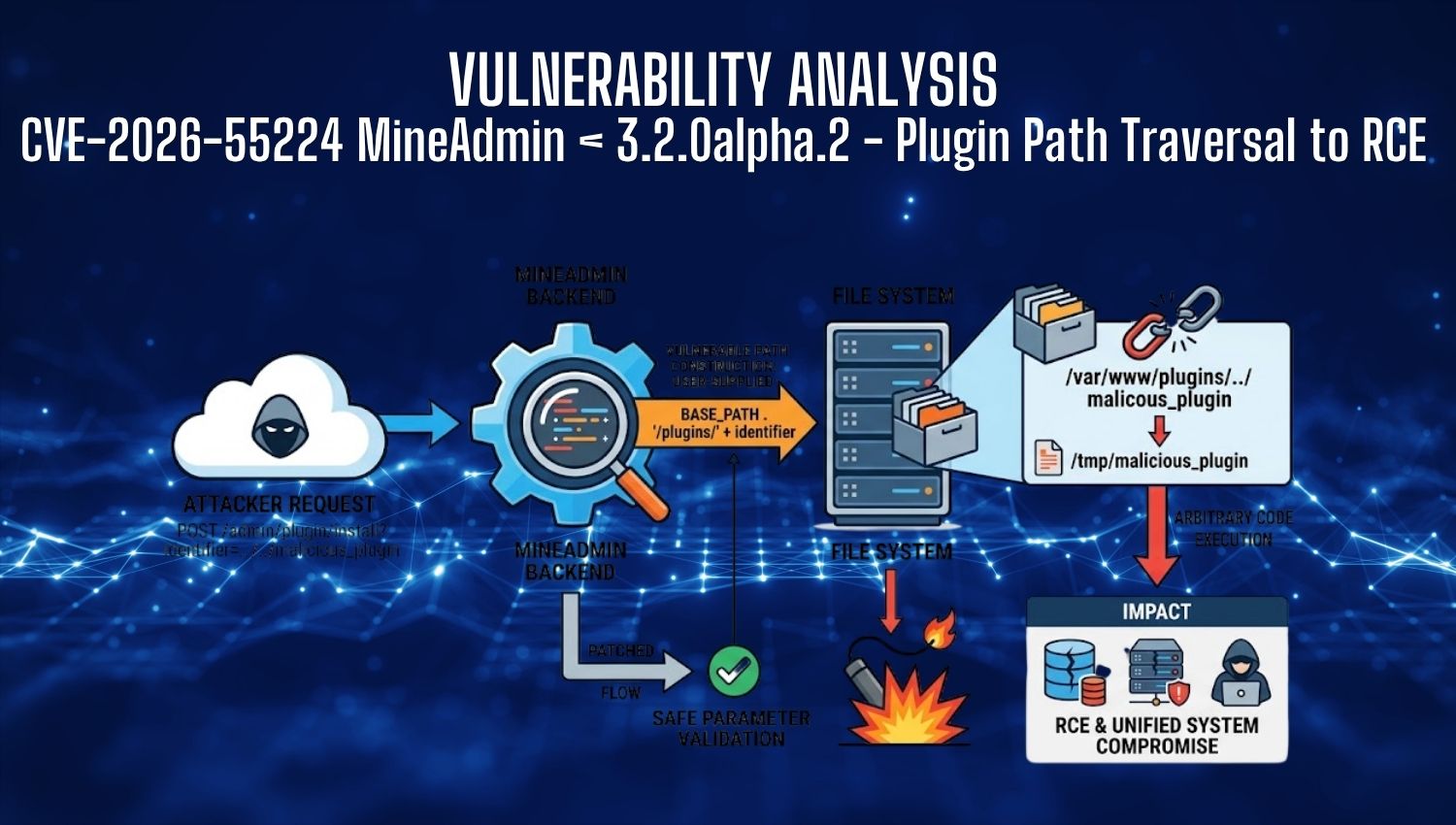
    [ Attacker Request ]
           |
           v
      POST /admin/plugin/install
      Payload: identifier = "../../../tmp/malicious_plugin"
           |
           v
    [ MineAdmin Backend (Unsanitized Concatenation) ]
      Path constructed: BASE_PATH . "/plugins/" + identifier
      Resolved path:    "/tmp/malicious_plugin"
           |
           v
    [ File System & Plugin Manager ]
      Executes Composer / Auto-loader from arbitrary directory
           |
           v
    [ Remote Code Execution (RCE) Achieved ]
Technical Detail: How the Vulnerability Works
Underneath the user interface, MineAdmin manages modular extensions through a dedicated background service that communicates directly with the underlying host OS file system. When an administrator initiates a plugin installation, update, or removal task, the application invokes internal helper methods designed to locate the plugin’s configuration files, dependencies, and executable source code. The fundamental breakdown occurs because the backend service trusts user-supplied input parameters without performing path canonicalization or character validation. Instead of verifying that the resolved path stays within the dedicated application directory (BASE_PATH/plugins/), the code takes the raw string supplied in the HTTP request payload and concatenates it directly into file system operation calls.
This missing boundary check creates an architectural flaw where relative path traversal tokens (../) alter the target context. Consequently, when the plugin manager subsequently executes lifecycle events—such as triggering package installation scripts via Composer or dynamically importing class files into the running PHP process—it ends up executing code from an arbitrary directory controlled or populated by the attacker.
1. Vulnerable Code Flow
The endpoint receives input and directly appends the identifier string to build local file system paths:
// Vulnerable Path Construction Pattern
public function install(string $identifier): bool
{
    // User-controlled $identifier directly concatenated into path without sanitization
    $pluginPath = BASE_PATH . '/plugins/' . $identifier;

    // Checks path existence without verifying directory boundary constraints
    if (! $this->filesystem->exists($pluginPath)) {
        throw new \Exception("Plugin directory not found");
    }

    // Unsafe execution: triggers composer or class autoloading on target directory
    return $this->pluginManager->loadPlugin($pluginPath);
}2. Attack Vector & Execution Path
- Payload Construction: An attacker crafts a malicious request containing a directory traversal payload, such as
../../../../tmp/malicious_plugin, passed within theidentifierJSON or form parameter. - Path Resolution: The application concatenates the base plugin path with the user payload, causing the host operating system to resolve the final canonical path to
/tmp/malicious_plugin, completely bypassing the restrictedBASE_PATH/plugins/environment. - Execution (RCE): The App-Store service subsequently executes lifecycle hooks, invokes
composermanagement operations, or registers PHP classes from the target path, triggering immediate code execution within the context and security privileges of the running web server process.
Remediation & Patching
To effectively remediate CVE-2026-55224, administrators and developers must immediately upgrade their MineAdmin installations to version 3.2.0-alpha.2 or higher. This update introduces essential security controls that prevent arbitrary directory traversal attempts within the App-Store plugin service, ensuring that all file system interactions remain strictly isolated to authorized locations. If an immediate software upgrade is not feasible in production environments, teams should apply defensive coding patches directly to the plugin management routines. Securing these endpoints requires implementing multi-layered input validation, including regex-based character, basename isolation, and explicit canonical path verification (realpath) to confirm that any target path resides firmly within the intended base directory before proceeding with installation or uninstallation logic.
Fix Breakdown: The patch enforces strict input sanitization and resolves canonical file paths using boundary checks:
// Vulnerable Path Construction Pattern
public function install(string $identifier): bool
{
    // User-controlled $identifier directly concatenated into path without sanitization
    $pluginPath = BASE_PATH . '/plugins/' . $identifier;

    // Checks path existence without verifying directory boundary constraints
    if (! $this->filesystem->exists($pluginPath)) {
        throw new \Exception("Plugin directory not found");
    }

    // Unsafe execution: triggers composer or class autoloading on target directory
    return $this->pluginManager->loadPlugin($pluginPath);
}Conclusion
The discovery of CVE-2026-55224 serves as a stark reminder of the underlying risks associated with improper input handling in dynamic web application architectures. When core features such as plugin management systems accept administrative parameters without thorough verification, even fundamental vulnerabilities like path traversal can quickly escalate into full system compromises. In modular PHP frameworks like MineAdmin, allowing raw user input to directly dictate server filesystem paths compromises the security boundaries intended to keep application environments isolated. Beyond immediate exploitation vectors, this security issue underlines the necessity of adopting secure coding principles throughout the entire software development lifecycle. Organizations must implement defense-in-depth strategies, ensuring that administrative privileges are accompanied by strict backend controls. Validating inputs at the controller level is vital, but backend operations—especially those interacting with operating system components, package managers, or dynamic script loaders—must independently verify file path boundaries before processing actions.
Ultimately, mitigating risks like CVE-2026-55224 requires proactive patch management combined with rigorous security audits. Modern applications must treat all external variables, regardless of user privilege levels, as untrusted input. By enforcing strict character, stripping path sequence tokens, and validating canonical file system locations (realpath), developers can prevent directory traversal attacks and protect enterprise environments against arbitrary code execution threats.