
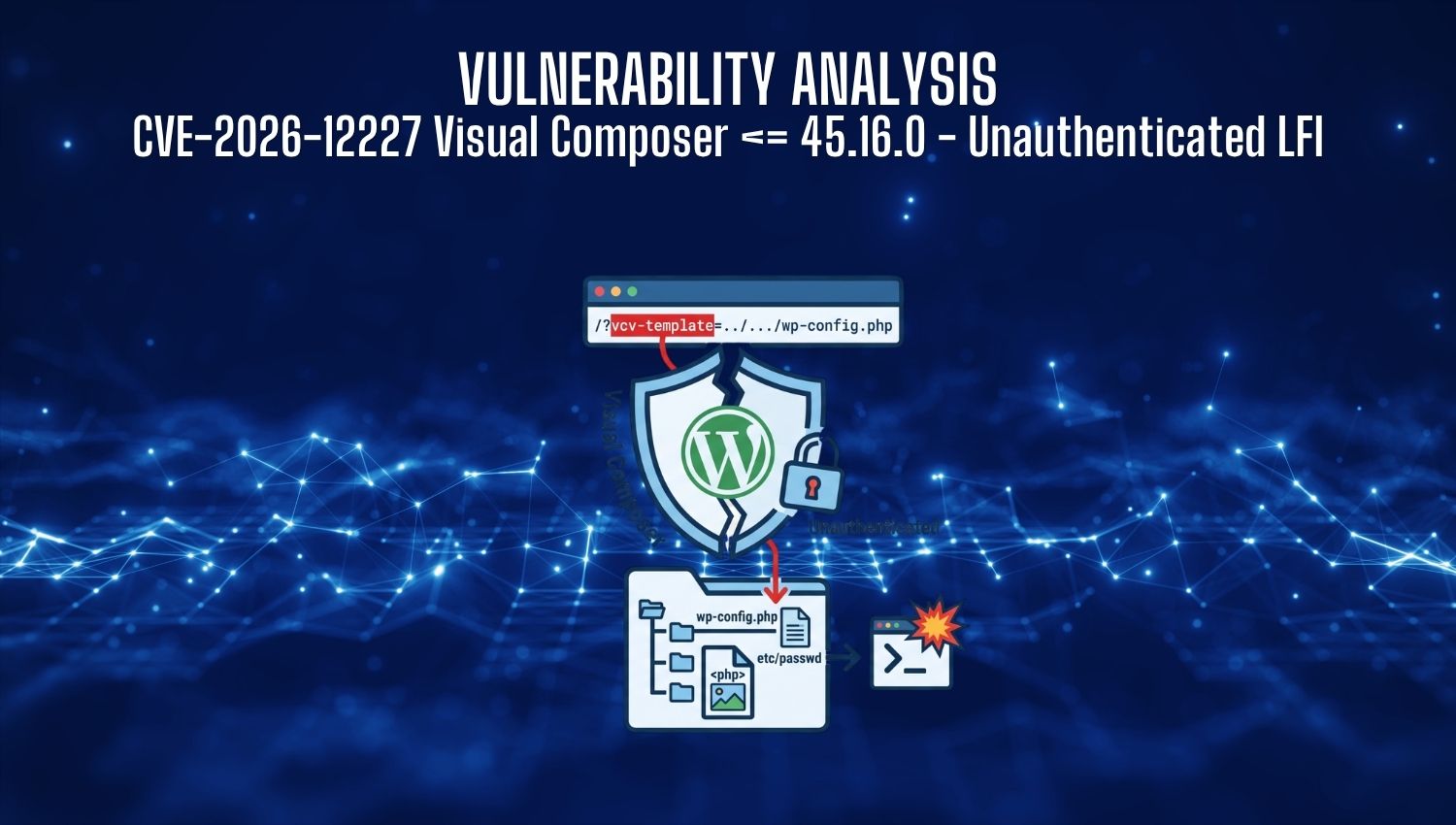
Introduction
In the landscape of web application security, WordPress plugins are frequently targeted due to their widespread deployment. The Visual Composer Website Builder, a highly popular page builder plugin for WordPress, was found to contain a critical security flaw designated as CVE-2026-12227. This vulnerability, affecting versions up to and including 45.16.0, allows unauthenticated attackers to exploit a Local File Inclusion (LFI) vulnerability. Due to its potential to escalate into Remote Code Execution (RCE), this flaw represents a significant risk to affected web servers, highlighting the critical importance of input validation and continuous patch management.
Learning Objectives
By reading this analysis, security professionals and web administrators will be able to:
- Understand the fundamental mechanics of Local File Inclusion (LFI) vulnerabilities.
- Analyze the specific attack vector and vulnerable parameters associated with CVE-2026-12227.
- Recognize how an LFI can be chained with other techniques to achieve Remote Code Execution (RCE).
- Implement effective mitigation and remediation strategies to secure web applications against similar threats.
What is Visual Composer <= 45.16.0 – Unauthenticated LFI (CVE-2026-12227)
CVE-2026-12227 is a critical security flaw with a CVSS v3.1 Base Score of 9.8, identified within the Visual Composer Website Builder plugin for WordPress. This vulnerability is classified as an Unauthenticated Local File Inclusion (LFI), a highly dangerous class of web application security issues. LFI vulnerabilities typically emerge when a web application dynamically includes local server files based on user-supplied input without enforcing strict validation, filtering, or sanitization protocols. In the context of this specific Visual Composer vulnerability, the “unauthenticated” designation makes the threat particularly alarming. It indicates that an attacker does not need to possess any valid user accounts, administrative credentials, or prior privileges on the target WordPress installation to launch a successful attack. Any anonymous user on the internet can interact with the vulnerable endpoint by sending a specially crafted HTTP request directly to the affected server.
By successfully manipulating this unauthenticated request, an adversary can coerce the underlying server into exposing highly sensitive local files, such as configuration files containing database credentials. Even more dangerously, if the attacker can upload a malicious payload to the server beforehand, this LFI can be weaponized to include and execute arbitrary PHP scripts, effectively paving the way for full Remote Code Execution (RCE) and total server compromise.
Key Characteristics of the Vulnerability:
- Critical Severity: Carries a near-maximum CVSS score of 9.8, reflecting its ease of exploitation and devastating potential impact.
- Zero Authentication Required: Attackers do not need any valid WordPress accounts or privileges to exploit the vulnerable endpoint.
- Improper Input Validation: The core failure lies in the plugin’s inability to properly sanitize user-controlled parameters against directory traversal paths.
- RCE Escalation Risk: The flaw extends beyond mere data disclosure, allowing attackers to execute unauthorized code on the host server.
Exploitation Flow Diagram:
+--------------+                                      +-------------------------------+
|              |     1. Malicious HTTP Request        |                               |
|   Attacker   | -----------------------------------> |       Target Web Server       |
|              |   (?vcv-template=../../wp-config)    |  (Vulnerable Visual Composer) |
+--------------+                                      +-------------------------------+
       ^                                                              |
       |                                                              | 2. Flawed Input
       |                                                              |    Validation
       |                                                              v
       |                                              +-------------------------------+
       |     3. Server Returns Sensitive File Data    |                               |
       +--------------------------------------------- |   Server Local File System    |
             (or executes embedded PHP payload)       | (e.g., config files, uploads) |
                                                      +-------------------------------+
Technical Detail: How the Vulnerability Works
The root cause of CVE-2026-12227 lies in the insecure handling of the vcv-template parameter within the plugin’s architecture. When a template is requested, the plugin dynamically relies on this specific parameter to locate and load the corresponding file directly from the server’s file system. Unfortunately, vulnerable versions of the plugin fail to adequately sanitize this user-supplied data, lacking strict defenses against common directory traversal sequences. Because of this insufficient validation, an unauthenticated attacker can easily manipulate the vcv-template parameter by injecting standard traversal characters, such as ../ or ..\. This manipulation allows the adversary to break out of the intended, safe template directory and navigate through the server’s broader directory structure. Instead of loading a legitimate layout file from /wp-content/plugins/visualcomposer/templates/, the attacker can redirect the application to parse and expose sensitive local system files.
While reading arbitrary server files poses a severe data disclosure threat, the most critical risk of this LFI vulnerability is its potential escalation to full Remote Code Execution (RCE). Attackers typically achieve this by exploiting WordPress’s standard media upload capabilities to host a malicious payload disguised as a benign file, such as a .jpg containing embedded PHP code. By pinpointing the uploaded file’s location and utilizing the LFI flaw to include() it, the server’s PHP interpreter is tricked into executing the hidden malicious code, granting the attacker complete operational control over the web environment.
Key Technical Mechanics:
- Vulnerable Parameter Identification: The security flaw resides specifically within the unrestricted processing of the
vcv-templateHTTP parameter during page rendering. - Directory Traversal Mechanism: Attackers utilize classic dot-dot-slash (
../) payload sequences to successfully escape the restricted plugin template directory. - Arbitrary File Disclosure: The initial phase of exploitation often involves targeting and reading sensitive configuration files, such as
wp-config.php, to extract database credentials and security keys. - Payload Execution Chain: Complete server compromise is achieved by combining the LFI vulnerability with a poisoned file upload (like a malicious image), leading directly to arbitrary PHP execution.
Mitigation and Remediation
Securing systems against CVE-2026-12227 requires immediate patching as the primary line of defense against potential exploitation. The vendor has released critical security updates (such as versions 45.16.1, 45.16.3, and subsequent releases) that resolve the core issue by enforcing strict validation and sanitization on the vcv-template parameter. This architectural fix ensures the application only processes explicitly allowed template paths, effectively closing the directory traversal vector and preventing unauthorized file inclusion.
Beyond immediate patching, organizations must implement defense-in-depth strategies to protect their infrastructure against related exploitation chains. This involves hardening the web server environment by aggressively restricting script execution capabilities in user-accessible folders and deploying network-level filtering to automatically detect and intercept malicious payloads before they reach the vulnerable application logic.
Core Defense Strategies:
- Apply Security Patches (Primary Remediation): Immediately update the Visual Composer Website Builder plugin to a patched version to repair the flawed input validation logic governing the
vcv-templateparameter. - Implement Web Application Firewalls (WAF): Deploy robust WAF rules to actively monitor incoming traffic and block HTTP requests containing directory traversal sequences (
../) or recognizable LFI exploitation patterns. - Restrict File Permissions: Enforce the principle of least privilege by utilizing
.htaccessor server block rules (e.g., in Nginx) to completely disable the execution of PHP scripts within user-upload directories likewp-content/uploads. - Proactive Threat Hunting: Continuously analyze web server access logs for anomalous behavior, specifically targeting irregular manipulations of the
vcv-templateparameter or unusual access to sensitive local files that might indicate a breach attempt.
Conclusion
CVE-2026-12227 serves as a stark and urgent reminder of the inherent dangers associated with improper input handling within widely used web application components. Because the Visual Composer Website Builder is deployed across a vast number of WordPress sites globally, a vulnerability of this magnitude instantly exposes a massive attack surface. It highlights how a single oversight in sanitizing a seemingly innocuous template parameter can completely undermine the security architecture of an otherwise well-protected server, proving that third-party plugins remain one of the most critical vectors in modern web exploitation. The technical trajectory of this exploit—transitioning from a simple unauthenticated Local File Inclusion to full-scale Remote Code Execution—perfectly illustrates modern attacker methodologies. It demonstrates how threat actors rarely rely on a single flaw, but rather chain relatively straightforward misconfigurations alongside native application features, such as media uploads, to engineer devastating breaches. This chaining capability transforms a localized file disclosure issue into a total system compromise, allowing attackers to bypass authentication boundaries entirely and execute arbitrary commands with the privileges of the web server.
For any organization utilizing the Visual Composer plugin, rapid deployment of the vendor’s security patches is an absolute and non-negotiable priority. More broadly, however, this vulnerability underscores a dual mandate for the web security ecosystem: developers must adopt secure coding paradigms that mandate strict, allow-list-based input validation by default, while system administrators must actively maintain robust, multi-layered security postures. By combining proactive patch management with defense-in-depth strategies like rigid file execution permissions and active threat monitoring, organizations can effectively contain and neutralize the impact of such critical flaws.
So, if all forms of external file uploading to the server have been completely disabled, is there any other way for an attacker to achieve RCE by exploiting only this LFI vulnerability?
This can be bypassed if log poisoning is possible on the server. For instance, if a malicious PHP code snippet is injected into the User-Agent header and a request is sent to the server, this code will be written to the Apache/Nginx access logs. Subsequently, by leveraging an LFI (Local File Inclusion) vulnerability to include that log file (e.g., /var/log/nginx/access.log), the PHP code will be executed, resulting in RCE.
Good article; however, it is worth noting that attackers often use `php://filter` wrappers when exploiting LFI (Local File Inclusion) vulnerabilities to bypass basic WAF (Web Application Firewall) rules. Through this method, files are read in a Base64-encoded format, allowing sensitive data to be exfiltrated without triggering WAF alerts.
The article explains the logic behind exploiting the vulnerability very clearly, but it fails to address the underlying source code flaws. To make it more educational for developers, the analysis would be significantly more insightful if it included a brief static code analysis, highlighting that the vulnerability stems from the absence of directory validation functions—such as `basename()` or `realpath()`—within the codebase.