
Introduction
CVE-2026-86426 represents a critical authentication bypass vulnerability affecting LibreNMS network monitoring installations running version 26.7.0 or earlier. Publicly disclosed and addressed in late 2026, the vulnerability received a severe CVSS v4.0 rating of 9.2 (Critical) due to its low attack complexity and high impact. The underlying flaw resides within the API authentication middleware, which fails to strictly enforce parameter types during input processing. As a result, an unauthenticated remote attacker can completely bypass standard token authentication mechanisms, hijack valid session permissions, and silently access internal system APIs. In high-privilege scenarios, this access quickly escalates to Remote Code Execution (RCE), giving attackers full control over the underlying host.
Learning Objectives
- Identify the conditions that lead to type confusion vulnerabilities in REST APIs processing JSON payloads.
- Understand how loose type comparison rules in MySQL databases interact with application-level validation to cause authentication bypasses.
- Analyze the escalation path from an unauthenticated API request to administrative privileges and Remote Code Execution.
- Apply proper patching and mitigation strategies to protect network monitoring software against authentication bypass vectors.
What is LibreNMS <= 26.7.0 – Unauthenticated API Access CVE-2026-86426
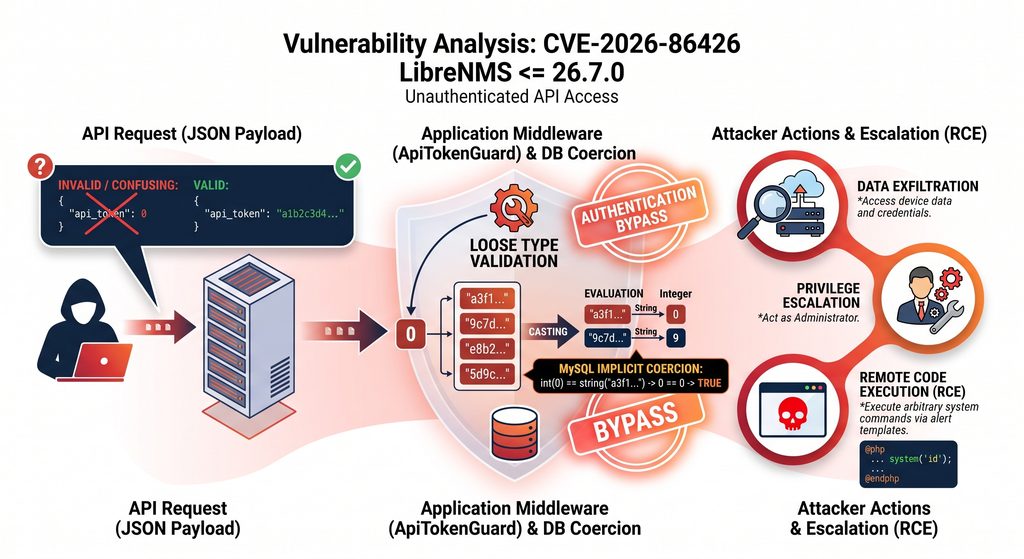
LibreNMS relies on secure API tokens to authenticate REST API requests sent to its management interfaces. In vulnerable installations running version 26.7.0 or earlier, a critical logic flaw exists in the application’s authentication middleware (ApiTokenGuard). This middleware fails to sanitize or strictly cast user-supplied input types when processing API token parameters sent via structured JSON payloads, exposing the authentication routine to severe type confusion. The core vulnerability emerges from the interaction between Laravel’s request parser and MySQL’s implicit type conversion rules. When an incoming JSON body contains an integer instead of an expected string token, the application forwards the numeric value directly into the database query builder. MySQL attempts to compare this integer with string-formatted hash values stored in the database, resulting in automatic type coercion that drastically reduces the entropy required to achieve a valid match.
Consequently, an unauthenticated attacker does not need to guess or steal complex, high-entropy API key strings to gain access. By systematically supplying small integer values (ranging from 0 through 9), an attacker can force the database to evaluate a valid token match, granting them immediate access under the context of an existing user or administrator account.
- Strict Type Failure: The application accepts non-string data types (integers/arrays) within JSON parameters without validating them against expected string formats.
- Database Coercion Exploitation: MySQL’s automatic casting rule truncates stored hash strings into numeric integers during comparisons, enabling loose equality matches.
- Minimal Attack Complexity: An attacker only needs to send up to 10 lightweight HTTP requests (testing single digits
0–9) to bypass the API authentication layer entirely. - Full Session Hijacking: Successful authentication grants the attacker all permissions attached to the matched token, opening pathways to internal network telemetry and server takeover.
Technical Detail: How the Vulnerability Works
The technical driver behind CVE-2026-86426 lies within LibreNMS’s ApiTokenGuard authentication mechanism and how Laravel’s request pipeline handles JSON-formatted body parameters. LibreNMS accepts API authentication tokens through multiple input channels, including HTTP headers, URL query parameters, and POST request body parameters. When an incoming request uses Content-Type: application/json, Laravel parses the payload into PHP native types without converting integer literals to strings. Consequently, sending {"api_token": 0} injects an integer primitive (0) directly into the authentication handler rather than the expected high-entropy alphanumeric string. Because ApiTokenGuard forwards this unvalidated input straight into the database query builder, the resulting SQL query attempts a direct comparison between the integer parameter and the string-based token_hash column in the database. In standard relational operations, strict type integrity prevents mismatched data comparisons; however, MySQL performs implicit type conversion whenever an integer is compared against a string field. Under MySQL’s coercion rules, any text string beginning with a non-numeric character (such as "a3f1..." or "e8b2...") evaluates numerically to 0. Similarly, a hash string starting with a digit (such as "5d9c...") evaluates directly to that leading digit (5).
This loose coercion mechanism creates a critical authentication bypass surface through brute-force reduction. Instead of cracking a 64-character hash, an attacker only needs to test single-digit integers from 0 to 9 to successfully trigger a match against existing active tokens in the database. Once matched, the authentication layer yields a valid user session context. If the matched token belongs to an administrative account, the attacker can leverage native administrative capabilities—such as custom PHP blocks within LibreNMS alert templates (@php ... @endphp)—to instantly gain arbitrary code execution on the underlying server.
- Payload Type Preservation: JSON endpoints preserve raw data types, allowing numeric primitives to bypass string-oriented sanitation filters in the application layer.
- Implicit SQL Coercion: MySQL casts stored string hashes to integer values during comparison operations, causing non-numeric starting characters to evaluate as
0. - Reduced Entropy Space: The required brute-force search space shrinks from possible hash combinations to just 10 single-digit integer requests (
0through9). - Post-Authentication RCE: Administrative API access allows direct modification of system alert templates, enabling native command execution through embedded template directives.
curl -i -s -k -X POST "http://target.local/api/v0/system" \
  -H "Content-Type: application/json" \
  -d '{"api_token": 0}'

HTTP/1.1 200 OK
Date: Sat, 12 Sep 2026 11:20:00 GMT
Server: Apache/2.4.52 (Ubuntu)
Content-Type: application/json

{
  "status": "ok",
  "system": {
    "version": "26.7.0",
    "db_schema": "1025",
    "php_ver": "8.2.10",
    "python_ver": "3.10.12",
    "mysql_ver": "10.11.2-MariaDB",
    "rrdtool_ver": "1.7.2",
    "netsnmp_ver": "5.9.1"
  },
  "authenticated_as": "admin_user"
}
Remediation & Mitigation
Addressing CVE-2026-86426 requires an immediate, prioritized response to eliminate the underlying type confusion vulnerability within the authentication pipeline. The definitive resolution is to update the LibreNMS software to version 26.8.0 or later. The patch introduces strict parameter type checking within the ApiTokenGuard middleware, ensuring that incoming api_token values are explicitly validated as strings before being processed by the database query builder. This prevents non-string JSON data types from triggering MySQL’s implicit coercion rules during token lookup operations. For organizations unable to deploy the official patch immediately, defense-in-depth measures should be applied at the network and application monitoring layers to reduce potential exposure. Restricting API access to trusted administrative IP segments significantly reduces the reach of unauthenticated attackers. Additionally, active monitoring of web server access logs and API tokens can assist incident response teams in identifying preliminary probe attempts, verifying system integrity, and revoking potentially compromised credentials.
- Apply Security Update: Upgrade LibreNMS installations to version 26.8.0+ immediately to enforce strict string input validation across all REST API endpoints.
- Restrict API Network Exposure: Deploy strict firewall rules, WAF policies, or internal VPN access controls to limit
/api/v0/endpoint access exclusively to authorized management hosts. - Audit Web Server Logs: Search HTTP request logs for POST or GET payloads directed at API endpoints that contain integer values or array types within the
api_tokenparameter. - Rotate API Tokens: Revoke and re-issue all existing administrative API keys if log auditing reveals suspicious single-digit integer probes (
0–9) targeting the API interface.
Conclusion
CVE-2026-86426 serves as a stark reminder of how subtle interactions between web application frameworks and relational database type systems can completely undermine critical security boundaries. Type confusion vulnerabilities of this nature highlight that security mechanisms must validate not only the presence and format of user input, but also its exact data type. When high-level web frameworks pass unvalidated JSON data primitives directly into database query builders, implicit engine behavior can easily transform low-complexity inputs into full authentication bypasses. ecause LibreNMS acts as a central telemetry and management hub across complex infrastructure environments, a compromise of its API interface yields extensive operational reach. Exposure of device configurations, internal IP maps, and SNMP credentials places the entire surrounding network at risk of lateral movement and administrative takeover. Consequently, leaving vulnerable LibreNMS deployments exposed to unauthenticated networks poses a direct threat to enterprise infrastructure security. Organizations maintaining vulnerable instances running version 26.7.0 or earlier must prioritize immediate isolation and remediation. Applying the 26.8.0+ patch, auditing historical access logs, and enforcing strict network segmentation around monitoring interfaces are essential steps to neutralize this threat and maintain a resilient security posture.