
Introduction
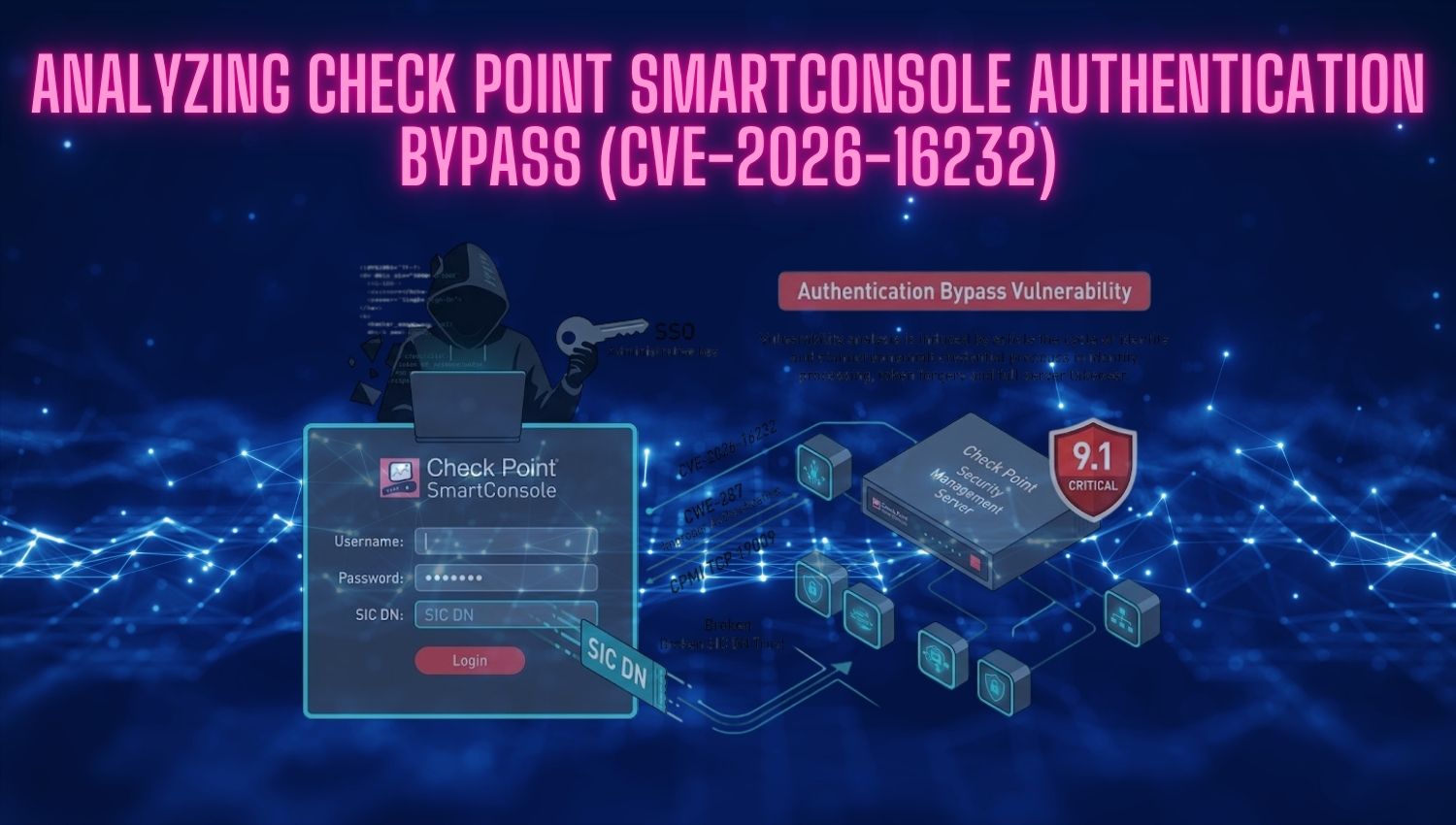
Check Point Security Management Servers and Multi-Domain Security Management (MDS) platforms serve as the central control plane for enterprise network security. They manage security policies, threat prevention rules, user directories, and gateway configurations across global corporate environments. A critical vulnerability designated as CVE-2026-16232 was discovered within these systems, drastically elevating organizational risk. This flaw allows unauthenticated remote attackers to completely bypass SmartConsole authentication mechanisms, forge administrative tokens, and assume unrestricted control over central management instances. Active zero-day exploitation in the wild was confirmed prior to vendor patch deployment, prompting CISA to add CVE-2026-16232 to its Known Exploited Vulnerabilities (KEV) Catalog for mandatory remediation.
Learning Objectives
After reading this article, cybersecurity professionals, network engineers, and system administrators will be able to:
- Understand the architecture of Check Point SmartConsole authentication and the interaction between core management services (CPMI, FWM, CPM/DLE).
- Identify the technical root cause of CVE-2026-16232, including broken trust boundaries and token forgery mechanisms.
- Evaluate the prerequisites necessary for successful remote exploitation in enterprise environments.
- Analyze the administrative impact and potential risks associated with gateway hijacking and policy tampering.
- Implement effective remediation measures, jumbo hotfix updates, and network access restrictions.
What is Check Point SmartConsole Authentication Bypass CVE-2026-16232
CVE-2026-16232 represents a critical Improper Authentication (CWE-287) vulnerability inherent to the authentication processing routines of Check Point Security Management Server and Multi-Domain Security Management (MDS) platforms. These management instances are essential for maintaining centralized security policies, threat prevention enforcement, and remote access configurations across enterprise infrastructures. Because of their central position within corporate network architectures, any failure in authentication boundaries can lead to widespread operational exposure. The vulnerability occurs when remote client applications establish connections with internal management daemons over management ports such as TCP 19009. Due to insufficient validation of identity assertions during initial handshake sequences, the system inadvertently accepts unverified Distinguished Name (DN) values supplied by remote peers. This flaw allows an unauthenticated adversary to bypass standard administrative credential checks, manipulate session parameters, and acquire validSingle Sign-On (SSO) administrative tokens directly from the server.
Because active zero-day exploitation was observed in production environments prior to public disclosure, security organizations worldwide have prioritized this vulnerability. Successful exploitation completely compromises the integrity, confidentiality, and availability of the management infrastructure. Consequently, cybersecurity authorities—including CISA—have officially categorized CVE-2026-16232 as an actively exploited threat requiring immediate remediation.
- Complete Administrative Takeover: Allows unauthenticated attackers to acquire full administrative privileges over central management servers.
- Active Zero-Day Exploitation: Leveraged by threat actors in real-world attacks prior to the release of official vendor patches.
- Infrastructure-Wide Impact: Enables adversaries to push unauthorized security policy modifications and tamper with connected firewall gateways.
- Broad Version Exposure: Affects major release tracks including R81.20, R82, and R82.10 running unpatched Jumbo Hotfix Accumulators.
| Attribute | Details |
|---|---|
| CVE Identifier | CVE-2026-16232 |
| CVSS v3.1 Score | 9.1 – 9.3 (Critical) |
| Vulnerability Class | CWE-287: Improper Authentication |
| Affected Components | Check Point Security Management Server, Multi-Domain Management (MDS) |
| Affected Versions | R81.20 (prior to Take 158), R82, R82.10 (unpatched Jumbo Hotfixes) |
| Exploitation Status | Actively Exploited in the Wild (CISA KEV Listed) |
Technical Detail: How the Vulnerability Work
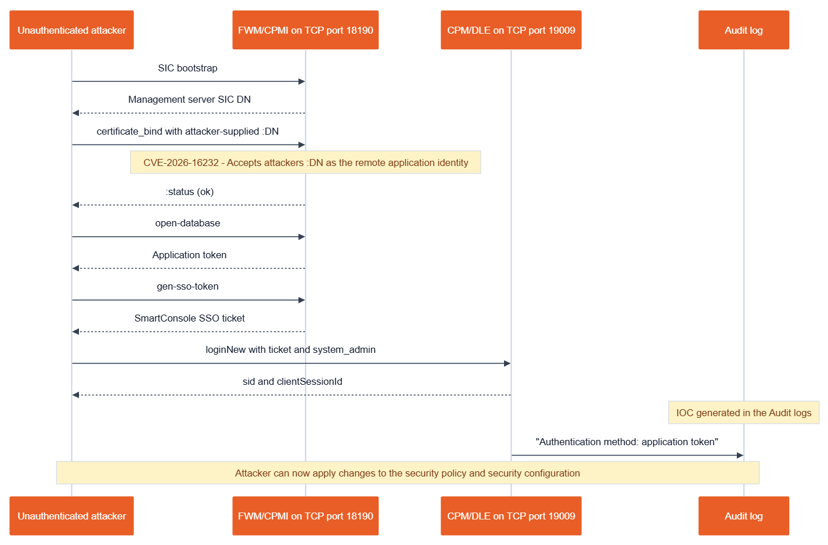
The underlying flaw resides within the remote authentication handling logic that orchestrates administrative sessions between SmartConsole and core server daemons, such as FWM, CPMI, and CPM/DLE. Under standard operations, when SmartConsole connects to the Security Management Server, a strict mutual authentication handshake occurs. The server validates the connecting client’s identity using Secure Internal Communication (SIC) certificates and cryptographic Distinguished Names (DNs), relying on routines like getCertificateDnName() to ensure that incoming connection requests originate from authenticated administrative peers. CVE-2026-16232 introduces a severe failure in this trust boundary during initial session negotiation. An attacker can initiate an unauthenticated bootstrap handshake over management ports (such as TCP 19009) to read the server’s own SIC DN from initial response headers. The attacker then crafts a forged application certificate bind request that presents the server’s extracted DN string instead of legitimate client credentials. Due to flawed validation logic, the server mistakenly prioritizes the attacker-supplied DN string over the actual verified peer certificate identity, causing the authentication engine to treat the untrusted connection as a legitimate internal system process.
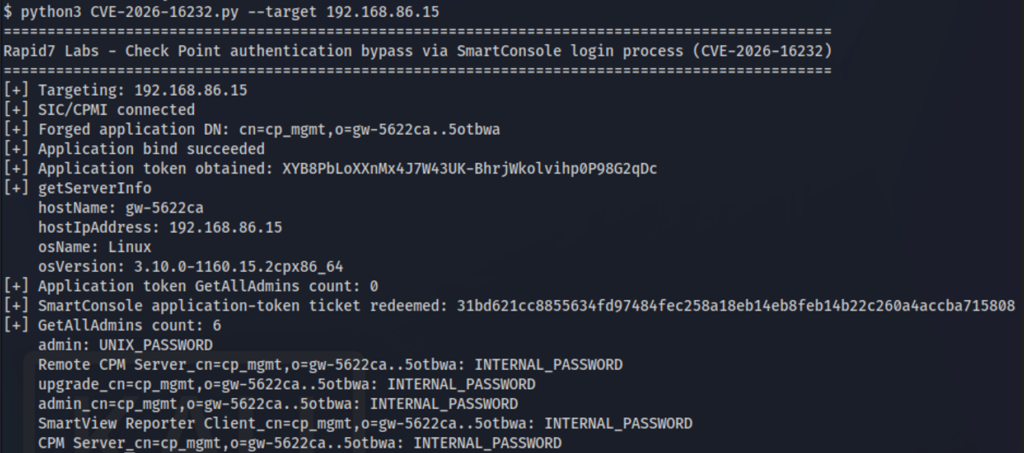
Once the flawed authentication path accepts the forged bind request, the management server issues a valid application login token to the unauthenticated connection. The attacker immediately exchanges this token for a fully privileged SmartConsole Single Sign-On (SSO) administrative ticket. With this high-level session ticket in hand, the adversary achieves complete control over the platform, allowing them to modify access policies, disable security features, extract sensitive VPN keys, or execute arbitrary code on connected network gateways.
- Cryptographic Identity Spoofing: Exploits a broken trust boundary where the server prioritizes attacker-supplied SIC DN strings over verified peer certificate identities.
- Unauthenticated Token Forgery: Enables attackers to extract internal server parameters during initial handshakes to generate valid administrative login tokens without credentials.
- Full Session Escalation: Allows seamless exchange of forged application tokens for high-privilege SmartConsole SSO tickets, granting unrestricted administrative authority.
Prerequisites for Remote Exploitation
While CVE-2026-16232 represents a critical vulnerability capable of granting full administrative control, successful remote exploitation is highly contingent on specific network configurations and environment conditions. Because the underlying flaw relies on unauthenticated application handshakes over management services, an adversary must be able to establish direct network paths to the management daemon listeners without encountering perimeter drop rules or strict client IP restrictions. Organizations that enforce zero-trust access, strictly limit administrative GUI access to designated hosts, and keep management interfaces off public networks significantly shrink their attack surface against external threat actors.
- Direct Network Reachability: Management service ports—specifically CPMI and FWM listener interfaces such as TCP 19009—must be directly accessible from the attacker’s network location.
- Permissive GUI Client Policy: The “GUI Clients / Trusted Clients” setting within the Security Management Server properties must be configured to permit logins from broad network ranges or
Any, rather than explicit administrative IPs. - Absence of In-Band Network Controls: The network path lacks upstream firewall filtering, network segmentation, or mandatory jump-box requirements that would otherwise intercept unauthorized connection attempts.
- Unpatched System State: The target platform is running an unpatched version of R81.20, R82, or R82.10 without the critical Jumbo Hotfix Accumulator updates applied.
Conclusion
CVE-2026-16232 represents an extraordinary threat to enterprise security posture because it completely dismantles the core authentication boundary of Check Point management platforms. By enabling unauthenticated remote attackers to forge session tokens and acquire full SmartConsole administrative access, this flaw compromises the central orchestration point of an organization’s network defense. Because confirmed zero-day exploitation is actively occurring in the wild and CISA has added this issue to its Known Exploited Vulnerabilities catalog, immediate and comprehensive mitigation must be executed. The foremost and most critical defensive step is the rapid deployment of vendor-supplied software patches across all affected management appliances. System administrators must urgently update their Check Point Security Management and Multi-Domain Management (MDS) servers to the latest Jumbo Hotfix Accumulator releases, such as R81.20 Take 158 or the corresponding patched builds for R82 and R82.10. Installing these hotfixes corrects the underlying logic flaw within the authentication daemons and restores proper SIC certificate identity verification. In tandem with patching, network administrators must harden their management server access configurations by enforcing strict GUI Client restrictions. Organizations should immediately modify SmartConsole properties to replace any broad network definitions or open access policies (such as Any) with explicit, dedicated administrative host IP addresses or isolated management subnets. Furthermore, management ports—including TCP 19009, 18190, and 443—must never be exposed to the public internet or untrusted internal segments, requiring all administrative connections to route exclusively through authenticated VPNs or secure jump boxes.
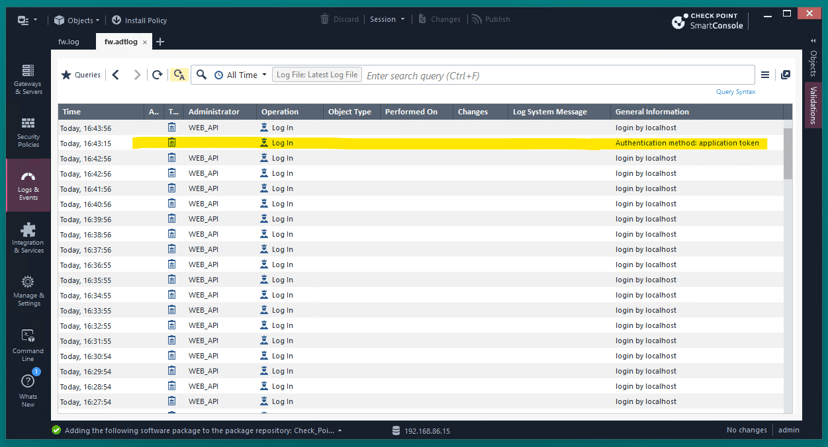
Finally, security operations teams should conduct immediate forensic reviews of their management infrastructure to verify that active exploitation has not already occurred. Defenders ought to inspect SmartConsole login audit trails, CPM service logs, and operating system event logs for anomalous administrative sessions originating from unexpected or unknown IP addresses. Combining immediate hotfix deployment, strict network segmentation, and proactive log analysis ensures robust protection against CVE-2026-16232.