
Introduction
In the modern corporate landscape, privileged access and remote control solutions form the backbone of IT administration and technical support infrastructure. However, because these systems inherently possess elevated rights over entire enterprise networks, they represent highly attractive targets for sophisticated threat actors. In July 2026, a critical security vulnerability designated as CVE-2026-40138 was publicly disclosed, impacting BeyondTrust’s flagship remote access software lines. Classified as a pre-authentication authentication bypass vulnerability, this flaw allows unauthenticated remote attackers to entirely circumvent security barriers, gain unauthorized entry to administrative interfaces, and potentially compromise the internal infrastructure of organizations worldwide. This specific structural flaw bypasses perimeter gates altogether, presenting an imminent threat to data integrity, confidentiality, and overall network health. Consequently, understanding its fundamental impact has become an immediate priority for security engineering teams globally who rely on these gateway tools to maintain daily operations.
Learning Objectives
By reading this technical analysis will achieve the following objectives:
- Understand the scope, architectural impact, and severity metrics of CVE-2026-40138.
- Identify the specific product versions and deployment environments that are susceptible to this exploitation vector.
- Analyze the underlying technical mechanism that permits remote attackers to bypass identity checks before authentication occurs.
- Implement definitive remediation workflows, immediate architectural workarounds, and hardening protocols to protect enterprise networks.
What is CVE-2026-40138?
CVE-2026-40138 is a critically rated security flaw discovered within the core authentication architecture of BeyondTrust’s enterprise-grade connectivity platforms, specifically affecting BeyondTrust Remote Support (RS) and BeyondTrust Privileged Remote Access (PRA). As organizations heavily rely on these systems to manage high-level administrative access, a vulnerability of this nature introduces profound risks to network integrity. Because of its capability to grant administrative access to unauthorized external entities, it represents a top-tier security concern for enterprise network infrastructure globally. The severity of this security flaw is reflected in its maximum-risk metrics, having been assigned a Common Vulnerability Scoring System (CVSS) v3.1 base score of 9.8 (Critical) and a CVSS v4.0 score of 9.2 (Critical). Officially categorized under CWE-287 (Improper Authentication), the vulnerability marks a significant deficiency in how the host application verifies identity claims before establishing a session. The sheer height of these metrics emphasizes the urgency for system administrators to audit their environments immediately.
Crucially, the flaw is fully exploitable during the pre-authentication phase, meaning an adversary requires absolutely no legitimate user credentials, active session tokens, or internal corporate network footprint to initiate the attack vector. If a vulnerable appliance exposes its endpoint login interfaces directly to untrusted web traffic, it can be remotely manipulated by bad actors. However, threat intelligence indicators highlight a vital structural constraint: the practical execution of this attack vector relies heavily on specific, non-default identity provider configurations or external directory integrations being enabled on the host appliance.
To understand the core characteristics of this vulnerability, the following primary metrics and key takeaways should be considered:
- Pre-Authentication Execution: The exploit requires zero prior authentication, permitting anonymous attackers on the internet to target the appliance without needing a low-privileged or valid staging account.
- High-Severity Risk Impact: With a CVSS score of 9.8, a successful compromise effectively hands complete administrative control of the remote support platform over to the attacker, leading to potential enterprise-wide lateral movement.
- Configuration Dependency: The vulnerability is not generic to every baseline installation but is actively triggered by specific, non-default authentication rules or identity provider (IdP) integration environments.
- Scope of Affected Systems: The flaw natively compromises both key lines of BeyondTrust’s remote infrastructure—Remote Support (RS) and Privileged Remote Access (PRA)—affecting version 25.3.2 and all previous builds.
Technical Detail: How the Vulnerability Works
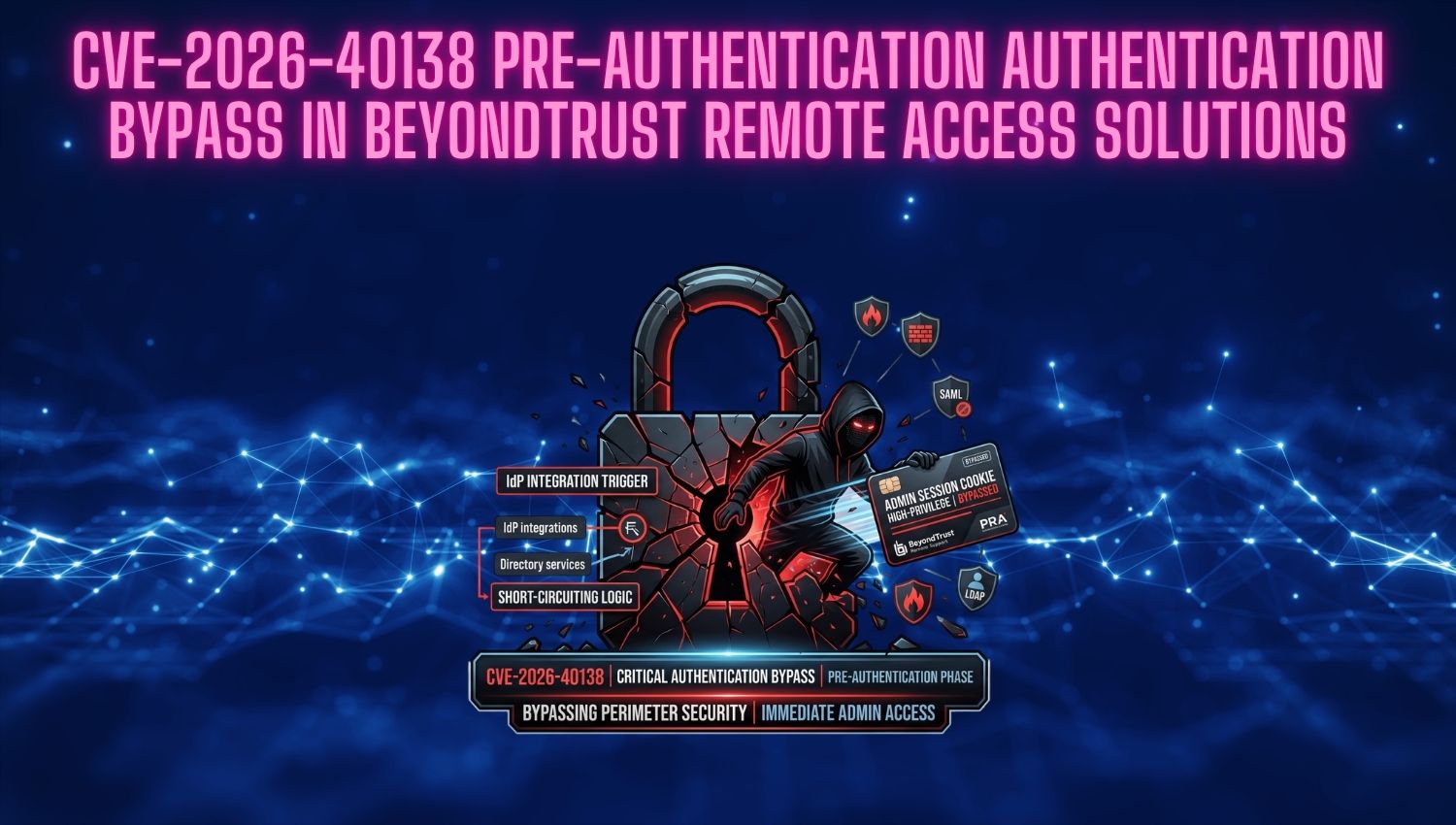
The root cause of CVE-2026-40138 stems from an architectural logic flaw inside the server-side code responsible for parsing and validating complex authentication payloads. When a user attempts to log into BeyondTrust Remote Support or Privileged Remote Access, the underlying appliance dispatches the user’s input to an internal validation subsystem designed to cross-reference credentials with configured identity stores. This subsystem is tasked with handling various communication standards, such as local databases, SAML assertions, or LDAP providers. During a normal, uncompromised authentication flow, the system must meticulously verify structural parameters, cryptographic signatures, or backend states before assigning a high-privileged session token. However, in affected versions (v25.3.2 and earlier), certain custom-crafted HTTP request payloads can completely trick this core parsing logic. Specifically, when an attacker submits an abnormally structured authentication object, the underlying state-machine parser encounters a severe logic exception or an unhandled validation oversight.
Instead of securely dropping the unverified request and throwing a standard Access Denied error, the vulnerable code paths inadvertently default to an approved state, short-circuiting past the cryptographic verification step entirely. Consequently, the system generates a fully operational administrative session cookie for the unauthenticated threat actor. Armed with this valid session, the attacker inherits the security context of a high-privileged administrator, which can lead to total platform takeover.
- Malformed Input Submission: The attacker crafts and dispatches a highly specific, abnormally structured HTTP request object directly to the appliance’s authentication subsystem.
- Parser State-Machine Exception: The server-side code fails to properly parse the complex payload, causing the internal state-machine to trigger a logic exception rather than rejecting the input.
- Cryptographic Short-Circuiting: Due to the unhandled exception, the validation routine skips past vital security mechanisms, including cryptographic signature verification and credential cross-referencing.
- Administrative Session Generation: The system mistakenly defaults to an approved authentication state, issuing a fully operational administrative session cookie to the unauthenticated adversary.
Remediation Strategies and Mitigation Measures
To secure enterprise networks against the active exploitation of CVE-2026-40138, organizations must execute a structured, defense-in-depth remediation strategy immediately. Relying solely on standard boundary defenses is insufficient; a combination of immediate vendor updates, aggressive attack surface reduction, and proactive behavioral monitoring is required to fully close this high-severity vector. Administrators should treat this deployment as an emergency change-management item due to the pre-authentication nature of the flaw.
- Immediate Software Patching: Upgrading self-hosted, on-premise, or private cloud implementations of BeyondTrust appliances to version 25.3.3 or higher is the primary defense to close the input parsing loophole and enforce strict state checks. (Note: BeyondTrust Cloud SaaS environments were already centrally patched and secured by the vendor in April 2026).
- Network Perimeter Segmentation: Restrict the appliance’s attack surface by immediately removing administrative login interfaces from the public internet, ensuring the BeyondTrust console is accessible only behind an enterprise firewall, a secure corporate VPN, or a Zero Trust Network Access (ZTNA) gateway.
- Targeted Log Auditing: Task the Security Operations Center (SOC) with analyzing appliance access logs for anomalous pre-authentication patterns, focusing heavily on truncated payload submissions or administrative actions initiated without an associated multi-factor authentication (MFA) trigger.
- Credential and Session Invalidation: As a trailing precautionary measure post-patching, rotate active administrative credentials and terminate any existing long-lived active sessions to ensure no legacy, potentially compromised cookies remain cached in the network environment.
Conclusion
CVE-2026-40138 serves as a stark reminder of the critical importance of safeguarding identity and access management tools. Because privileged access utilities act as the definitive keys to the enterprise kingdom, any flaw that permits an unauthenticated bypass introduces catastrophic risks to an organization’s perimeter. When infrastructure designed to protect a network becomes the very vector used to compromise it, the foundational trust of the entire security architecture is called into question. Fortunately, swift coordination between independent security researchers and the engineering teams at BeyondTrust has minimized the window of opportunity for widespread exploitation by providing stable, robust patches. This rapid vendor response highlights the strength of collaborative threat intelligence and responsible disclosure within the cybersecurity community. However, the ultimate responsibility now shifts to enterprise administrators, who must act quickly to deploy these fixes across their unique environments. By executing immediate version upgrades, thoroughly auditing access logs for historical indicators of compromise, and enforcing strict network perimeter controls, organizations can fully mitigate the risk posed by this critical vulnerability. Adopting these defense-in-depth measures not only neutralizes the threat of CVE-2026-40138 but also ensures the ongoing resilience and integrity of corporate remote support infrastructures against future waves of sophisticated cyber attacks.
