
Introduction
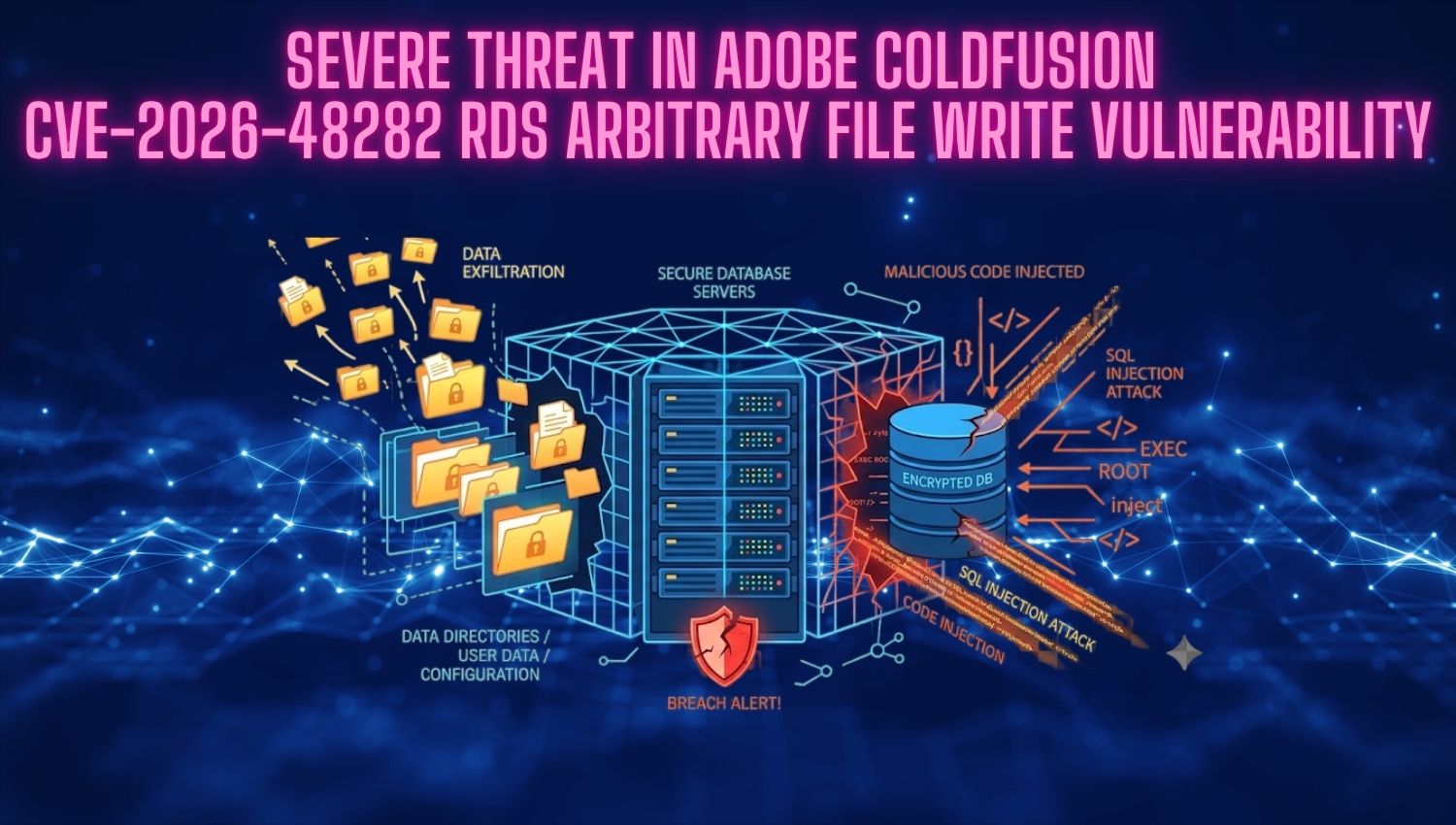
When it comes to enterprise web applications and dynamic content management, Adobe ColdFusion stands out as one of the most widely adopted platforms. However, it has recently become the focus of intense cybersecurity scrutiny due to a maximum-severity flaw. Tracked as CVE-2026-48282, this vulnerability leverages a logical oversight within the platform’s remote development services, granting attackers a direct path to full system compromise. Because ColdFusion heavily underpins critical internal portals and corporate infrastructure, the surface area for potential devastation is immense. Sophisticated threat actors are actively leveraging this flaw to bypass traditional perimeter defenses entirely. Added to the Cybersecurity and Infrastructure Security Agency (CISA) Known Exploited Vulnerabilities (KEV) catalog, this vulnerability demands immediate attention, rapid patch deployment, and thorough remediation from system administrators and security operations teams globally to prevent imminent data breaches.
Learning Objectives
By completing this article, you will be able to:
- Understand the core architecture of CVE-2026-48282 and why it is classified with the maximum critical severity score (CVSS 10.0).
- Comprehend the functional mechanics of the Remote Development Services (RDS) component and the logical flaws leading to exploitation.
- Identify the specific versions of Adobe ColdFusion affected by this vulnerability.
- Implement best practice patching and hardening strategies to insulate your corporate environments against this threat vector.
What is Adobe ColdFusion – RDS Arbitrary File Write CVE-2026-48282
CVE-2026-48282 is an unauthenticated, maximum-severity (CVSS 3.1 score: 10.0) path traversal and unrestricted arbitrary file write vulnerability embedded deeply within the core architecture of Adobe ColdFusion. This flaw represents a severe risk to enterprise infrastructure because it completely bypasses the security perimeter, allowing remote, unauthorized entities to manipulate the server’s local storage without needing any prior system access or valid credentials. Due to its ease of exploitation and devastating impact, global security agencies have flagged it as a primary target for active corporate exploitation. The flaw directly targets the platform’s integrated Remote Development Services (RDS) component, a subsystem designed to facilitate remote file management, database querying, and Remote Procedure Calls (RPC) for developers working via external IDEs. In many production deployments, this capability is mistakenly left exposed to untrusted public traffic or operates under default configurations with weak or absent authentication protocols. When unauthenticated external actors are allowed to freely interact with this service, the boundary between the public internet and the internal file system completely dissolves.
By manipulating the inputs processed by this exposed component, an attacker can force the underlying web server to create, overwrite, or append malicious data anywhere on the local drive. Because the ColdFusion application engine natively executes with elevated system privileges, the injected files can instantly subvert normal application logic. This mechanism effectively transforms a standard file-handling oversight into a catastrophic remote code execution gateway, rendering the host completely vulnerable to persistent control by malicious actors.
- Zero Authentication Required: Attackers do not need valid administrative or developer credentials to interact with the vulnerable RDS endpoint and trigger the exploit.
- Elevated Privileges Inherited: The vulnerability executes actions using the native permissions of the ColdFusion service account, which often runs as a high-privilege user like
NT AUTHORITY\SYSTEMorroot. - Path Traversal Mechanism: Kötü niyetli aktörler can break out of authorized development directories by embedding specialized traversal sequences (like
../) into the request parameters. - Direct Route to Web Shells: The ultimate real-world impact is the unauthorized placement of
.cfmor.jspfiles directly into public web roots, enabling permanent backdoors and full host takeover.
            [Attacker]
               │
               │  1. Unauthenticated HTTP POST with "../" sequence
               ▼
            [ /CFIDE/main/ide.cfm?ACTION=FILEIO ]
               │
               │  2. Blindly accepts path without checking boundaries
               ▼
            [ ColdFusion Core Process (High Privileges) ]
               │
               │  3. Escapes intended directory structure via Path Traversal
               ▼
            [ C:\ColdFusion2025\cfusion\wwwroot\webshell.cfm ]
               │
               │  4. Attacker visits URL ──> Triggers Remote Code Execution (RCE)
               ▼
            [ Full Server Compromise ]
Technical Detail: How the Vulnerability Works
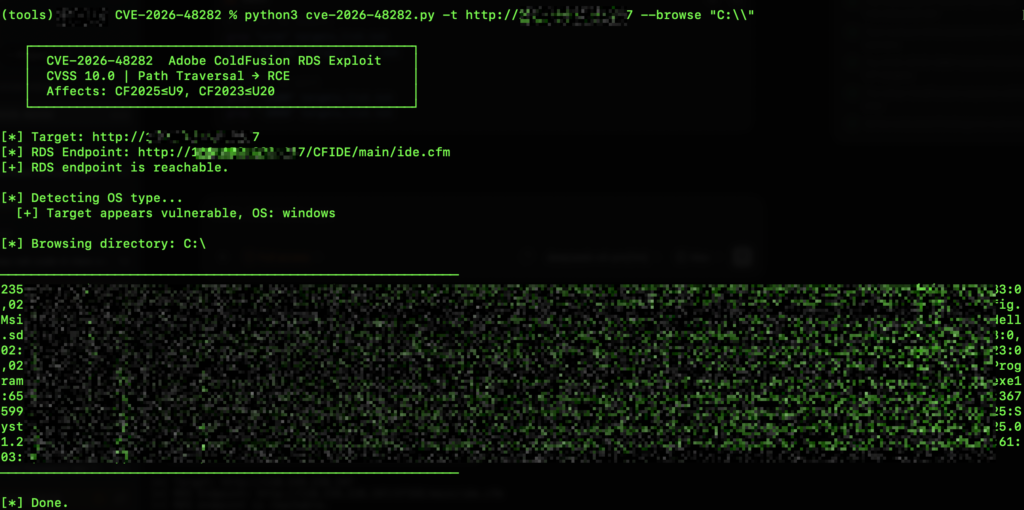
The underlying structural flaw behind CVE-2026-48282 centers on a severe breakdown in input validation and path canonicalization within Adobe ColdFusion’s internal Remote Development Services (RDS) framework. When developers or integrated development environments (IDEs) communicate with the server, they route commands through specific, predictable web endpoints, most notably /CFIDE/main/ide.cfm. This endpoint acts as a traffic router, unpacking incoming client inputs and forwarding them directly to a powerful backend subsystem known as the FILEIO handler. Because the framework implicitly trusts these inbound requests to be well-formed and benign, it lacks the necessary defensive filters required to intercept maliciously altered parameters. The core breakdown manifests directly within this FILEIO handler, which is responsible for executing remote file creation, read, and modification commands. When an HTTP POST request is dispatched to the server, the handler extracts the target file path without verifying whether the path remains restricted to authorized development workspaces. By injecting specialized path traversal sequences, such as ../ or ..\, an external actor can force the operating system’s file resolver to iteratively step backward through the folder architecture. This allows the request to break entirely free from the intended directory boundaries, giving the attacker the ability to target any arbitrary folder on the local storage drive.
What elevates this unauthorized file-writing capability into a catastrophic security breach is the highly privileged operational environment of the ColdFusion application server itself. To support extensive enterprise capabilities, the underlying application service typically runs under elevated system accounts, such as NT AUTHORITY\SYSTEM on Windows platforms or root equivalents on Linux environments. Consequently, when the manipulated path escapes the application sandbox, the operating system’s native file system enforces no access controls against the write operation. By deliberately targeting a publicly accessible web root directory, the attacker can drop a malicious web shell script, which the server will gladly parse and execute upon a simple browser request, culminating in an absolute host takeover.
- Inadequate Parameter Sanitization: The backend
FILEIOsubsystem processes raw, user-supplied file path strings directly without scrubbing harmful special characters or validating input boundaries. - Sanitization Bypass via Traversal: Attackers utilize classic directory traversal strings to escape the restrictive RDS workspace, tricking the server into resolving paths outside the application’s intended scope.
- Inherited System Privileges: The backend file-writing operations execute with the extensive administrative rights of the primary ColdFusion service account, completely bypassing normal operating system file protections.
- Execution via Web Root Placement: Dropping a
.cfmor.jsppayload into a web-accessible directory allows attackers to browse directly to the file, forcing the server to compile and run the malicious code.
HTTP Request (Exploit Request)
In this request, the attacker calls the FILEIO function of the RDS component. Using directory traversal characters (../../) within the yk_path parameter, they exit the application and write a malicious file named bka_shell.cfm to the root directory (wwwroot) accessible via the web.

Server Response (Vulnerable Response)
If the server is not updated and the RDS service is exposed to the outside without protection, it will successfully process the request because there is no input validation filter. The file is written to the system and the server returns a 200 OK response

Affected Software & Plugins
This critical vulnerability directly targets the core web infrastructure of enterprise environments running legacy or unpatched iterations of Adobe ColdFusion’s Remote Development Services. Because the flaw is embedded natively within the software’s internal file-handling architecture rather than a third-party extension or external add-on, any deployment that leaves the RDS subsystem exposed to untrusted networks without the necessary security updates is inherently vulnerable to full system takeover.
- Adobe ColdFusion 2025: Deployments operating on Update 9 or any earlier minor version.
- Adobe ColdFusion 2023: Deployments operating on Update 20 or any earlier minor version.
Conclusion
CVE-2026-48282 serves as a textbook reminder of how a single input validation omission can escalate into a full-scale, unauthenticated Remote Code Execution chain. When core developer tools like the Remote Development Services subsystem are left exposed with excessive operating system privileges, the boundary between an external visitor and an administrative controller entirely dissolves. Given its status as an actively exploited flaw in the wild, reactive log monitoring alone is entirely insufficient; security operations teams must shift toward an immediate, proactive posture to eliminate the threat surface before attackers scan and pinpoint vulnerable endpoints. To effectively insulate your corporate architecture against this threat, organizations must immediately prioritize the deployment of official remediation updates detailed in Adobe Security Bulletin APSB26-68. Applying these binary updates introduces the necessary input validation checks and strict path canonicalization required to stop directory traversal attacks directly at the application boundary. For systems where a maintenance window cannot be scheduled immediately, web server access control rules should be temporarily instituted to intercept and drop any external inbound traffic routing toward the raw interface endpoints.
Beyond immediate hotfixing, long-term resilience requires enforcing strict defense-in-depth architectural measures across all corporate network boundaries. Remote Development Services functionality should be completely disabled across all public-facing and production environments, as these features are natively intended purely for isolated, local development sandboxes. If business requirements dictate that administrative zones like /CFIDE/ must remain accessible remotely, they must be completely shielded behind a dedicated corporate VPN, an identity-aware proxy, or strict IP allowlisting to ensure that unauthorized external actors can never interact with the system backend.