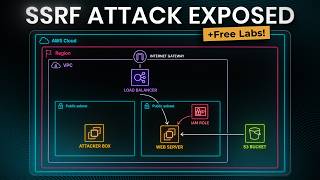
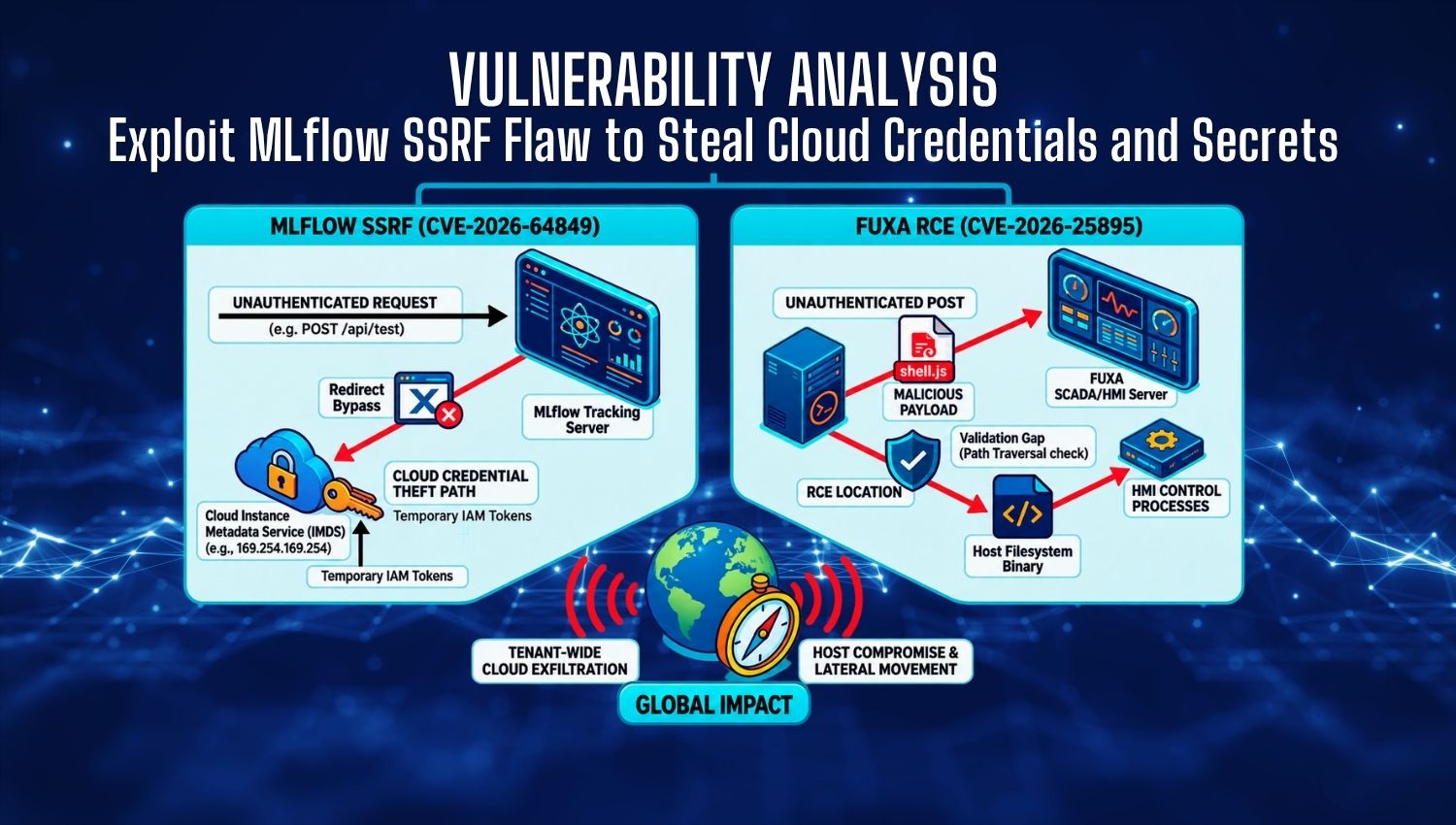
Introduction
Recent security intelligence highlights a wave of sophisticated attacks targeting exposed enterprise infrastructure across modern cloud environments and industrial networks. Threat actors are actively hunting for internet-facing assets to establish initial footholds, systematically weaponizing unauthenticated vulnerabilities in popular AI lifecycle platforms and critical industrial automation systems. By abusing missing access controls and flawed input validation mechanisms, remote attackers can seamlessly bypass traditional perimeter defenses. These initial compromises often serve as a launchpad for catastrophic downstream activities, enabling adversaries to hijack cloud infrastructure, extract sensitive operational secrets, execute arbitrary code on target hosts, and move laterally across critical internal networks without raising immediate alarms.
Learning Objectives
- Understand how unauthenticated endpoints in popular open-source software lead to severe operational risks.
- Analyze the technical mechanics behind Server-Side Request Forgery (SSRF) and Arbitrary File Write/Path Traversal vulnerabilities.
- Identify impacted components and apply immediate remediation strategies to protect cloud and industrial infrastructure.
What is Modern Unauthenticated Infrastructure Exploitation?
Modern unauthenticated infrastructure exploitation describes a class of cyberattacks where threat actors systematically target exposed internal services, APIs, and administrative portals that lack strict identity verification. As enterprise software stacks grow more complex, organizations frequently deploy specialized tools—such as machine learning tracking frameworks or industrial SCADA control panels—assuming they will operate within trusted network zones. When these systems are inadvertently exposed to the public internet, adversaries leverage missing access controls to interact with sensitive core components without submitting valid login credentials or session tokens. Unlike traditional web application attacks that aim to compromise isolated user accounts, infrastructure exploitation focuses on weaponizing the server’s own underlying trust boundaries. Threat actors abuse flawed input sanitization routines and unauthenticated endpoints to trick the application into making unauthorized network connections, reading restricted local files, or executing system-level routines. Because these operations are processed under the context of the running application service, security controls like web application firewalls (WAFs) often fail to distinguish malicious API calls from legitimate operational traffic.
Once established, these footholds transform middle-tier servers into unwitting proxies for deeper system penetration. Attackers exploit these flaws to bridge the gap between public networks and isolated private environments, accessing non-routable internal services, querying cloud instance metadata endpoints, or placing malicious code directly onto the host filesystem. This operational strategy enables malicious actors to achieve rapid credential theft, establish persistent remote control, and move laterally across critical enterprise infrastructure without triggering initial security alerts.
- Zero-Authentication Access: Exploitation relies on public endpoints, webhook test triggers, or unauthenticated REST APIs, allowing any remote user to initiate requests without credentials.
- Trust Boundary Abuse: Attackers leverage the victim server’s internal permissions to proxy traffic into isolated network zones or internal IP addresses (such as
169.254.169.254). - Arbitrary File Operations: Flawed file-handling mechanisms enable attackers to traverse directory boundaries and write executable payloads, leading directly to Remote Code Execution (RCE).
- Cloud Credential Exfiltration: By interacting with local cloud metadata services, threat actors dump temporary IAM tokens, storage access keys, and sensitive environment variables to compromise entire cloud tenants.
Technical Detail: How the Vulnerability Chain Works
Step 1: MLflow Webhook Redirect Bypass (CVE-2026-64849)
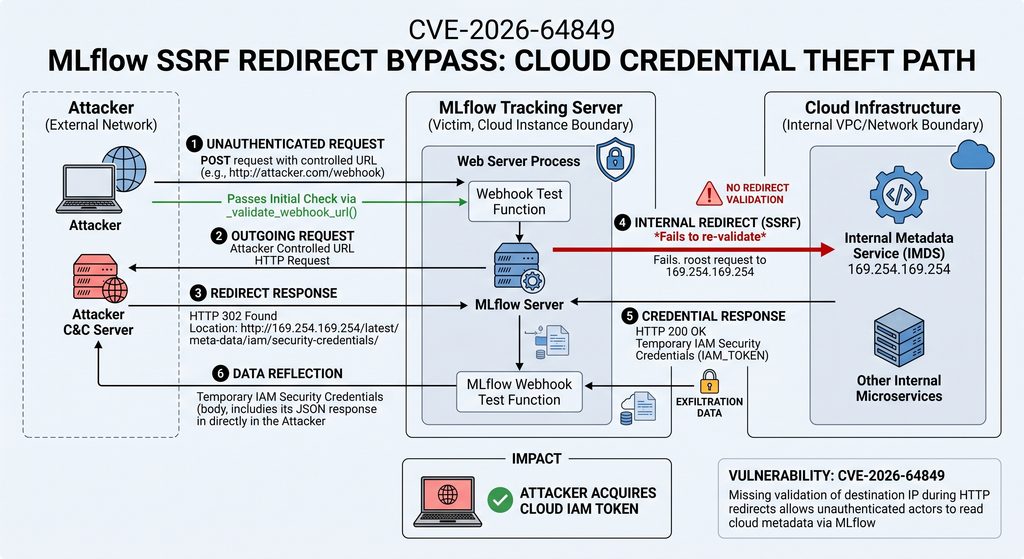
The root cause of CVE-2026-64849 lies in how MLflow handles outgoing HTTP requests triggered by the model registry webhook testing mechanism. When a user configures a webhook notification, MLflow allows them to test the connection to verify endpoint availability. However, because this feature lacks proper authorization checks and fails to re-validate destination addresses across HTTP redirection hops, an attacker can trick the server into issuing privileged requests on their behalf. The server acts as an open proxy, seamlessly bridging the gap between public internet traffic and isolated internal cloud infrastructure.
- Mechanism: The default MLflow Tracking Server exposes the
POST /api/2.0/mlflow/webhooks/{id}/testendpoint publicly without requiring authentication or session tokens. - Validation Gap: While MLflow executes an initial URL sanitization check via
_validate_webhook_url(), the underlying HTTP client library automatically follows301/302 Redirectresponses without re-running security validation against the secondary target IP. - Exploitation: An attacker submits a public domain under their control (e.g.,
[http://attacker.com/webhook](http://attacker.com/webhook)). When MLflow initiates the test request, the attacker’s server responds with an HTTP302 Foundheader redirecting MLflow directly to restricted internal addresses, such as the cloud Instance Metadata Service ([http://169.254.169.254/latest/meta-data/iam/security-credentials/](http://169.254.169.254/latest/meta-data/iam/security-credentials/)). - Impact: The webhook testing logic processes the internal metadata endpoint, capturing the HTTP response status and body, and sends it directly back to the unauthenticated attacker. This allows full remote read access to temporary cloud IAM tokens, storage access keys, and sensitive environment secrets.
Step 2: FUXA Unauthenticated Path Traversal & RCE (CVE-2026-25895)
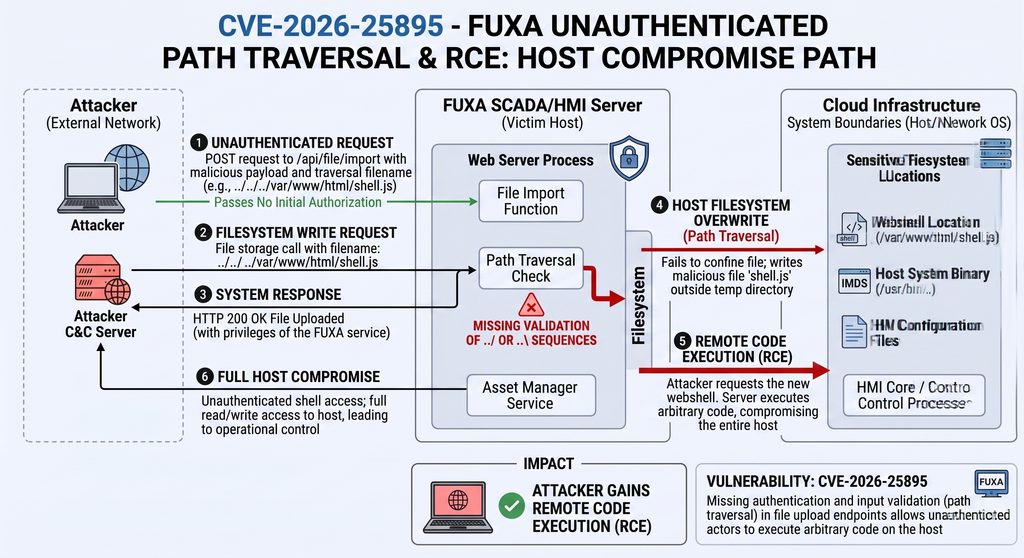
The severity of CVE-2026-25895 stems from a critical oversight in how FUXA, a web-based SCADA and HMI platform, handles incoming file uploads and API request authorization. Because the web server exposes sensitive management interfaces to the network without enforcing user login checks, any remote entity can trigger administrative routines. Furthermore, the file-processing backend blindly accepts user-defined filenames and destination paths, allowing malicious input to break free from restricted directory boundaries and overwrite arbitrary system files.
- Mechanism: FUXA’s web-based SCADA/HMI server exposes file import and asset management API endpoints publicly, failing to check for active user sessions or authentication tokens.
- Validation Gap: File upload routines lack proper input sanitization and fail to filter directory traversal sequences (such as
../or..\), allowing supplied filenames to escape the designated temporary upload folder. - Exploitation: An unauthenticated remote attacker sends an HTTP
POSTrequest containing a malicious payload (e.g., a webshell or executable script) paired with a path-traversal filename targeting sensitive system locations (e.g.,../../../../var/www/html/shell.js). - Impact: The application writes the attacker’s arbitrary file directly to the host filesystem with the privileges of the running FUXA service. Executing or requesting this newly created file gives the attacker full Remote Code Execution (RCE), leading to total host compromise and potential control over underlying industrial processes.
Affected Software & Plugins
The exploitation vectors detailed above highlight a growing threat to modern infrastructure stacks: unauthenticated entry points in both enterprise AI management systems and operational technology (OT) control interfaces. Organizations deploying these platforms must audit their environments to verify whether exposed endpoints fall within affected release ranges. Because both vulnerabilities carry CVSS scores above 9.0, automated scanning tools and threat actors actively target these specific version fingerprints across public-facing IP spaces. To mitigate immediate exploitation risks, security teams should prioritize inventorying all instances of MLflow and FUXA, restricting network visibility via firewalls or VPNs, and enforcing mandatory authentication layers. The detailed breakout below outlines the affected software components, identified CVE identifiers, vulnerability types, severity ratings, and targeted patch releases required to secure deployment environments.
| Component / Software | CVE Identifier | Vulnerability Type | Vulnerable Versions | Severity (CVSS v3.1) | Primary Exploitation Impact | Fixed Version | Recommended Action |
|---|---|---|---|---|---|---|---|
| MLflow Tracking Server | CVE-2026-64849 | Server-Side Request Forgery (SSRF) / Auth Bypass | Versions < 3.15.0 | CVSS 9.3 (Critical) | Unauthorized reading of cloud metadata (169.254.169.254) and IAM credential theft | 3.15.0 | Upgrade to 3.15.0+, enforce IMDSv2, and restrict web accessibility |
| FUXA SCADA/HMI Platform | CVE-2026-25895 | Missing Authentication & Path Traversal | Versions <= 1.2.9 | CVSS 9.5 (Critical) | Arbitrary file write to system directories leading to Remote Code Execution (RCE) | 1.3.0 | Upgrade to 1.3.0+, apply reverse proxy authentication, and restrict system file permissions |
Conclusion
Unauthenticated flaws in critical management software represent one of the most immediate and devastating threats facing modern enterprise environments. Whether deployed to track machine learning experiments or to supervise industrial SCADA operations, applications exposed to public networks without robust identity controls act as wide-open gateways for remote adversaries. As demonstrated by recent exploits targeting MLflow and FUXA, threat actors actively hunt for these low-friction entry points to bypass perimeter defenses and compromise core business operations without needing valid credentials. The cascading impact of these vulnerabilities underscores a fundamental breakdown in traditional trust boundaries. When an application server can be manipulated into issuing unauthorized requests to internal infrastructure or writing executable payloads into restricted system paths, the security of the entire underlying network is jeopardized. An isolated application vulnerability quickly escalates into tenant-wide cloud credential exfiltration or persistent, full-system remote access, putting sensitive data, intellectual property, and physical operational systems at risk. Remediating these risks requires an immediate shift toward strict network hygiene and rapid patch management protocols. Organizations must prioritize identifying internet-facing assets, applying vendor security updates promptly, and placing unauthenticated management interfaces behind secure access barriers such as VPNs or authenticating reverse proxies. Furthermore, security teams should assume breach conditions for exposed systems by thoroughly auditing cloud access logs, rotating potentially compromised credentials, and enforcing strict local privilege controls on application processes.
Ultimately, defending modern infrastructure demands defense-in-depth mechanisms that limit the impact of inevitable application flaws. Implementing architectural safeguards—such as forcing IMDSv2 with strict hop limits on cloud workloads, isolating industrial management software within segmented VLANs, and applying zero-trust network access policies—ensures that even if an application endpoint is compromised, attackers cannot leverage it to pivot laterally or exfiltrate sensitive cloud assets.