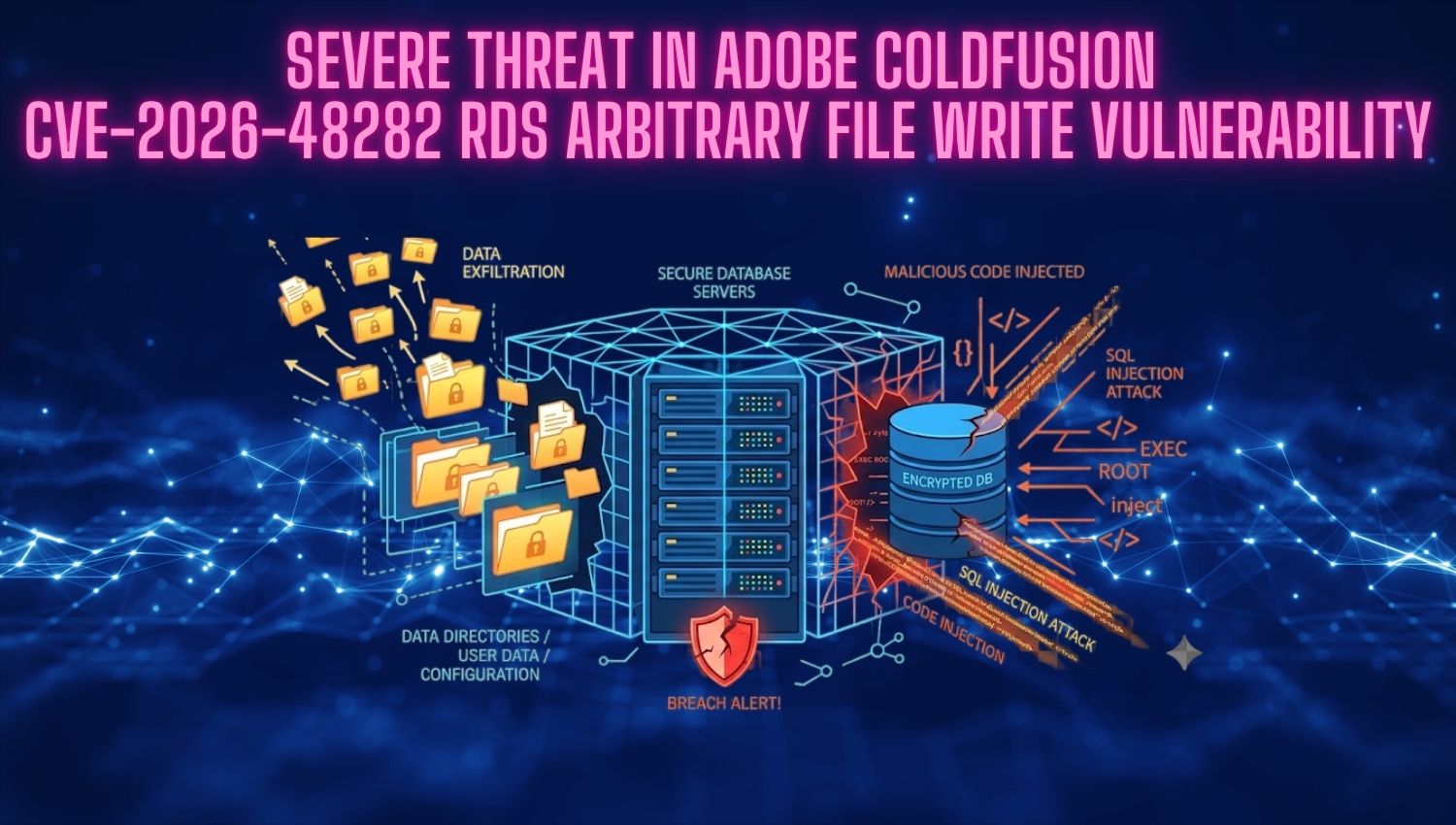
Severe Threat in Adobe ColdFusion: CVE-2026-48282 RDS Arbitrary File Write Vulnerability

Severe Threat in Adobe ColdFusion CVE-2026-48282 RDS Arbitrary File Write Vulnerability

Introduction When it comes to enterprise web applications and dynamic content management, Adobe ColdFusion stands out as one of the most widely adopted platforms. However, it has recently become the focus of intense cybersecurity scrutiny due to a maximum-severity flaw. Tracked as CVE-2026-48282, this vulnerability leverages a logical oversight within the platform’s remote development services, granting attackers a direct path to full

Critical Threats in Critical Infrastructures: June 2026 Cybersecurity Analysis

Critical Threats in Critical Infrastructures June 2026 Cybersecurity Analysis

Introduction Modern computing ecosystems are becoming increasingly complex due to the convergence of cloud-based architectures, intricate network protocols, and widespread web integrations. While this complexity yields an expansive attack surface for threat actors, it mandates proactive patch management for defensive teams. This rapid digital transformation has outpaced traditional perimeter security, leaving legacy frameworks highly susceptible to sophisticated, automated multi-stage attacks. June 2026 marked

Exploiting Cisco Catalyst SD-WAN Manager: Deep Dive into Unrestricted File Upload (CVE-2026-20262)

ExploItIng CIsco Catalyst SD-WAN Manager UnrestrIcted File Upload (CVE-2026-20262)

Introduction Modern enterprise network architectures heavily rely on Software-Defined Wide Area Networks (SD-WAN) to ensure operational flexibility, automated routing, and centralized management across global infrastructures. At the heart of these complex ecosystems lie the orchestration and management planes, which dictate the entire network topology, enforce unified security policies, and maintain edge node configurations. Because they hold such high administrative privileges over the network fabric, these

Exploitation of DbGate Remote Code Execution via Dynamic Import Bypass (CVE-2026-47670)

ExploItatIon of DbGate Remote Code ExecutIon vIa DynamIc Import Bypass (CVE-2026-47670)

Introduction In modern web architectures, open-source cross-platform database administration tools like DbGate are widely adopted by DevOps teams and database administrators to streamline data visualization, schema editing, and multi-database query management. However, when these powerful administrative tools implement dynamic server-side script execution mechanisms without enforcing rigorous input sanitization, strict type validation, and robust context isolation, severe security vulnerabilities can easily emerge. This article explores CVE-2026-47670, a critical authenticated

CVE-2026-20253 – Splunk Enterprise Unauthenticated Arbitrary File Vulnerability

Introduction In modern enterprise environments, Splunk sits at the heart of cyber defense architectures, serving as a central hub for log management, SIEM, and data analytics. However, the very platforms deployed to monitor and protect infrastructures can sometimes introduce severe security risks, effectively turning a defensive tool into a primary attack vector. A security advisory released by Splunk in June 2026 exposed a

Oracle PeopleSoft Zero-Day Vulnerability Exploitation (CVE-2026-35273)

Oracle PeopleSoft Zero-Day Vulnerability Exploitation (CVE-2026-35273)

Introduction Enterprise Resource Planning (ERP) systems store an organization’s most sensitive financial, operational, and personal data, making them prime targets for sophisticated cyber threat actors looking to maximize their leverage. On June 10, 2026, Oracle released an urgent, out-of-band security alert addressing CVE-2026-35273—a critical remote code execution (RCE) vulnerability actively exploited as a zero-day within the Oracle PeopleSoft PeopleTools component. Attributed to the advanced persistent threat group UNC6240 (which has

Exploitation of Ivanti Sentry – OS Command Injection CVE-2026-10520

ExploItatIon of IvantI Sentry - OS Command InjectIon CVE-2026-10520

Introduction Edge gateways that secure and route mobile traffic to back-end corporate networks are primary targets for threat actors due to their perimeter placement. In June 2026, Ivanti released a critical security advisory addressing a pre-authentication OS Command Injection vulnerability in Ivanti Sentry (formerly MobileIron Sentry), tracked as CVE-2026-10520 with a maximum CVSS score of 10.0. This vulnerability allows remote, unauthenticated