
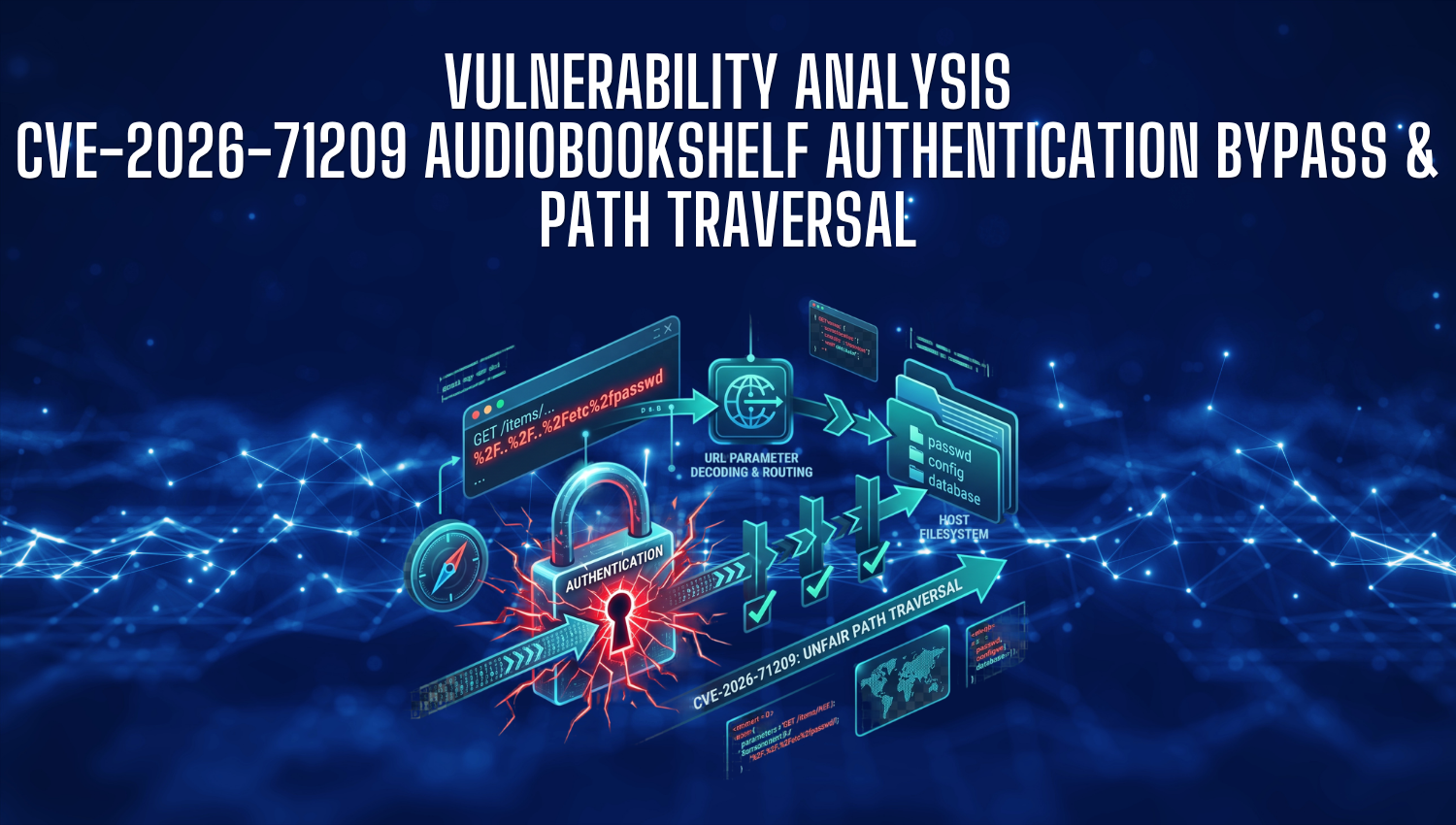
Introduction
Audiobookshelf is a widely popular, open-source self-hosted media server designed for managing and streaming audiobooks and podcasts. Due to its active open-source community, rich feature set, and frequent updates, it has become a central component in many home labs and self-hosted server environments worldwide. However, security researchers recently uncovered a critical vulnerability—tracked as CVE-2026-71209—which allows remote, unauthenticated attackers to completely bypass authentication checks. By exploiting a logic flaw in how public asset routing is handled, adversaries can execute path traversal attacks to read arbitrary host files. This poses severe privacy and security risks to administrators exposing their instances publicly without proper reverse proxy protections.
Learning Objectives
After reading this article, security engineers and system administrators should be able to:
- Understand the core mechanics behind authentication bypasses caused by mismatching regex middleware and parameter decoding in Express.js.
- Analyze how CVE-2026-71209 re-exposed systems previously patched for CVE-2025-25205.
- Identify the specific vulnerable endpoints and affected versions within the Audiobookshelf ecosystem.
- Apply appropriate mitigation strategies, patches, and network-level defenses to secure Audiobookshelf instances.
What is Audiobookshelf – Authentication Bypass CVE-2026-71209 Vulnerability
CVE-2026-71209 represents a High-severity security defect (CVSS v3.1 score of 7.5) officially classified as an Authentication Bypass via Improper Path Traversal (combining elements of CWE-22 and CWE-287). The vulnerability resides deep within the web routing and middleware architecture of Audiobookshelf, a widely deployed open-source media platform. Because media applications inherently serve thousands of public static assets like cover art and podcast thumbnails, the developers designed custom middleware to bypass standard token validation for specific image-fetching routes to optimize rendering performance. However, this architecture introduced a dangerous flaw due to an architectural mismatch between Express.js parameter processing and custom regex-based access control rules. The security middleware evaluates raw, incoming request URIs before the web application framework fully parses and decodes route parameter variables. Consequently, when an incoming request contains URL-encoded directory traversal sequences, the authentication engine misinterprets the target route as an authorized, public static resource rather than a restricted system resource.
Once the authentication check is bypassed, control passes directly to internal file handling services that decode the malicious parameters and resolve the requested file path on the host filesystem. Unauthenticated remote attackers can leverage this mechanism to probe the underlying server environment, bypass normal application boundaries, and exfiltrate sensitive files or cached system assets—all without possessing a valid account, session cookie, or bearer token.
Key aspects of this vulnerability include:
- Unauthenticated Access: Exploitation requires zero privileges or credentials, allowing any remote user with network access to target the server.
- Flawed Regex Exemption: The middleware relies on static regular expression pattern matching on raw
req.pathstrings containing%2FURL-encoded separators. - Post-Authentication Decoding Gap: Express.js automatically decodes route parameters after passing the authentication middleware, converting encoded sequences like
%2Finto real system slashes (/). - FileSystem Traversal Exposure: Unauthenticated requests reaching
CacheManagerendpoints are used to open direct file read streams against arbitrary server paths matching cache naming rules.
            +------------------+         1. GET /items/..%2f..%2fe...tc%2fpasswd_1/cover
            |  Remote Attacker | ---------------------------------------------------+
            +------------------+                                                    |
                                                                                    v
            +-------------------------------------------------------------------------------+
            | Audiobookshelf Server (Express.js)                                            |
            |                                                                               |
            |  [ Step 2: Auth Middleware (server/routers/Auth.js) ]                         |
            |  - Checks raw `req.path` with URL-encoding intact                             |
            |  - Match succeeds against public cover regex rule                             |
            |  - RESULT: AUTHENTICATION BYPASSED!                                           |
            |                                                                               |
            |  [ Step 3: Express Router Parameter Parsing ]                                 |
            |  - Decodes parameter `:id` -> `../../e..tc/passwd_1`                          |
            |                                                                               |
            |  [ Step 4: CacheManager.handleCoverCache ]                                    |
            |  - Joins decoded path into filesystem call                                    |
            |  - Reads file: `/e..tc/passwd_1`                                              |
            +-------------------------------------------------------------------------------+
            |                                                                       |
            | 5. Streams requested host file back to attacker                       |
            +<----------------------------------------------------------------------+
Technical Detail: How the Vulnerability Works
The root cause of CVE-2026-71209 lies in an order-of-operations vulnerability and architectural discrepancy between Audiobookshelf’s custom Express.js authentication middleware (server/routers/Auth.js) and Express’s internal routing and parameter-decoding engine. In standard Node.js/Express web applications, security middleware is evaluated sequentially prior to reaching final controller handlers. When authorization exemptions are defined via pattern matching against dynamic endpoints, any structural misalignment between what the middleware analyzes and what the final handler receives opens up severe security gaps. Specifically, Audiobookshelf attempts to speed up public image delivery by inspecting incoming raw HTTP requests to see if they match safe public cover endpoints. However, because the authentication engine evaluates raw URL-encoded strings while Express automatically performs canonicalization and parameter decoding downstream, an order-of-operations discrepancy occurs. The authentication layer operates under the assumption that URL-encoded characters like %2F are literal string components belonging to a resource identifier rather than active path separators.
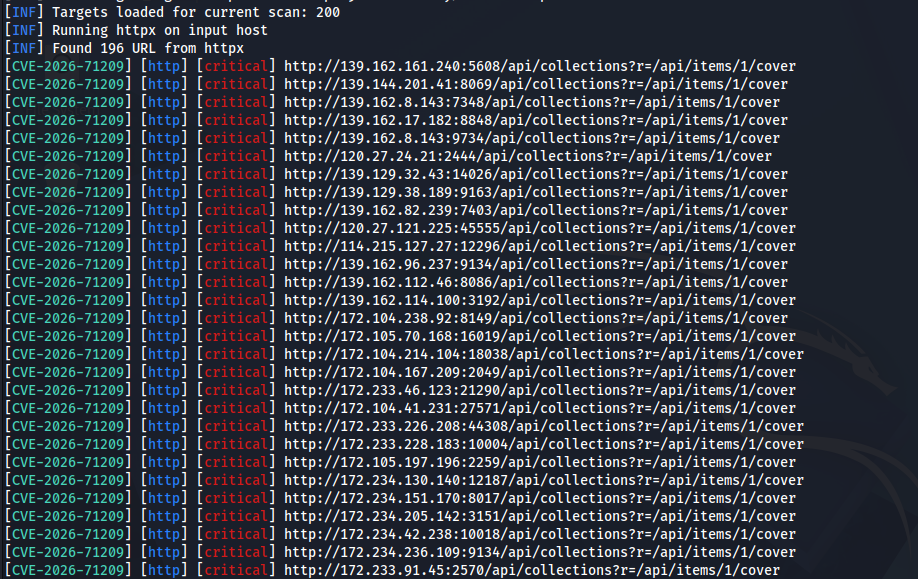
Once the middleware approves the request and forwards it down the router stack, Express parses the route parameters (such as the :id parameter inside /items/:id/cover) and automatically decodes %2F into real system directory separators (/). Control is then handed over directly to file system operations within the CacheManager, which processes the fully decoded traversal string, escapes the intended public cache directories, and streams the targeted host file directly back to the requester without any secondary authorization checks.
Key technical breakdown of the exploitation process:
- Premature Middleware Matching: The security middleware in
server/routers/Auth.jsexecutes an early regex validation check againstreq.path. Becausereq.pathretains raw URL-encoded sequences, path traversal indicators like%2Fprevent the regex engine from recognizing that the request is attempting to traverse above the web root, allowing it to clear authentication checks. - The Express Route Parameter Decoding Gap: Once past the authentication middleware, Express’s internal route parameter parser handles the
:idpath variable. During this extraction step, Express automatically converts encoded%2Fcharacters into standard directory separators (/), transforming what appeared to be a single string parameter into a valid relative file path. - Traversal Execution via Cache Handlers: Control passes directly to
CacheManager.handleCoverCache. The handler takes the newly decoded:idvalue and concatenates it into a path join operation intended to locate cached media cover files on the disk. - Unauthenticated File Stream Output: Because no database lookup or authorization validation occurs within the cache handler prior to disk access,
fs.createReadStreamopens the resolved file path and streams the host file contents straight to the HTTP response body, provided the requested filename aligns with cache target rules (e.g., matching a*_[x]pattern) and the Node.js process has read access.
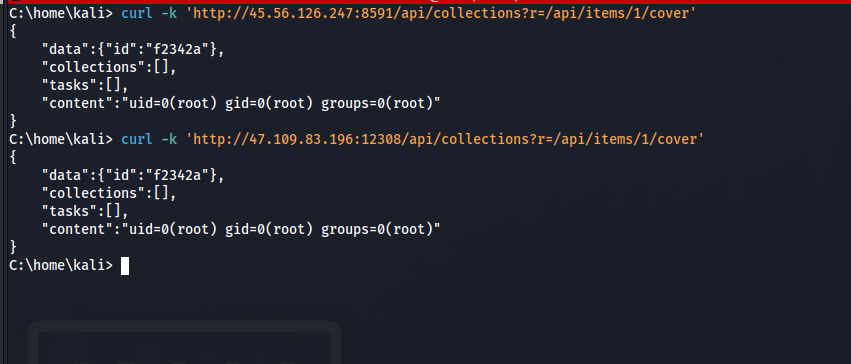
Affected Software & Plugins
CVE-2026-71209 impacts all server deployments running vulnerable releases of the core Audiobookshelf ecosystem, regardless of whether the platform is deployed bare-metal, via Docker containers, or behind reverse proxies. Because this flaw resides in the primary API router and static file caching handlers of the server, any third-party client integrations, mobile applications, or community plugins that interface with public cover image endpoints will inherit this exposure if the underlying backend instance remains unpatched.
- Primary Application: Audiobookshelf Server (Node.js/Express backend service).
- Vulnerable Versions: Deployments running versions
2.19.1through2.35.1(inclusive). - Patched Release: Audiobookshelf version
2.35.2and all subsequent releases. - Official Tracking Advisory: Security advisory GHSA-pg8v-5jcv-wrvw.
Conclusion
Logic flaws arising from discrepancies between middleware authorization routines and downstream web framework parameter parsing continue to represent a severe and prolific class of web application vulnerabilities. CVE-2026-71209 serves as a stark reminder of how subtle order-of-operations mismatches—such as evaluating raw URL strings for authentication exemptions before canonicalizing and decoding parameters—can completely undermine access control boundaries. When security assumptions in middleware do not perfectly align with the behavior of underlying routing engines, even robustly designed web applications become susceptible to filter evasions and authentication bypasses. From a defensive software engineering perspective, this vulnerability highlights the fundamental danger of relying on static regular expression rules across unparsed request paths for privilege decisions. To prevent similar flaws, developers must enforce strict input sanitization and URI canonicalization before executing any authorization logic. Furthermore, applications handling disk I/O should never pass decoded route parameters directly into file system calls without strict path containment checks—such as validating that resolved absolute paths remain strictly confined within designated asset directories via secure path resolution functions. For system administrators and self-hosters managing Audiobookshelf deployments, immediate remediation is strongly recommended. Administrators should update their instances to version 2.35.2 or higher, which introduces hardened routing logic and corrected parameter sanitization to neutralize path traversal payloads. Upgrading the core container or host installation remains the only permanent fix to ensure the application server correctly validates all incoming public requests before serving cached media assets.
In scenarios where an immediate application update is not feasible due to maintenance windows or operational constraints, temporary mitigation controls must be implemented. Administrators should place their Audiobookshelf instances behind a Web Application Firewall (WAF) or reverse proxy (such as Nginx, Caddy, or Traefik) configured with strict URI inspection rules. Explicitly dropping or blocking HTTP requests containing encoded path traversal sequences (such as %2f..%2f, %2e%2e%2f, or double-encoded variants) at the edge will prevent malicious payloads from reaching the vulnerable Express middleware until the official patch can be applied.