
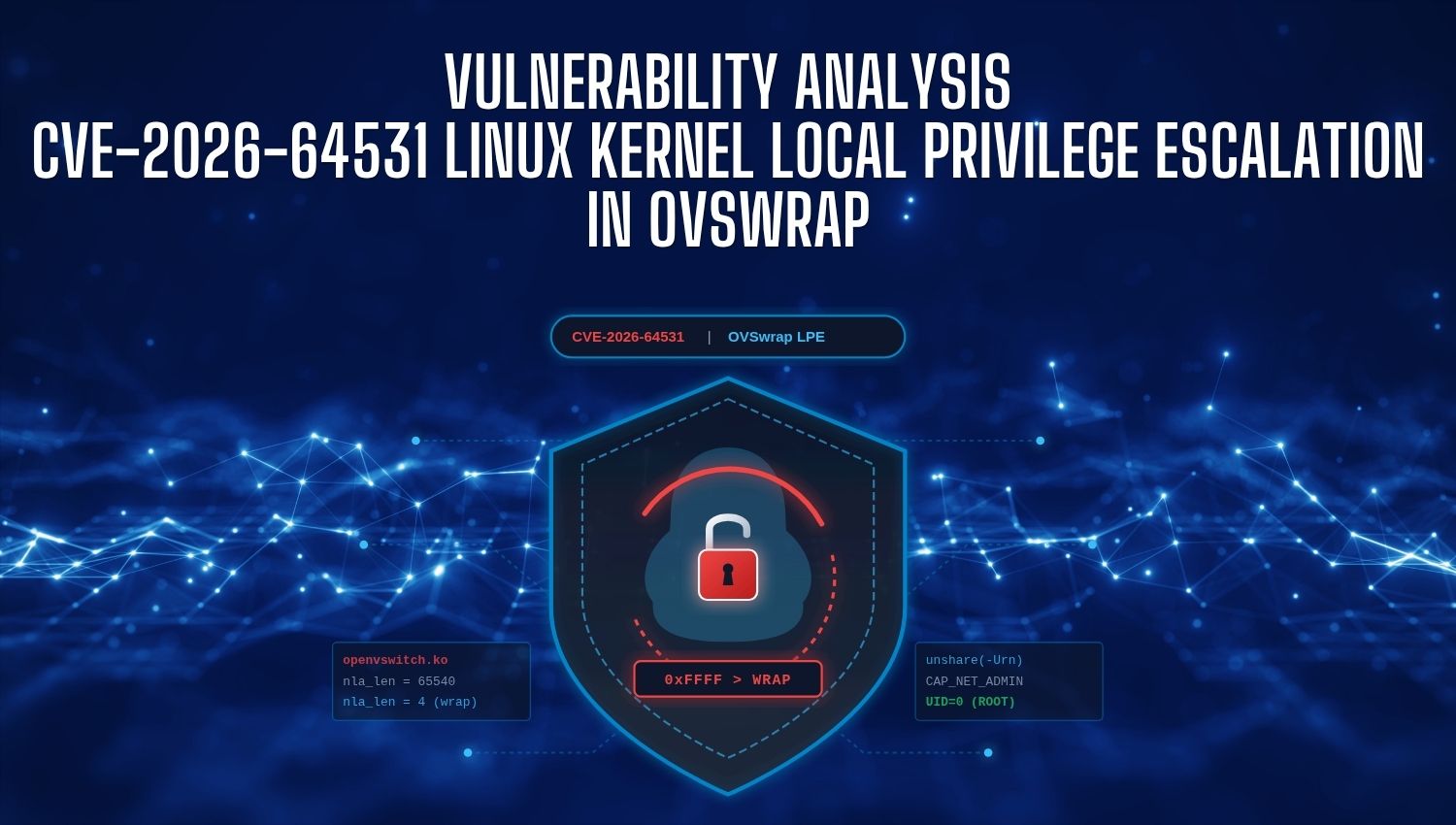
Introduction
In modern enterprise cloud environments, multi-tenant container orchestration platforms, and heavily virtualized infrastructure, security isolation relies fundamentally on rigid Linux kernel boundaries and software-defined networking components. A newly disclosed vulnerability designated as CVE-2026-64531 (dubbed OVSwrap) poses a critical threat to system integrity and data confidentiality across enterprise Linux deployments. Discovered by security researcher Asim Manizada, OVSwrap allows unprivileged local users, low-privilege service accounts, or compromised web-application processes to bypass standard security controls and seamlessly elevate their execution privileges to full root access. Because it targets fundamental kernel module parsing, even tightly sandboxed environments remain vulnerable. This comprehensive analysis breaks down the architectural mechanics of OVSwrap, evaluates its widespread impact across major server distributions, and details actionable mitigation strategies to prevent full host compromise.
Learning Objectives
- Understand the fundamental nature of CVE-2026-64531 and how it affects Linux kernel subsystems.
- Analyze the three-stage attack pipeline: Netlink integer wrapping, automatic module loading, and User Namespace abuse.
- Assess server infrastructure risk across popular enterprise distributions (RHEL, Ubuntu, Debian, AlmaLinux, Rocky Linux).
- Execute effective mitigation strategies, including module kernel updating without service disruption.
What is OVSwrap local root exploit – CVE-2026-64531
OVSwrap (CVE-2026-64531) is a critical Local Privilege Escalation (LPE) flaw that resides directly within the Linux kernel’s core openvswitch.ko module. Open vSwitch (OVS) serves as a foundational component in multi-layer virtual switching architectures powering cloud networks, software-defined networking (SDN) environments, and container platforms. Unlike traditional application-layer vulnerabilities that affect user-space daemons (such as ovs-vswitchd), CVE-2026-64531 operates deep within kernel-space memory, specifically exploiting how the kernel handles incoming Netlink flow rules and network action structures. The severity of OVSwrap stems from its exceptionally low barrier to exploitation combined with its widespread reach across modern Linux systems. An attacker does not need prior administrative access, special group memberships, active OVS bridge setups, or pre-existing network configurations on the target machine. Even if Open vSwitch has never been configured or initialized by system administrators, the vulnerability can still be triggered on-demand by low-privilege accounts due to automatic kernel module loading routines.
When successfully exploited, OVSwrap allows local attackers—including low-privileged shell accounts, compromised service daemons, or web-shell processes—to completely compromise the kernel execution boundary. This breaks host multi-tenancy, bypasses standard system security restrictions, and grants the attacker full, unrestricted root (UID 0) administrative privileges over the underlying physical or virtual host.
- Kernel-Level Vulnerability: Targets the
openvswitch.kokernel driver during Netlink attribute parsing rather than user-space software daemons. - On-Demand Auto-Loading: Leverages
request_module()routines to automatically load the vulnerable kernel driver when requested via Netlink sockets. - Namespace Boundary Bypass: Uses unprivileged user and network namespaces (
unshare -Urn) to obtain localCAP_NET_ADMINcapabilities necessary to trigger the bug. - Complete System Compromise: Results in kernel memory corruption that leads directly to arbitrary kernel code execution and complete host root elevation.
            +-----------------------------------------------------------------------+
            |                       UNPRIVILEGED ATTACKER                           |
            |  - Standard User Account / Compromised Web Shell                      |
            |  - No Root / No Special Group Privileges Required                     |
            +-----------------------------------------------------------------------+
                                               |
                                               | 1. Spawns Unshared Namespace (unshare -Urn)
                                               v
            +-----------------------------------------------------------------------+
            |                    ISOLATED USER & NET NAMESPACE                      |
            |  - Gains CAP_NET_ADMIN within isolated namespace context              |
            |  - Opens Netlink socket to query Open vSwitch family                  |
            +-----------------------------------------------------------------------+
                                               |
                                               | 2. Netlink Request triggers kernel auto-load
                                               v
            +-----------------------------------------------------------------------+
            |                        LINUX KERNEL SUBSYSTEM                         |
            |  - Executes request_module() -> Loads openvswitch.ko dynamically       |
            +-----------------------------------------------------------------------+
                                               |
                                               | 3. Sends crafted nested Netlink flow actions
                                               v
            +-----------------------------------------------------------------------+
            |                     OPENVSWITCH KERNEL MODULE                         |
            |  - 16-Bit Integer Overflow (nla_len length wrapping > 65535 bytes)    |
            |  - Attribute Parser Bounds Miscalculation -> Memory Corruption        |
            +-----------------------------------------------------------------------+
                                               |
                                               | 4. Arbitrary Code Execution in Kernel Space
                                               v
            +-----------------------------------------------------------------------+
            |                         FULL ROOT ACCESS                              |
            |  - Attacker elevates execution context to Root UID 0 on Host System   |
            +-----------------------------------------------------------------------+
Technical Detail: How the Vulnerability Works
The primary root cause of CVE-2026-64531 lies in a classic 16-bit integer overflow (length wrapping) vulnerability within the Linux kernel’s Netlink attribute parser. Open vSwitch processes complex networking rules and action sequences (such as connection tracking CT or packet cloning CLONE actions) passed from user space using standard Netlink messaging structures. In the Netlink protocol specification, individual attribute lengths are stored inside a 16-bit unsigned integer field named nla_len, which can hold a maximum value of 65,535 bytes (). When an attacker constructs deeply nested action trees whose combined length exceeds this 65,535-byte threshold, the calculated total length wraps around to a small residual value (for instance, ). Consequently, the kernel miscalculates the actual memory buffer bounds, misinterpreting raw attacker-controlled payload bytes as valid kernel-space instructions and triggering out-of-bounds memory corruption. To exploit this integer wrapping condition, an attacker must first interact with the openvswitch.ko kernel driver, even if Open vSwitch is completely disabled or unconfigured on the system. The Linux kernel features an automated module loading mechanism designed to streamline network driver availability. When an unprivileged user process opens a generic Netlink socket (NETLINK_GENERIC) and queries the registered Open vSwitch family interface, the kernel’s internal request_module() routine automatically locates and dynamically loads openvswitch.ko into kernel memory space on-demand. This behavior effectively removes any requirement for Open vSwitch to be active prior to the attack, granting any local user access to the vulnerable code paths.
Finally, the attacker bypasses standard administrative privilege checks by abusing unprivileged User Namespaces. By issuing an unshare -Urn system call, an unprivileged user creates an isolated container-like namespace environment where they are granted full local network administrative capabilities (CAP_NET_ADMIN). Although these capabilities are restricted entirely to the isolated namespace context, they satisfy all internal permission checks required by the Open vSwitch driver to accept and parse custom Netlink flow actions. Once the crafted Netlink payload is submitted through the socket, the integer overflow corrupts kernel memory structures (such as struct cred), resulting in full host-level root elevation.
- 16-Bit Integer Overflow: The
nla_lenfield wraps around when nested action structures exceed 65,535 bytes, corrupting buffer boundaries during parsing. - Dynamic Driver Loading: The kernel automatically invokes
request_module("openvswitch")upon receiving Netlink queries, exposing the vulnerable module on demand. - Unprivileged Namespace Abuse: Creating unprivileged User and Network Namespaces via
unsharegrants localCAP_NET_ADMINprivileges required to trigger the bug. - Kernel Memory Corruption: Arbitrary out-of-bounds writes overwrite kernel credential objects, elevating local process execution directly to UID 0 (root).
[+] OVSwrap Local Root Exploit (CVE-2026-64531)
[+] Target System : Linux target-node 6.6.0-generic #1 SMP x86_64
[+] Author        : Asim Manizada
====================================================================
[*] Step 1: Spawning unprivileged user and network namespaces...
    [+] Executing unshare(CLONE_NEWUSER | CLONE_NEWNET)...
    [+] Namespace created! Virtual UID: 0 (CAP_NET_ADMIN obtained in NS).

[*] Step 2: Triggering openvswitch.ko auto-loading...
    [+] Opening Netlink socket (NETLINK_GENERIC)...
    [+] Querying OVS Genl family 'openvswitch'...
    [+] Kernel invoked request_module("openvswitch") successfully!

[*] Step 3: Constructing malicious Netlink payload...
    [+] Building deeply nested CT/CLONE flow actions...
    [+] Crafting 65,540 bytes payload to trigger 16-bit integer wrapping...
    [+] Original Payload Size : 65540 bytes
    [+] Calculated nla_len    : 4 bytes (65540 % 65536 - Length Wrapped!)

[*] Step 4: Sending payload to kernel Netlink socket...
    [+] Netlink message dispatched.
    [+] Kernel attribute parser miscalculated buffer boundary.
    [+] Triggering kernel memory corruption & overwriting cred struct...

[*] Step 5: Checking execution context...
    [+] Kernel payload executed successfully!
    [+] Real UID updated: 0 (root)
    [+] Effective UID updated: 0 (root)

[+] SUCCESS: Escalated privileges to root!
# id
uid=0(root) gid=0(root) groups=0(root)
# whoami
root
Detection and Mitigation Methods
Securing enterprise environments against CVE-2026-64531 requires a proactive combination of immediate threat detection and defensive engineering. Because the OVSwrap exploit relies on on-demand kernel module loading (request_module()), system administrators must first evaluate whether the openvswitch.ko binary exists within their current kernel build tree. Systems running enterprise Linux distributions—such as RHEL, AlmaLinux, Rocky Linux, Ubuntu, or Debian—are exposed by default if the driver module resides in /lib/modules/$(uname -r)/, regardless of whether Open vSwitch services are actively configured or running. To accurately determine system exposure, administrators can execute a directory lookup command to verify the presence of the compiled driver module. If the file path returns a valid kernel object file, the underlying system remains vulnerable to unprivileged Netlink socket exploitation until temporary mitigations or permanent kernel patches are applied.
# Checking System Exposure
$ ls -l /lib/modules/$(uname -r)/kernel/net/openvswitch/openvswitch.ko* 2>/dev/null
-rw-r--r-- 1 root root 384512 Feb  2 11:20 /lib/modules/6.6.0-generic/kernel/net/openvswitch/openvswitch.ko.xz

[!] VULNERABLE: The openvswitch kernel module is present and can be auto-loaded via Netlink calls.
1. Immediate Temporary Mitigation via Module Disabling
For systems that do not actively rely on Open vSwitch software-defined networking (such as clusters using standard Linux bridges or alternative CNI plugins), blocking the kernel from loading openvswitch.ko provides immediate protection without requiring a system reboot. Standard blacklist openvswitch directives in /etc/modprobe.d/ are insufficient on their own because they only prevent automatic loading during boot-time alias resolution; they do not block internal kernel-level request_module() calls triggered directly by Netlink sockets. By overriding the module installation command with /bin/false, any attempt to load the driver—whether by root, user-space daemons, or unprivileged exploit sockets—will fail instantly.
# Applying the temporary module disable configuration
$ echo 'install openvswitch /bin/false' | sudo tee /etc/modprobe.d/ovswrap.conf
install openvswitch /bin/false

# Unloading the module if currently active in kernel memory
$ sudo modprobe -r openvswitch

# Verifying that the module cannot be loaded
$ sudo modprobe openvswitch
modprobe: ERROR: could not insert 'openvswitch': Operation not permitted

[+] SUCCESS: openvswitch module loading is completely disabled.
2. Handling Open vSwitch-Dependent Infrastructure
In environments where Open vSwitch cannot be completely disabled—such as hypervisors running OpenStack, OVN, or specialized Kubernetes CNI networking—temporary module blocking is not a viable option. In these scenarios, security teams must rely on kernel livepatching tools (such as KernelCare or vendor-provided livepatch services) or restrict unprivileged user namespace creation (sysctl user.max_user_namespaces=0). Restricting unprivileged namespaces prevents non-root accounts from executing unshare -Urn to acquire the virtual CAP_NET_ADMIN capabilities necessary to interact with the flawed Netlink code paths.
# Restricting unprivileged user namespace creation (Alternative Workaround)
$ sudo sysctl -w user.max_user_namespaces=0
user.max_user_namespaces = 0

# Making the namespace restriction persistent
$ echo 'user.max_user_namespaces = 0' | sudo tee /etc/sysctl.d/99-disable-userns.conf
user.max_user_namespaces = 0

[+] SUCCESS: Unprivileged namespace creation disabled. Attackers cannot spawn sandboxes for CAP_NET_ADMIN.
3. Permanent Patch Remediation via Kernel Updates
The ultimate resolution for CVE-2026-64531 requires updating the host kernel to an upstream version containing commit 3f1f75536668 or installing vendor-patched kernel updates provided by distribution maintainers. Mainline Linux kernel series 5.15.212, 6.1.178, 6.6.145, and 6.12.97 (or higher) contain corrected length-validation checks in the Netlink attribute parsing logic. Upgrading vendor packages via standard package managers replaces the vulnerable driver object and permanently removes the integer overflow condition.
# Updating kernel packages on Enterprise Linux (RHEL / AlmaLinux / Rocky Linux)
$ sudo dnf update -y kernel

# Updating kernel packages on Debian / Ubuntu
$ sudo apt-get update && sudo apt-get install --only-upgrade linux-image-generic -y

# Checking current kernel version after reboot
$ uname -r
6.6.145-generic

[+] REMEDIATION COMPLETE: Running kernel contains commit 3f1f75536668 patch fixes.
4. Livepatching in Zero-Downtime Production Environments
For mission-critical production clusters where host reboots incur unacceptable downtime, livepatching offers a seamless hot-patching mechanism. Enterprise livepatch services inject binary function redirects directly into running kernel memory, replacing vulnerable functions in openvswitch.ko without interrupting active virtual machine switches or container networking flows.
# Applying zero-downtime hotfix via kpatch / livepatch
$ sudo kpatch load /var/cache/kpatch/patch-CVE-2026-64531.ko
loading patch module /var/cache/kpatch/patch-CVE-2026-64531.ko...
patch module loaded successfully.

# Verifying livepatch status
$ sudo kpatch list
Loaded patch modules:
patch_CVE_2026_64531 [enabled]

[+] LIVEPATCH ACTIVE: Vulnerable Netlink parsing function successfully redirected in RAM.
Conclusion
The discovery of OVSwrap (CVE-2026-64531) highlights a critical lesson in modern Linux kernel security: small, subtle edge-case bugs—such as 16-bit integer length wrapping—can yield catastrophic security outcomes when combined with standard kernel features. The vulnerability demonstrates how modular design, dynamic driver loading, and unprivileged user namespaces can inadvertently form a multi-stage attack path. Even if a system feature like Open vSwitch is not actively configured or used, default kernel behavior can still expose the attack surface to unprivileged local accounts. Furthermore, OVSwrap underscores the ongoing security challenges surrounding multi-tenant cloud environments and containerized infrastructure. In shared hosting, Kubernetes nodes, or virtualized hypervisors, isolation relies entirely on the kernel enforcing hard privilege boundaries. When an unprivileged process or compromised web application can break these boundaries through a single Netlink call, the integrity of all co-located workloads on that physical machine is fundamentally compromised. Because functional Proof-of-Concept (PoC) exploit code is already publicly available and actively circulating, enterprise security teams cannot afford a passive response. Organizations must immediately audit their infrastructure to identify vulnerable Linux nodes and evaluate whether Open vSwitch is strictly necessary for daily operations. Implementing simple defensive measures—such as overriding module installation rules or temporarily restricting unprivileged user namespaces—provides vital protection while long-term maintenance windows are scheduled.
Ultimately, permanent protection requires a disciplined patch management strategy. Enterprise administrators should prioritize deploying patched kernel releases (containing kernel commit 3f1f75536668) across all physical servers, virtual machines, and container host nodes, or utilize kernel livepatching tools for zero-downtime environments. By addressing vulnerable driver code at the kernel level, organizations can effectively close the privilege escalation vector and maintain robust defense-in-depth across their infrastructure.