Microsoft Defender Elevation of Privilege Vulnerability: CVE-2026-50656

MIcrosoft Defender ElevatIon of PrIvIlege VulnerabIlIty CVE-2026-50656

Introduction In modern operating systems, antivirus and protection engines form the most critical layer of system security. However, by design, these software components must operate with the highest possible system privileges (NT AUTHORITY\SYSTEM). This fundamental necessity turns security engines into a primary and highly lucrative target for cyber adversaries. The local elevation of privilege (EoP) vulnerability identified within Microsoft Defender, publicly dubbed “RoguePlanet” and tracked as CVE-2026-50656, directly

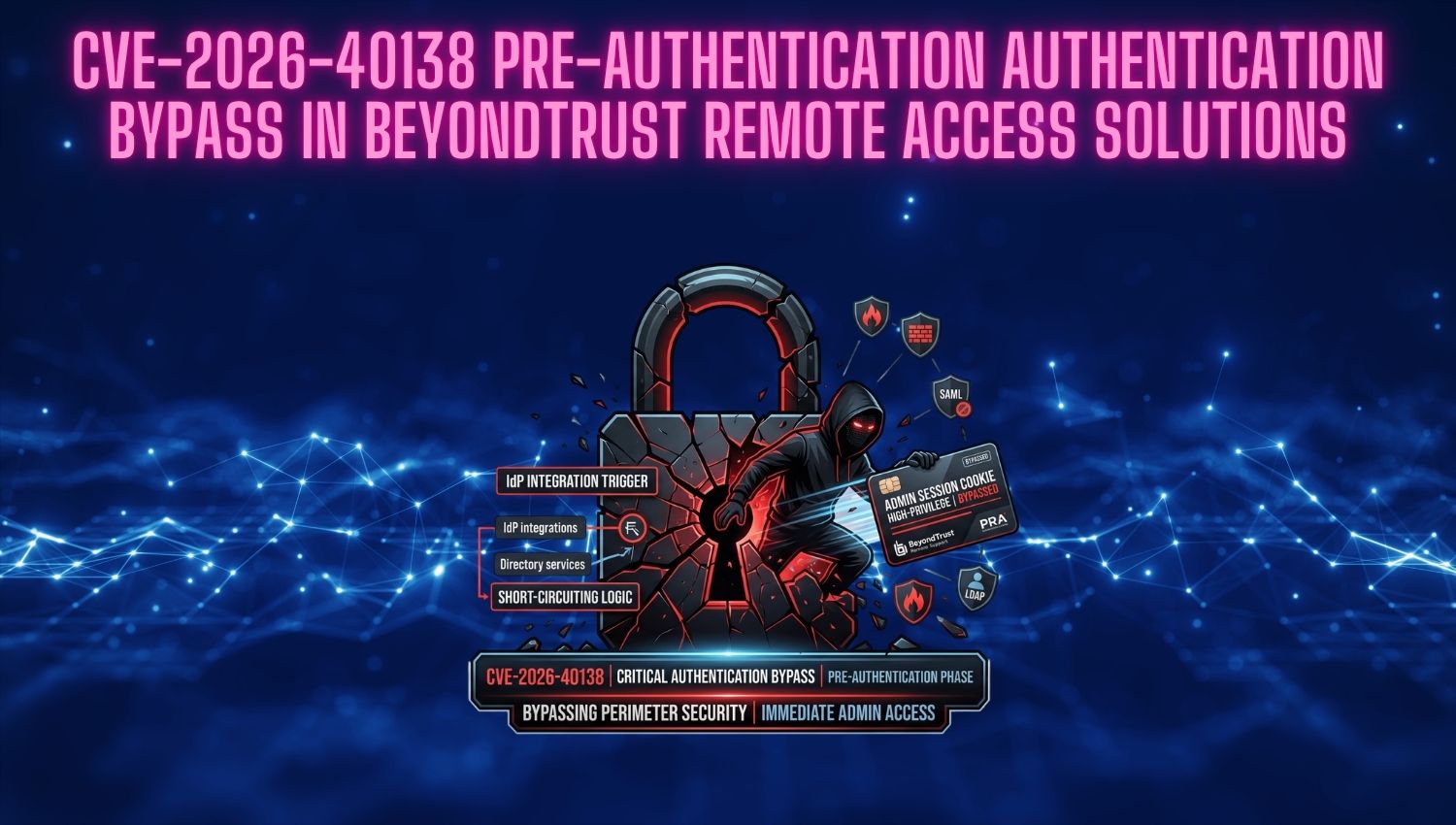
Deep Dive CVE-2026-40138: Pre-Authentication Authentication Bypass in BeyondTrust Remote Access Solutions

CVE-2026-40138 Pre-AuthentIcatIon AuthentIcatIon Bypass In BeyondTrust Remote Access SolutIons

Introduction In the modern corporate landscape, privileged access and remote control solutions form the backbone of IT administration and technical support infrastructure. However, because these systems inherently possess elevated rights over entire enterprise networks, they represent highly attractive targets for sophisticated threat actors. In July 2026, a critical security vulnerability designated as CVE-2026-40138 was publicly disclosed, impacting BeyondTrust’s flagship remote access software lines. Classified as

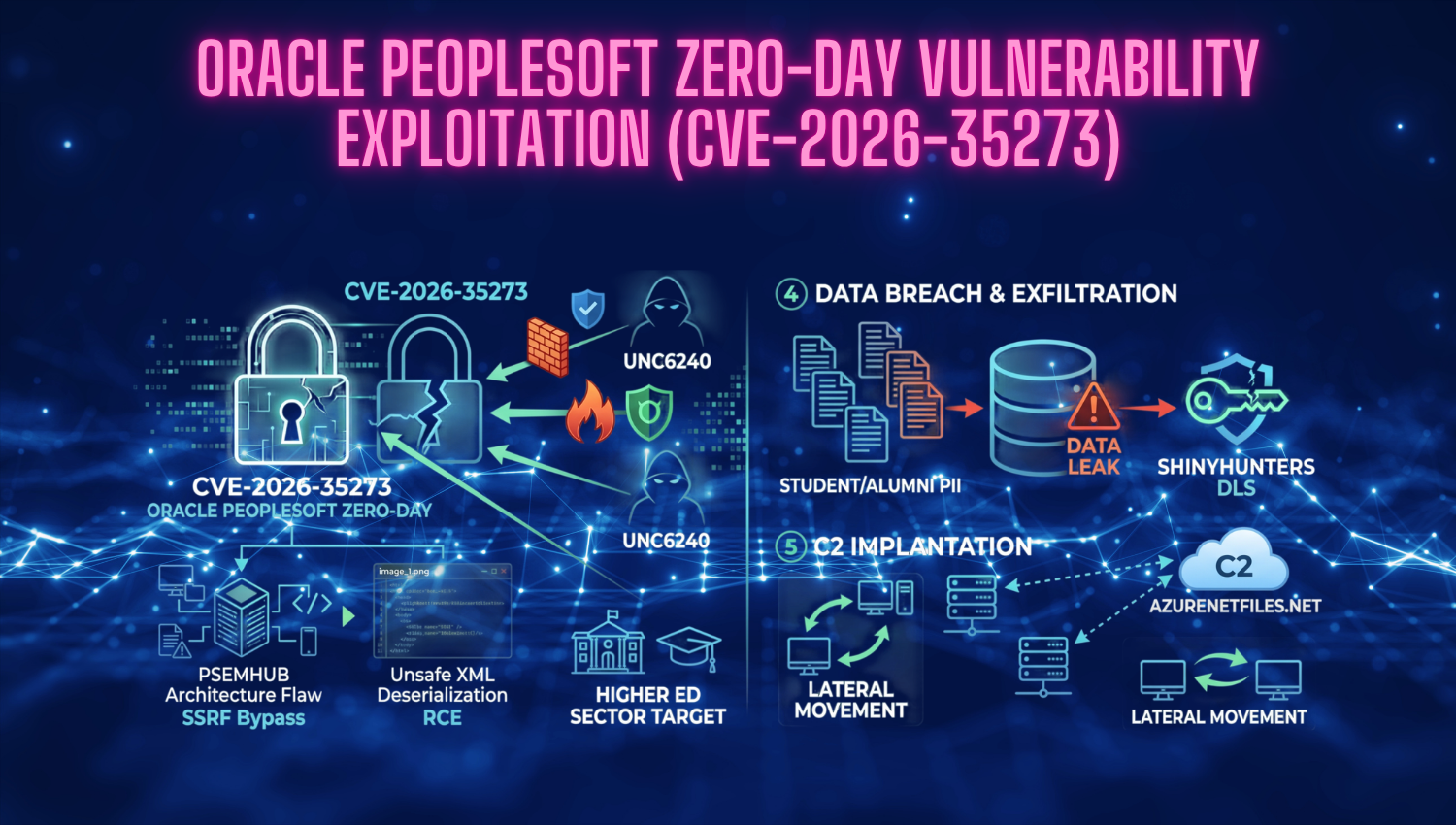
Oracle PeopleSoft Zero-Day Vulnerability Exploitation (CVE-2026-35273)

Oracle PeopleSoft Zero-Day Vulnerability Exploitation (CVE-2026-35273)

Introduction Enterprise Resource Planning (ERP) systems store an organization’s most sensitive financial, operational, and personal data, making them prime targets for sophisticated cyber threat actors looking to maximize their leverage. On June 10, 2026, Oracle released an urgent, out-of-band security alert addressing CVE-2026-35273—a critical remote code execution (RCE) vulnerability actively exploited as a zero-day within the Oracle PeopleSoft PeopleTools component. Attributed to the advanced persistent threat group UNC6240 (which has

Responder Tool for Network Credential Capture in Active Directory

Responder Tool for Network Credential Capture in Active Directory

Introduction Responder is a powerful, open-source Python-based penetration testing tool that directly targets the fundamental weaknesses present in Windows network environments. By manipulating how machines resolve hostnames when DNS lookups fail, Responder intercepts broadcast name resolution requests—specifically those using LLMNR (Link-Local Multicast Name Resolution), NBT-NS (NetBIOS Name Service), and MDNS (Multicast DNS) protocols—and impersonates legitimate network resources. This approach lets attackers seamlessly perform man-in-the-middle (MITM) attacks: when victims

Subdomain Takeover Vulnerabilities and Prevention

Subdomain Takeover Vulnerabilities and Prevention

Introduction Subdomain takeover is a critical security vulnerability that allows attackers to gain unauthorized control over a subdomain of a legitimate domain through misconfigured or abandoned DNS records. This vulnerability exploits the gap between DNS configuration and actual resource ownership, creating an entry point for sophisticated attacks that leverage the trust associated with legitimate domain names. Unlike traditional

SSH Tunneling and Port Forwarding Techniques: A Comprehensive Guide

SSH Tunneling and Port Forwarding Techniques

Introduction SSH (Secure Shell) tunneling and port forwarding have become indispensable tools for system administrators, cybersecurity professionals, and developers worldwide. In an era where network security threats continuously evolve and data breaches occur with alarming frequency, the ability to create secure encrypted channels for data transmission has never been more critical. SSH tunneling transforms the ubiquitous SSH protocol from a simple remote

What is Web Cache Poisoning Attack and Defense: A Comprehensive Guide

What is Web Cache Poisoning Attack and Defense

Introduction Web cache poisoning has emerged as one of the most sophisticated and dangerous attack vectors in modern cybersecurity landscapes. Unlike traditional attacks that target individual users or specific sessions, cache poisoning exploits fundamental vulnerabilities in shared caching systems to distribute malicious content at scale. This attack technique leverages the tension between performance optimization through caching and security

What is NetBIOS and SMB Exploitation Techniques: A Practical Guide

What is NetBIOS and SMB Exploitation Techniques

Introduction NetBIOS (Network Basic Input/Output System) and SMB (Server Message Block) are fundamental protocols that form the backbone of modern Windows networking environments. These protocols enable critical network functions including file sharing, printer access, and inter-process communication across enterprise systems. However, their widespread deployment and legacy compatibility features have made them frequent targets for attackers seeking unauthorized network access. Understanding how these protocols work, their inherent

NoSQL Injection Attacks: MongoDB, CouchDB, and More – NoSQL injection

NoSQL Injection Attacks MongoDB, CouchDB, and More - NoSQL injection

Introduction NoSQL databases have transformed how modern applications store and manage data, offering unparalleled scalability, flexibility, and performance compared to traditional relational databases. MongoDB, CouchDB, Redis, Elasticsearch, and Cassandra have become foundational technologies in cloud-native and microservices architectures. However, this architectural flexibility introduces unique security challenges that many developers overlook. NoSQL injection has emerged as one of the most dangerous and frequently exploited vulnerabilities in contemporary