
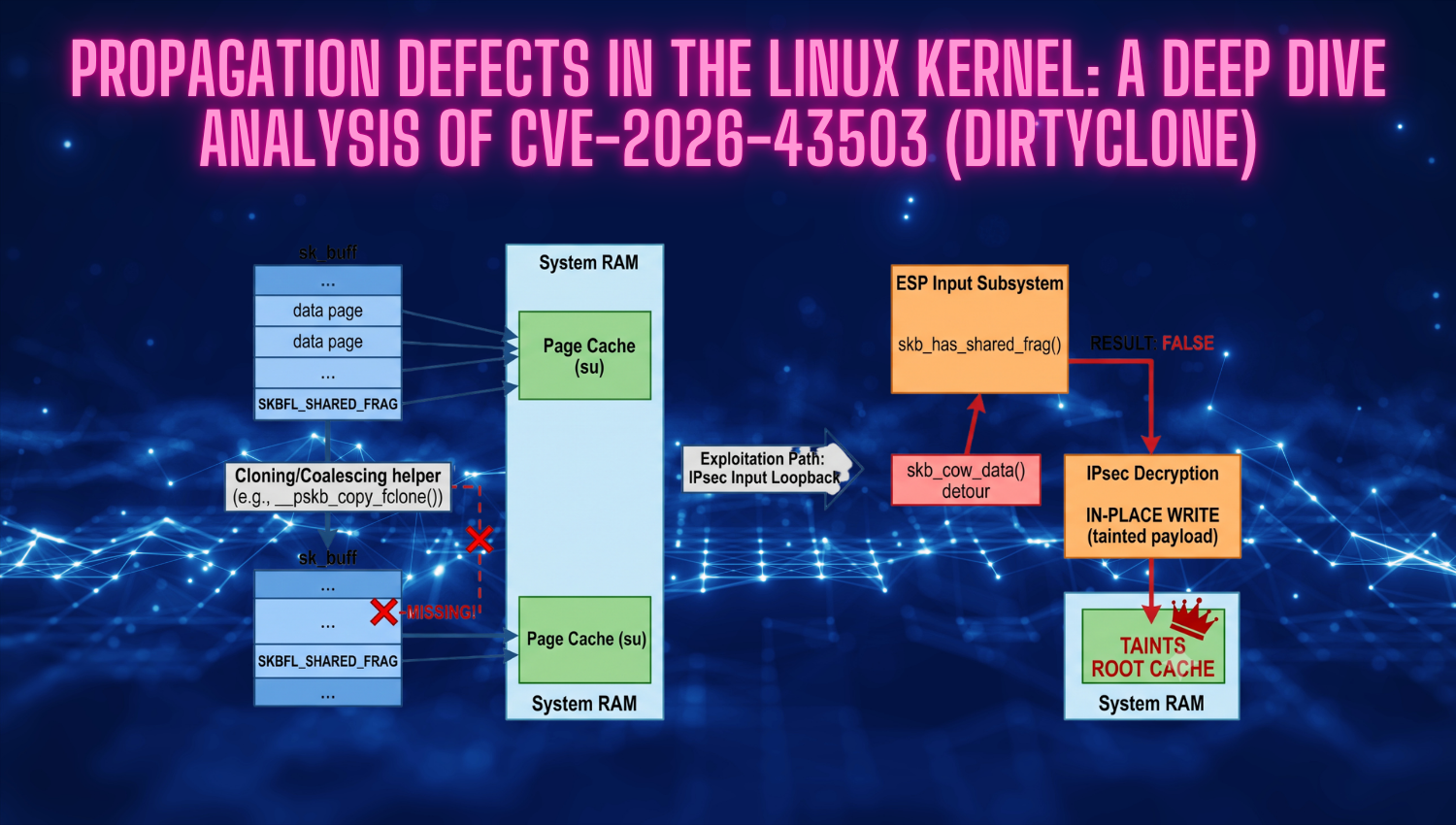
Introduction
At the heart of modern operating systems, the Linux kernel relies heavily on advanced optimization techniques to maintain exceptional performance and throughput during memory management and network operations. One of the most fundamental of these architectural safeguards is the Copy-on-Write (COW) mechanism, which allows multiple unprivileged processes to share the exact same physical memory pages safely until an explicit modification is required by a user space application. However, when highly complex, performance-critical subsystems like the internal kernel networking stack fail to track precise state transitions across their data structures, severe logical errors can manifest and entirely dismantle these critical security boundaries. This article explores CVE-2026-43503, colloquially known in the cybersecurity research community as “DirtyClone”—a high-severity Local Privilege Escalation (LPE) vulnerability that exposes this exact structural flaw. By analyzing the intersection of shared socket memory and system memory management, we will examine its granular root cause within the kernel network stack, trace the precise execution path through which it breaks fundamental COW protections, and outline robust remediation strategies to secure production environments against this class of memory-sharing bypass vectors.
Learning Objectives
By the end of this article, you will understand:
- How metadata propagation defects can induce high-severity kernel vulnerabilities.
- The core architecture of socket buffers (
sk_buff) within the Linux networking subsystem. - Mitigation and remediation strategies to safeguard systems against this class of kernel threats.
- The explicit exploitation mechanism of CVE-2026-43503 and how it bypasses Copy-on-Write (COW) boundaries
What is Linux (DirtyClone) CVE-2026-43503
CVE-2026-43503 is a high-severity Local Privilege Escalation (LPE) flaw residing deep within the Linux kernel’s core networking architecture. Discovered as a logical extension of the notorious “DirtyFrag” vulnerability family, DirtyClone represents a sophisticated, modern iteration of classic memory-sharing bypasses. It serves as a stark reminder of how minor synchronization gaps in highly optimized kernel code can still lead to catastrophic security boundary failures across the entire system. The vulnerability fundamentally allows a local, unprivileged attacker to manipulate system memory pages that directly back critical, read-only files on disk, such as /etc/passwd or /usr/bin/su. By leveraging an architectural blind spot during internal packet cloning, an attacker can trick the system into allowing unauthorized write operations. This structural flaw enables them to inject malicious data straight into these protected files while they are loaded into active system memory.
Because this manipulation takes place directly within the volatile Page Cache in RAM, the underlying blocks on the physical storage disk remain completely unaltered during the runtime execution of the exploit. This transient behavior makes the attack exceptionally stealthy, allowing malicious actors to bypass standard file integrity monitors. Consequently, it grants them immediate root shell execution while leaving traditional system administrators in the dark.
- Severe Privilege Impact: Carries a CVSS v3 base score of 8.8, classifying it as a critical local threat for multi-tenant and shared-hosting environments.
- Bypasses Core Guardrails: Effectively breaks the fundamental Copy-on-Write (COW) protection layers designed to isolate shared memory buffers from unauthorized tampering.
- Zero Disk Footprint: Generates no typical filesystem audit trails, disk logs, or storage integrity alerts since all malicious modifications happen exclusively in memory.
- Targeted Subsystem Defect: Specifically exploits a metadata tracking omission during flag state propagation within the kernel’s socket buffer (
sk_buff) processing path.
Technical Detail: How the Vulnerability Works
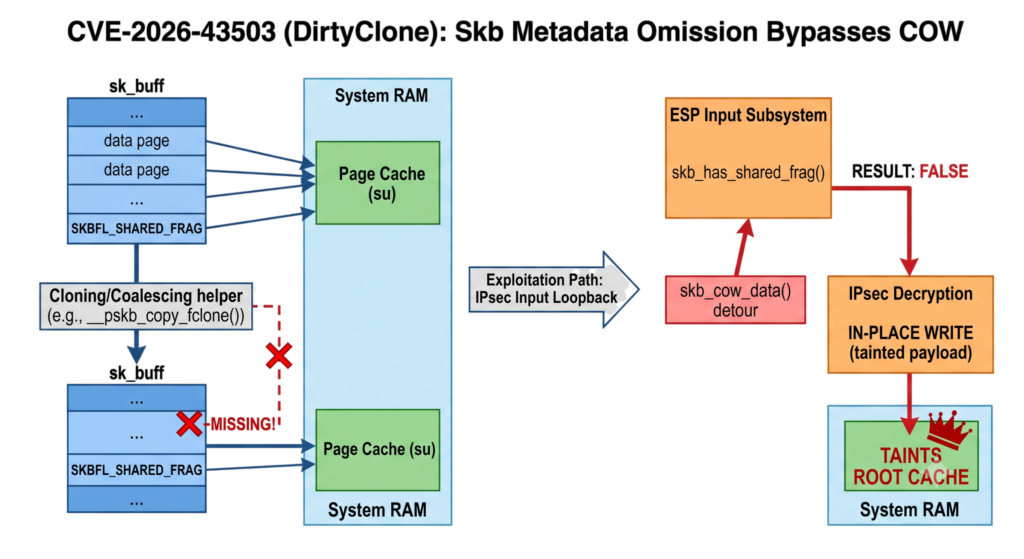
The flaw is deeply rooted in an architectural metadata propagation gap nested inside the internal helper functions responsible for managing socket buffers. These socket buffers—formally known as the sk_buff (or skb) data structures—serve as the core foundational elements used by the Linux kernel to handle, encapsulate, and route network packets across different layers of the operating system. To process network payloads efficiently without introducing massive performance overhead or allocating redundant, costly memory buffers, the kernel implements zero-copy mechanisms wherever possible. When network packets are generated or mirrored from file-backed memory segments, the kernel tracks the shared state of these pages by applying a specific metadata bitmask. This marker is the SKBFL_SHARED_FRAG flag, and it is stored securely inside the shared information structure of the buffer at skb_shinfo()->flags. The primary purpose of this explicit flag is to signal downstream kernel components that a given packet fragment directly references a shared, immutable memory page in the system cache, mandating strict isolation safeguards if modifications are attempted.
The exploit lifecycle exploits a structural blind spot in this state-tracking logic, unfolding through the following precise stages:
- The Flag Omission (The Silent Dropping): When the kernel processes network data through packet-duplication, cloning, or fragment-coalescing routines, it calls highly optimized helper functions such as
__pskb_copy_fclone(),skb_shift(),skb_gro_receive(), orskb_try_coalesce(). During this migration phase, the kernel meticulously duplicates the low-level memory page references into a new destination socket buffer. However, due to a severe omission in the source code logic, it fails to pass along or fold theSKBFL_SHARED_FRAGflag into the newly constructed destinationskbheader. - State Divergence (The Ghost Reference): As a direct consequence of this metadata omission, a dangerous divergence in states occurs within the kernel’s memory tracking layer. The newly cloned or shifted
skbnow points directly to a shared, read-only system file page residing right inside the global Page Cache (such as/usr/bin/su). Despite referencing a highly sensitive, protected resource, the packet’s internal header falsely declares that it possesses exclusive, private ownership over that memory block. When downstream kernel validation checks query the buffer status usingskb_has_shared_frag(), the function erroneously returnsfalse. - Bypassing the COW Guardrail: To weaponize this divergent state, the packet is intentionally forced through an in-place transformation layer. This is typically achieved by setting up a local loopback IPsec configuration or utilizing a netfilter mirroring rule via utility extensions (such as
iptables -j TEE). When the network stack routes this compromised packet into a local Encapsulating Security Payload (ESP) tunnel (esp_input()), the subsystem prepares to decrypt the payload incoming from the wire. Under standard operations, if the kernel recognizes a shared fragment, it immediately callsskb_cow_data()to trigger a safe Copy-on-Write (COW) allocation detour, creating an isolated workspace copy. Because the metadata flag was stripped in the previous steps, the kernel assumes the buffer is private and skips this critical safety protocol entirely. - Direct Cache Overwrite (The Memory Taint): With the COW guardrail bypassed, the IPsec cryptographic engine performs decryption routines directly over the live memory fragment. The engine writes the decrypted payload bytes directly onto the shared, file-backed page cache currently mapped in RAM. By meticulously aligning the packet payload with the entry point logic of an executable binary like
/usr/bin/su, a local adversary silently alters the application behavior in volatile memory. Because this interaction alters the active Page Cache instead of writing block sectors directly onto the underlying physical disk, the modification bypasses traditional filesystem integrity monitors, allowing an unprivileged user to execute the corrupted memory structure and gain instant root access.
Conceptual Shell Interaction & Diagnostics
To understand the runtime manifestation of this vulnerability from a systems diagnostics perspective, the following mock outputs demonstrate how the state divergence appears during exploitation tracking and kernel debugging sessions.
1. Verification of the Local Vulnerability Prerequisites
Before triggering the kernel path, an attacker typically validates whether the necessary netfilter mirroring vectors and unprivileged namespaces are available to construct the looping interface path:
user@vulnerable-host:~$ id
uid=1001(user) gid=1001(user) groups=1001(user)

user@vulnerable-host:~$ cat /proc/sys/kernel/unprivileged_userns_clone
1

user@vulnerable-host:~$ lsmod | grep -E "TEE|nf_dup"
xt_TEE                 16384  0
nf_dup_ipv4            20480  1 xt_TEE
x_tables 53248 1 xt_TEE2. Kernel Dynamic Tracing (ftrace / kprobes Output)
When the exploit binary executes the packet duplication path using a simulated netfilter configuration, low-level kernel tracing instruments reveal the exact moment the SKBFL_SHARED_FRAG (hex value 0x2) bit state gets lost between the source socket buffer and the target clone:
user@vulnerable-host:~$ sudo cat /sys/kernel/debug/tracing/trace_pipe
# tracer: function_graph
#
# CPU  DURATION                  FUNCTION CALLS
# |     |   |                     |   |   |   |
  0)               |  /* Triggering network duplication loop */
  0)               |  nf_dup_ipv4() {
  0)               |    __pskb_copy_fclone() {
  0)   0.412 us    |      skb_clone();
  0)               |      /* DIAGNOSTIC CHECK */
  0)               |      /* Source SKB flags read: shinfo->flags = 0x0002 (SKBFL_SHARED_FRAG) */
  0)               |      /* Destination SKB initialized... */
  0)   1.890 us    |      /* BUG: shinfo->flags = 0x0000 (METADATA DROPPED) */
  0)   2.910 us    |    }
  0)   3.450 us    |  }
  0)               |
  0)               |  /* Packet re-entering IPsec stack */
  0)               |  esp_input() {
  0)               |    skb_has_shared_frag() {
  0)   0.210 us    |      return false; /* COW guardrail skipped! */
  0)               |    }
  0)               |    /* IPsec engine overwrites live memory cache of /usr/bin/su */
  0)  12.450 us    |    crypto_authenc_decrypt();
0) 14.110 us | }3. Successful Exploitation Phase
Once the target binary’s memory representation inside the kernel Page Cache has been successfully modified via the zero-copy injection, running the targeted utility no longer requests the standard validation routine but instead drops the user into an elevated root environment:
user@vulnerable-host:~$ ./dirtyclone_exploit_injector --target /usr/bin/su
[+] Mapping target binary into memory space...
[+] Establishing local loopback ESP tunnel endpoints...
[+] Initializing netfilter packet duplication rules.
[+] Triggering metadata propagation flaw via __pskb_copy_fclone()...
[+] Injection packet transmitted to IPsec input pipeline.
[+] Page Cache taint complete. Executing modified payload hook...

user@vulnerable-host:~$ su -
root@vulnerable-host:# id
uid=0(root) gid=0(root) groups=0(root)
root@vulnerable-host:# tail -n 1 /var/log/auth.log
Jun 26 21:20:15 vulnerable-host su: session opened for user root by (uid=1001)
# Note: Notice that no disk anomalies or tripwire file-change alerts are generated.How to Improve and Reduce
Protecting infrastructures from DirtyClone requires a combination of immediate deployment patches and preventative configurations to reduce the attack surface.
- Kernel Upstream Patching (Permanent Solution): The upstream fix enforces rigorous state tracking by forcing all fragment migration helpers to merge and carry over the
SKBFL_SHARED_FRAGbit from source to destination buffers. This resolution was integrated into Linux v7.1-rc5 and backported to major stable/LTS distribution kernels. System administrators should run system updates and reboot into the latest kernel immediately. - Restricting User Namespaces (Temporary Mitigation): To successfully trigger the network paths required for the exploit, local attackers typically need to instantiate custom network boundaries (such as a separate network namespace to manipulate routing rules without root permissions). This can be strictly curtailed by disabling unprivileged user namespaces via the system control configuration:
- Netfilter Duplication Modules: If your server environment does not explicitly rely on packet mirroring, advanced local logging, or complex routing setups, you can proactively prevent the kernel from dynamically loading the specific modules used as attack vectors. This forces the exploit chain to break during the netfilter initialization phase:
- Verifying Post-Mitigation Security Posture: After applying the mitigations, security teams can audit the environment to ensure that the unprivileged exploitation prerequisites have been neutralised successfully:
Conclusion
CVE-2026-43503 (DirtyClone) serves as a stark, powerful reminder of the delicate balance between software performance optimizations and strict system isolation boundaries within production environments. In low-level kernel development, achieving high data throughput often relies on zero-copy memory practices and intricate data structures like socket buffers. When these performance-centric features are introduced, they require absolute perfection in state management across every branch; omitting even a single tracking bit can instantly invalidate robust, high-level access control layers built throughout the operating system, rendering security architectures ineffective against local attackers. The architectural flaw behind DirtyClone underscores how deeply interdependent different kernel subsystems—specifically networking structures, netfilter subsystems, and virtual memory management components—have become in modern computing environments. A simple failure to properly propagate a metadata flag across internal buffer cloning routines completely shattered the structural integrity of Copy-on-Write (COW) defenses, which are traditionally deemed impenetrable. This demonstration proves that vulnerability research cannot examine kernel components in isolation, as the unexpected intersection of two seemingly safe, standard network operations can easily create an entirely new class of memory taints that put infrastructure at severe risk.
Moving forward, defending enterprise infrastructure and multi-tenant cloud architectures against modern kernel exploitation techniques requires a proactive, deeply layered security posture. While maintaining a rapid, automated patching cadence remains the absolute permanent solution to eliminate underlying kernel flaws, system administrators must also reduce their immediate attack surface through tactical configuration hardening. Implementing principle-of-least-privilege system controls, such as restricting unprivileged user namespaces and unnecessary network duplication modules, ensures that critical infrastructure hosts remain resilient even when unexpected zero-day vulnerabilities emerge.