
Introduction
For years, the cybersecurity industry has increasingly relied on automated code analysis and AI-driven vulnerability scanners to secure open-source software. However, the discovery of the “Bad Epoll” vulnerability (CVE-2026-46242) in May 2026 proved that even the most advanced AI models have their limitations. Found deep within the Linux kernel’s fundamental epoll I/O framework, this Local Privilege Escalation (LPE) flaw allows a low-privileged attacker to bypass critical security boundaries and gain full root control over a machine. This breakthrough discovery has ignited a crucial debate regarding our over-reliance on autonomous security tools, exposing how easily subtle, multi-threaded timing issues can evade automated detection. While machine learning excels at identifying deterministic code patterns, it struggles with microarchitectural race conditions. Consequently, this article explores the intricate anatomy of the vulnerability, its profound intersection with artificial intelligence development, and how the underlying exploitation mechanism functions in real-world environments.
Learning Objectives
By the end of this article, you will be able to:
- Understand the vital role of the
epollmechanism within the Linux kernel subsystem. - Grasp the mechanics behind the Use-After-Free (UAF) and race condition utilized in the “Bad Epoll” vulnerability.
- Explain why advanced AI models (such as Anthropic’s Mythos) failed to detect this specific flaw.
- Identify affected versions and implement necessary remediation and mitigation steps.
What is Bad Epoll (CVE-2026-46242)?
Bad Epoll (CVE-2026-46242) is a severe local privilege escalation vulnerability located in the core subsystem of the Linux kernel. At its surface, it grants any local user with standard, unprivileged access—or a malicious actor who has successfully compromised a low-level background service account—the ability to break out of their operational boundaries and escalate their privileges directly to root. Discovered by security researcher Jaeyoung Chung, the bug was submitted as a highly critical zero-day submission to Google’s prestigious kernelCTF program, accompanied by a weaponized, production-grade exploit implementation that demonstrates absolute control over affected systems. What makes Bad Epoll particularly noteworthy in the broader cybersecurity community is its profound and humbling relationship with AI-driven bug hunting. Earlier in 2026, Anthropic’s state-of-the-art research AI model, Mythos, successfully analyzed this exact same small stretch of the epoll codebase and uncovered a different, critical flaw now tracked as CVE-2026-43074. However, while the AI model successfully flagged that initial vulnerability, it completely overlooked Bad Epoll—which had been sitting silently in the production kernel codebase since an architectural refactoring in 2023. This striking blind spot serves as a stark reminder that despite rapid advancements in machine intelligence, human intuition, rigorous manual code auditing, and deep exploitation expertise remain absolutely indispensable in modern offensive research.
The broader implications of this vulnerability extend well beyond traditional Linux servers and enterprise cloud environments, deeply impacting the mobile ecosystem. Because the flawed synchronization logic resides in the foundational eventpoll architecture, the vulnerability natively crosses over into modern Android kernels and secure runtime environments. Security teams are particularly alarmed by the exploit’s unique ability to successfully execute from within heavily isolated user spaces. By proving that a microscopic timing error can completely neutralize advanced kernel protections, Bad Epoll has forced a fundamental reassessment of how kernel developers handle multi-threaded file monitoring.
Key Structural Takeaways:
- Zero-Day Submission: Discovered by Jaeyoung Chung and validated through Google’s kernelCTF initiative with a remarkably stable exploit payload.
- The AI Blind Spot: Highlighted the cognitive limits of Anthropic’s Mythos model, which patched a sibling bug in the exact same file but missed this specific race condition.
- Sandbox Evasion Capability: Capable of being triggered from inside Google Chrome’s highly restrictive Renderer Sandbox, drastically increasing its utility in multi-stage attack chains.
- Monolithic Monitored Scope: Affects widespread Linux distributions, modern Android systems, and containerized cloud environments running mainline kernel versions from 6.4 up to mid-2026.
        +-------------------------------------------------------------+
        |                     USER SPACE APPLICATION                  |
        |  - Operates inside isolated Google Chrome Renderer Sandbox |
        |  - Triggers concurrent close/remove on file descriptors      |
        +-------------------------------------------------------------+
                                      |
                                      | [Initiates Epoll Syscalls]
                                      v
        +-------------------------------------------------------------+
        |                      LINUX KERNEL SPACE                     |
        |                                                             |
        |   Thread A: Calls `ep_remove_file` -> Frees Epoll Object    |
        |                                                             |
        |   =======> CRITICAL 6-INSTRUCTION RACE WINDOW <=======      |
        |                                                             |
        |   Thread B: Writing data simultaneously via `hlist_del_rcu`  |
        +-------------------------------------------------------------+
                                      |
                                      | [Exploit Widens Window / Use-After-Free]
                                      v
        +-------------------------------------------------------------+
        |                   KERNEL HEAP CORRUPTION                    |
        |  - Memory corrupted safely without tripping KASAN alerts     |
        |  - System execution hijacked to overwrite process state     |
        +-------------------------------------------------------------+
                                      |
                                      | [Privilege Escalation Verified]
                                      v
        +-------------------------------------------------------------+
        |                     ROOT ACCESS GRANTED                     |
        |  - Full administrative machine compromise achieved (99%)    |
        +-------------------------------------------------------------+
Technical Detail: How the Vulnerability Works
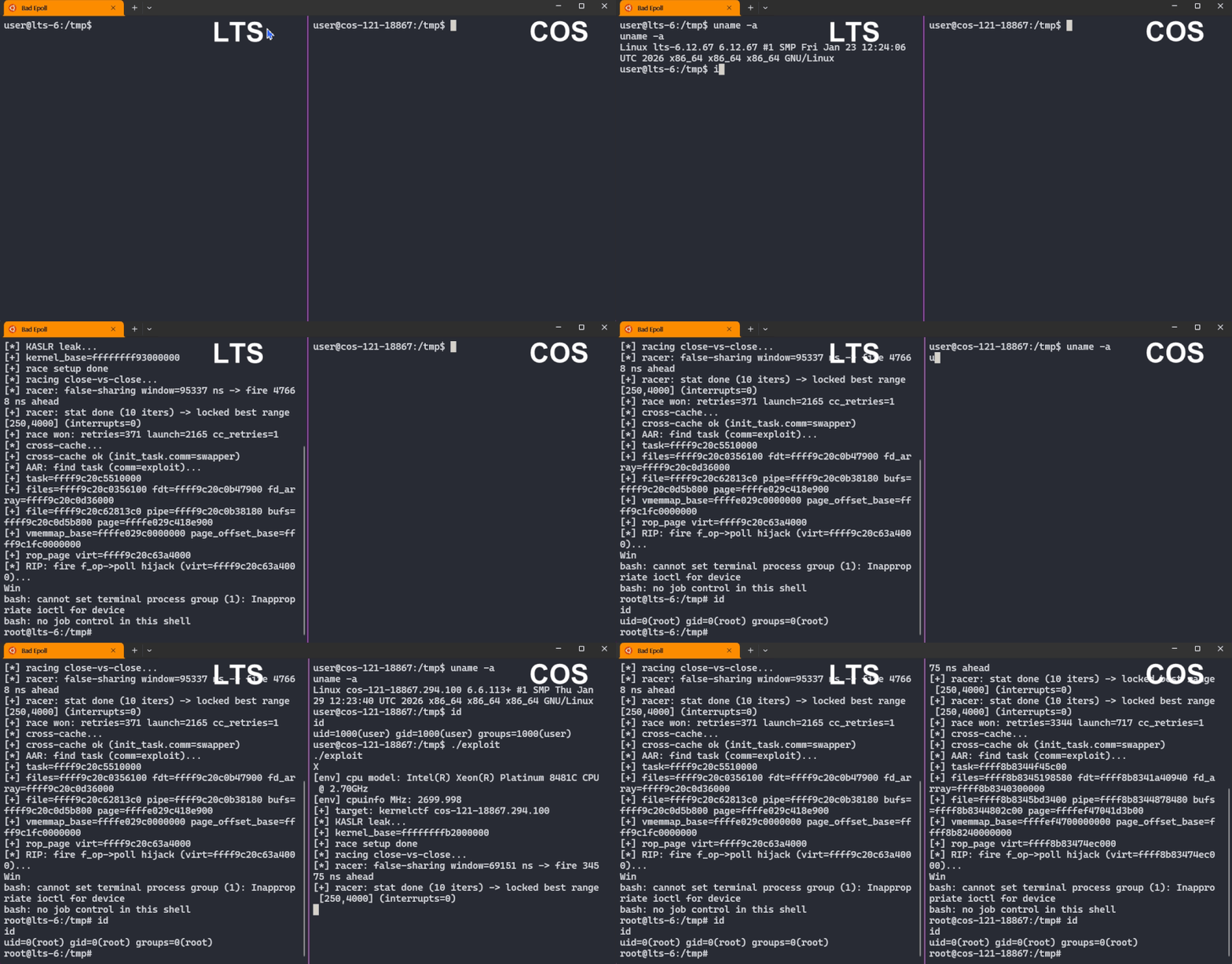
At its core, Bad Epoll is a highly sophisticated deterministic Use-After-Free (UAF) vulnerability born out of a microscopic Race Condition within the kernel’s memory management subsystem. Under normal operations, the Linux kernel employs the epoll (event poll) subsystem to handle massive asynchronous I/O multiplexing. High-performance software—such as Nginx web servers, high-throughput network daemons, and modern multi-process web browsers—relies heavily on this framework to concurrently monitor thousands of file descriptors or network sockets. When one of these monitored file descriptors is closed, unlinked, or explicitly removed from the monitoring set, the kernel automatically invokes the internal ep_remove_file function inside the eventpoll module to safely tear down, unhook, and clean up the associated memory tracking structures. The vulnerability itself was introduced during a major architectural synchronization and performance refactoring of the epoll subsystem code back in 2023. Due to flawed locking logic and an inadequate consideration of concurrent execution paths, a critical race condition was inadvertently injected into the kernel. When a high-volume application triggers rapid, parallel modifications to its file descriptor states, two entirely separate kernel execution threads can be forced to manipulate the exact same internal epoll tracking object simultaneously. Thread A swiftly identifies the object as obsolete and completely deallocates its memory block from the kernel heap. Meanwhile, due to missing synchronization barriers, Thread B remains completely unaware of this deallocation, continuing its execution path and actively attempting to write structural data directly into that exact same, newly freed memory address via unsafe Read-Copy-Update (RCU) callbacks like hlist_del_rcu.
What makes this flaw an exceptional engineering feat from an offensive perspective is how the exploit subverts traditional kernel telemetry and hardware limitations. In a standard runtime environment, the critical collision window where these two execution paths overlap lasts for only about six machine instructions. Statistically, attempting to hit a six-instruction race window at random is virtually impossible and almost always triggers an immediate null-pointer dereference, resulting in a loud system crash known as a kernel panic. However, the exploit engineered by researcher Jaeyoung Chung implements a highly reliable stabilization mechanism that artificially stretches this timing window at the CPU cache level. By doing so, the attacker can repeatedly target the race window safely without crashing the operating system, converting a highly volatile race condition into a deterministic exploitation technique that achieves a remarkable 99% success rate in spawning a root shell on targeted host environments.
Key Technical Breakdowns:
- Flawed RCU Synchronization: The vulnerability exploits the asynchronous nature of
hlist_del_rcu, where pointer unlinking occurs while another thread is actively freeing the parent data structure. - Microarchitectural Timing Manipulation: The exploit uses specialized cache-grooming and thread-scheduling techniques to artificially widen a microscopic 6-instruction processing window into a stable target.
- KASAN Telemetry Defeat: Because the memory corruption occurs gracefully within normal kernel heap boundaries and reuses valid structures, it leaves virtually no anomalous runtime footprints, entirely bypassing Kernel Address Sanitizer protections.
- Chrome Sandbox Escapability: The exploit utilizes system calls that remain fully exposed to unprivileged users, allowing code executing inside Google Chrome’s strict Renderer Sandbox to directly reach the vulnerable kernel paths.
                     THREAD A (Deallocation Path)             THREAD B (Write/Unlink Path)
                     ----------------------------             ----------------------------
                                  |                                        |
                 [Invokes `ep_remove_file`]                                |
                                  |                                        |
                                  v                                        v
                    Identifies Target Epoll Object           Identifies Same Epoll Object
                                  |                                        |
                 [Frees Memory Block via `kfree()`]                        |
                                  |                                        |
                                  +---------------> [ FREE ] <-------------+
                                                      |
                    ==================================|==================================
                    CRITICAL RACE WINDOW: ONLY 6 MACHINE INSTRUCTIONS WIDE (CPU CACHE LEVEL)
                    ==================================|==================================
                                                      v
                                           Memory is Now Vacant
                                                      |
                                                      v
                                        [Exploit Floods/Grooms Heap]
                                                      |
                                                      v
                                        Fake Structure Placed in Cache
                                                      |
                                                      v
                                           [UAF Write Triggered]
                                                      |
                                                      v
                                      Thread B Executes `hlist_del_rcu`
                                      Using the Attacker's Corrupted Pointer
                                                      |
                                                      v
                                      ==================================
                                      KERNEL PRIVILEGE ESCALATION (99%)
                                      ==================================
Affected Software & Plugins
Because Bad Epoll is baked directly into the core monolithic architecture of the Linux kernel, it operates entirely independent of any third-party plugins, specific web server software, or external application packages. The true blast radius of this flaw is determined solely by the underlying kernel version running on the host machine, making it a universal threat across diverse environments. When the flawed performance refactoring was committed to the upstream codebase, it inadvertently distributed this vulnerability across the entire modern Linux ecosystem. Consequently, the flaw spans across enterprise cloud infrastructure, containerized environments, orchestrators, desktop distributions, and mobile ecosystems alike, presenting a massive patching challenge for system administrators and device manufacturers globally.
Key Exposure Categories:
- Mainline Linux Kernels: Vulnerable on all mainstream, unpatched Linux kernel versions starting from version 6.4 and newer (including various releases up to
6.18.xand7.0.xprior to the mid-2026 security patches). - Enterprise & Desktop Distributions: Highly impactful across major operating systems that deploy modern kernels, including Ubuntu, Red Hat Enterprise Linux (RHEL), Debian, AlmaLinux, Rocky Linux, and Fedora.
- Android & IoT Ecosystems: Inherently compromises modern smartphones and tablets running newer kernel branches (6.4+), alongside high-end Linux-based IoT appliances, smart infrastructure, and edge routers.
- Immune LTS Branches: Completely leaves older, stable Long-Term Support (LTS) kernels—specifically the 6.1 branch powering devices like the Google Pixel 8—unaffected, as the underlying buggy code refactoring did not exist in those earlier development cycles.
Conclusion
The emergence of Bad Epoll (CVE-2026-46242) highlights two critical, unyielding realities in modern infrastructure defense and operational security. First and foremost, core monolithic subsystems like epoll cannot simply be disabled, or isolated via traditional firewalling or user-space configuration workarounds; they are fundamentally woven into how modern operating systems process asynchronous network data and manage system calls. Because this component is vital to the performance of everything from web servers to container engines, attempting to block its usage would completely paralyze the host operating system. Consequently, applying raw, kernel-level security patches stands as the only viable path forward to restore system integrity. Secondly, this flaw serves as a profound case study in the current cognitive limitations of artificial intelligence within the realm of automated offensive research and code auditing. While modern large language models and specialized AI scanners act as incredible force multipliers for catching traditional memory bugs, standard buffer overflows, or “low-hanging fruit” vulnerabilities, they still fundamentally struggle to reason through complex, asynchronous logic. Multi-threaded race conditions that rely on microscopic, microarchitectural timing windows require a deep, contextual understanding of execution flows over time—a paradigm where human intuition, creative fuzzing, and manual code auditing still maintain a definitive upper hand.
Ultimately, there are absolutely no configuration workarounds, sysctl tweaks, or temporary mitigation strategies available to blunt the threat of Bad Epoll. Because the vulnerability bypasses standard runtime telemetry like KASAN and can be cleanly weaponized from within heavily sandboxed applications, passive monitoring alone is insufficient. System administrators, DevOps engineers, and enterprise security teams must immediately coordinate downtime to pull downstream updates from their respective distribution vendors or directly compile the upstream Linux kernel patch (commit a6dc643c6931) to fully secure their production workloads and endpoints against potential exploitation.