
Introduction
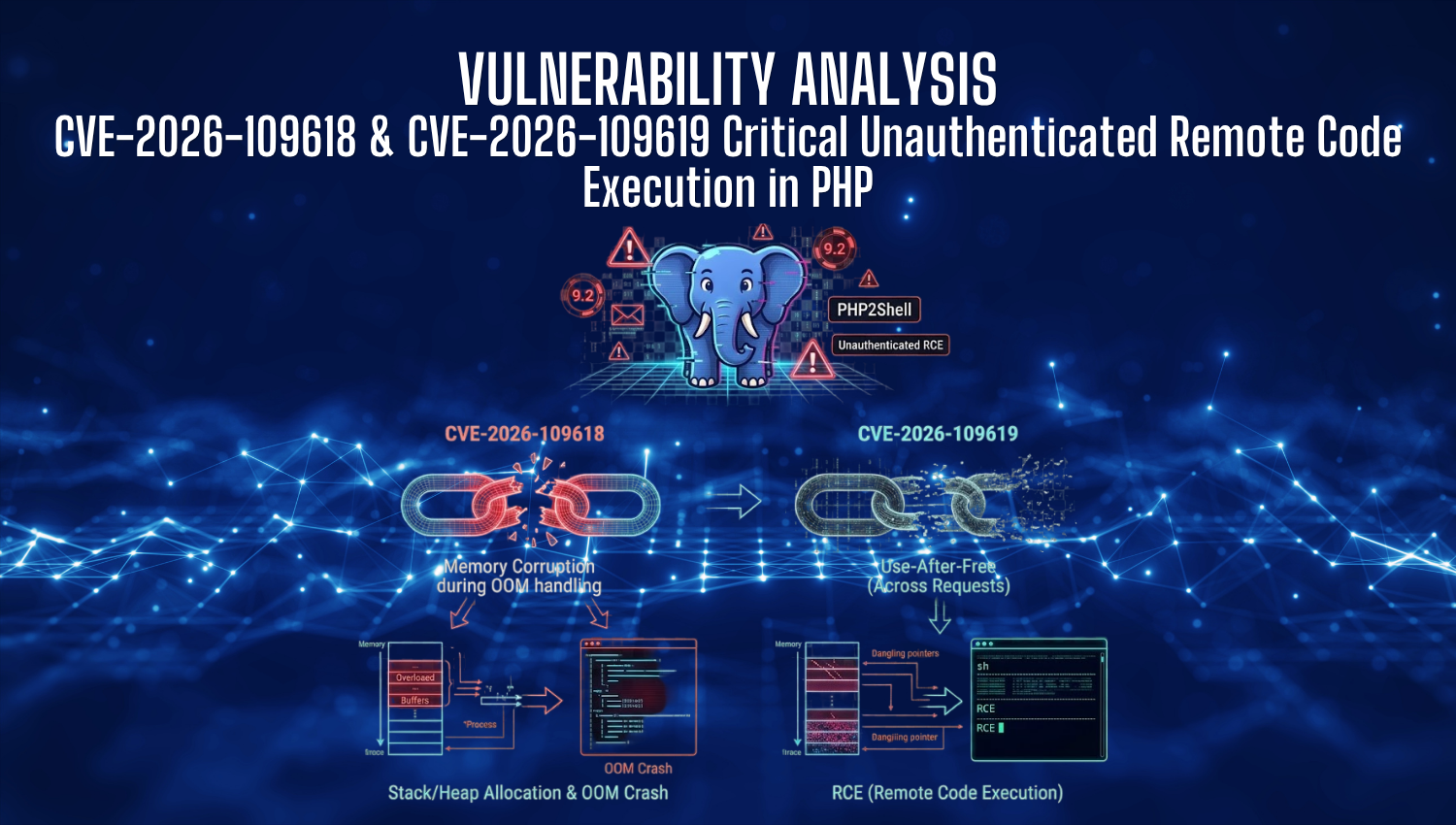
CVE-2026-109618 and CVE-2026-109619 represent one of the most critical security emergencies in recent PHP history, threatening millions of active web servers globally. Highlighting the fundamental dangers of memory management flaws within persistent web server worker environments—such as PHP-FPM or Apache mod_php—these vulnerabilities enable unauthenticated remote attackers to execute arbitrary system commands with the privilege level of the underlying web service. Dubbed “PHP2Shell” by cybersecurity researchers, the combined exploit chain directly targets low-level fatal error handling routines in the Zend Engine core, turning standard memory exhaustions into total host compromise. Because the vulnerability manifests prior to application-level routing, standard code hardening within web applications fails to provide protection, leaving unpatched web infrastructure completely exposed.
Learning Objectives
By analyzing this security advisory and technical breakdown, you will learn to:
- Understand the Root Mechanism: Identify how low-level longjmp-based unwinding disrupts normal variable cleanup and state resetting in the C-based PHP Zend Engine.
- Grasp the Exploit Chain Architecture: Comprehend how an initial data-leak/memory corruption bug (CVE-2026-109618) combines with a cross-request Use-After-Free bug (CVE-2026-109619) to yield reliable Remote Code Execution.
- Assess Attack Vectors: Recognize how common HTTP interfaces (like
multipart/form-datauploads) can trigger engine-level flaws prior to any application-layer code execution. - Formulate Defense & Remediation: Implement immediate web-server mitigations and long-term patch strategies across both active and End-of-Life (EOL) PHP branches.
What is Critical Unauthenticated Remote Code Execution in PHP (CVE-2026-109618 & CVE-2026-109619)
Both vulnerabilities carry a CVSS v3 score of 9.2 (Critical), reflecting their severity and ease of exposure across default installations. Unlike traditional application-level weaknesses—such as SQL injection, local file inclusion, or insecure deserialization written into custom scripts—these flaws reside deep within the C source code of the PHP engine itself. Consequently, every web application hosted on an unpatched PHP binary is exposed regardless of how securely the application code was written or audited. The underlying issue centers on how the Zend Engine manages worker process state when an out-of-memory (OOM) condition occurs. When a script or request parser exceeds the allocated memory_limit, PHP forces an abrupt execution halt using C-level longjmp() unwinding. This abrupt jump bypasses standard garbage collection and destructor routines, leaving allocated memory structures in a corrupted or partially initialized state. When persistent worker architectures process subsequent requests, these leftover memory pointers are incorrectly treated as active context.
Because this memory corruption occurs during early request parsing—specifically while processing standard HTTP headers, body content, or file upload handlers—an attacker does not require valid credentials, session tokens, or access to specific application endpoints. Simply sending crafted HTTP requests directly to any valid PHP-serviced path triggers the underlying engine routines, making unauthenticated remote exploitation straightforward for persistent worker setups.
- CVSS Score: 9.2 (Critical) — High impact on confidentiality, integrity, and availability.
- Attack Vector: Network (Unauthenticated HTTP/HTTPS POST or GET requests).
- Core Vulnerability Mechanics: Out-of-memory
longjmp()execution bypass combined with cross-request memory reuse. - Affected Component: Core Zend Engine request lifecycle and memory allocator (
zend_alloc).
Technical Detail: How the Vulnerability Chain Works
The mechanics of this security flaw rely on the architectural design of persistent PHP processes, such as PHP-FPM pools or FastCGI implementations. To minimize performance overhead, these worker processes remain alive after completing an HTTP request, waiting to process the next incoming connection in the same memory address space. When a memory allocation failure occurs during request handling, the engine must safely clean up the current request’s state and reset its internal allocator without terminating the entire worker process. However, the unwinding mechanism triggered by longjmp() fails to clean up complex nested data structures properly. When an allocation fails, the control flow jumps directly to the top-level error handler, skipping intermediate cleanup handlers for file upload monitors, global symbol tables, and internal buffers. This creates a desynchronization between the engine’s global tracker state and the actual allocated heap memory blocks managed by zend_alloc.
When the persistent worker receives a follow-up HTTP request, the engine reinitializes request memory without fully resetting stale global pointers from the previous aborted execution. This architectural flaw allows an attacker to control the contents of freed memory via the first request, and then trick the engine into executing code paths derived from those dangling pointers during the second request.
- Prerequisite Condition: A web architecture utilizing persistent worker processes (e.g., PHP-FPM, Apache event MPM with FastCGI).
- Initial State Manipulation: Forcing memory exhaustion (
memory_limitboundary hit) during early request payload parsing. - Memory Address Mapping: Utilizing uninitialized buffer reads during process failure to bypass ASLR protections.
- Control Flow Hijacking: Overwriting internal function pointer tables (such as
zend_execute_internal) in freed memory structures.
Below is a conceptual terminal demonstration showing an administrator inspecting HTTP responses during a diagnostic test against an unpatched PHP worker:
$ curl -i -s -X POST "http://target-server.local/index.php" \
  -H "Content-Type: multipart/form-data; boundary=---------------------------109618109619" \
  --data-binary "@large_payload.bin"

HTTP/1.1 500 Internal Server Error
Server: nginx/1.24.0
Date: Wed, 21 Oct 2026 20:41:00 GMT
Content-Type: text/html; charset=UTF-8
Connection: keep-alive
X-Powered-By: PHP/8.3.35

Fatal error: Allowed memory size of 134217728 bytes exhausted (tried to allocate 140000000 bytes) in Unknown on line 0
Step 1: Memory corruption during OOM handling (CVE-2026-109618)
The first stage of the vulnerability chain relies on forcing an out-of-memory error during early request initialization. When an HTTP request containing large headers, structured parameters, or upload progress keys is received, the Zend Engine allocates heap memory to track incoming data structures. By crafting a payload that rapidly consumes memory right up to the configured memory_limit, the engine fails mid-allocation and immediately invokes the fatal error recovery routine via longjmp(). Because longjmp() abruptly transfers control back to the main request loop, standard destructors and pointer cleanup routines are skipped. Consequently, internal memory references remain registered in global engine trackers despite their underlying memory blocks being marked as reusable or uninitialized. This structural mismatch leaves valid global pointers referencing corrupted memory locations, laying the groundwork for process memory state leakage.
Step 2: Use after free across requests (CVE-2026-109619)
The second stage occurs when the persistent worker process accepts the subsequent HTTP request from the network. Rather than terminating the corrupted worker process, the web server reuses it to handle new traffic. As the engine initializes the context for the incoming request, it encounters leftover pointers that still reference the memory space freed during the previous request’s OOM failure. During initialization, incoming request data overwrites the freed memory region, allowing an attacker to populate those address locations with controlled payload values. When the Zend Engine attempts to invoke internal execution functions using the stale pointers, it mistakenly reads the newly supplied attacker data as valid function tables or execution contexts. This type confusion allows arbitrary control flow redirection, culminating in unauthenticated system command execution.
Affected Software & Plugins
Because these security flaws reside inside the core Zend Engine runtime, all web applications and CMS platforms deployed on unpatched PHP installations are vulnerable, regardless of application-level security controls, input validation, or framework-level sanitization.
- PHP 8.5 Branch: Versions 8.5.0 through 8.5.11 (Patched in 8.5.12).
- PHP 8.4 Branch: Versions 8.4.0 through 8.4.26 (Patched in 8.4.27).
- PHP 8.3 Branch: Versions 8.3.0 through 8.3.35 (Patched in 8.3.36).
- PHP 8.2 Branch: Versions 8.2.0 through 8.2.34 (Patched in 8.2.35).
Applications built on popular content management systems and frameworks—including WordPress, Drupal, Joomla, Laravel, Symfony, and Magento—are instantly exposed if hosted on vulnerable binary versions. Legacy environments running End-of-Life (EOL) versions (such as PHP 7.x or 8.1) do not receive official upstream patches and require operating system distribution backports or immediate upgrading to supported releases.
Conclusion
CVE-2026-109618 and CVE-2026-109619 highlight the severe implications of memory safety vulnerabilities in underlying server runtimes. When engine-level cleanup routines fail during exceptional error states like OOM conditions, traditional application-layer defenses offer no security margin. Organizations must treat these advisories as high-priority infrastructure threats requiring rapid patch validation and deployment. System administrators and DevOps teams should immediately audit active environments and update PHP packages to patched releases (8.2.35+, 8.3.36+, 8.4.27+, or 8.5.12+). For infrastructure running EOL branches where immediate upstream upgrades are infeasible, enterprise Linux security backports (such as Red Hat, Ubuntu ESM, or AlmaLinux advisories) must be applied without delay to secure persistent worker processes. In environments where immediate binary replacement is blocked by change freezes, temporary perimeter mitigations should be implemented. Web Application Firewalls (WAFs) and reverse proxies can be configured to inspect and block anomalous upload progress payloads or restrict maximum request body sizes below the PHP memory_limit threshold, preventing malicious requests from reaching vulnerable error-handling code paths.