
Introduction
Package managers are the backbone of system maintenance and software deployment in Linux environments. A critical security flaw, designated as CVE-2026-109518, has been identified in APT, the default package manager for Debian and Ubuntu distributions. Discovered by security researcher Max Justicz, this vulnerability allows a Man-in-the-Middle (MitM) attacker to intercept package downloads, bypass verification, and execute arbitrary code with root privileges. Because APT is ubiquitous across Debian-based systems, understanding and mitigating this threat is an immediate priority for system administrators and security professionals. As organizations increasingly rely on automated infrastructure and continuous integration pipelines, the integrity of these core utilities is paramount. The discovery of this flaw highlights a significant blind spot in how legacy fetching mechanisms interact with modern threat landscapes. When a foundational tool like APT is compromised, the entire security posture of the server fleet collapses, making rapid patching and threat awareness absolutely essential to maintaining operational continuity and data integrity.
Learning Objectives
- Understand the fundamental mechanism of CVE-2026-109518 and how it compromises the package installation process.
- Identify the specific configuration settings, such as
Acquire::Retries, that enable the exploit. - Recognize the specific Linux distributions and APT versions vulnerable to this attack.
- Grasp the operational steps required to remediate the vulnerability across enterprise environments.
What is APT MitM vulnerability grants root access (CVE-2026-109518)
CVE-2026-109518 is a critical security flaw with a CVSS 4.0 score of 7.7, specifically targeting the Advanced Package Tool (APT) used heavily in Debian and Ubuntu ecosystems. It fundamentally breaks the trust model between the local operating system and remote package repositories. The core issue lies in how APT processes failed HTTP requests and manages its subsequent retry attempts when downloading software updates or new installations. To exploit this vulnerability, a malicious actor must first establish a Man-in-the-Middle (MitM) position on the network. This means the attacker is strategically situated between the target Linux machine and the upstream Debian or Ubuntu package server. From this vantage point, the attacker can observe, intercept, and modify the unencrypted HTTP traffic flowing to the package manager, setting the stage for payload injection. Once the attacker successfully manipulates the connection state, they can swap a cryptographically verified package with a malicious alternative during the automated retry phase. Because APT operations inherently require superuser privileges to install software, modify system directories, and execute deployment scripts, the injected malicious code is automatically executed with root access. This grants the attacker complete, unfettered control over the compromised machine.
- CVSS 4.0 Score: 7.7 (High Priority), reflecting the severe impact of local network root-level compromise.
- Attack Vector: Network-based Man-in-the-Middle (MitM) manipulation of unencrypted HTTP traffic.
- Trigger Mechanism: Exploitation of the
Acquire::Retriesconfiguration during simulated or real failed package downloads. - Final Impact: Arbitrary code execution as the root user, leading to immediate and full system takeover.
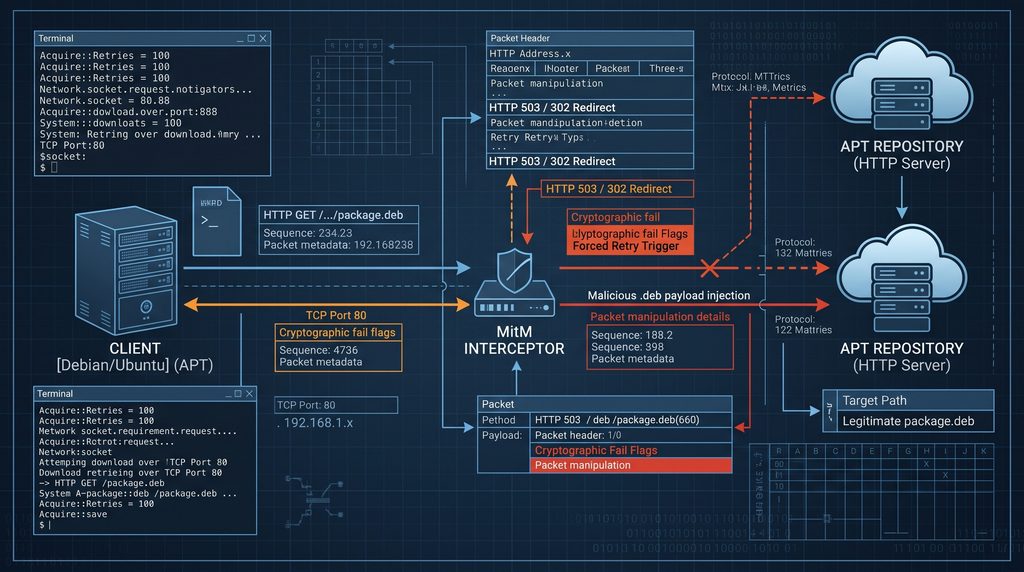
[ Target Machine (APT) ]
       |
       | 1. HTTP GET /legitimate-package.deb
       v
[ MitM Attacker ] --(Drops/Redirects request)--> [ Legitimate Repo ]
       |
       | 2. HTTP 500 / Redirect Error (Forces APT to Retry)
       v
[ Target Machine (APT) ]
       |
       | 3. Retries Download (Acquire::Retries triggered)
       v
[ MitM Attacker ] --(Injects Malicious .deb file)
       |
       | 4. Malicious Package Received & Executed as Root
       v
[ System Compromised ]
Technical Detail: How the Vulnerability Works
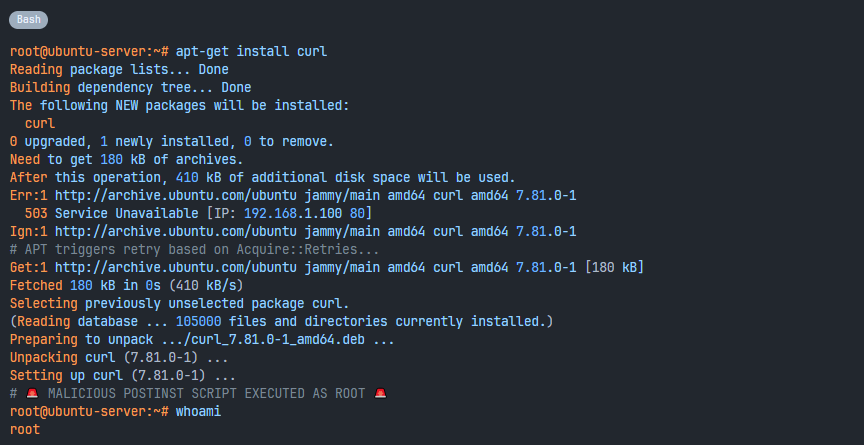
The technical execution of CVE-2026-109518 is an elegant abuse of a standard reliability feature. Under normal circumstances, if APT encounters a network hiccup or a temporary server error, it relies on the Acquire::Retries directive to re-establish the connection and attempt the download again. This is intended to prevent broken installations on unstable networks. However, the core flaw exists because the developers failed to enforce strict cryptographic state verification consistently across these subsequent retry attempts over HTTP. An attacker actively monitoring the network traffic waits for an apt-get install or apt update command to be initiated by the victim. When the system requests a package, the attacker intercepts the HTTP traffic and intentionally responds with specific HTTP status codes, such as temporary redirects (3xx) or server errors (5xx). This artificial disruption forces APT to drop the initial, secure transaction flow and immediately fall back to its retry routine.
It is exactly during this narrow window of the retry phase that the exploit occurs. The MitM attacker intercepts the retried HTTP request and serves a heavily modified .deb package in place of the requested software. Because the validation checks are bypassed or improperly handled during the forced HTTP redirect sequence, APT accepts the fraudulent package. The pre-install (preinst) or post-install (postinst) scripts embedded within the malicious .deb file are then executed natively by the system as root.
- Traffic Interception: The attacker monitors port 80 to catch outbound APT HTTP requests.
- Error Injection: The attacker serves specific HTTP 503 or 302 responses to disrupt the initial download state.
- Retry Trigger: APT automatically initiates a new request based on the vulnerable
Acquire::Retrieslogic. - Payload Execution: The malicious
.debis unpacked, and its scripts run with maximum system permissions.
Affected Software & Plugins
The scope of CVE-2026-109518 is extensive, affecting a vast ecosystem of Debian and Ubuntu-based distributions deployed across enterprise servers, cloud environments, and personal workstations. The vulnerability’s presence is primarily dictated by the default network configuration shipped with the operating system. Because package managers are fundamental components, any downstream distribution (like Linux Mint or Pop!_OS) that relies on the main APT repositories and standard configurations inherits this vulnerability. The critical differentiator between a vulnerable and secure system out-of-the-box is the Acquire::Retries setting. Modern distributions have this feature enabled by default to improve user experience on unstable connections, inadvertently opening the door to this exploit. Conversely, older legacy systems are technically immune under their factory settings, but frequently become vulnerable because administrators often enable the retry feature manually to stabilize automated deployment scripts and continuous integration pipelines.
- Debian 12 (Bookworm): Vulnerable by default due to standard retry configurations.
- Ubuntu 22.04 LTS, 24.04 LTS & 26.04 LTS: Vulnerable by default; patched builds are actively being distributed to security archives.
- Debian 11 & Ubuntu 20.04 LTS: Not vulnerable by default, but highly exposed if
Acquire::Retriesis manually configured by users or scripts. - Ubuntu 14.04 (via Ubuntu Pro): Affected under specific retry configurations, but currently receiving patched versions through Extended Security Maintenance.
Conclusion
CVE-2026-109518 serves as a stark reminder that even the most trusted, foundational utilities in an operating system can harbor critical security flaws. The APT package manager has been a reliable cornerstone for Linux administrators for decades, but this vulnerability demonstrates how features designed for reliability—like automated HTTP retries—can be weaponized by a sophisticated Man-in-the-Middle attacker. It highlights the inherent risks of relying on unencrypted HTTP traffic for system-level software distribution, even when cryptographic package signing mechanisms are assumed to be in place. While there are currently no reported instances of this vulnerability being actively exploited in the wild, the detailed public disclosure provides threat actors with a clear blueprint for attack. Local network adversaries, malicious Wi-Fi hotspots, or compromised proxy servers could leverage this flaw to silently hijack enterprise servers or personal workstations during routine updates. The ease with which root access is achieved makes this a highly attractive vector for initial access and lateral movement within corporate networks. Immediate remediation is non-negotiable for anyone managing Debian or Ubuntu infrastructure. System administrators must prioritize patching APT to the latest secure versions provided by their respective distribution maintainers. Until patches can be fully validated and deployed, security teams should actively audit their configurations to determine if Acquire::Retries is needlessly enabled on older systems, and enforce strict network monitoring to detect anomalous HTTP redirect behaviors aimed at package repositories.