
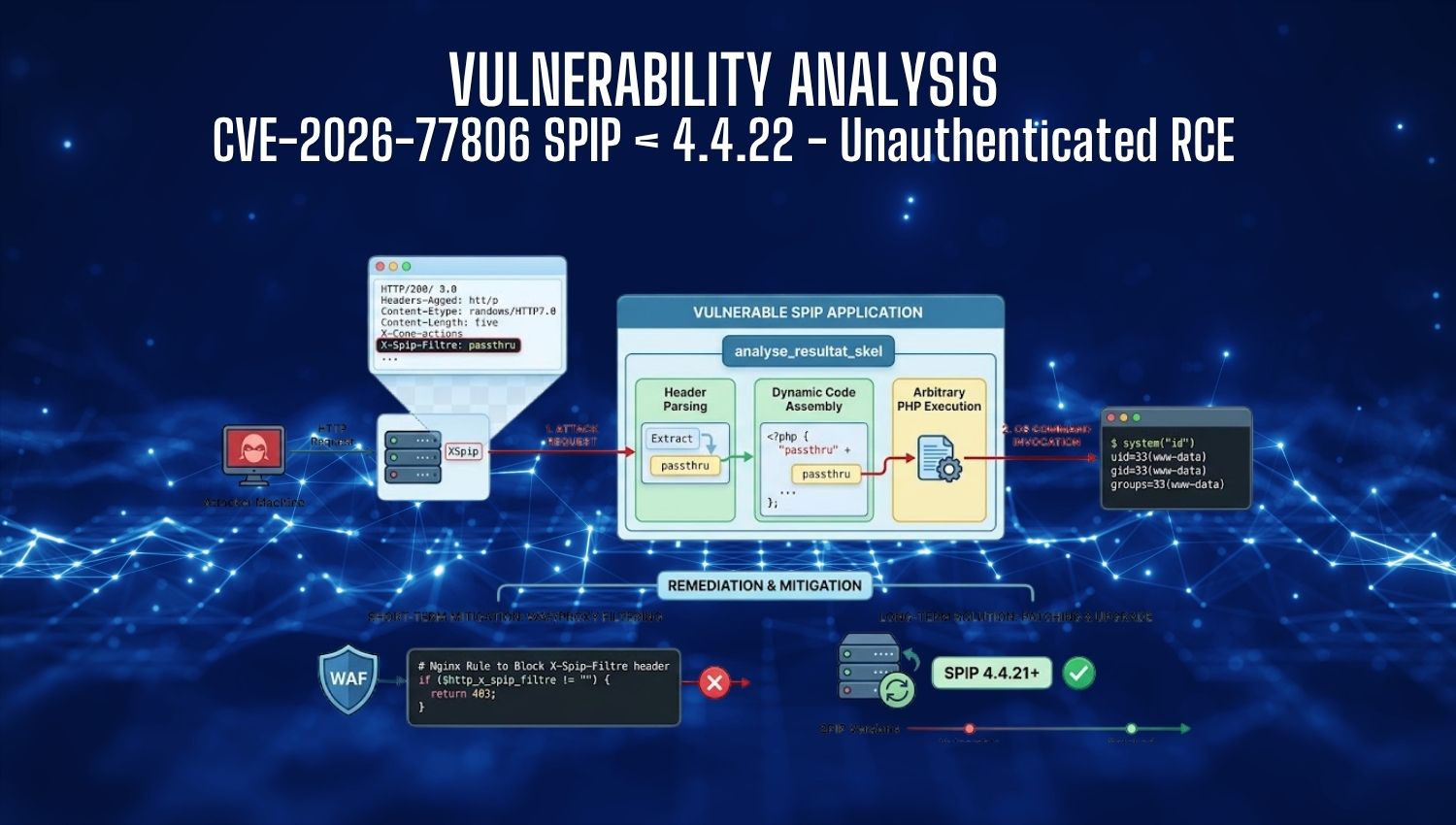
Introduction
Content Management Systems (CMS) form the backbone of millions of web applications worldwide. When a critical vulnerability surfaces within a core CMS framework, the potential blast radius is immense. CVE-2026-77806 represents one such severe threat—a critical, unauthenticated Remote Code Execution (RCE) flaw affecting the SPIP publishing framework in versions prior to 4.4.21. Achieving a CVSS score of 9.8 (Critical), this vulnerability allows unauthenticated remote attackers to execute arbitrary system commands on the underlying web server. Because SPIP powers numerous governmental, academic, and media portals across Europe and North America, understanding the mechanics of this vulnerability and implementing swift remediation is vital for security teams. Furthermore, because this flaw requires zero authentication or privilege pre-requisites, automated threat actors can launch widespread exploitation campaigns against internet-facing web assets. Left unpatched, vulnerable instances risk full system compromise, sensitive data exfiltration, and lateral movement across host networks.
Learning Objectives
By reading this technical analysis, you will be able to:
- Identify the root cause behind CVE-2026-77806 and the mechanics of
X-Spip-Filtreheader processing. - Understand how the SPIP template compilation process processes untrusted input into PHP code execution.
- Evaluate the risks associated with unauthenticated HTTP header injection in template engines.
- Implement effective remediation steps, including immediate WAF rules, web server restrictions, and patching.
What is SPIP < 4.4.22 – Unauthenticated RCE (CVE-2026-77806)
SPIP (Système de Publication pour l’Internet) is a widely used open-source Content Management System (CMS) designed primarily for managing content-heavy websites, online journals, and large-scale public portals. Due to its extensive use across European government institutions, academic organizations, and media outlets, vulnerabilities within its core architecture carry high operational risk. The security flaw designated as CVE-2026-77806 represents a critical vulnerability in SPIP’s processing framework, enabling unauthenticated threat actors to achieve full Remote Code Execution (RCE) on vulnerable servers. At the heart of the issue is a fundamental flaw in SPIP’s proprietary template rendering logic. The application relies on dynamic skeleton (skel) compilation to convert layout files into executable PHP code on the fly. During this compilation step, SPIP ingests user-controlled input provided through custom HTTP request headers—most notably the X-Spip-Filtre header. Because the engine treats the contents of this header as trusted instructions for chaining template filters, an attacker can manipulate header values to inject and execute arbitrary PHP functions directly into the server’s memory space.
The danger of this vulnerability is significantly amplified by its exposure surface. The template endpoints responsible for parsing these headers are publicly reachable and do not require any active session, user credentials, or administrative privileges. Consequently, any unauthenticated visitor can target public-facing endpoints (such as forum submission or comment preview pages) to execute operating system commands under the security context of the web server process (e.g., www-data).
- Unauthenticated Attack Surface: The vulnerability can be exploited completely remotely without needing valid user accounts, API keys, or session tokens.
- Header-Based Payload Delivery: The exploit relies on custom HTTP headers (
X-Spip-Filtre) rather than conventional POST body or URL parameter inputs. - Complete Infrastructure Compromise: Successful execution grants full command delivery capabilities, leading to data theft, persistent backdoors, or lateral network movement.
- Evasion of Built-in Defenses: The attack bypasses standard SPIP security mechanisms (écran de sécurité) because those default controls fail to inspect custom HTTP headers for dangerous PHP filter strings.
  +-------------------+
  |     Attacker      |
  +---------+---------+
            |
            | 1. HTTP Request (GET/POST)
            |    Header: X-Spip-Filtre: system("id")
            v
  +-------------------------------------------------+
  |                Target Web Server                |
  |  +-------------------------------------------+  |
  |  |               SPIP CMS                    |  |
  |  |                                           |  |
  |  |  2. Ingests request & custom headers      |  |
  |  |  3. Passes header to template compiler    |  |
  |  |     (analyse_resultat_skel)               |  |
  |  |  4. Injects filter into compiled PHP      |  |
  |  +---------------------+---------------------+  |
  +------------------------|------------------------+
                           |
                           v
            +------------------------------+
            |  5. Arbitrary OS Execution   |
            |     Context: www-data        |
            +------------------------------+
Technical Detail: How the Vulnerability Works
The primary mechanism behind this vulnerability resides within SPIP’s underlying core template compilation engine, specifically located in the analyse_resultat_skel function. SPIP relies on an internal template syntax that allows developers and administrators to apply dynamic filters to data fields (e.g., modifying text cases, stripping HTML tags, or manipulating image assets). Under standard operations, these filters are evaluated during the compilation phase when converting raw SPIP templates into cached, executable PHP scripts. However, the application design contains an oversight: it exposes template compilation directives directly to client-controlled HTTP headers. When a client sends a request to any endpoint that invokes template rendering, SPIP automatically checks for the presence of the X-Spip-Filtre header. The core engine parses the values passed within this header and directly appends them as additional PHP filter function calls within the dynamic template code array without applying strict function allowlists or input sanitization.
Once the template compiler finishes assembling the PHP script string, it writes the result to disk or executes it dynamically via internal evaluation mechanisms. Because the injected function string originates directly from the attacker’s HTTP header, standard PHP execution primitives (such as system, passthru, exec, or shell_exec) are invoked directly under the operational permissions of the web server daemon. This allows an attacker to achieve instant remote command execution in a single HTTP request.
- Header Extraction: The core engine ingests client request headers and extracts raw, untrusted strings directly from
X-Spip-Filtre. - Dynamic Code String Assembly: SPIP concatenates the unstripped filter string into the dynamic PHP snippet intended for execution within
analyse_resultat_skel. - Unsanitized Function Execution: The compiled output contains raw native PHP functions capable of triggering operating system commands.
- Payload Execution Context: The commands execute with the full operational privileges of the underlying web process (e.g.,
www-dataorapache).
$ curl -s -k -X POST "https://target-spip-domain.com/spip.php?page=forum" \
  -H "Host: target-spip-domain.com" \
  -H "X-Spip-Filtre: passthru" \
  -d "arg=id"

uid=33(www-data) gid=33(www-data) groups=33(www-data)
Linux spip-prod-server 5.15.0-88-generic #98-Ubuntu SMP Mon Oct 2 15:18:56 UTC 2023 x86_64 x86_64 x86_64 GNU/Linux
Remediation & Mitigation
To effectively mitigate the risks associated with CVE-2026-77806, security teams must deploy a defense-in-depth strategy that combines immediate patch management with proactive network-level controls. Relying solely on default application-layer security scripts is insufficient, as built-in protection mechanisms fail to detect malicious header-based inputs. Organizations must prioritize upgrading vulnerable installations while applying perimeter-level web application firewall (WAF) filters to instantly block suspicious incoming requests before they reach the core PHP application.
- Apply Core Updates: Upgrade all SPIP instances immediately to patched versions (4.4.21 or later) via standard package managers or the official
spip_loaderutility. - Implement WAF & Proxy Header Filtering: Configure edge proxies (such as Nginx, Apache, or Cloudflare) to drop any incoming HTTP request containing the
X-Spip-Filtreheader. - Restrict Process Permissions: Ensure the underlying web server user (
www-data) operates with minimal system privileges and restricted execution capabilities across sensitive directory paths. - Conduct Active Log Analysis: Periodically audit web server access logs for anomalous GET or POST requests directed toward dynamic template endpoints containing custom
X-Spip-header flags.
# Example Nginx log check for suspicious X-Spip-Filtre header activity
$ grep -i "X-Spip-Filtre" /var/log/nginx/access.log

192.168.1.105 - - [27/Aug/2026:14:22:01 +0000] "POST /spip.php?page=forum HTTP/1.1" 200 4522 "-" "Mozilla/5.0" "X-Spip-Filtre: passthru"
10.0.4.12 - - [27/Aug/2026:14:25:39 +0000] "GET /spip.php?page=sommaire HTTP/1.1" 403 162 "-" "curl/7.81.0" "X-Spip-Filtre: system"
Conclusion
CVE-2026-77806 serves as a stark reminder of the risks associated with trusting user-controlled HTTP headers within complex template processing logic. By allowing arbitrary parameters passed through the X-Spip-Filtre header to directly influence code execution during template compilation, SPIP introduced a critical design oversight. This flaw highlights how unconventional input vectors—often overlooked during standard security assessments—can bypass conventional application-level defenses. The unauthenticated nature of this vulnerability significantly heightens the overall operational risk for organizations hosting SPIP instances. Because an attacker requires zero pre-existing privileges, valid user sessions, or specialized access credentials, vulnerable endpoints become immediate targets for automated mass-scanning frameworks. In environments where web server processes maintain broad privileges, successful exploitation can swiftly escalate from localized code execution to full host takeover. To neutralize this threat, system administrators must prioritize immediate deployment of vendor-supplied patches (version 4.4.21 or later). In scenarios where immediate application updating is delayed by operational constraints, network-level mitigations—such as stripping custom X-Spip- headers at the reverse proxy or WAF layer—must be enacted without delay to disrupt incoming attack vectors before they reach the PHP engine.
Ultimately, mitigating modern web security threats demands a robust, defense-in-depth posture. Combining rapid patch management, stringent perimeter filtering, strict process isolation, and continuous log auditing remains the most reliable strategy for protecting web infrastructure against both known exploits and emerging zero-day vulnerabilities.