
Introduction
In cybersecurity operations, backup management servers represent high-value targets because they hold centralized control over system recovery infrastructure and host sensitive organizational data. In late 2026, security researchers observed threat actors exploiting critical zero-day vulnerabilities in AhsayCBS—a widely deployed cloud backup server solution—to execute unauthenticated remote code execution (RCE). By chaining an authentication bypass vulnerability with a path traversal command injection flaw, malicious actors deployed webshells, established sandbox-evading Python implants, and executed cryptojacking routines across exposed enterprise networks. This article analyzes the technical mechanism of the vulnerability chain, the post-exploitation tactics, affected components, and recommended mitigation strategies.
Learning Objectives
After reading this article, security professionals and enterprise administrators will be able to:
- Identify the root causes of authentication bypass and command injection vulnerabilities within backup software APIs.
- Understand defense evasion techniques, such as deploying embedded Python environments and automated script monitoring.
- Implement remediation and hardening procedures to safeguard exposed AhsayCBS installations against persistent backdoors.
- Analyze the multi-stage exploit chain combining
CVE-2026-105133andCVE-2026-105134to achieve unauthenticated remote code execution.
AhsayCBS Vulnerabilities and Sandbox-Evading Python Backdoors

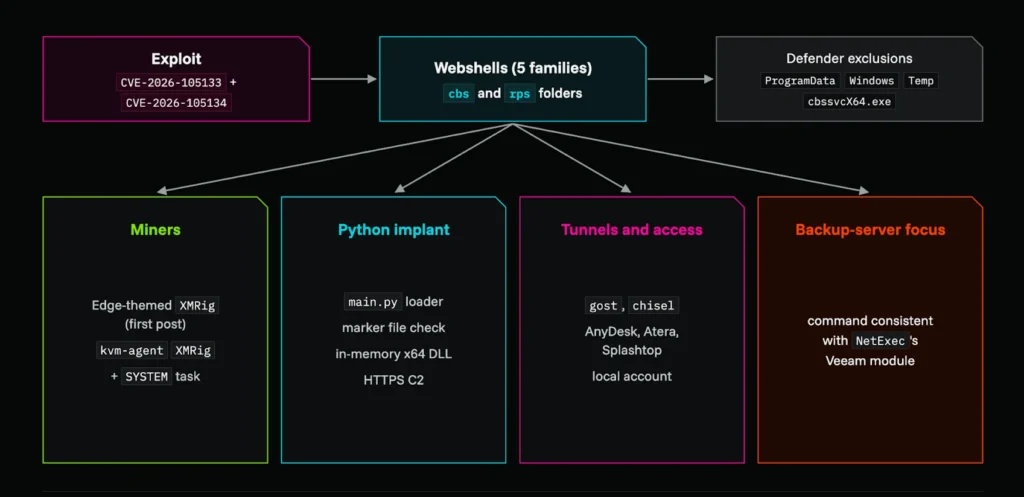
The Ahsay Cloud Backup Suite (AhsayCBS) serves as a core infrastructure utility designed to handle centralized backup, recovery, and data management for Managed Service Providers (MSPs) and enterprise IT environments. Because these backup servers maintain elevated administrative rights and harbor direct connections to critical endpoints across the enterprise, they represent high-priority targets for malicious actors. Cyber threat intelligence teams identified widespread in-the-wild exploitation targeting unpatched AhsayCBS instances, allowing attackers to achieve unauthenticated remote code execution and seize complete administrative control over host systems. Upon gaining initial access, adversaries established web-based persistence mechanisms by planting obfuscated JavaServer Pages (JSP) webshells—such as nsmind.jsp disguised as routine image-upload assets—into public-facing web applications. To bypass contemporary Endpoint Detection and Response (EDR) solutions, heuristic detection, and automated dynamic sandbox analysis, threat actors deployed a custom, self-contained Python runtime environment onto compromised systems. By delivering a portable Python binary bundled with custom Command-and-Control (C2) implants, the attackers executed malicious logic directly within the embedded interpreter. This design choice bypassed traditional telemetry markers, as the implant conducted network communications, process manipulations, and command executions without spawning monitored parent-child shell processes like cmd.exe or powershell.exe. Operating through isolated interpreter threads effectively concealed the backdoor’s behavioral signature from behavioral monitoring engines and sandboxing technologies.
Beyond maintaining covert C2 access, adversaries leveraged compromised AhsayCBS servers to deploy secondary payloads aimed at resource exploitation and credential theft. The attackers installed Monero (XMRig) cryptojacking miners, configuring them to execute as persistent system services masked under legitimate operational names such as MicrosoftEdgeUpdateSvc. To sustain long-term operations without detection, the mining modules were paired with active monitoring scripts programmed to kill mining processes instantly whenever Task Manager or recognized security monitoring software was launched. Concurrently, attackers utilized post-exploitation modules to extract stored backup credentials and establish encrypted tunnels across internal networks.
- Centralized Target Surface: Exploited AhsayCBS servers grant threat actors direct access to enterprise backup repositories and system-level administrative credentials.
- Persistent Webshell Placement: Obfuscated JSP webshells (e.g.,
nsmind.jsp) were deployed within web-accessible Tomcat directories to maintain permanent entry points. - Sandbox & EDR Evasion: Custom embedded Python runtimes ran C2 implants directly in memory spaces without invoking standard command-line interpreters.
- Stealth Resource Exploitation: Cryptojacking payloads disguised as
MicrosoftEdgeUpdateSvcused active monitoring scripts to suspend execution during administrator inspection.
Technical Detail: How the Vulnerability Chain Works
Step 1: Ahsay AhsayCBS – Authentication Bypass (CVE-2026-105133)
The first stage of the exploit chain targets the JSON API handler embedded within the server’s backend core (com.ahsay.c.json.JSONApi.execute()). Under standard operational conditions, administrative endpoints and sensitive API routines validate caller sessions using the checkSysPwd() method to ensure proper identity verification. However, flaw CVE-2026-105133 arises from a critical flaw in the API authentication logic, which automatically skips password and session validation whenever an incoming JSON request includes the specific key-value pair {"FromServlet": "Y"}. By embedding this parameter into custom HTTP requests, unauthenticated remote attackers completely bypass identity checks, granting them unrestricted access to internal administrative API handlers. Beyond simply accessing internal functions, bypassing this initial barrier exposes administrative routines that were never intended to process untrusted external input. Because the application trusts requests bearing the servlet flag, adversaries can interact with lower-level administrative modules without supplying credentials or valid session tokens. This authentication bypass sets the foundation for secondary exploitation, allowing threat actors to manipulate server-side file management interfaces, issue administrative API calls, and prepare the target environment for arbitrary payload delivery.
Step 2: Ahsay AhsayCBS – Command Injection (CVE-2026-105134)
With administrative authentication bypassed, attackers immediately pivot to target the replication file upload endpoints (PUT /rps/obs7/rpsfile/upload or /rps/api/json/UpdateReceivers.do). The underlying replication receiver module parses user-controlled HTTP request headers—most notably UserHome and TopDir—to compute destination file paths via internal functions like getReplicatedPath(). However, the software fails to enforce proper sanitization, directory traversal protections, or parameter denylist filters (com.ahsay.c) on these user-supplied values, creating a dangerous path traversal and command injection condition tracked as CVE-2026-105134. By injecting directory traversal sequences such as ../../webapps/ into these HTTP headers, attackers can manipulate the file resolution logic to write arbitrary files outside the designated replication directory. This enables direct write access to Apache Tomcat web-accessible directories, allowing threat actors to plant executable JSP webshells or run OS-level commands directly. Because the underlying AhsayCBS services typically execute with administrative system privileges, the resulting code execution allows attackers to gain complete, unauthenticated system-level control over the underlying host.
Affected Software & Plugins
The exploitation campaign primarily targets vulnerable installations of the AhsayCBS Cloud Backup Server across enterprise networks and Managed Service Provider (MSP) environments. Specifically, all AhsayCBS software installations running versions 10.3.4 and earlier are susceptible to this attack chain. The exposure is exacerbated by the server’s backend structure, where core administrative servlets and API functions process incoming untrusted web requests without enforcing adequate session controls or strict input validation.
The vulnerability chain relies on abusing specific application endpoints to bypass identity checks and achieve unauthorized file system access. Attackers leverage flaws within the JSON API handler—specifically JSONApi.execute()—to bypass authentication, while simultaneously targeting replication handlers such as /rps/obs7/rpsfile/upload and /rps/api/json/UpdateReceivers.do to execute path traversal operations. The table below details the impacted software versions, vulnerable modules, and key Indicators of Compromise (IOCs) identified during post-exploitation analysis:
- Vulnerable Application Versions: AhsayCBS Cloud Backup Server versions
10.3.4and all earlier releases. - API Authentication Bypass Handler: The internal JSON API interface (
com.ahsay.c.json.JSONApi.execute()) via the{"FromServlet": "Y"}parameter. - Replication File Upload Endpoints: The replication receiver endpoints (
/rps/obs7/rpsfile/uploadand/rps/api/json/UpdateReceivers.do). - Persistence & Webshell Artifacts: Obfuscated JavaServer Pages (JSP) web components, including
nsmind.jspdisguised as image uploaders. - Evasion & C2 Infrastructure: Portable embedded Python runtime environments executing custom Command-and-Control (C2) implants directly in memory.
- Disguised Cryptojacking Payloads: Monero (XMRig) mining executables running under masqueraded service names such as
MicrosoftEdgeUpdateSvc.
Conclusion
The exploitation of CVE-2026-105133 and CVE-2026-105134 underscores the severe cybersecurity risks associated with unauthenticated entry points in enterprise infrastructure utilities. Because backup management servers like AhsayCBS maintain broad administrative privileges and hold sensitive organizational data, compromising them grants adversaries a direct gateway into internal networks. The seamless combination of authentication bypass and command injection techniques illustrates how modern threat actors exploit legacy API handlers to bypass perimeter defenses entirely. To mitigate these immediate threats, security administrators must prioritize updating affected AhsayCBS servers to patched software versions, specifically 10.3.4.45, 9.15.2.70, or newer releases. Beyond applying software patches, organizations should enforce strict access controls by shielding management interfaces behind Virtual Private Networks (VPNs) or IP allowlists. Restricting public internet exposure significantly narrows the attack surface and prevents unauthorized actors from reaching vulnerable API endpoints.
Finally, because attackers often plant persistent backdoors during initial access, applying security patches alone is insufficient for systems that were exposed while vulnerable. Security teams should conduct thorough threat hunting across web root directories for unauthorized JavaServer Pages (JSP) webshells and audit active processes for suspicious embedded Python runtimes. If evidence of compromise is detected, organizations should initiate full incident response protocols, rebuild affected instances from clean images, and rotate all administrative credentials across the environment.