
Introduction
Containerized applications have become the undisputed backbone of modern enterprise architectures, transforming how software is packaged, shipped, and scaled across complex hybrid-cloud environments. As microservices proliferate, container registries serve as the central repositories for storing, managing, and distributing these vital artifacts, making them high-value targets for malicious threat actors. Red Hat Quay is widely deployed across enterprise ecosystems to ensure seamless, secure image management and distribution. However, the discovery of CVE-2026-123710—a critical vulnerability carrying a maximum CVSS score of 9.8—underscores the severe risks posed by authorization flaws in core infrastructure. This article delivers a comprehensive technical breakdown of the vulnerability, detailing its underlying mechanism, software supply chain implications, and essential mitigation strategies to safeguard enterprise environments against potential compromise.
Learning Objectives
By the end of this article, you will understand:
- The core nature and severity scope of CVE-2026-123710 in Red Hat Quay.
- The specific architectural mechanism that allows unauthenticated threat actors to bypass security controls.
- The potential risks to software supply chain integrity stemming from unauthorized signing key manipulation.
- Practical mitigation steps, including patching guidelines, network-level restrictions, and audit log analysis techniques.
What is Critical Security Vulnerability in Red Hat Quay (CVE-2026-123710)

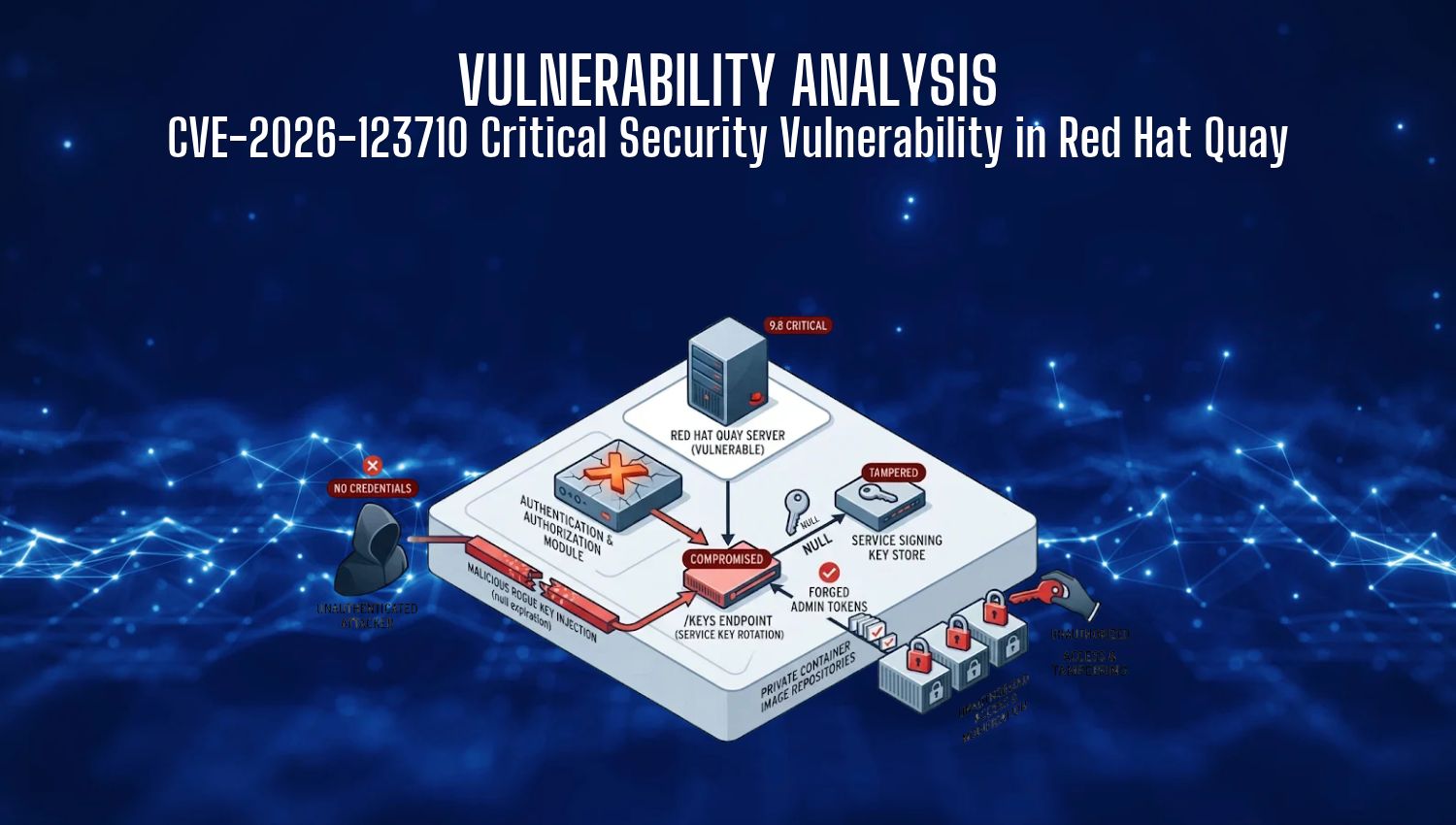
CVE-2026-123710 represents a critical authorization bypass vulnerability that severely impacts Red Hat Quay 3 and Quay 5 deployments. Rated at a maximum 9.8 on the CVSS scale, this vulnerability permits unauthenticated remote attackers to interact directly with sensitive registry endpoints without presenting valid credentials, completely subverting the authentication boundaries designed to protect private enterprise assets. In typical enterprise environments, container registries hold proprietary code, sensitive configuration data, and production-ready images. When an authentication mechanism fails at this foundational level, the confidentiality and integrity of every containerized application stored within the registry are severely compromised, leaving organizations vulnerable to widespread data exposure, intellectual property theft, and operational disruption.
The threat posed by this vulnerability extends far beyond simple data theft or unauthorized viewing. By granting malicious actors unauthorized administrative capabilities, CVE-2026-123710 enables deep persistence and malicious modifications across enterprise software supply chains, effectively transforming a trusted repository into an active vector for malware distribution and downstream system compromise.
- Affects Red Hat Quay 3 and Quay 5 major enterprise deployments.
- Critical CVSS severity score of 9.8.
- Requires zero authentication or prior credentials to exploit.
- Compromises entire repository ecosystems and private image integrity.
+-----------------------+     Unauthenticated Request     +----------------------+
|   Malicious Attacker  | ------------------------------> | Red Hat Quay Server  |
|   (No Credentials)    |      to vulnerable /keys        | (CVE-2026-123710)    |
+-----------------------+                                 +----------------------+
                                                                     |
                                                                     v
                                                          +----------------------+
                                                          | Unauthorized Rogue   |
                                                          | Signing Key Uploaded |
                                                          +----------------------+
Technical Detail: How the Vulnerability Works
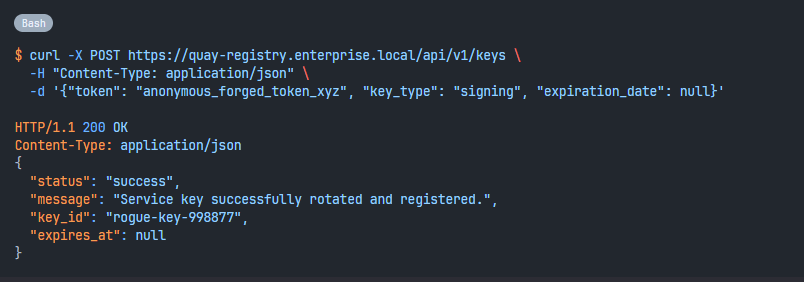
The root cause of CVE-2026-123710 lies in an input validation defect, categorized under CWE-1287, residing specifically within Quay’s /keys endpoint. This internal endpoint is originally designed to handle service key rotation operations securely, requiring strict validation of administrative contexts before processing any changes to cryptographic keys. During an active exploit, an unauthenticated threat actor constructs a custom, anonymous registry token and submits it directly to the vulnerable /keys endpoint. Due to deficient input verification routines, the Quay server fails to properly interrogate the token’s provenance, mistakenly treating it as a legitimate administrative credential.
This authorization bypass empowers the attacker to upload a rogue, self-signed approval key configured with an indefinite or null expiration date. Because the platform accepts this key as authoritative, any subsequent signing operations leverage it, granting the attacker unhindered access to read, overwrite, or delete private container images across all repositories.
- Input validation flaw (CWE-1287) isolated within the
/keysrotation endpoint. - Acceptance of self-generated, anonymous registry tokens by the server.
- Upload of rogue signing keys featuring indefinite or
nullexpiration timestamps. - Generation of trusted, forged authentication tokens valid across all repositories.
Solution and Interim Measures
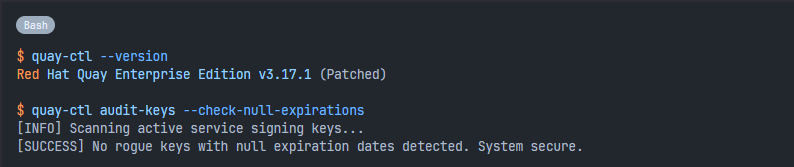
Addressing CVE-2026-123710 requires a robust two-pronged approach combining immediate defensive hardening with permanent vendor-supplied software patches. Because the vulnerability stems from core application logic flaws, temporary workarounds only mitigate active exploitation risks until a full upgrade can be safely deployed across production environments. Administrators must urgently update their Quay instances to the latest secure releases provided by Red Hat. Simultaneously, enforcing strict perimeter controls and conducting thorough forensic audits of existing service keys ensure that any prior unauthorized tampering is identified, contained, and neutralized immediately.
- Apply official Red Hat patches for Quay versions 3.17, 3.15, 3.14, 3.10, and 3.9.
- Enforce network-level restrictions on the
/keysendpoint via WAF or load balancer rules. - Restrict internal administrative routing exclusively to trusted cluster nodes.
- Audit logs for suspicious
service_key_rotateevents withnullexpiration dates.
Conclusion
CVE-2026-123710 highlights the critical importance of rigorous input validation and robust access controls in enterprise container infrastructure. As container registries continue to anchor modern software delivery pipelines, even a single overlooked validation flaw in auxiliary endpoints can jeopardize an entire organization’s operational security and trustworthiness. Proactive vulnerability management, rapid patch deployment, and defense-in-depth strategies are essential for countering sophisticated authorization bypass threats. Organizations cannot rely solely on perimeter security; they must enforce strict internal endpoint segmentation and continuous cryptographic auditing to maintain visibility over their assets. By maintaining vigilance, securing administrative interfaces, and keeping registry platforms strictly updated, security teams can preserve the integrity of their software supply chain and ensure that containerized workloads remain resilient against evolving cyber threats.