
Introduction
Modern web applications heavily leverage template engines to optimize dynamic content generation, manage complex user interfaces, and streamline automated client communication. However, insufficient input validation and improper sanitization can turn these highly flexible engines into primary targets for malicious actors seeking server-side control. When software platforms integrate powerful rendering utilities without enforcing strict isolation boundaries, the underlying server inherently becomes exposed to structural manipulation. This article analyzes CVE-2026-28496, a critical Server-Side Template Injection (SSTI) vulnerability discovered in FOSSBilling, an open-source billing and client management platform widely utilized within hosting and SaaS ecosystems. Left unpatched, this specific flaw allows attackers to transcend application layer constraints, manipulate template execution environments, and ultimately transition from basic input injection to unauthorized command execution.
Learning Objectives
By completing this article, you will achieve the following theoretical and technical competencies:
- Understand the core mechanics of Server-Side Template Injection (SSTI) and its specific impact on the Twig template engine.
- Analyze the root causes of CVE-2026-28496 within FOSSBilling’s architecture and its interaction with the Dependency Injection (DI) Container.
- Comprehend how separate vulnerabilities (such as authentication bypasses) can be chained together to form a devastating Unauthenticated Remote Code Execution (RCE) vector.
- Learn best practices for secure template engine configuration and application hardening against advanced server-side attacks.
What is FOSSBilling – Server-Side Template Injection CVE-2026-28496
CVE-2026-28496 represents a critical security flaw identified within the template processing framework of the FOSSBilling platform, an open-source solution designed for automation, billing, and client management. Carrying an exceptionally high CVSS v4.0 base score of 9.4, this vulnerability poses an immediate threat to infrastructure integrity. The underlying issue manifests because the software architecture allows user-supplied inputs and external data configurations to pass directly into the template rendering cycle without subjected to rigorous filtering, sanitization, or input validation. Since FOSSBilling relies heavily on the popular, feature-rich PHP-based Twig engine for handling dynamic layouts and client communications, this lack of structural defense creates an expansive attack surface. When a template engine operates without strict context-awareness or restriction boundaries, it treats untrusted data as executable instructions rather than flat, passive strings. Consequently, remote adversaries can manipulate this behavior to break free from standard application-layer restrictions, query internal components, and ultimately execute arbitrary code directly on the underlying hosting server.
The widespread adoption of FOSSBilling by hosting providers and domain registrars amplifies the real-world impact of this zero-day discovery. Because billing platforms inherently handle sensitive infrastructure credentials, API tokens, and payment workflows, an exploitation at this layer could lead to lateral movement across internal networks, complete database exfiltration, and full host takeover. Security researchers highlight this flaw as a prominent example of how trust boundaries fail when powerful backend engines interact directly with unverified external parameters.
- Critical Severity Metric: It possesses a near-maximum CVSS v4.0 rating of 9.4, classifying it as an immediate priority for enterprise and individual system administrators globally.
- Flawed Core Engine: The vulnerability targets FOSSBilling’s implementation of the Twig Template Engine, exploiting a fundamental lack of server-side sanitization and validation on user-controlled inputs.
- Direct RCE Capability: Successful exploitation bypasses logical software boundaries, enabling remote threat actors to transition directly from basic text injection to full Remote Code Execution (RCE) at the server level.
- Target Environment Risks: Due to FOSSBilling’s specific operational role in automated hosting and client environments, compromising this component puts system databases, financial records, and network-connected services at imminent risk.
Technical Detail: How the Vulnerability Works
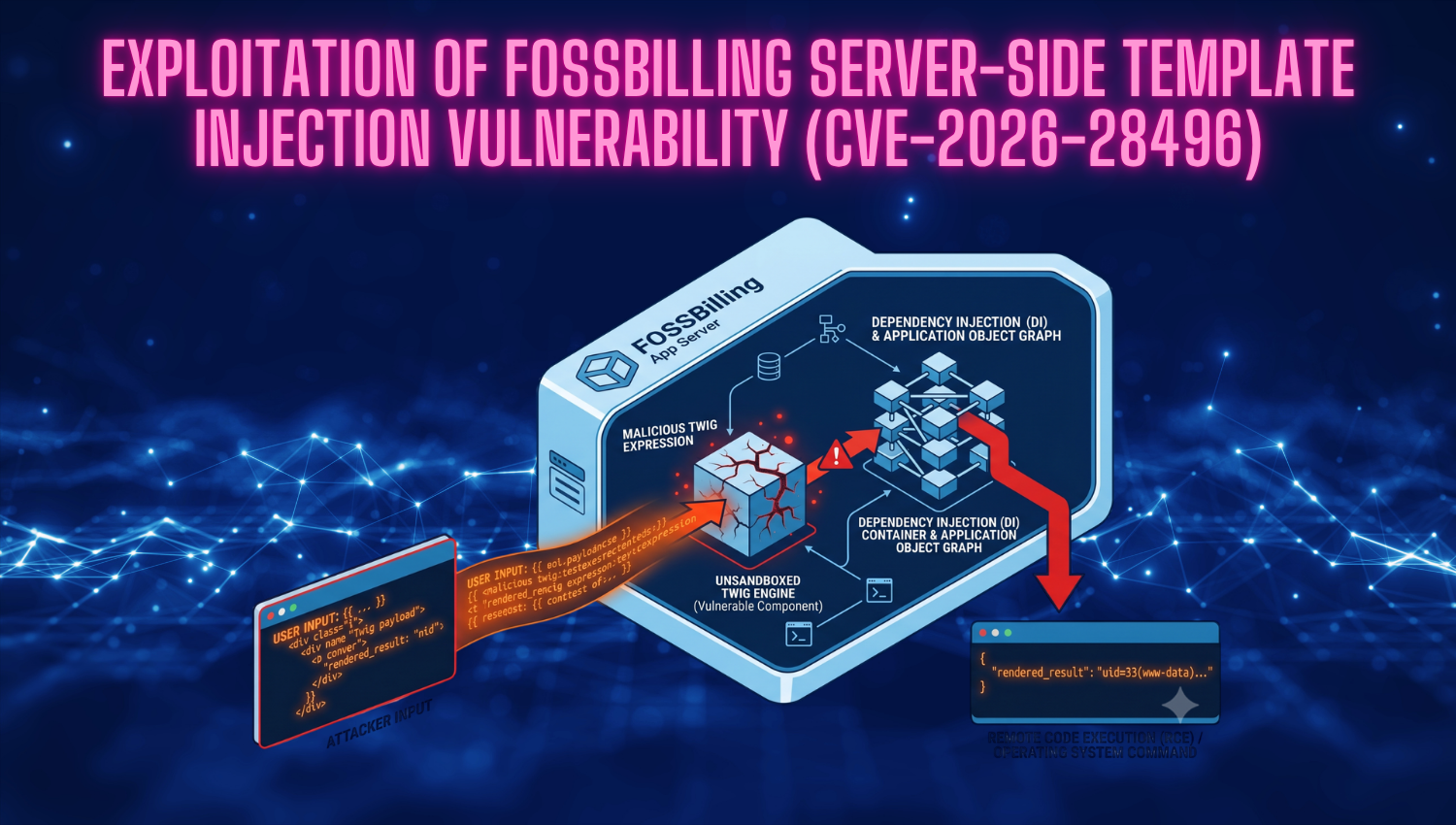
The technical root cause of this high-severity vulnerability is officially classified under CWE-1336 (Improper Neutralization of Special Elements in a Content Template). In affected versions of FOSSBilling, the application handles dynamic backend strings processed through custom email layouts, automated mass mail marketing campaigns, third-party payment adapters, or specific internal system API endpoints like /api/system/string_render. When these inputs are handled, they are directly interpreted by the underlying PHP-based Twig template engine without any active sandbox environment or rigid structural encapsulation. Because the template engine operates without isolation boundaries, it inherently allows injected template expressions to break out of their intended lexical scope. Instead of treating the input as a passive string to be rendered visually, the engine grants the template syntax direct interaction privileges with the application’s global dependencies and its core Dependency Injection (DI) Container. When a threat actor successfully injects malicious Twig syntax—such as the standard expression delimiters {{ ... }} or control tags {% ... %}—the engine evaluates the expressions server-side. By traversing the application’s object graph via the exposed DI container, an attacker can programmatically instantiate sensitive system classes, invoke forbidden internal methods, and execute arbitrary operating system commands at the web server’s privilege level.
This vulnerability becomes significantly more dangerous when analyzed in the context of advanced exploit chaining. While modifying administrative templates normally requires a high-privileged administrator session, CVE-2026-28496 can be natively chained with a separate authentication bypass flaw tracked as GHSA-78×5-c8gw-8279. By pairing these two distinct vulnerabilities together, an unauthenticated external attacker can systematically bypass frontend access control layers, reach the unprotected /api/system/string_render API endpoint, inject the Twig payload, and achieve full Unauthenticated Remote Code Execution (RCE) without possessing any prior credentials.
Exploitation Walkthrough: HTTP Request and Response Examples
The following architectural examples simulate how an unauthenticated attacker targets the vulnerable API endpoint by feeding a malicious Twig expression designed to execute the system command id via PHP’s system execution functions.
Malicious HTTP Request:
POST /api/system/string_render HTTP/1.1
Host: vulnerable-fossbilling.local
User-Agent: Mozilla/5.0 (Security-Research)
Content-Type: application/json
Accept: application/json
Connection: close

{
    "template_string": "{{ [_self.env.registerUndefinedFilterCallback('system'), _self.env.getFilter('id')] | join }}"
}Request Component Breakdown:
- POST /api/system/string_render: The attacker targets the specific structural API endpoint responsible for taking a raw string and rendering it dynamically via Twig.
- Content-Type: application/json: Indicates that the payload payload is delivered as a JSON object, which FOSSBilling processes natively for its internal API routines.
- template_string Parameter: This is the vulnerable entry point. Instead of safe, text-based data, the attacker provides a highly specific Twig payload.
- The Payload Syntax (
_self.env...): In older, unsandboxed versions of Twig, the special variable_selfreferences the current template instance, exposing theenv(environment) object. The payload creatively invokesregisterUndefinedFilterCallbackto map native PHP execution functions (likesystem) onto Twig’s internal filtering system, allowing the commandidto be passed directly to the operating system shell.
Vulnerable Server Response:
HTTP/1.1 200 OK
Date: Thu, 25 Jun 2026 17:25:00 GMT
Server: Apache/2.4.52 (Ubuntu)
Content-Type: application/json
Content-Length: 142
Connection: close

{
    "status": "success",
    "rendered_result": "uid=33(www-data) gid=33(www-data) groups=33(www-data)"
}Response Component Breakdown:
- HTTP/1.1 200 OK: The server successfully accepts, processes, and responds to the request, indicating that no input-validation firewall blocked the data package.
- rendered_result Value: Instead of displaying the literal code strings, the server returns the raw terminal execution text:
uid=33(www-data) gid=33(www-data).... This confirms that the engine implicitly evaluated the template expression on the host operating system, proving successful Remote Code Execution under the security context of thewww-dataweb server user.
How to Improve and Reduce
To entirely eliminate the structural risks posed by this vulnerability, safeguard administrative assets, and shield your application environment from similar template-based threats, an aggressive defense-in-depth security approach must be strictly enforced across all operational layers:
- Immediate Production Version Upgrade (Primary Control): This critical Server-Side Template Injection flaw has been fully patched and resolved beginning with FOSSBilling version 0.8.0. Affected infrastructure deployments must be prioritized for an immediate upgrade to this version or any subsequent stable release. The updated software architecture explicitly remediates the flaw by encapsulating dynamic string processing loops and isolating the engine from global backend scopes. This comprehensive rewrite prevents injected strings from mapping directly to core core logic, rendering standard exploitation techniques entirely ineffective.
- Restrict Endpoint Access via WAF or Edge Reverse Proxy: If corporate maintenance windows or legacy dependencies prevent an immediate software upgrade, infrastructure teams must deploy an immediate temporary hotfix at the perimeter layer. By utilizing a Web Application Firewall (WAF), a Security Gateway, or an edge reverse proxy architecture (such as Nginx, HAProxy, or Apache), you must configure rigid routing rules to drop or block all external, public-facing traffic directed at the
/api/system/*pathing parameters. Implementing this structural block at the edge effectively breaks the unauthenticated authentication bypass chain, isolating the vulnerable internal renderer from external malicious probes. - Enforce Rigid Template Sandboxing and Context Isolation: For development scenarios where users, tenants, or support staff must retain the ability to customize email templates, notification views, or localized text blocks, the underlying layout renderer must never run in an unconstrained mode. The backend architecture must explicitly initialize the Twig rendering factory with the native
Twig\Extension\SandboxExtensionmodule declared. This actively strips away global class reflection capabilities, disables high-risk variables (such as_self), and strictly binds template compilation to a granular, pre-approved of secure functions, tags, and formatting filters. - Implement Robust Continuous Security Auditing and Network Segment Hardening: Beyond localized engine patching, long-term risk reduction requires hardening the broader deployment ecosystem through proactive system visibility and restriction. System administrators should configure fine-grained SELinux or AppArmor profiles to limit the execution boundaries of the web server process (e.g.,
www-data), blocking its ability to call binaries like/bin/shor/usr/bin/identirely. Furthermore, security operations must deploy continuous log monitoring and runtime behavioral rules to detect anomalous JSON payloads targeting API endpoints, ensuring immediate incident visibility if a malicious actor attempts to spray the environment with known Twig exploit patterns.
Conclusion
CVE-2026-28496 serves as a stark and critical reminder of the vital role that strict input validation, context-aware sanitization, and secure third-party component lifecycle management play in modern web application engineering. The vulnerability clearly demonstrates that the inherent flexibility and feature-rich design of modern template engines can easily become double-edged swords. If these powerful utilities are not explicitly confined within a highly restrictive, resilient security perimeter—such as a dedicated, low-privilege sandbox—they can inadvertently expose critical backend server internals, system object graphs, and dependency containers directly to external threat actors. In an era where software ecosystems are heavily intercoFnnected, relying solely on single-layer defenses or expecting frontend authentication barriers to remain impenetrable is an architectural anti-pattern. As demonstrated by the real-world exploitation chains pairing this flaw with an authentication bypass, vulnerabilities rarely exist in total isolation; instead, sophisticated adversaries systematically chain seemingly minor misconfigurations to achieve devastating operational compromises. Securing an enterprise environment requires shifting from a reactive patching mindset to a proactive, defense-in-depth security posture.
Moving forward, dedicated security teams, software developers, and system administrators must work in tandem to establish robust monitoring baselines and infrastructure hardening standards. Organizations must proactively track security advisories, rapidly deploy critical upstream vendor updates, and systematically minimize their public-facing attack surface by tightly restricting access to internal API pathways. By embedding automated security scanning into continuous integration pipelines and enforcing the principle of least privilege across both the application layer and the underlying host operating system, defenders can significantly raise the cost of attack, successfully breaking multi-vulnerability exploitation vectors before they ever jeopardize critical business infrastructure.