

Introduction
In modern web architectures, data compression plays a pivotal role in reducing network bandwidth consumption, optimizing server response times, and accelerating overall web content delivery across distributed networks. Brotli—a popular lossless data compression algorithm originally developed by Google—has quickly established itself as a ubiquitous open-source standard widely integrated across major web browsers, edge reverse proxies, content delivery networks (CDNs), and backend server runtime environments. However, because low-level memory allocation and pointer arithmetic operations within native C-based decompression engines operate outside managed runtime safety boundaries, they represent extremely high-value targets for threat actors seeking server-side compromises. CVE-2026-111497 represents a critical security defect residing directly in the upstream C implementation of Google Brotli (c/dec/decode.c) as compiled and statically bundled inside the Node.js runtime environment. Assigned a CVSS v3.1 base score of 9.2 (Critical), this memory corruption flaw allows unauthenticated remote attackers to trigger out-of-bounds write conditions, leading to immediate process crashes, severe heap corruption, sensitive information leakage, or potential Remote Code Execution (RCE) in server environments. This technical analysis explores the core vulnerability mechanics, runtime operational impact, affected software components, and mandatory mitigation procedures required to protect infrastructure.
Learning Objectives
After reading this technical analysis, cybersecurity analysts, devops engineers, and software architects will be able to:
- Understand the Root Cause: Identify the memory management defect within the C layer of the Brotli decoder.
- Analyze Attack Vectors: Comprehend how malicious compressed payloads travel through standard Node.js APIs (
zlib,fetch, and HTTP middleware). - Assess Risk Exposure: Evaluate the operational threat level, including CISA KEV catalog inclusion and potential remote code execution risks.
- Apply Remediation Measures: Execute version upgrades and deploy defensive network configurations to isolate vulnerable systems.
What is Critical out-of-bounds write in the Node.js Brotli decoder (CVE-2026-111497)
CVE-2026-111497 is a severe out-of-bounds (OOB) memory write flaw located in the underlying C library of Google Brotli across versions 1.0.3 through 1.2.0. Because the Node.js core development team statically compiles and bundles Google Brotli into its native deps/brotli engine, every active Node.js runtime release directly inherits this low-level memory vulnerability. The vulnerability is triggered when a Node.js application attempts to decompress a specifically engineered or corrupted Brotli-compressed data stream (.br). By manipulating internal Huffman coding tables, symbol length definitions, and block metadata within the payload, an attacker tricking the decoder causes it to lose accurate track of allocated buffer boundaries during decompression. Consequently, the native code writer writes decompressed bytes beyond the assigned memory segment into adjacent heap regions.
Because Node.js relies on native C routines for high-performance cryptography and compression, an out-of-bounds write in native code completely bypasses V8 JavaScript engine memory isolation guarantees. A successful attack shatters process memory integrity and provides attackers with a direct foothold inside the server environment.
- Immediate Denial of Service (DoS): Uncontrolled out-of-bounds memory writes corrupt heap metadata, triggering immediate segmentation faults and terminating active worker threads.
- Heap Layout Corruption: Adjacent memory structures, including function pointers and internal runtime state objects, can be selectively overwritten by crafted payloads.
- Sensitive Memory Leakage: In certain execution paths, partial heap corruption exposes adjacent memory segments containing secret tokens, internal keys, or sensitive user data.
- Remote Code Execution (RCE): Under favorable heap layout conditions, precise control over the write offset allows attackers to hijack process execution flow and run arbitrary commands.
+------------------------------------------------------------------------------------+
|                            ATTACKER-CONTROLLED INPUT                               |
|   Malformed Brotli Stream (.br) containing invalid Huffman codes and block headers |
+------------------------------------------------------------------------------------+
                                         |
                                         v
+-----------------------------------------------------------------------------------+
|                        NODE.JS INGRESS DECOMPRESSION LAYER                        |
|    Express / Fastify (Content-Encoding: br)  OR  node:zlib Decompress Streams     |
+-----------------------------------------------------------------------------------+
                                         |
                                         v
+------------------------------------------------------------------------------------+
|                       UPSTREAM C BROTLI DECODER ENGINE                             |
|             c/dec/decode.c -- Missing boundary check during state update           |
+------------------------------------------------------------------------------------+
                                         |
                                         v
+------------------------------------------------------------------------------------+
|                            OUT-OF-BOUNDS MEMORY WRITE                              |
|  Output Pointer writes past Target Output Buffer into adjacent V8 Heap Memory      |
+------------------------------------------------------------------------------------+
                         /                                   \
                        v                                     v
+-----------------------------------------------+   +-----------------------------------------+
|             DENIAL OF SERVICE (DoS)          |   |          REMOTE CODE EXECUTION (RCE)     |
| Immediate Segmentation Fault / Process Crash |   | Overwritten Function / Control Flow      |
+-----------------------------------------------+   +-----------------------------------------+
Technical Detail: How the Vulnerability Works
The root cause of CVE-2026-111497 stems directly from flawed boundary validation inside the Huffman decoding and symbol processing routines in c/dec/decode.c. As the Brotli decoder parses compressed stream meta-blocks, it dynamically generates lookup tables to convert variable-length bit codes back into uncompressed byte sequences. During normal operation, the decoder updates internal ring buffer pointers and verifies that written bytes do not exceed the destination buffer size. However, when supplied with malformed inputs that combine conflicting code lengths with invalid block headers, the decoder fails to detect an overflow condition in its return status check. This logic oversight allows internal destination offsets to increment unchecked past the buffer’s upper limit. As the decoding loop continues processing input symbols, it repeatedly writes decoded output data into memory locations past the boundary of the allocated buffer. This mathematical relationship illustrates the buffer index overflow:
Because the native routine does not validate this boundary condition, the excess stream bytes directly overwrite adjacent administrative structures on the heap.
- Missing Return Value Verification: Failure in
c/dec/decode.cto catch invalid decoder state flags before processing subsequent stream blocks. - Index Arithmetic Desynchronization: Misalignment between declared compressed block length and calculated destination memory offsets.
- Ubiquitous Attack Surface: Express 5 body-parsers,
fastify, nativezlib, and globalfetch()responses withContent-Encoding: brautomatically hit this vulnerable C code. - Active Exploitation in the Wild: CISA added CVE-2026-111497 to its Known Exploited Vulnerabilities (KEV) Catalog in October 2026 due to active weaponization.
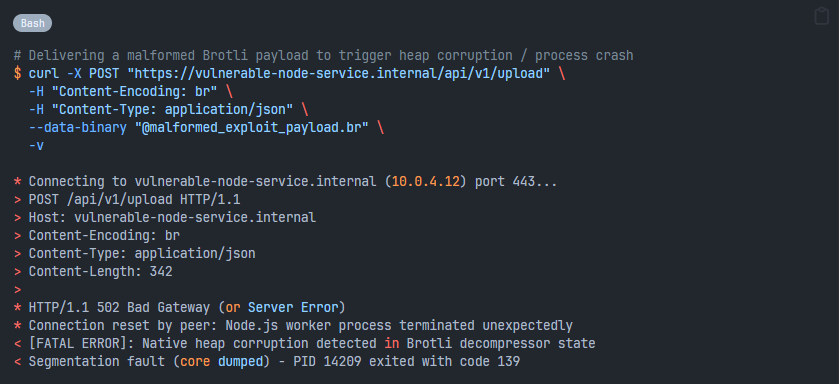
Example Terminal Attack Simulation
An attacker can trigger this vulnerability on vulnerable HTTP endpoints that accept compressed bodies by delivering a crafted Brotli payload using standard tools:
Affected Software & Plugins
The scope of CVE-2026-111497 spans multiple software ecosystems and runtime frameworks that statically link or bind against vulnerable Google Brotli C source files (1.0.3 through 1.2.0). Because Node.js core includes Google Brotli inside its main repository tree, all standard binary distributions, official Docker base images, and cloud serverless environments built on vulnerable Node.js versions remain exposed. Beyond the official Node.js releases, third-party runtime environments, API gateways, and native language wrappers that compile upstream C Brotli without latest patch updates share identical risk profiles. Security administrators must inventory both primary Node.js applications and secondary utility scripts across all server environments.
- Node.js Release Line v26.x: Vulnerable on versions prior to v26.12.1.
- Node.js Release Line v24.x: Vulnerable on versions prior to v24.22.1.
- Node.js Release Line v22.x: Vulnerable on versions prior to v22.23.4.
- Alternative Runtimes & Bindings: Bun runtime releases, Python
brotli/brotlicffimodules< 1.2.1, and Envoy proxies using unpatched Brotli C sources.
Conclusion
CVE-2026-111497 highlights the structural memory safety challenges that arise when high-level interpreted runtimes rely heavily on unmanaged C/C++ libraries for performance-critical operations. A single bounds-checking oversight deep inside an underlying decompression utility can instantly compromise the isolation boundary of an entire enterprise server application. Given that this vulnerability has reached active exploitation status in live production environments, organization-wide remediation must be prioritized without delay. Security engineering teams should immediately upgrade Node.js base images across container registries, build pipelines, and production clusters to patched releases (>=22.23.4, >=24.22.1, or >=26.12.1). In environments where immediate runtime upgrades cannot be performed, defensive edge mitigations must be instituted at ingress controllers, load balancers, or Web Application Firewalls (WAFs). Dropping or stripping Content-Encoding: br headers on inbound HTTP requests prevents untrusted streams from reaching vulnerable server processes until permanent patches are fully deployed.