
Introduction
Cyberattackers are employing increasingly creative and sophisticated methods to bypass modern defense mechanisms, shifting away from traditional exploits toward complex, living-off-the-land techniques. The latest example of this is a highly targeted, multi-stage cyberattack wave aggressively hitting the hospitality and accommodation sector, particularly across Europe and Asia. Exploiting the daily, high-volume document workflows of hotel reception and front desk staff, this advanced campaign cleverly involves manipulating legitimate cloud services to bypass inbound perimeter controls. Furthermore, it utilizes advanced obfuscation techniques and silently executes an external runtime environment (Node.js) that is not natively installed on the target system, effectively creating a stealthy execution layer out of thin air. This article provides a comprehensive technical breakdown and analyzes the intricate anatomy of this sophisticated attack, as detailed by Microsoft Threat Intelligence, which has sent shockwaves through the global cybersecurity community.
Learning Objectives
- Understand the “Authentication Laundering” tactic used by attackers to bypass traditional email security filters (SPF, DKIM, DMARC).
- Comprehend anti-bot mechanisms implemented to obstruct automated sandbox environments and security analysis tools.
- Learn how attackers orchestrate a portable deployment of a software development environment (Node.js) on a victim’s machine.
- Analyze how Command and Control (C2) traffic is obscured using BigInt (Large Number Arithmetic) obfuscation and TON Blockchain API integration.
- Deploy proactive security measures within corporate networks to defend against such Advanced Persistent Threat (APT) actors.
Microsoft Photo ZIP Campaign Warns Hospitality Industry of Persistent Access Targets
Microsoft Threat Intelligence issued a critical global threat intelligence alert regarding a targeted campaign aggressively focused on the hospitality sector. According to threat analysts, once the attackers successfully gain an initial foothold within an organization’s network, they deploy an advanced, JavaScript-based malware implant called “TonRAT”. This specific implant is engineered with high technical sophistication, making it notoriously difficult for traditional endpoint detection tools to discover or isolate. The primary objective of this malicious operation is to establish a stealthy, long-term backdoor within the target environment without triggering corporate security software. By remaining completely undetected, the threat actors can maintain continuous, persistent access to compromised workstations. This deep network penetration ultimately allows them to exfiltrate highly sensitive customer data, monitor internal communications, or harvest credentials to access lucrative financial systems.
What makes this campaign particularly alarming is that its success relies heavily on the flawless manipulation of human psychology and corporate workflows rather than exploiting zero-day or unpatched software vulnerabilities. By engineering scenarios that demand urgent operational responses from hotel staff, the attackers successfully turn standard business practices into a direct conduit for network compromise.
Phishing and Social Engineering Phase
The initial stage of this highly coordinated campaign focuses entirely on exploiting the operational reflexes and daily customer-service responsibilities of hospitality employees. Threat actors carefully structure their social engineering traps around scenarios engineered to induce high levels of stress, panic, and immediate urgency, such as unexpected reservation cancellations, highly damaging customer room complaints, or sudden public health inspections. Because front desk and reception personnel are conditioned to resolve customer issues rapidly to preserve the business’s reputation, they are highly susceptible to taking immediate action without questioning the underlying legitimacy of the communication. To lower the victim’s defenses, the attackers execute a sophisticated technique known as “Authentication Laundering” to completely mask their malicious intent. Rather than routing phishing lures directly through known malicious domains or newly registered infrastructure—which would be easily flagged by modern threat intelligence networks—they route their malicious links through respected, legitimate third-party platforms. By misusing automated notification features on scheduling platforms and utilizing trusted open-redirect features on major search networks, the attackers ensure their delivery mechanism appears entirely benign.
As a direct result of this tactical redirection, the phishing emails originate from authentic, highly trusted enterprise servers that possess pristine domain reputations. When these incoming messages strike the target organization’s perimeter, traditional Secure Email Gateways (SEGs) and standard authentication filters—including SPF, DKIM, and DMARC—evaluate them as entirely safe and allow them straight into the employee’s main inbox. This clever subversion of trust effectively neutralizes the primary automated line of defense, leaving the organization entirely dependent on the security awareness of its frontline staff.
- Socio-Emotional Manipulation: The attackers meticulously craft highly specific, localized pretexts designed to provoke immediate anxiety and bypass rational scrutiny, targeting the employee’s natural instinct to quickly fix service failures.
- Brand Exploitation and Spoofing: Phishing communications regularly masquerade under highly reputable, legitimate enterprise service names, utilizing urgent subject lines that warn of impending operational crises like severe pest infestations or immediate legal escalations.
- Evasion of Perimeter Security: By combining automated email notifications from legitimate platforms with trusted URL redirection systems, the infrastructure successfully tricks advanced antispam filters into classifying the malicious payloads as verified, safe corporate traffic.
Malicious File Delivery and Trigger Mechanism
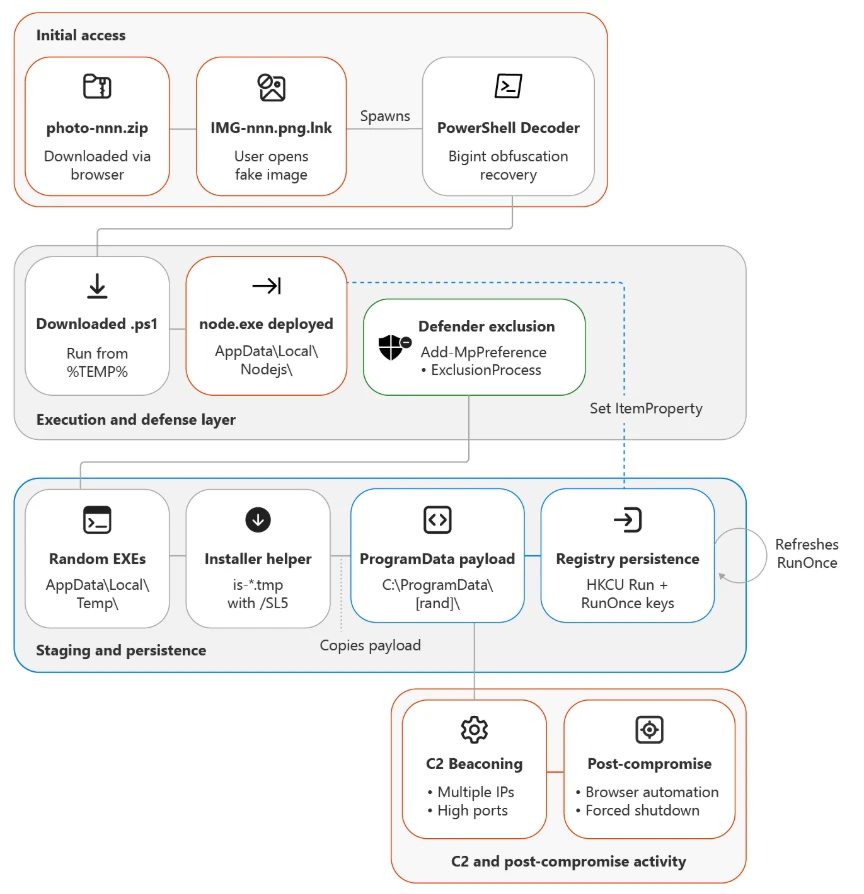
When an unsuspecting employee interacts with the embedded link within the phishing email, they are not immediately greeted by a direct file download; instead, the attack chain routes them through a calculated, multi-layered intermediary phase meticulously engineered to neutralize automated sandbox environments, evade endpoint security scanners, and thwart the efforts of cybersecurity analysts. This tactical delay relies on an anti-analysis gateway that presents a deceptive Cloudflare Turnstile CAPTCHA verification, mimicking a routine website security check to successfully block automated threat emulation tools while allowing the human victim to advance the execution chain by checking the box. Once this defensive perimeter is crossed, a photo-themed ZIP archive containing an obfuscated Windows Shortcut (LNK) file is delivered to the host system, leveraging the operating system’s default behavior of hiding known file extensions to trick the user into executing a malicious payload under the guise of opening a harmless corporate photograph.
- Automated Defense Neutralization: The implementation of a Cloudflare Turnstile obstacle effectively segregates automated security crawlers and sandbox emulators from human users, ensuring that the underlying malicious archive cannot be automatically grabbed and analyzed by perimeter defenses.
- Deceptive Content Packaging: Following successful user validation, the delivery platform drops a structured, photo-themed ZIP archive named
photo-[random-numbers].zipdirectly onto the target machine, carefully matching the social engineering pretext established in the initial email. - The Hidden Shortcut Execution: Inside the unpacked archive, the presence of a double-extension Windows Shortcut file like
IMG-[numbers].png.lnkexploits user trust; double-clicking what appears to be a legitimate image immediately triggers a silent, heavily obfuscated background PowerShell script.
Background Node.js Execution and the TonRAT Implant
This phase represents the most unusual and technically innovative aspect of the attack chain, showcasing a massive shift toward highly independent post-exploitation techniques. The threat actors completely eliminate dependencies on the victim’s pre-existing environment by choosing not to rely on whether Node.js is already installed on the target machine. Instead, they programmatically construct their own localized, fully functional runtime environment on the fly, transforming a standard workstation into an unintentional host for complex JavaScript-based malware execution. To achieve this undetected setup, the stealthy PowerShell script initiates an outbound connection directly to the official, trusted Node.js repository to fetch a legitimate, portable binary. Because the download originates from a completely benign and verified domain (nodejs.org), network monitoring tools rarely flag the traffic as suspicious. Once dropped into user-writable directories like AppData or %TEMP%, this clean, dual-use binary is weaponized to execute the core malicious payload completely isolated from native Windows administrative restrictions.
The payload itself, known as the TonRAT implant, leverages advanced evasion techniques by integrating decentralized blockchain architecture into its command and control (C2) workflow. Rather than hardcoding static IP addresses that security researchers could easily burn, the implant dynamically resolves its infrastructure locations through public blockchain networks. Combined with robust, bidirectional Windows Registry modifications, the malware cements its persistence inside the host system, ensuring it silently boots up and maintains its foothold completely under the radar of traditional security solutions.
[LNK Double-Click] -> Triggers Obfuscated PowerShell Script
                             │
                             ▼
              Downloads Clean Portable Node.js
              (From official nodejs.org to %TEMP%)
                             │
                             ▼
              Decrypts C2 Data via BigInt Math
              & Launches TonRAT JavaScript Payload
                             │
                             ▼
       Queries TON Blockchain APIs (tonapi.io) -> Resolves Dynamic C2 IPs
- Portable Runtime Deployment: The background PowerShell script seamlessly fetches a clean, legitimate Node.js v24.13.0 portable runtime directly from official web repositories, automatically dropping and extracting it into
%TEMP%orAppData\Local\Nodejsto establish an independent execution layer. - Mathematical Obfuscation (BigInt): To completely blind static analysis tools and string-matching signatures, the underlying command and control infrastructure domains are heavily encrypted using complex BigInt (Large Number Arithmetic) formulas, which are decoded in memory only at runtime.
- Decentralized C2 Routing & Persistence: Once the trusted Node.js engine executes the TonRAT implant, the malware communicates directly with TON Blockchain APIs (
tonapi.io) to dynamically fetch active C2 server locations, while simultaneously writing bidirectional registry keys to guarantee silent, long-term persistence.
Microsoft’s Security Recommendation
Because it is highly anomalous for a software development tool and runtime engine like Node.js (node.exe) to be present, installed, or actively executing out of user-writable directories on dedicated operational endpoints—such as hotel front desk terminals, reservation booking systems, or front-of-house reception computers—Microsoft Threat Intelligence and leading endpoint security experts strongly advise organizations within the hospitality sector to immediately review their defensive postures and implement a series of strict, proactive hardening steps designed to break this sophisticated multi-stage attack chain before the malicious execution layer can take root.
- EDR and XDR Behavioral Rules: Configure Endpoint Detection and Response (EDR) and Extended Detection and Response (XDR) platforms to aggressively monitor, alert on, and strictly block any instance of
node.exe,powershell.exe, orcmd.exebeing spawned directly out of user-writable paths such as\Users\<username>\AppData\...or the local%TEMP%directory. - Double-Extension and LNK Restrictions: Implement robust Group Policy Objects (GPOs) or Attack Surface Reduction (ASR) rules to completely restrict users from launching Windows Shortcut (
.lnk) files out of compressed ZIP archives, while simultaneously configuring Windows to globally display all file extensions to prevent the visual masking of double extensions like.png.lnk. - Blockchain Infrastructure and API Blocking: Establish explicit network security and firewall egress rules to log, alert, and block outbound connections heading toward decentralized blockchain communication networks, specifically targeting lookups to the TON Blockchain API gateway (
tonapi.io) from non-technical business zones. - Ingress Email and Scheduling Platform Controls: Adjust Secure Email Gateways (SEGs) to scrutinize incoming third-party platform notifications—such as automated messages originating from Calendly or Google redirect URLs—by applying heuristic rules that flag unsolicited attachments or urgent external links sent to high-risk public alias mailboxes like
reception@orfrontdesk@. - Proactive Prototyping and Threat Hunting: Initiate routine threat hunting queries across the entire workstation fleet to scan for unauthorized bidirectional registry modifications associated with persistence, while actively conducting targeted siber güvenlik farkındalığı training sessions to educate hospitality employees on how to spot advanced “Authentication Laundering” and baiting tactics.
Conclusion
The photo-themed ZIP campaign highlighted by Microsoft Threat Intelligence clearly demonstrates a profound evolution in modern threat actor tactics, proving that cybercriminals are shifting away from a sole reliance on traditional software vulnerabilities and zero-day exploits. Instead, they are actively exploiting the trusted infrastructure of the modern digital economy. By stitching together unrelated, legitimate ecosystem tools—such as Calendly scheduling services, Google URL redirection systems, and official Node.js installation binaries—salladıganlar are able to orchestrate highly sophisticated, trusted delivery pipelines that seamlessly bypass traditional perimeter controls. This strategic pivot toward “living off the cloud” and deploying independent runtime environments on the fly poses a significant challenge to conventional signature-based security products. Because each individual component of the attack chain leverages a globally trusted service or a clean utility, the threat remains effectively invisible until the final payload executes in memory. This methodology underscores a broader trend where the complexity of the attack lies not in rewriting advanced exploit code, but in flawlessly manipulating operational trust and human behavior within targeted vertical industries.
Ultimately, defending against these highly adaptive, multi-stage campaigns requires an equally sophisticated, defense-in-depth approach. The most effective line of defense against such complex attacks involves drastically increasing Endpoint Visibility to capture behavioral anomalies, extending strict Zero Trust architectures directly down to the individual workstation level, and enforcing robust application. Furthermore, organizations must commit to continuously updating employee cybersecurity awareness training to ensure that frontline personnel can recognize advanced social engineering pretexts before an execution layer can take root.