
Introduction
In modern operating systems, antivirus and protection engines form the most critical layer of system security. However, by design, these software components must operate with the highest possible system privileges (NT AUTHORITY\SYSTEM). This fundamental necessity turns security engines into a primary and highly lucrative target for cyber adversaries. The local elevation of privilege (EoP) vulnerability identified within Microsoft Defender, publicly dubbed “RoguePlanet” and tracked as CVE-2026-50656, directly exploits this highly privileged operational architecture. As enterprises increasingly rely on automated defense mechanisms, vulnerabilities within core security binaries radically alter the threat landscape, transforming trusted protective software into a viable vector for internal compromise. This article provides a comprehensive analysis of the vulnerability’s technical infrastructure, its operational mechanics, and the necessary remediation steps to secure affected endpoints.
Learning Objectives
Upon completing this article, you are expected to understand:
- The root cause, scope, and impact of the CVE-2026-50656 (RoguePlanet) vulnerability.
- The specific system configurations affected and the deployment of corresponding patches.
- The inherent architectural risks associated with running highly privileged security agents on endpoints.
- The conceptual mechanics behind “Link Following” and Time-of-Check to Time-of-Use (TOCTOU) race conditions.
What is CVE-2026-50656 (RoguePlanet)?
CVE-2026-50656 is a high-severity Local Elevation of Privilege (EoP) vulnerability found deep within the core architecture of the Microsoft Malware Protection Engine (mpengine.dll), carrying an official CVSS base score of 7.8. Known throughout the cybersecurity ecosystem by its code name “RoguePlanet,” this flaw fundamentally undermines the security boundaries of Windows environments. It grants local attackers, or malicious processes already running with restricted user privileges, the ability to subvert the operating system’s trust model and seamlessly escalate their permissions to the absolute highest administrative level: NT AUTHORITY\SYSTEM. The vulnerability was discovered and responsibly disclosed by a prominent independent security researcher operating under the pseudonym “Chaotic Eclipse” (also known as Nightmare-Eclipse). RoguePlanet is not an isolated discovery; rather, it follows a dangerous lineage of sophisticated flaws exposed within the Microsoft Defender engine by the same researcher, building upon the technical foundations of previous exploits known as BlueHammer, UnDefend, and RedSun. This continuous exposure highlights systemic complexities in how anti-malware engines interact with the underlying Windows filesystem.
A deeply concerning aspect of this specific vulnerability is its resilience against standard host-based defensive measures. Because the flaw resides within the engine’s primary file-handling logic, RoguePlanet can be successfully triggered regardless of whether Microsoft Defender’s Real-Time Protection feature is actively toggled on or off. This allows an exploit payload to bypass traditional behavioral optics, as the very agent designed to block system tampering is the entity being manipulated into executing the attack.
To fully contextualize the scope of CVE-2026-50656, the following key characteristics define its nature and operational impact:
- Local Execution Dependency: The flaw cannot be weaponized remotely over a network; an adversary must establish an initial foothold on the target machine through a low-privileged user shell or separate malware delivery vector before executing the exploit.
- Flaw of a Trusted Binary: The vulnerability targets
mpengine.dll, meaning that traditional application Endpoint Detection and Response (EDR) tools often fail to flag the anomalous behavior initially because the actions are executed by a trusted, Microsoft-signed process. - Real-Time Protection Evasion: Because standard static signatures cannot easily catch the microsecond filesystem race conditions utilized during the attack, toggling Defender’s security states offers zero mitigation value against a well-crafted exploit.
- Broad Enterprise OS Vulnerability: The underlying security flaw natively impacts default installations across both desktop and server editions of Windows 10 and Windows 11, creating a widespread patching requirement for enterprise IT administrators.
Technical Detail: How the Vulnerability Works
The core mechanics of the RoguePlanet vulnerability rely heavily on a fundamental architectural challenge in operating system security: handling file system operations safely within shared or low-privileged directories when operating at the highest security tier. Classified formally under CWE-59 as an “Improper Link Resolution Before File Access” (Link Following) bug, this flaw manifests because the Microsoft Malware Protection Engine fails to safely isolate its temporary workspace during high-privilege operations. By weaponizing a highly precise timing race condition, local attackers can force a system-level process to interact with objects they do not explicitly own, turning a routine anti-malware scan into an elevation vector. The structural foundation of the exploit hinges entirely on a classic Time-of-Check to Time-of-Use (TOCTOU) architectural flaw within mpengine.dll. When Microsoft Defender identifies a potentially malicious payload or executes a routine quarantine/remediation sweep, it dynamically creates and references temporary file paths within predictable locations. Because there is a minute, fractional-second delay between the moment the engine inspects and validates the destination path structure and the exact microsecond it attempts to modify files within it, a dangerous window of opportunity opens. During this precise interval, the OS trust boundary can be broken using standard filesystem controls.
Because the Microsoft Defender engine executes natively under the almighty NT AUTHORITY\SYSTEM context, it inherits the right to override standard Access Control Lists (ACLs) across the entire Windows installation. The attacker uses a low-privileged background loop to swap out the validated path with an NTFS Junction point or an advanced symbolic link. When Defender attempts to write out its routine scan logs or quarantine telemetry, it blindly traverses the attacker’s redirection link. This structural subversion allows the attacker to corrupt or overwrite protected system files, effectively tricking the engine into spawning an entirely unconstrained, fully privileged command shell.
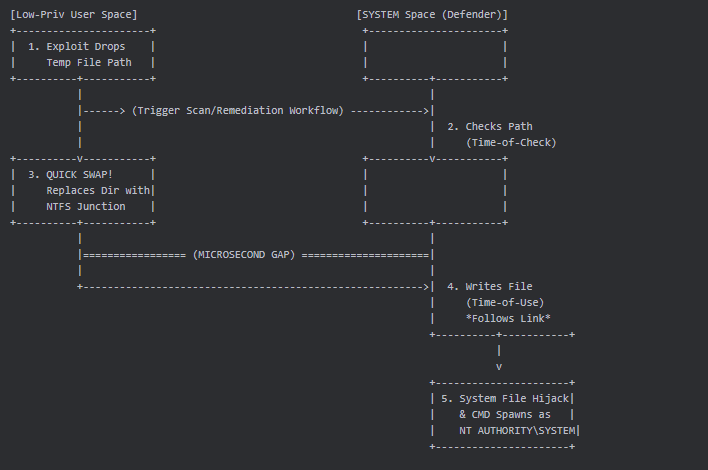
To fully break down the exact exploitation sequence, the following technical phases detail how the flaw processes system states:
- The Timing Gap (TOCTOU): The primary flaw surfaces during a microsecond timing window that exists natively between the initial target verification routine and the physical implementation of file adjustment operations.
- Symbolic Link and Junction Manipulation: Low-privileged exploit threads run in tight asynchronous loops to actively tear down expected temporary paths, substituting them with advanced NTFS directory junctions that route directly into protected Windows directories.
- Privileged File Operation: Because the scanning engine possesses full
SYSTEMauthority, it automatically follows the newly mounted symbolic structure without validating ownership, inadvertently altering critical system-owned objects. - Code Execution and Privilege Escalation: The resulting structural disruption forces the high-privilege engine to seamlessly hand off process execution to an attacker-controlled binary or script, immediately dropping a root-level terminal session.
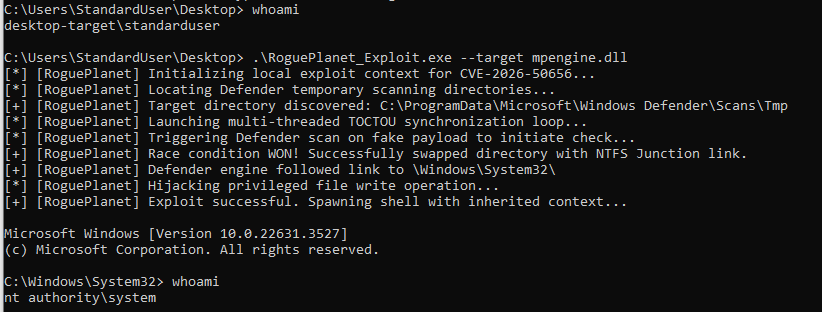
The following interactive terminal output demonstrates a successful deployment of the RoguePlanet local privilege escalation payload on an unpatched Windows 11 endpoint:
Patch & Remediation Status
Microsoft officially addressed the structural risks posed by the RoguePlanet vulnerability by releasing a critical security update on July 9, 2026. The engineering team successfully remediated the underlying link-following flaw within the Microsoft Malware Protection Engine version 1.1.26060.3008 and all subsequent releases. By introducing stricter access validation checks prior to file resolution, the updated engine ensures that directory junctions and symbolic links created by low-privileged users are safely rejected during privileged scanning or remediation routines. Fortunately for enterprise administrators and individual consumers alike, Microsoft Defender manages its core engine updates and malware definitions automatically in the background. Consequently, the vast majority of Windows endpoints receive this crucial security protection seamlessly without requiring any manual intervention or system reboots. This centralized, cloud-driven distribution framework significantly minimizes the window of opportunity for threat actors looking to weaponize local race conditions across unpatched infrastructure.
To verify that an endpoint is completely protected against CVE-2026-50656, administrators can perform the following verification steps:
- Open Windows Security: Launch the native Windows Security desktop application from the Start menu or the system tray.
- Navigate to Settings: Click on the gear icon located in the bottom-left corner to access system settings, and then select the About section.
- Inspect the Engine Version: Locate the specific row labeled Engine Version within the product information list.
- Confirm Patch Compliance: Ensure that the displayed version number reads
1.1.26060.3008or higher to guarantee that the RoguePlanet mitigation is active.
Conclusion
The RoguePlanet (CVE-2026-50656) vulnerability serves as a stark reminder within the cybersecurity landscape that security tools themselves can inadvertently become potent attack vectors. Because modern anti-malware solutions require unfettered access to system resources to intercept sophisticated threats, they inherently present a highly attractive target for local privilege escalation. When a security binary operating at the highest architectural tier contains a logical flaw, the very defensive perimeter built to protect an enterprise is effectively inverted against it. This specific vulnerability vividly demonstrates how low-level file system behaviors, such as NTFS junction links, symbolic links, and microsecond race conditions, can be weaponized to manipulate the most trusted mechanisms of an operating system. It exposes a systemic challenge in software engineering: the difficulty of safely handling file system operations within shared or user-writable environments. Security vendors must continue to refine their development lifecycles to ensure that high-privilege routines strictly validate file path ownership prior to executing any state changes. While Microsoft’s automated update pipeline successfully mitigated the immediate threat across the vast majority of global endpoints, the incident underscores a broader operational lesson. Relying solely on automated patch distribution can introduce a false sense of complacency, particularly within complex corporate networks where disconnected or legacy systems may fall through the cracks. Organizations must maintain robust asset inventory and vulnerability management programs to actively verify compliance rather than assuming background updates have completed seamlessly.
Ultimately, the discovery of CVE-2026-50656 highlights the ongoing necessity of continuously auditing, monitoring, and maintaining the integrity of privileged endpoint protection agents. As threat actors become increasingly adept at exploiting complex logic flaws rather than relying on traditional memory corruption bugs, a defense-in-depth posture remains critical. Security teams must complement automated endpoint tools with strict least-privilege policies, behavioral monitoring, and robust access controls to limit the blast radius of any successful local exploit foothold.