
Introduction
To achieve the highest level of privileges within an operating system, cyber threat actors frequently target the OS kernel or security software running with full system administrative rights. Discovered under the moniker “BlueHammer,” CVE-2026-33825 is a high-severity vulnerability that directly targets Windows’ native security mechanism, Microsoft Defender. Added by CISA to its Known Exploited Vulnerabilities (KEV) catalog due to evidence of active real-world exploitation, this flaw allows a local, low-privileged user to escalate their privileges to NT AUTHORITY\SYSTEM. The severity of this flaw highlights a broader shift in the threat landscape, where attackers increasingly abuse the structural design of trusted system processes rather than relying on traditional memory corruption bugs. By subverting the very tool meant to police the operating system, threat actors can bypass advanced Endpoint Detection and Response (EDR) agents that traditionally rely on Defender’s integrity. Consequently, understanding BlueHammer is essential for modern defenders, as it underscores how minor timing discrepancies can completely undermine enterprise-grade perimeter security. This article explores the logical background, underlying attack mechanics, and practical mitigation strategies of this critical vulnerability.
Learning Objectives
Upon completing this article, you will be able to:
- Identify the necessary remediation steps to defend systems against privileged logical design flaws.
- Explain what CVE-2026-33825 (BlueHammer) is and why it poses a critical threat to enterprise environments.
- Understand the core concepts of Race Conditions and TOCTOU (Time-of-Check to Time-of-Use) flaws from a cybersecurity perspective.
- Comprehend how Windows filesystem components like NTFS Symbolic Links, Reparse Points, and Opportunistic Locks (Oplocks) are leveraged in privilege escalation attacks.
What is BlueHammer CVE-2026-33825 Vulnerability
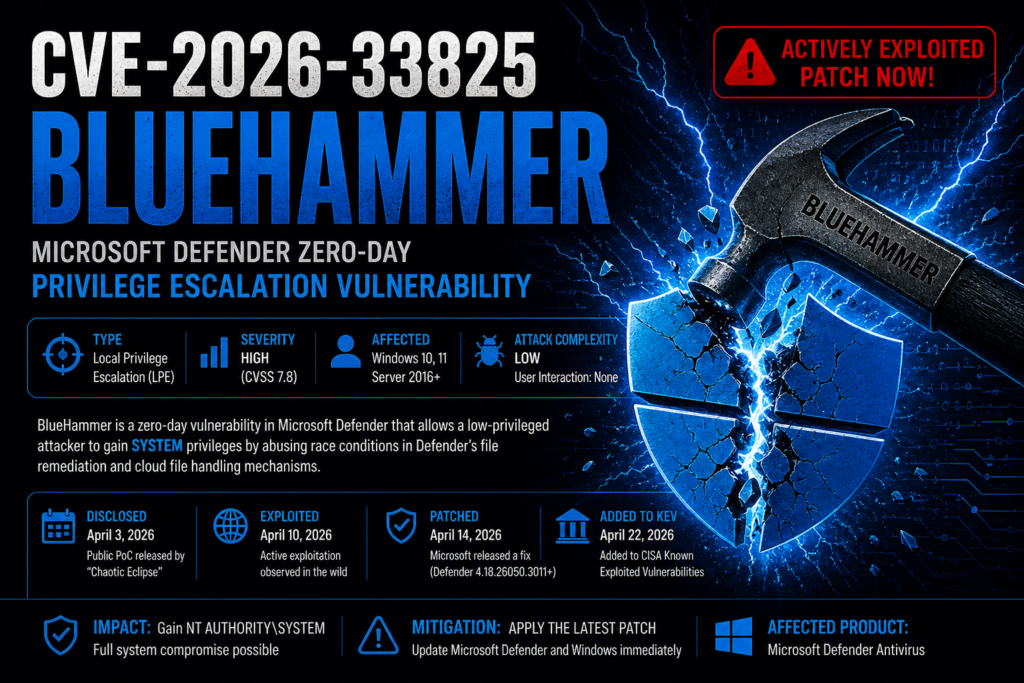
CVE-2026-33825 is a Local Privilege Escalation (LPE) vulnerability found within the Microsoft Defender Antimalware Platform (specifically impacting core workflows driven by engines like MsMpEng.exe and MpSigStub.exe). Rated 7.8 (High) on the CVSS v3.1 scale, this vulnerability is not a remote code execution (RCE) flaw or a memory corruption bug (such as a buffer overflow). Instead, it is a logical design flaw embedded within filesystem interaction routines. Because Microsoft Defender inherently executes tasks with the highest local privileges on a Windows operating system, manipulating its filesystem operations inherently gives an attacker a vector to compromise the entire system. The significance of BlueHammer lies in its reliance on structural exploitation rather than binary exploitation. In traditional privilege escalation scenarios, attackers look for flaws like heap overrides or null-pointer dereferences within drivers or applications running at the kernel level. However, BlueHammer completely bypasses the need for complex memory grooming or shellcode execution. Instead, it weaponizes the asymmetric trust model built into Windows operating systems. When an anti-malware solution is tasked with sweeping, cleaning, or updating system structures, it operates with absolute authority. If that process can be deceived regarding the identity of the file it is modifying, the security barrier collapses entirely from within.
This specific flaw fundamentally breaks down the isolation between a low-privileged local user and the core operating system layer. In multi-tenant environments, specialized servers, or enterprise workstations, restricting administrative rights is a primary line of defense. BlueHammer demonstrates that an attacker who has established a minor foothold via phishing or a separate low-impact exploit can instantly cross the most critical boundary in Windows security. By turning Microsoft Defender against itself, the exploit transforms a trusted defense mechanism into a high-powered proxy execution engine, rendering local access control lists (ACLs) completely ineffective. Consequently, its presence in the wild represents a profound systemic risk, as it weaponizes the exact software deployed to keep the infrastructure secure.
Technical Detail: How the Vulnerability Works
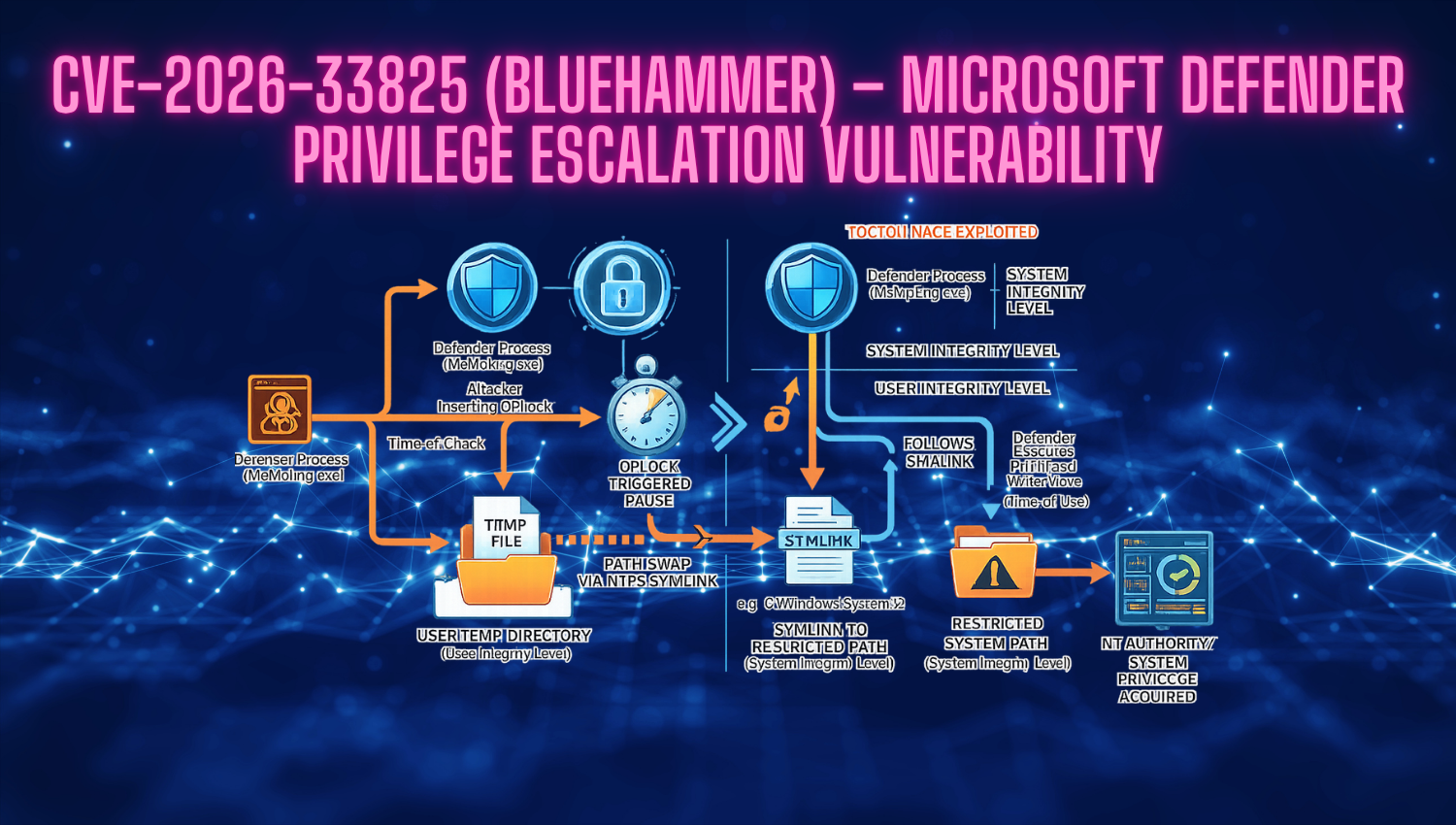
The BlueHammer vulnerability stems from a timing flaw known in computer science as a Time-of-Check to Time-of-Use (TOCTOU) race condition. A microsecond-level window of vulnerability exists between the moment a high-privilege security mechanism verifies a file’s location or safety (Time-of-Check) and the exact moment it executes an operation on that file (Time-of-Use). Threat actors exploit this gap through the following structured phases:
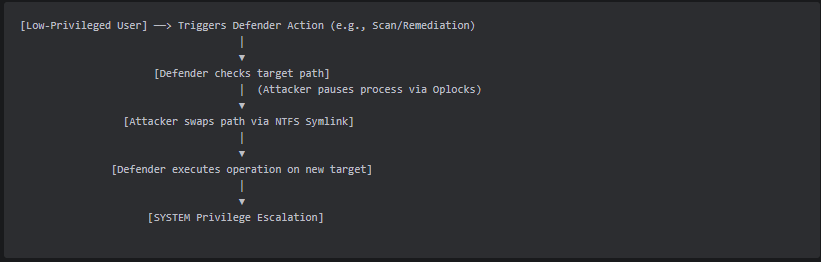
- Process Triggering & Monitoring: The attacker initiates an automated background routine in Defender—such as signature updates, log rotations, or malware remediation scans—and monitors the specific temporary directories (
AppData\Local\Temp,C:\ProgramData\Microsoft\Windows Defender\Scans\History, etc.) where Defender reads or writes temporary deployment files. Because these locations are shared or writable by lower-privileged processes, they serve as the perfect sandbox for establishing a file-system hook. The attacker utilizes Windows change journals or file system mini-filter techniques to watch for the exact moment the privilegedMsMpEng.execreates a temporary handle. - Abusing Opportunistic Locks (Oplocks): Because native filesystem operations occur almost instantaneously, winning a pure hardware-level race condition is highly unstable. To make the race condition stable and 100% repeatable, attackers abuse Windows Opportunistic Locks (Oplocks). An Oplock is a mechanism designed to let clients cache file data locally without immediately pushing it to a server. The attacker places an exclusive Oplock on the target temporary file right after its creation. When Defender attempts to open or read this file to verify its structural integrity (the Time-of-Check), the filesystem driver hits the lock. This forces the operating system to temporarily freeze Defender’s high-privilege thread execution, suspending it mid-air and expanding a microsecond window into an indefinite pause controlled entirely by the attacker.
- Redirection via Reparse Points: While Defender’s execution thread is frozen in this paused state, the attacker drops their exclusive lock to free the system handle. Instantly, before releasing the thread, the attacker deletes the original temporary file and replaces it with an NTFS Symbolic Link (Symlink) or an NTFS Directory Junction (both variations of Reparse Points). This link redirects the exact path Defender is trying to process to a highly restricted system directory, such as
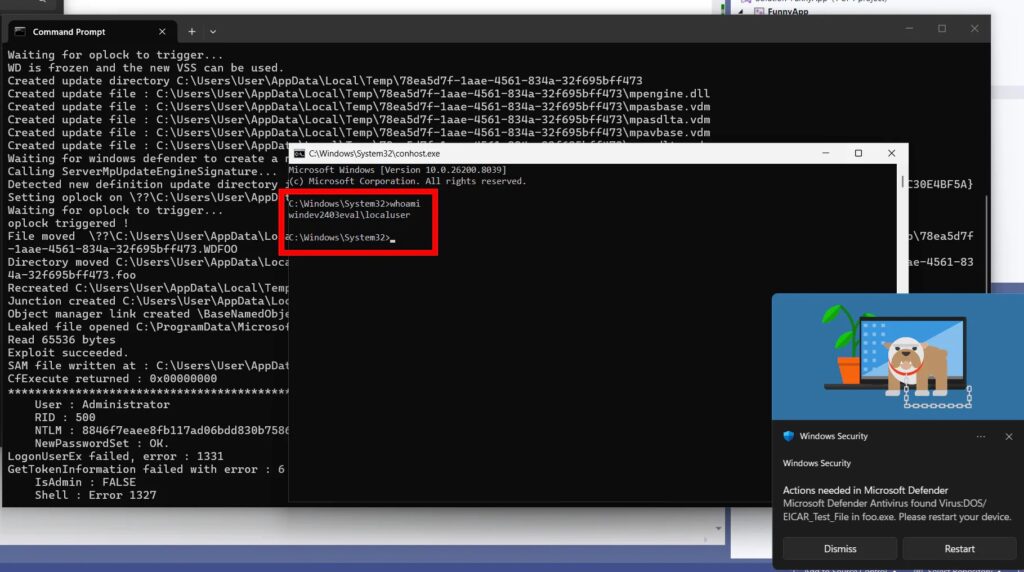
C:\Windows\System32or the Windows Tasks scheduler configuration paths. Under normal operating conditions, a low-privileged local user has zero security permissions to modify, inject, or write into these folders due to standard Access Control Lists (ACLs). - Privilege Escalation: When the attacker finishes swapping the path, the file system unpauses Defender, which resumes execution at the exact point it left off (the Time-of-Use). Believing it is safely executing a standard sanitation, write, or file-move operation on the benign temporary path it already verified, Defender blindly follows the NTFS reparse point pointer. It performs its highly privileged write action directly inside the protected system directory. The next time that system service fires up, it executes the attacker’s payload, permanently achieving full, unconstrained arbitrary code execution as
NT AUTHORITY\SYSTEM.
Conclusion
CVE-2026-33825 (BlueHammer) serves as a potent reminder that logical architectural flaws can be just as dangerous as traditional memory-corruption bugs. Complex operating system features designed for interoperability—such as Symlinks and Oplocks—can be subverted into high-leverage tools when security software performs actions with asymmetric privileges. Defending against such flaws requires immediate and proactive patching. Administrators should verify that the Microsoft Defender platform is updated to version 4.18.26030.3011 or higher, enforce strict principles of least privilege, and continuously monitor SIEM or EDR logs for anomalous reparse point creation within low-privileged user spaces. Furthermore, the emergence of the BlueHammer vulnerability signals a critical imperative for security architecture teams to rethink how high-privilege endpoints handle shared resources. When security software interacts with user-writable directories without isolating those operations from the local user context, it creates a systemic risk that cannot be easily mitigated by static detection rules. Relying solely on signature-based anti-malware engine integrity becomes a paradox when the engine itself can be manipulated into serving as an exploitation proxy. This vulnerability fundamentally highlights the necessity of implementing absolute isolation principles, ensuring that privileged system daemons execute multi-stage file tasks within secure, randomized, and strictly ACL-protected root directories that are completely inaccessible to lower integrity levels.
Ultimately, long-term resilience against logical privilege escalation attacks demands a shift toward behavioral, telemetry-driven defense models. Organizations must move beyond basic patch management and aggressively configure Endpoint Detection and Response (EDR) platforms to monitor for structural anomalies. This includes building specific telemetry rules to detect rapid, automated combinations of file locking and reparse point generation occurring sequentially within temporary user paths. By treating these structural file manipulations as high-fidelity indicators of compromise (IoCs), enterprise security teams can intercept logical race conditions before an attacker successfully bridges the gap between a low-privileged user account and complete, domain-threatening control under the NT AUTHORITY\SYSTEM context.