
Introduction
In modern operating systems, Endpoint Security components such as antivirus engines and EDR (Endpoint Detection and Response) agents operate close to the kernel layer to intercept malicious behavior. Within the Microsoft Windows ecosystem, Microsoft Defender serves as the native defense mechanism, inherently executing its tasks with the highest possible privilege level: NT AUTHORITY\SYSTEM. While this design is mandatory for system-wide remediation, any architectural or logical flaw inside such a highly privileged service quickly transforms it into a prime target for attackers. This article provides a deep dive analysis into CVE-2026-50656 (codenamed “RoguePlanet”), a high-severity local Elevation of Privilege (EoP) vulnerability discovered in the Microsoft Malware Protection Engine. We will dissect how local, low-privileged users can exploit file-handling race conditions to subvert Defender’s routine operations, bypass Real-Time Protection constraints, and obtain unconstrained SYSTEM-level control over a host machine.
Learning Objectives
By completing this technical analysis, you will achieve the following core competencies:
- Abusing Windows File System Mechanics: Understanding how logical links (Symbolic Links, Junction Points, and Mount Points) can be weaponized to manipulate highly privileged file paths.
- Deconstructing Race Conditions: Analyzing the fundamentals of Time-of-Check to Time-of-Use (TOCTOU) flaws within core security software components.
- Mastering CVE-2026-50656 Dynamics: Comprehending how Microsoft Defender’s routine file-scanning or file-upload/quarantine routines are forced into target-swapping scenarios.
- Threat Hunting & Engineering Defenses: Implementing logging and detection telemetry to hunt for anomalous anti-malware child process creation and executing temporary mitigations prior to hotfix deployment.
What is CVE-2026-50656 – Microsoft Defender Elevation of Privilege Vulnerability File Upload
CVE-2026-50656 represents a critical vulnerability stemming from an improper link resolution flaw (categorized under CWE-59 / Link Following) residing deep within the file-handling logic of the Microsoft Malware Protection Engine. This specialized software engine forms the operational core of Microsoft Defender, meaning any structural security failure within its binary components exposes the host operating system to severe compromise. A local attacker holding minimal guest or low-privileged access permissions on an affected endpoint can reliably trigger this vulnerability to bypass standard user access boundaries, manipulate trusted operating system assets, and escalate privileges directly to NT AUTHORITY\SYSTEM.
| Metric / Attribute | Technical Value / Detail |
|---|---|
| Vulnerability Name | Microsoft Malware Protection Engine Elevation of Privilege |
| CVE Identifier | CVE-2026-50656 |
| Codenamed By Researchers | RoguePlanet |
| CVSS v3.1 Base Score | 7.8 (High) |
| CVSS Vector String | CVSS:3.1/AV:L/AC:L/PR:L/UI:N/S:U/C:H/I:H/A:H |
| Primary Component Affected | Microsoft Defender Core Scanning Engine (MsMpEng.exe) |
A defining aspect of CVE-2026-50656 is its highly resilient execution context. The exploit functions seamlessly regardless of whether Real-Time Protection is enabled or disabled, and it remains operational even when Microsoft Defender is configured in passive mode alongside a third-party endpoint protection product. The flaw primarily leverages the engine’s routine handling of file upload, writing, and background scanning behaviors within standard, user-writable temporary directories (such as \AppData\Local\Temp or \Public\Downloads). Because these directories are universally accessible to low-privilege service accounts and standard users, they serve as the perfect staging ground for path redirection. While early internal variants of this exploit hinted at a potential technical pathway toward Remote Code Execution (RCE) via malicious input streams, prior anti-tampering and containerization modifications deployed by Microsoft successfully limited the exploitation boundaries of this flaw strictly to a local privilege escalation capability..
To fully understand the foundational impact and threat profile of this vulnerability, it can be broken down into the following four core pillars:
- Abuse of Privileged Actions via CWE-59: The root cause centers on Microsoft Defender following symbolic links, junction points, or hard links created by an untrusted user. Because the main service process (
MsMpEng.exe) executes with absolute administrative rights, it fails to verify if the final target path of a resolved link points to a restricted operating system directory, resulting in arbitrary file manipulation performed on behalf of a low-privileged actor. - Independence from Defensive Configurations: Unlike standard application-layer exploits that can be mitigated by disabling specific software components or adjusting heuristics, CVE-2026-50656 targets the core parsing routine of the scanning engine itself. Whether a system is running active, on-demand, or scheduled scans, any file ingestion or mock “File Upload” simulation targeted by the engine initiates the flawed synchronization cycle.
- Refactored from an RCE to an EoP Threat: Initial architectural assessments of the core parser indicated that remote file streams could trigger memory corruption or unauthenticated execution boundaries. However, due to security mitigations introduced in earlier engineering cycles by Microsoft, the remote entry points were structurally closed, forcing the exploit to be refactored exclusively as a highly stable local privilege escalation mechanism.
- Strategic Weaponization Value for Threat Actors: While a local privilege escalation vulnerability cannot grant initial access to an enterprise network on its own, it holds immense strategic value for adversaries who have already established a foothold via phishing, compromised credentials, or web shells. By deploying this exploit, an actor instantly transitions from a restricted observer to an unconstrained system administrator capable of halting logging, dumping credentials, and establishing permanent persistence.
Technical Detail: How the Vulnerability Works
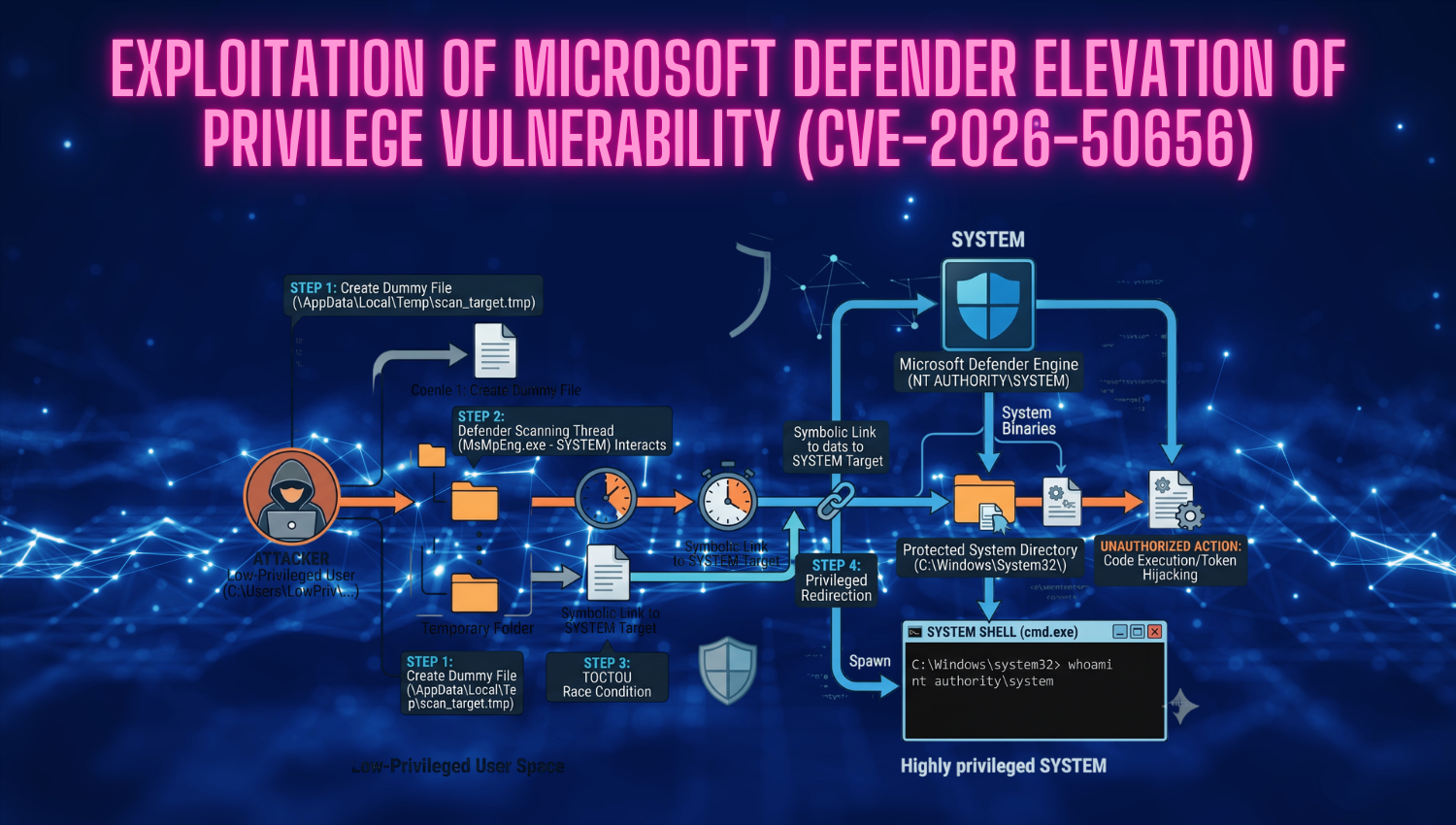
The deep-seated mechanics of CVE-2026-50656 depend heavily on a complex state-synchronization flaw known as a Time-of-Check to Time-of-Use (TOCTOU) race condition. This classic asynchronous exploit pattern materializes when a software security architecture assumes that a specific environmental state—such as a file path’s validity, structural identity, or access permission checklist—remains entirely static between the moment the application verifies that state and the moment it executes an operation based on it. In the context of this vulnerability, the exploit window cracks open the millisecond the main anti-malware service binary, MsMpEng.exe (executing as NT AUTHORITY\SYSTEM), registers and queues a user-controlled file for an active analysis, quarantine, or parsing loop.
Because the anti-malware solution must process files in real-time, its continuous synchronization loops run at blistering speeds. However, the multi-threaded architecture of modern Windows systems allows an attacking process to execute threads concurrently alongside the security service. This allows an adversary to target the microscopic time gap between the engine’s defensive confirmation check and its subsequent privileged action.
The systematic, granular breakdown of the attack lifecycle unfolds across the following highly coordinated phases:
- Directory Staging and Workspace Creation: Operating entirely within a low-privileged user token (e.g., standard guest or domain user), the attacker configures a tailored workspace tree. This workspace is strategically mapped inside a globally or user-writable temporary directory where standard accounts possess unhindered directory manipulation rights, such as
C:\Users\LowPriv\AppData\Local\Temp\ExploitDir. Because this workspace is fully controlled by the low-privileged process, the attacker can rapidly instantiate, alter, and delete files or link structures without triggering access-denied faults from the underlying NTFS subsystem. - Scan Triggering and Thread Ingestion (File Upload/Creation): The exploit binary writes an engineered, synthetic dummy file (e.g.,
scan_target.tmp) into the staging directory. This file contains precise payload signatures or deliberate file heuristics designed to instantly catch the attention of the Microsoft Defender file-system filter driver (WdFilter.sys). The filter driver intercepts the I/O request, flags the newly committed disk object, and immediately notifies the user-mode engine service, causing a high-priority scanning thread insideMsMpEng.exeto spin up, allocate memory resources, and target the specified file path for deep processing. - Winning the TOCTOU Race via File Interception: The core exploitation phase relies on splitting the atomic execution sequence of the Defender thread. First, the high-privilege scanning engine accesses the file path to perform its mandatory pre-processing checks (Time-of-Check), verifying that the target object is a routine file located inside a legitimate user directory. Immediately after
MsMpEng.exereleases its temporary validation handle—but microseconds before it re-opens a functional handle to read, lock, move, or quarantine the object (Time-of-Use)—the attacker’s background thread intervenes. Exploiting this precise microsecond delay, the attacker’s process aggressively deletes the original dummy file and instantly swaps the exact same directory entry with an NTFS junction point or a native Symbolic Link. This newly planted link points directly to a heavily protected, highly restricted system asset, such as a core operating system binary insideC:\Windows\System32or an administrative configuration file. - Privileged Redirection and Execution Hijack: When the Defender engine resumes its execution sequence to finalize the file operation, it blindly calls file-system creation APIs (like
CreateFile) using the original path string. Operating seamlessly under fullSYSTEMrights, the engine transparently resolves the attacker’s newly deployed symbolic link. Because the engine runs at the highest privilege level, it bypasses all standard access-control lists (ACLs) that would normally protect the operating system files from the low-privileged user. As a result, when Defender attempts a routine administrative action—such as locking the file, cleaning a signature, or transferring it to a secure quarantine container—it inadvertently executes that destructive or structural modification upon the critical system target instead.
Technical Consideration on Race Reliability: Historically, winning a raw TOCTOU race condition yielded a fluctuating success probability, governed entirely by hardware performance, variable disk input/output (I/O) saturation, and CPU scheduling variance. However, weaponized exploit variants of CVE-2026-50656 eliminate this randomness by implementing advanced kernel-synchronization primitives. Attackers leverage Windows opportunistic locks (oplocks) on the staging folder, allowing them to artificially pause the engine’s execution thread exactly when the file is touched. Alternatively, they can flood the system with synthetic I/O requests to deliberately exhaust the operating system’s thread pool. This strategic manipulation artificially inflates the time delay () between the Check and Use states, raising the exploit’s execution success rate to near-100% on targeted endpoints.
Ultimately, this structural path hijacking turns Defender’s own system authority against itself. By forcing the high-privilege engine to manipulate system configuration files or override access permissions, the attacker tricks a trusted system component into loading an unauthorized DLL file, hijacking an access token, or spawning a completely unconstrained command prompt directly out of the privileged service architecture:
[+] Exploit initialized. Monitoring Defender thread activity...
[+] Created dummy file at \AppData\Local\Temp\scan_target.tmp
[+] Defender engine triggered scanning sequence.
[*] WINNING THE RACE: Deleting target and deploying Symbolic Link to System32...
[+] Race condition WON. MsMpEng.exe accessed the high-privileged symlink.
[+] Access Token hijacked successfully.
[+] Spawning privileged shell...

Microsoft Windows [Version 10.0.22631.3527]
(c) Microsoft Corporation. All rights reserved.

C:\Windows\system32> whoami
nt authority\systemRelated Vulnerabilities
The weaponization of privileged file routines within endpoint protection utilities and operating system components is an enduring attack vector in computer security literature. CVE-2026-50656 is part of an ongoing lineage of privilege boundary failures and logical file system manipulation exploits.
To contextualize this threat landscape, the vulnerability can be compared to the following four related vulnerabilities and security flaws, each highlighting specific CVE identifiers and shared exploitation methodologies:
- CVE-2026-33825 (BlueHammer Analysis): Discovered earlier on Microsoft Defender platforms, this high-severity vulnerability similarly targeted severe logic inconsistencies inside the anti-malware security engine to abuse system self-defense mechanics. By tricking Microsoft Defender into compromising the very host system it was deployed to protect, this flaw serves as a modern textbook baseline for subverting local EDR self-protection baselines through trusted processes.
- CVE-2020-0875 (Microsoft Malware Protection Engine EoP): This historical precedent represents a direct architectural relative to RoguePlanet within the same software component (
MsMpEng.exe). It demonstrated how a failure to safely handle symbolic links during routine operations inside user-writable directories allows a local attacker to hijack file access tokens and completely subvert the Windows security boundary. - CVE-2021-26858 (Microsoft Exchange Server Arbitrary File Write): While occurring in a different software ecosystem, this vulnerability shares a strong methodological kinship with CVE-2026-50656 regarding path manipulation and privileged redirection. It proved how an attacker can leverage an application’s elevated system context to bypass standard authentication, manipulate underlying file routing logic, and force the environment into writing unauthorized data directly into restricted system spaces.
- CVE-2022-26904 (Windows User Profile Service EoP / CWE-59): A classic example of a Time-of-Check to Time-of-Use (TOCTOU) link-following race condition within a core Windows service. This flaw highlighted how arbitrary symbolic links and directory junctions planted inside temporary, low-privilege folders can trick a high-privilege system process into executing administrative file creation and deletion tasks on behalf of an unprivileged actor.
Conclusion
CVE-2026-50656 provides a clear reminder that security tooling running with elevated permissions can itself become an operational vulnerability if its file-handling operations are not thoroughly hardened. When a security agent’s own SYSTEM token can be manipulated into executing an attack on behalf of a low-privileged actor, traditional trust boundaries require thorough reevaluation. Although the flaw requires local execution capabilities, it is a highly viable mechanism for lateral movement, privilege escalation, and establishing long-term enterprise persistence post-compromise. Until a permanent, stable engine update is systematically pushed across all endpoints, enterprise security operators and SOC analysts must pivot toward proactive behavioral workflows. Defensive engineering teams should immediately deploy SIEM rules specifically tailored to detect and alert on unauthorized child process creation chains stemming directly from the Microsoft Defender binary, watching closely for instances where MsMpEng.exe initiates a shell context like cmd.exe or powershell.exe. In tandem with process monitoring, organizations should utilize advanced Sysmon auditing to actively flag the rapid, anomalous generation of symbolic links, mount points, and directory junction points inside low-privilege temporary folders by keeping a strict watch on Event ID 25 or related file-creation telemetry. Finally, it remains paramount for system administrators to verify that managed corporate assets are successfully checking in and configured to receive automated Microsoft Malware Protection Engine definition and engine updates the moment they are officially released by the vendor to ensure seamless, blanket remediation across the enterprise fleet.