
Introduction
Enterprise voice and video communication infrastructures rely heavily on Cisco Unified Communications Manager (Unified CM / CUCM) as a core asset within modern corporate network architectures. Because these unified communications platforms handle sensitive proprietary data, orchestrate internal routing, and connect disparate branch offices, they represent highly attractive targets for sophisticated threat actors looking to establish a persistent foothold. Disclosed by Cisco PSIRT in June 2026, the vulnerability designated as CVE-2026-20230 highlights how vulnerable these foundational systems can be to external attacks when specialized components are exposed without strict input validation. This critical security flaw allows an unauthenticated, remote attacker to bypass traditional security boundaries and directly achieve the highest privilege level—root access—on the underlying Linux operating system.
Once an attacker secures root-level control over a CUCM node, the entire confidentiality, integrity, and availability of the organization’s communication system are compromised, potentially allowing for unauthorized call monitoring, data exfiltration, and lateral movement. This article analyzes the technical anatomy of the flaw, its underlying execution mechanics, and the critical mitigation steps required to defend corporate networks against immediate exploitation.
Learning Objectives
After completing this technical analysis, you will be able to:
- Analyze the Scope: Understand the impact of CVE-2026-20230, its affected CUCM versions, and the risk context behind its severity rating.
- Deconstruct the Exploit Chain: Technical tracking of how a Server-Side Request Forgery (SSRF) flaw scales into local arbitrary file writes and full root privilege escalation.
- Implement Defenses: Verify the exposure status of the vulnerable WebDialer service and apply immediate mitigation steps before deploying patches.
What is CVE-2026-20230 – Cisco Unified CM
CVE-2026-20230 represents a highly severe, structurally critical Server-Side Request Forgery (SSRF) vulnerability meticulously identified within the web-based management subservices of both Cisco Unified Communications Manager (Unified CM) and Cisco Unified Communications Manager Session Management Edition (Unified CM SME). While standard automated metrics in the official advisory track its mathematical CVSS v3.1 base score at 8.6, Cisco’s Product Security Incident Response Team (PSIRT) has purposefully elevated its status to an absolute Critical impact rating. This deliberate escalation stems from the fact that the vulnerability acts as a direct catalyst for full-scale underlying operating system compromise, overriding what a standard CVSS sub-score might initially imply. The most alarming aspect of this security flaw is its complete lack of prerequisite barriers; it requires absolutely zero authentication, meaning an adversary does not need to possess a valid user account, active credentials, or a pre-established session cookie to execute the attack. An attacker merely requires basic network visibility and the ability to send unauthenticated HTTP or HTTPS requests directly to the target Unified CM server’s exposed web interface. Consequently, any CUCM administrative endpoint left accessible to untrusted network zones, unsegmented corporate subnets, or the public internet becomes an immediate, low-effort target for exploitation.
The threat matrix surrounding this flaw is further compounded by its operational readiness in the wild.
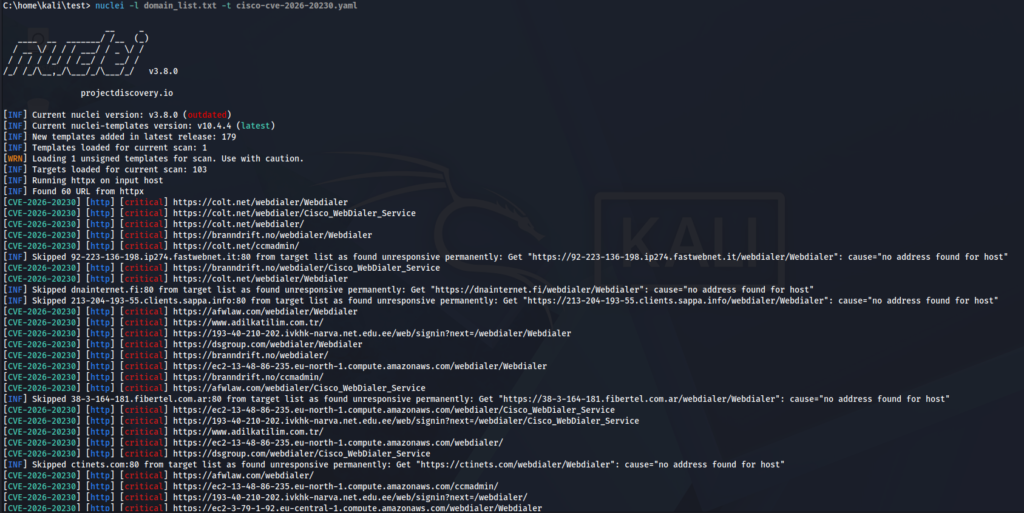
⚠️ Threat Intelligence Note: Fully functional, weaponized Proof-of-Concept (PoC) exploit codes were publicly leaked and distributed across open-source security repositories on June 4, 2026—just twenty-four hours after Cisco’s initial disclosure. The availability of these public blueprints drastically compresses the time window for defensive teams, as sophisticated threat syndicates and opportunistic actors alike are actively incorporating these exploit primitives into automated external scanning engines and threat delivery frameworks.
Technical Detail: How the Vulnerability Works
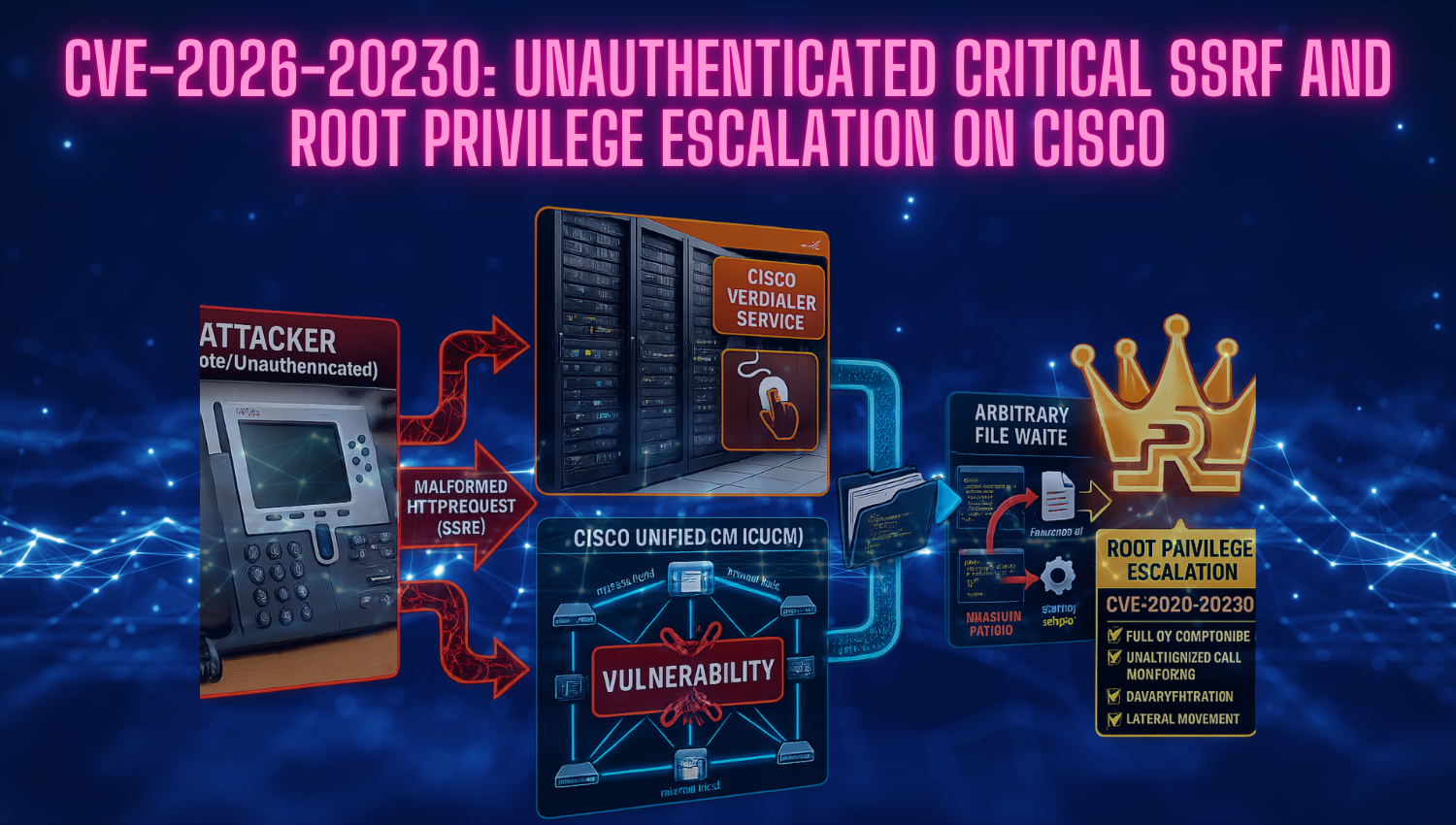
The root cause of this critical vulnerability lies in a severe lack of input validation and sanitization within the embedded Cisco WebDialer service. This service is designed to handle click-to-call integrations by processing incoming web-based triggers and translating them into telephony commands. However, because the backend parsing logic lacks strict validation boundaries, it can be manipulated into interacting with internal systems. The full exploitation process progresses through a multi-stage attack chain:
- Input Manipulation & SSRF Trigger: The attack begins when a remote, unauthenticated adversary constructs a malformed HTTP request targeting the WebDialer application endpoints. Within this request, the attacker injects crafted parameter strings containing unexpected destination tracking, loopback indicators, or URI structures. Because the WebDialer service fails to validate these inputs against an explicit allowlist, it processes the request and blindly initiates an outbound or internal connection on the attacker’s behalf, establishing a Server-Side Request Forgery (SSRF) primitive.
- Bypassing Trust Boundaries: In a secure architecture, external users are strictly isolated from internal administrative services. However, by exploiting this SSRF flaw, the attacker effectively forces the vulnerable WebDialer application to act as an internal proxy. The web server routes the attacker’s manipulated inputs directly to high-privileged local network interfaces (such as
127.0.0.1or internal Inter-Process Communication [IPC] sockets). Since these internal endpoints implicitly trust traffic originating from the local host, the attacker successfully bypasses peripheral firewall rules and network segmentation, gaining direct communication with sensitive local configuration mechanisms and internal file management APIs. - Arbitrary File Write via Internal Abuse: Once the trust boundary is broken, the attacker leverages the SSRF foothold to interact with internal administrative APIs that possess file-system modification capabilities. By tricking these internal services into executing file-creation commands, the attacker can write completely arbitrary data to almost any location on the local Linux filesystem. In a typical attack scenario, the adversary uses this capability to drop malicious payloads, altered configurations, or web shells into highly sensitive system paths—such as system initialization directories, scheduled automated tasks (
cron.d), or application startup components. - Privilege Escalation to Root: The final phase of the exploit chain relies on the operating system’s automated background maintenance routines. The Linux operating system regularly reads and executes scripts located within system directories (like cron tables or startup daemons) using the highest possible system privileges (
root). When the OS automatically parses and triggers the file previously dropped or modified by the attacker, the payload executes within this administrative context. This completely shatters the application layer container, granting the remote adversary interactive command execution as therootuser and resulting in full, unrestricted compromise of the underlying Cisco Unified CM operating system.
[Attacker (Remote/Unauthenticated)]
       |
       |  Crafted HTTP Request (WebDialer Parameter Manipulation)
       v
[Cisco WebDialer Service]
       |
       |  Insufficient Input Control -> Internal Request Generation (SSRF)
       v
[Local File API / System Services]
       |
       |  Arbitrary File Write (e.g., Malicious cron injection)
       v
[Linux Operating System OS] ---> Trigger Event: Full ROOT Access!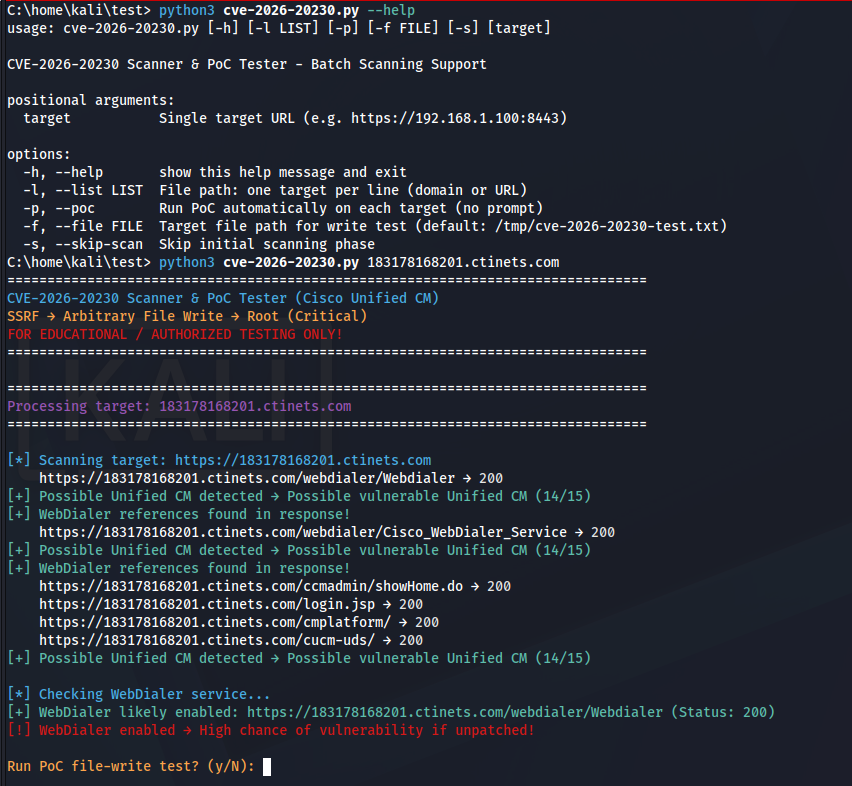
Affected Software Versions
| Major Train | Affected Versions | First Fixed Version / Remediation |
|---|---|---|
| Cisco Unified CM 12.5 | All versions prior to 12.5SU9 | 12.5SU9 (Released June 2026) |
| Cisco Unified CM 14 | All versions prior to 14SU6 | 14SU6 (Released June 2026) |
| Cisco Unified CM 15 | All versions prior to 15SU5 | Apply interim COP patch immediately |
Conclusion
CVE-2026-20230 serves as a stark, definitive reminder of the systemic security risks surrounding critical enterprise VoIP and IP PBX environments, which often sit at the very nexus of corporate operations. The total absence of authentication requirements to initiate the exploit chain, combined with the alarming reality of highly functional, publicly available PoC code distributed across the internet, elevates this threat vector to a maximum operational priority for global defense teams. It represents an immediate window of vulnerability that automated attack infrastructure will seek to exploit opportunistically. To mitigate this immediate exposure, organizations must act decisively. Security administrators should immediately log into their Cisco Unified Serviceability dashboard to explicitly verify whether the underlying Cisco WebDialer Web Service is currently active and running within their deployment. If the service is found to be running, and an immediate patch window is not accessible, the service should be disabled entirely as a critical interim workaround. While disabling this feature may temporarily disrupt click-to-call business workflows, it effectively closes the primary attack surface and nullifies the SSRF exploit primitive entirely. For permanent resolution and structural remediation, reactive workarounds must be replaced with official vendor updates. Systems running legacy or active production trains 12.5 and 14 must be scheduled for immediate upgrades to 12.5SU9 or 14SU6 respectively. For enterprises running newer deployments on the 15 train, where full service updates may still be in a targeted release cycle, administrators must prioritize the manual acquisition and installation of the specific interim COP patch provided directly by Cisco Systems.
Ultimately, passive posture management is insufficient when dealing with core infrastructure components. A root-level compromise on a central infrastructure asset like CUCM does far more than simply expose unencrypted telephony data and call routing paths. Because these servers maintain extensive internal network trusts, an attacker commanding root access can manipulate the server into an ideal, high-privilege pivot point—allowing them to bypass perimeter firewalls, map hidden internal segments, and orchestrate a deeper, devastating compromise across the wider corporate network.