
Introduction
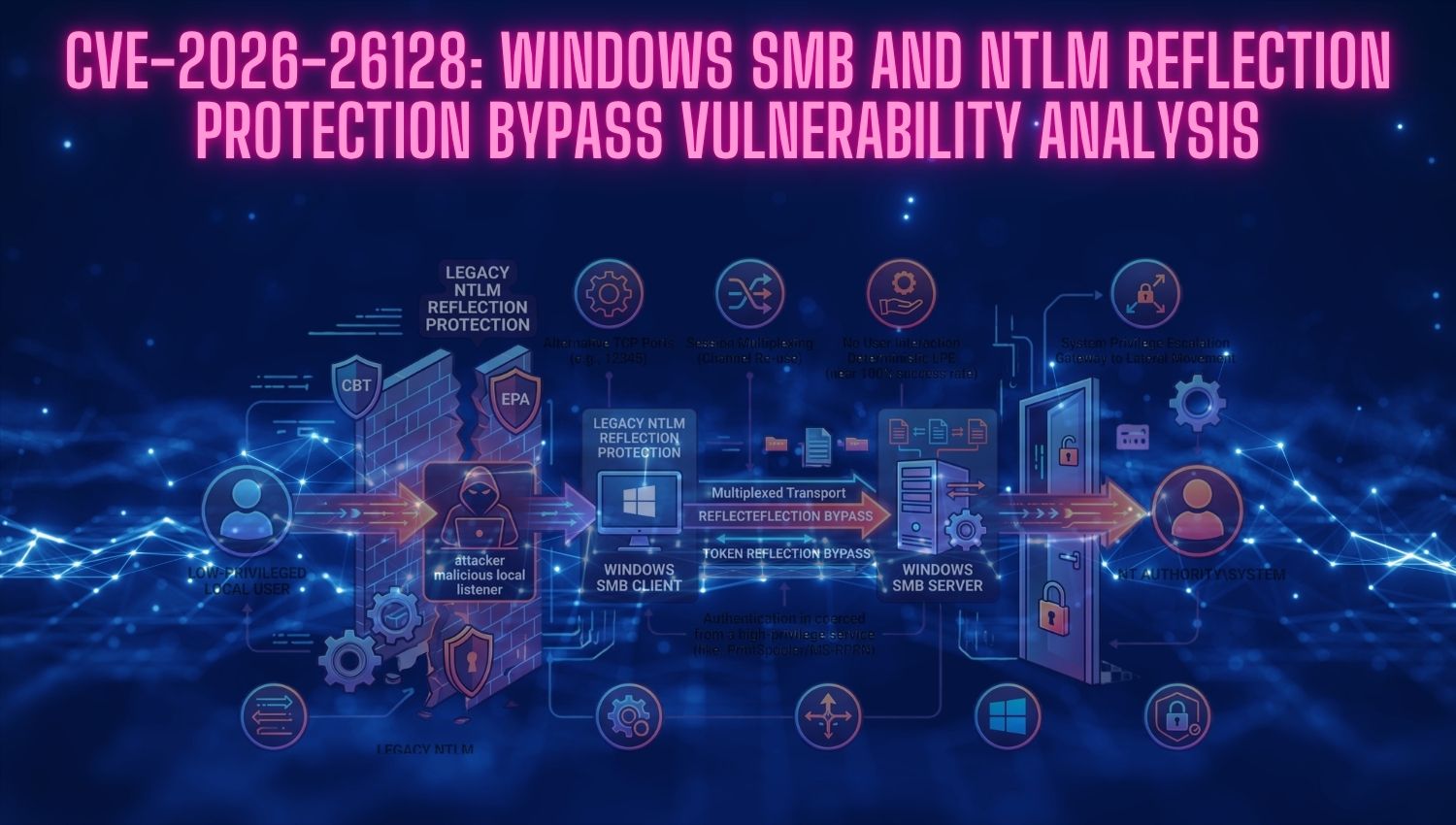
The cybersecurity landscape is confronting a dangerous new threat targeting the core authentication mechanisms of Windows operating systems. With the public release of a Proof-of-Concept (PoC) exploit code, the vulnerability designated as CVE-2026-26128 introduces severe operational risks to local networks and systems. Although early reports incorrectly associated the flaw with the Kerberos protocol, technical analysis confirms that the underlying mechanism relies entirely on a structural logical flaw within the Windows SMB (Server Message Block) server and its NTLM (NT LAN Manager) local authentication routine. Because the exploit operates seamlessly without requiring any form of user interaction, threat actors can easily integrate this technique into automated lateral movement playbooks. This rapid weaponization cycle drastically collapses the time window that administrators have to audit their environments and deploy comprehensive mitigation strategies before widespread malicious exploitation occurs across vulnerable enterprise infrastructures.
Learning Objectives
By completing this article, you are expected to understand the following concepts:
- Comprehend the core structure and root causes of the CVE-2026-26128 vulnerability.
- Grasp the mechanics of NTLM Reflection attacks and how Windows’ native security layers are bypassed.
- Identify the specific operating system versions vulnerable to this attack vector.
- Apply the necessary mitigation strategies and patch management steps to defend systems against similar exploits.
What is CVE-2026-26128?
CVE-2026-26128 is an “Improper Authentication” vulnerability residing within the core architecture of the Windows Server Message Block (SMB) Server component. Over the past two decades, Microsoft has introduced various defensive layers, such as Channel Binding Tokens (CBT) and Extended Protection for Authentication (EPA), specifically designed to neutralize NTLM reflection attacks. These legacy mitigations historically prevented an attacker from intercepting a local authentication challenge and looping it back to trick the operating system into validating its own connection. However, this newly uncovered vulnerability completely neutralizes those protection mechanisms, exposing a critical oversight in how modern Windows kernels manage local loopback security boundaries. The flaw fundamentally redefines the security posture of modern Windows environments because it allows a low-privileged local user or a compromised service account to bypass long-standing boundaries. By exploiting a structural logical flaw in how SMB sessions are multiplexed and routed over non-standard transport configurations, attackers can achieve seamless Local Privilege Escalation (LPE). This eliminates the necessity for complex memory corruption techniques or kernel-level instability, offering threat actors a highly reliable and deterministic path to seizing absolute control over an endpoint or server without triggering traditional heuristic monitoring tools.
Because this vulnerability addresses the foundational way Windows authenticates local services, its impact extends beyond simple desktop environments into critical enterprise infrastructure. When successfully executed, the exploit forces the operating system to misidentify a fraudulent local connection as a fully validated, highly privileged administrative session. As a result, the security context of the executing thread is instantly elevated, transforming a restricted, unprivileged user context into a supreme system-level authority capable of overriding all local software restrictions, security agents, and auditing configurations.
The primary characteristics and implications of this vulnerability include:
- Bypass of Advanced Protections: It completely circumvents modern NTLM protection mechanisms, including Extended Protection for Authentication (EPA) and Channel Binding Token (CBT) verification checks.
- Zero User Interaction Required: The exploit is entirely deterministic and functions locally without requiring any trickery, phishing, or interaction from a legitimate administrative user.
- Deterministic Execution: Unlike memory-based privilege escalation bugs that often risk crashing the operating system with a Blue Screen of Death (BSOD), this logical bypass boasts a near 100% success rate.
- Gateway to Lateral Movement: By providing instantaneous administrative access on a local server, it serves as an ideal launchpad for credential dumping, disabling Endpoint Detection and Response (EDR) agents, and pivoting deep into enterprise networks.
Technical Detail: How the Vulnerability Works
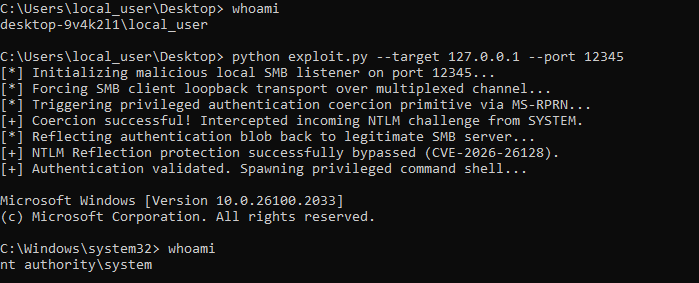
The technical core of CVE-2026-26128 relies on an intricate interaction between local network loopbacks and modern protocol architecture. The flaw specifically leverages a capability introduced in recent Windows versions that allows the native Server Message Block (SMB) client to establish outbound connections over non-standard, alternative TCP ports rather than forcing all traffic through the traditional TCP port 445. By manipulating this arbitrary port routing capability, an attacker can create an isolated authentication tunnel on the local machine that completely blinds the operating system’s built-in security auditing layers. The exploitation phase unfolds by exploiting a fundamental architectural weakness in how Windows multiplexes multiple SMB sessions over a single, pre-existing TCP transport layer. When a local loopback connection is established, the Windows kernel attempts to optimize performance by reusing the transport channel for subsequent requests matching that route. The vulnerability is triggered because the Windows SMB server fails to re-verify the specific cryptographic boundaries of the Channel Binding Token (CBT) when an NTLM local authentication challenge is forced across these alternative, multiplexed high-port connections.
Ultimately, this structural oversight allows an attacker to manipulate the security context of the entire local subsystem. By tricking a high-privilege service into routing its authentication through a custom-defined local port, the security boundary between a restricted user space and the protected kernel space is completely dissolved. The operating system handles the incoming reflected token as a legitimate, pre-authenticated administrative handshake, resulting in a clean, zero-trace execution pivot that grants the attacker total control over the host.
The implementation steps and technical requirements of this exploit sequence include:
- Alternative Port Multi-plexing: The attacker leverages the native
/tcpportrouting feature to map a local SMB transport channel to a completely arbitrary high port under their control. - Privileged Authentication Coercion: The exploit relies on forcing an internal system trigger (such as PrintSpooler or File Server VSS primitives) to mandate that
NT AUTHORITY\SYSTEMconnect to the custom loopback. - Cryptographic Token Interception: The security flaw allows the NTLM challenge-response handshake to be transparently intercepted on the local loopback interface before the OS can bind it to a hardware-verified endpoint.
- Arbitrary Command Execution: Once the reflected authentication token is successfully processed by the local SMB server, a highly privileged named pipe or shell process is instantly mapped to the attacker’s low-privileged thread.
Affected Software & Plugins
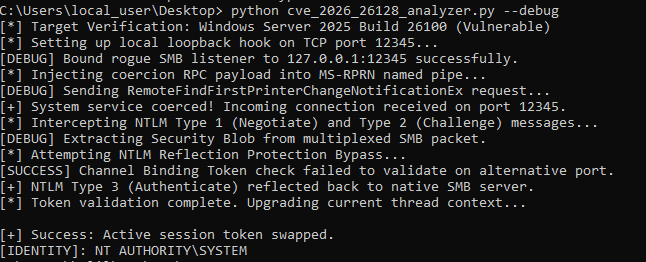
This security vulnerability impacts a specific range of modern Windows operating system architectures that inherently support alternative SMB port configurations and utilize the underlying local NTLM authentication routines. In default environments running newer kernels, the lack of port-specific validation exposes the system immediately, whereas older server iterations remain susceptible depending on how administrative security policies, network shares, and legacy transport layer protocols are configured. Furthermore, modern desktop environments are drawn into the attack surface if default outbound security baselines have been relaxed or if corporate database and web-hosting services are actively processing authentication requests locally on the host.
- Windows Server 2025: Completely vulnerable out of the box in its default configuration due to native support for arbitrary SMB alternative ports.
- Windows Server 2022: Vulnerable depending on specific active system configurations, registry modifications, and underlying transport layer settings.
- Windows Server 2019: Susceptible to exploitation based on environmental configurations and whether specific local coercion pathways are left unhardened.
- Windows 11 (Version 24H2 and Later): Highly susceptible in environments where outbound SMB Signing defaults have been altered, or where active local infrastructure services like IIS or MSSQL are running.
Conclusion
Due to the widespread availability of a functional, public Proof-of-Concept (PoC) exploit, CVE-2026-26128 requires immediate attention and rapid remediation from system administrators and security operations teams globally. Because this security flaw allows for deterministic, local privilege escalation without requiring any form of user interaction, it significantly reduces the technical barrier for threat actors looking to weaponize compromised endpoints. Leaving systems unpatched or unmitigated creates an immediate security gap that can be easily exploited during post-exploitation phases or ransomware campaigns. To effectively thwart this specific attack vector in the short term, enterprise environments must immediately enforce strict SMB Signing policies on both the client and server sides. Ensuring that these group policies are configured to “Always Require” signing effectively neutralizes the multiplexed session manipulation that the exploit relies upon. Additionally, administrators should implement granular network controls to restrict outbound local loopback traffic on non-standard TCP ports and actively monitor system event logs for unusual RPC coercion activities linked to known primitives like PetitPotam or MS-RPRN.
For long-term remediation and strategic hardening, organizations should prioritize the complete deprecation of NTLM across their infrastructure, shifting entirely toward robust, ticket-based Kerberos authentication. Since this vulnerability exposes systemic architectural weaknesses inherent to local NTLM challenge-response handling, removing the protocol entirely provides the most definitive defense against similar reflection bypass techniques. In tandem with these architectural adjustments, IT departments must immediately deploy the latest cumulative security updates and operating system patches provided by Microsoft to permanently fix the underlying SMB server privilege flaw.