Vulnerability Analysis: CVE-2026-123158 “SSHole” – Critical Root Vulnerability in Alpine Linux Systems

Introduction The cybersecurity landscape recently witnessed a highly critical vulnerability dubbed “SSHole” (CVE-2026-123158). This flaw represents a severe authentication bypass issue that primarily impacts lightweight, container-friendly operating systems like Alpine Linux. By exploiting an unintended collision between several independent security mechanisms, unauthenticated remote attackers can bypass SSH authentication entirely. In specific cloud environments, this seamlessly translates to immediate, unauthorized root access, making it one

Bad Epoll (CVE-2026-46242): The New Linux Kernel Threat That Outsmarted AI

Bad Epoll (CVE-2026-46242) The New LInux Kernel Threat That Outsmarted AI

Introduction For years, the cybersecurity industry has increasingly relied on automated code analysis and AI-driven vulnerability scanners to secure open-source software. However, the discovery of the “Bad Epoll” vulnerability (CVE-2026-46242) in May 2026 proved that even the most advanced AI models have their limitations. Found deep within the Linux kernel’s fundamental epoll I/O framework, this Local Privilege Escalation (LPE) flaw allows a low-privileged attacker to bypass critical security

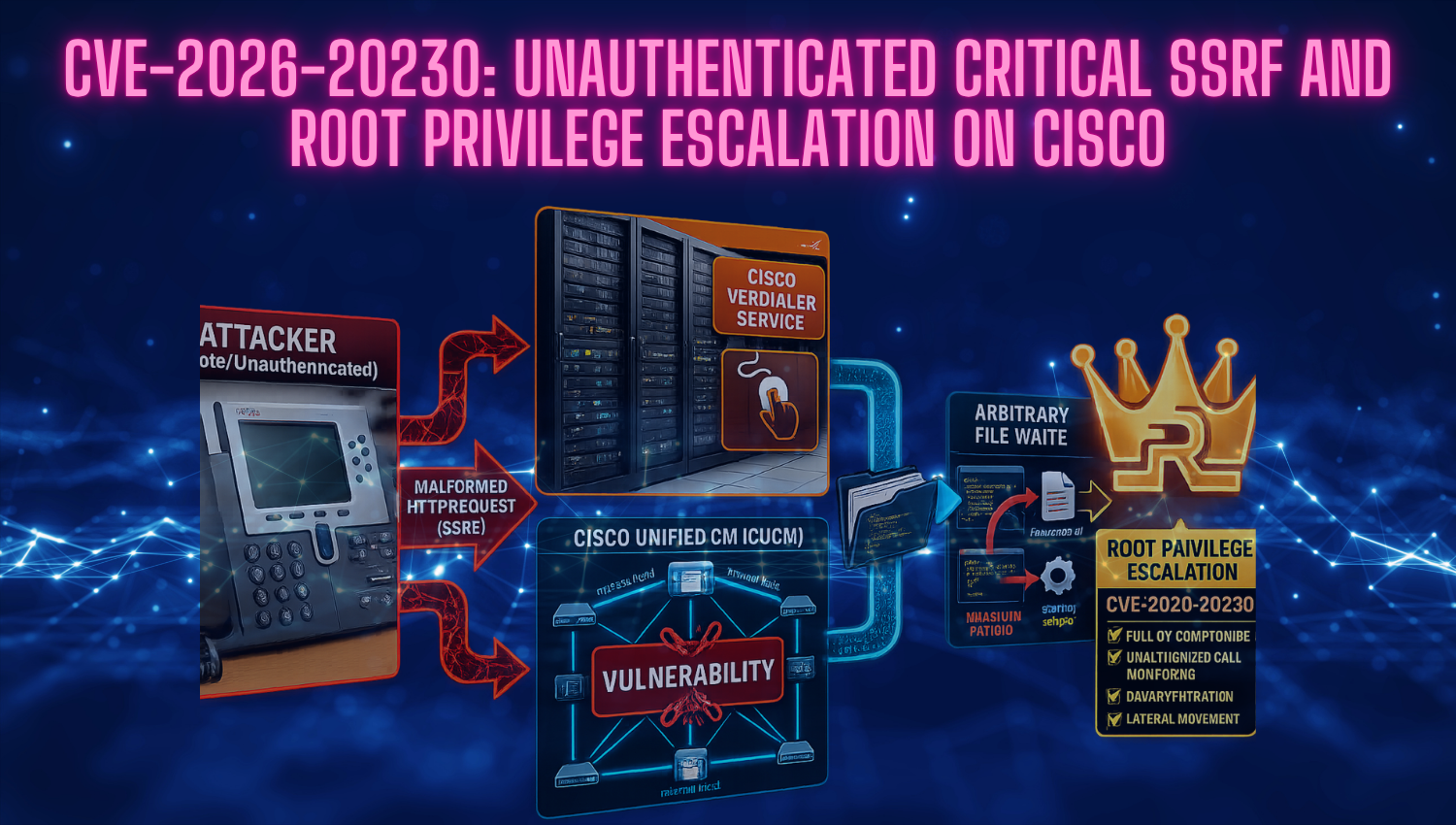
CVE-2026-20230: Unauthenticated Critical SSRF and Root Privilege Escalation on Cisco

Introduction Enterprise voice and video communication infrastructures rely heavily on Cisco Unified Communications Manager (Unified CM / CUCM) as a core asset within modern corporate network architectures. Because these unified communications platforms handle sensitive proprietary data, orchestrate internal routing, and connect disparate branch offices, they represent highly attractive targets for sophisticated threat actors looking to establish a persistent foothold. Disclosed by Cisco PSIRT in