
Introduction
Industrial Control Systems (ICS) and SCADA architectures form the core of modern infrastructures, critical utilities, and automated production facilities. Integrating these legacy operational environments with modern web-based interfaces and open-source solutions significantly enhances operational flexibility and real-time data accessibility, but it simultaneously expands the digital cyber threat landscape exponentially. FUXA is a popular, web-native open-source SCADA platform widely used by engineers for process visualization, human-machine interfaces (HMIs), and interactive dashboard panels. However, a severe vulnerability designated as CVE-2026-47717 discovered in FUXA v1.3.0 completely undermines these deployments. This flaw allows remote, unauthenticated attackers to seamlessly exfiltrate entire industrial project data files, structural layouts, and sensitive hardware configuration assets due to a critical logic breakdown within the platform’s backend authentication mechanisms.
Because such detailed architectural data gives adversaries a perfect blueprint of the underlying industrial processes, understanding this flaw is paramount. This article details the comprehensive technical anatomy of the vulnerability, step-by-step exploitation dynamics, and its broader security implications on vulnerable operational technology (OT) environments.
Learning Objectives
After completing this analysis, you are expected to gain proficiency in the following areas:
- Understanding authentication bypass mechanisms within the FUXA SCADA architecture.
- Analyzing source-code-level logic errors behind the CVE-2026-47717 vulnerability.
- Evaluating the reconnaissance risks that unauthorized data disclosure (CWE-201) introduces to OT (Operational Technology) environments.
- Protecting ICS/SCADA systems against similar unauthenticated API exploits through defense strategies.
What is CVE-2026-47717 – FUXA 1.3.0 – Unauthenticated ICS/SCADA Project Data Disclosure
CVE-2026-47717 is a high-severity data disclosure vulnerability residing within the backend runtime component of the FUXA platform, specifically identified in builds up to v1.3.0-2773. Carrying a CVSS base score of 7.5, this security flaw allows a remote, unauthenticated attacker to bypass intended access controls and completely retrieve the entire active project file from the hosting system. Under normal operating conditions, when an administrator activates the secureEnabled parameter and assigns a unique, randomized secretCode, all critical project configurations and operational assets are expected to remain strictly blocked from unauthorized third parties.
Instead, this structural vulnerability completely misuses the token generation mechanism originally designed to facilitate restricted guest user mode views. By exploiting this flaw, an attacker can trick the system into generating a legitimate context that subsequently leaks the complete proprietary configuration stored in the backend database. Rather than requiring step-by-step privileges, the flaw dumps everything—ranging from physical controller pathways to internal automation scripts—directly into a single, unencrypted JSON payload. Because the application inadvertently packs sensitive system secrets into an authorized network reply, this flaw is formally classified under CWE-201: Insertion of Sensitive Information Into Sent Data.
The core impacts of this unauthenticated project data disclosure can be categorized into four primary operational threats:
- Complete Operational Visibility (Reconnaissance): The leaked database grants adversaries immediate, zero-authentication access to the internal schematics of the target facility. This eliminates the need for noisy network scanning, allowing attackers to chart out the entire industrial topology completely undetected.
- Exposure of Device and Driver Topology: The leaked payload contains explicit communication parameters, driver details, and hardware addresses for all connected PLCs (Programmable Logic Controllers), RTUs, and industrial edge devices, creating an immediate roadmap for subsequent direct targeting.
- HMI Variable Binding Leakage: By exposing the exact SVG layouts alongside their live variable tags, the vulnerability reveals precisely which data points control real-world machinery. This gives attackers the exact register maps required to forge malicious control commands or spoof sensor data.
- Automation Logic and Script Exposure: The disclosure extracts the system’s backend JavaScript files and custom automation loops. This allows malicious actors to analyze proprietary logic structures offline to discover further zero-day primitives or design process-disrupting payloads.
Technical Detail: How the Vulnerability Works
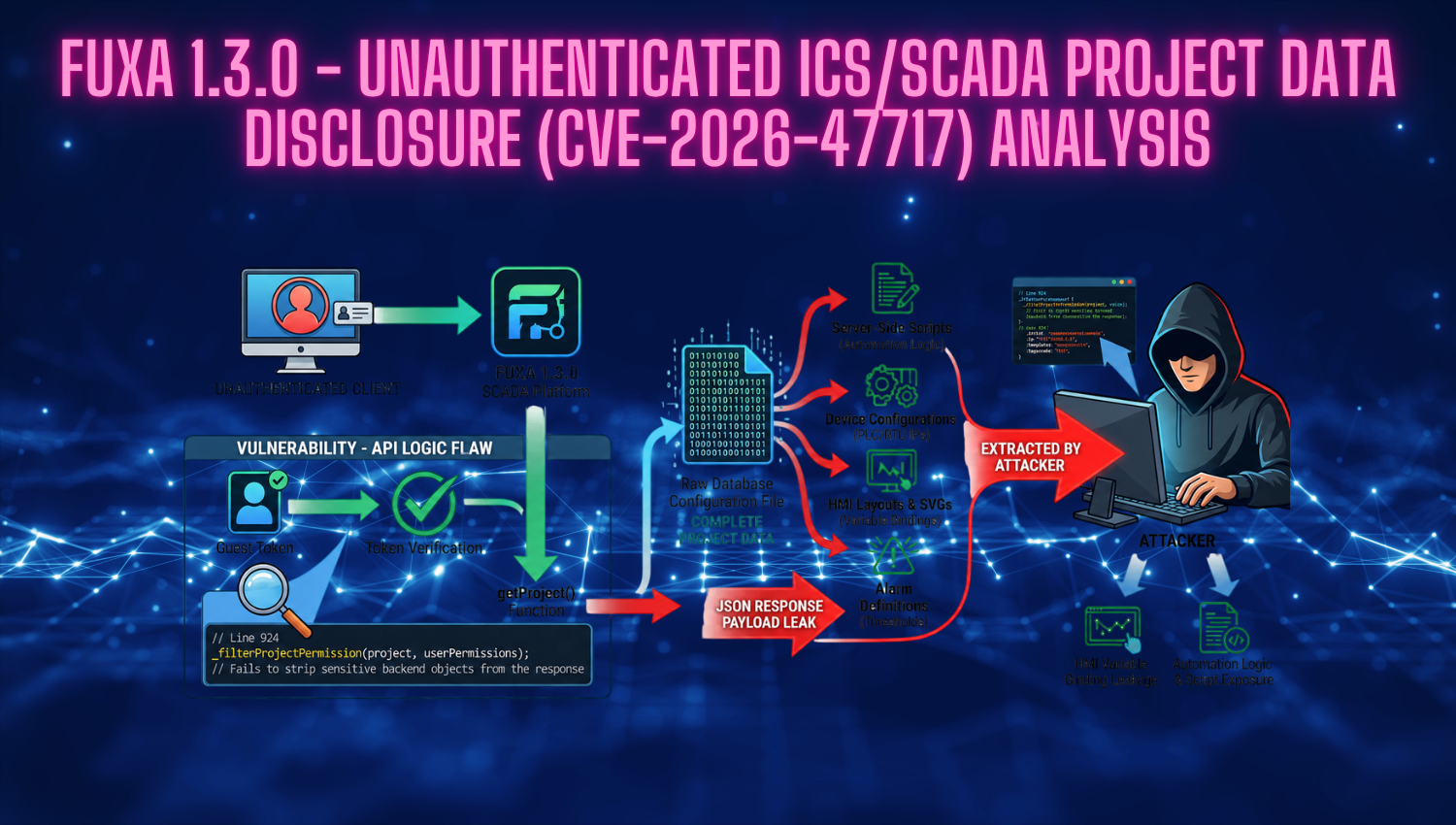
The root cause of the vulnerability lies in a design flaw within the routing and authorization logic of the GET /api/project HTTP endpoint inside the FUXA server component’s server/runtime/project/index.js file. Even when security mode is globally enabled, the backend generates a valid “guest token” signed with the server’s secret key so that guest or anonymous users can view the interface in a restricted mode. When a request is made using this guest token, it passes authentication successfully, and the server then calls the getProject function to respond to the request. Regarding the logic flaw at the code level, after fetching the raw project data, the FUXA backend architecture executes the _filterProjectPermission function located around line 924 to attempt filtering based on the user’s privilege level. However, this function only focuses on hiding specific buttons or administrative pages on the front-end user interface. It completely fails to strip or sanitize operational intelligence, backend scripts, and hardware connection strings from the underlying JSON object returned by the backend, allowing sensitive configuration data to be fully transmitted to unauthorized clients.
The diagram below illustrates the flawed logic flow where sensitive backend data completely bypasses front-end visual sanitization filters and exposes the entire ICS/SCADA environment configuration to the unauthorized client:
[Unauthenticated Attacker]
          │
          │  1. Sends HTTP GET /api/project (with Guest Token)
          ▼
   [FUXA API Gateway]
          │
          │  2. Validates Guest Token (Authentication Passes)
          ▼
     [getProject()]  ───► Retrieves Raw Database Configuration File
          │
          ▼
[_filterProjectPermission()]
          │
          ├─► [Hides Administrative Buttons in UI] (Front-end Restriction Only)
          │
          └─► CRITICAL FLAW: Fails to strip sensitive data objects from JSON response!
          │
          ▼
[Massive JSON Response Payload Leak] ───► Extracted by AttackerConsequently, when an unauthenticated attacker directly targets the GET /api/project endpoint, the server leaks a massive dataset, creating distinct high-risk categories instead of applying proper filtering:
- Server-Side Scripts (Automation Logic Exposure): The backend response exposes core automation logic, internal JavaScript source code, function names, object IDs, and backend permission maps. This hands adversaries the blueprints necessary for uncovering subsequent logical or processing flaws offline.
- Device Configurations (Network Topology Mapping): The unencrypted dump fully discloses network IP addresses, exact communication protocol drivers (such as Modbus, OPC UA, or Siemens S7), and physical hardware parameters of connected PLCs, RTUs, and industrial edge controllers, mapping out the target network without any footprint.
- HMI Layouts & SVGs (Variable Binding Leakage): The data yields the complete structural SVG schema of the human-machine interface operator screens. Most critically, it exposes the explicit variables and tag addresses mapping visual components directly to physical automation points on the factory floor.
- Alarm Definitions (Safety Threshold Compromise): The leak reveals alarm threshold levels, conditional triggers, safety margins, and configured operational notification workflows, providing attackers with the knowledge required to suppress or spoof critical industrial alerts.
Related Vulnerabilities
The CVE-2026-47717 vulnerability is part of a broader trend of deficient API security and insufficient input/entry point validation frequently observed across the shifting landscape of the ICS/SCADA ecosystem. As modern web architectures integrate deeper into legacy operational technology (OT) platforms, a persistent failure to fully enforce backend authentication layers or strip unfiltered datasets before they reach the client side has historically led to critical security breakdowns. Rather than generating noisy network anomalies by actively scanning industrial subnets, these architectural weaknesses allow adversaries to passively map out critical industrial parameters through seemingly benign API transactions. By capitalizing on this quiet reconnaissance blueprint, malicious actors can easily compile precise register maps and configuration intelligence to construct highly targeted, devastating payloads designed to manipulate field equipment directly without triggering immediate operational alarms.
- CVE-2022-23131 (Strapi RCE / Ignition Integration): This vulnerability highlights a similar design pattern where flawed session handling and validation on web endpoints associated with industrial frameworks allowed unauthenticated users to bypass authentication entirely, leading to unauthorized state modifications.
- CVE-2021-32932 (Advantech WebAccess/SCADA Information Disclosure): A structurally related flaw where the backend API endpoints failed to adequately restrict access permissions, inadvertently leaking active internal configuration parameters and system path architectures to unauthenticated remote entities.
- CVE-2023-28343 (Node-RED Dashboard Insecure Direct Object Reference): Reflecting the exact core logic error of missing backend object filtering, this flaw permitted unauthorized remote users to interact with sensitive administrative endpoints, leaking core environmental state data directly via the application’s API.
- CVE-2024-38100 (Rockwell Automation FactoryTalk Information Leak): A prominent industrial API vulnerability where sensitive configuration files and device metadata were exposed to users with restricted privilege baselines because the backend failed to properly sanitize internal database elements prior to serialization.
Conclusion
The CVE-2026-47717 data disclosure vulnerability in FUXA v1.3.0 underscores how critical the backend data filtering phase is to modern industrial cybersecurity. In operational technology (OT) ecosystems, letting unauthenticated network adversaries smoothly mapped out entire system architectures, server-side scripts, and active PLC tags with zero prior authorization represents an unacceptable risk that completely undermines physical plant safety. When web-native software functions as the primary bridge to industrial floor automation, frontend visualization restrictions can never serve as a substitute for rigorous, server-side data sanitization and strict object-level access control boundaries. To effectively mitigate this exposure, operators must prioritize immediate patch management by updating their current FUXA deployments to the latest secure release tags provided by the maintenance team on GitHub. Upgrading beyond the vulnerable development snapshots ensures that the backend system natively enforces appropriate permission checks and strips sensitive internal project metadata before any serialized JSON packages are transmitted back over the network interface. Applying this software fix resolves the root code-level logic flaw and forms the first line of defense against targeted unauthenticated endpoint querying.
Furthermore, comprehensive defense-in-depth principles must be applied across the broader industrial network architecture to insulate these critical process visualization panels from external threat vectors. Administrators must ensure that the FUXA HMI/SCADA server interface is never exposed directly to the public internet or untrusted corporate IT zones, isolating it instead behind secure DMZs and strict firewall Access Control Lists (ACLs). Finally, overall platform hardening should be reinforced by disabling guest access mode entirely if it is not operationally required, alongside implementing continuous log monitoring to rapidly detect any anomalous API request volumes or unauthorized administrative telemetry transfers.