
Introduction
A severe security crisis recently emerged within the WordPress ecosystem involving Gravity SMTP, a widely adopted plugin designed to streamline outbound email delivery. Tracked as CVE-2026-4020, this unauthenticated sensitive information exposure vulnerability has rapidly transitioned from a theoretical risk to an active, widespread threat vector. As attackers increasingly weaponize automation to scan the modern web, leading cybersecurity firms, including Wordfence, have documented an unprecedented wave of global exploitation, recording over 17 million automated malicious attempts targeting this single flaw. This massive offensive highlights how critical infrastructure components can be compromised silently without direct administrative interaction. This article breaks down the architectural origin of the vulnerability, analyzes the underlying REST API misconfiguration that enabled the data leak, and outlines the urgent, practical steps required to secure your enterprise infrastructure against ongoing campaigns.
Learning Objectives
- Understand the Nature of CVE-2026-4020: Identify the affected plugin versions and grasp the real-world severity of the flaw.
- Analyze the REST API Exploit Mechanism: Learn how improper access control logic in
permission_callbackroutines exposes critical backend operations. - Assess the Data Leakage Footprint: Examine the specific types of high-value credentials and environmental blueprints exposed during an exploit.
- Implement Detection and Remediation: Review log analysis techniques to discover indicators of compromise (IoCs) and execute a complete mitigation strategy.
What is Gravity SMTP WordPress Plugin – Sensitive Information Exposure CVE-2026-4020
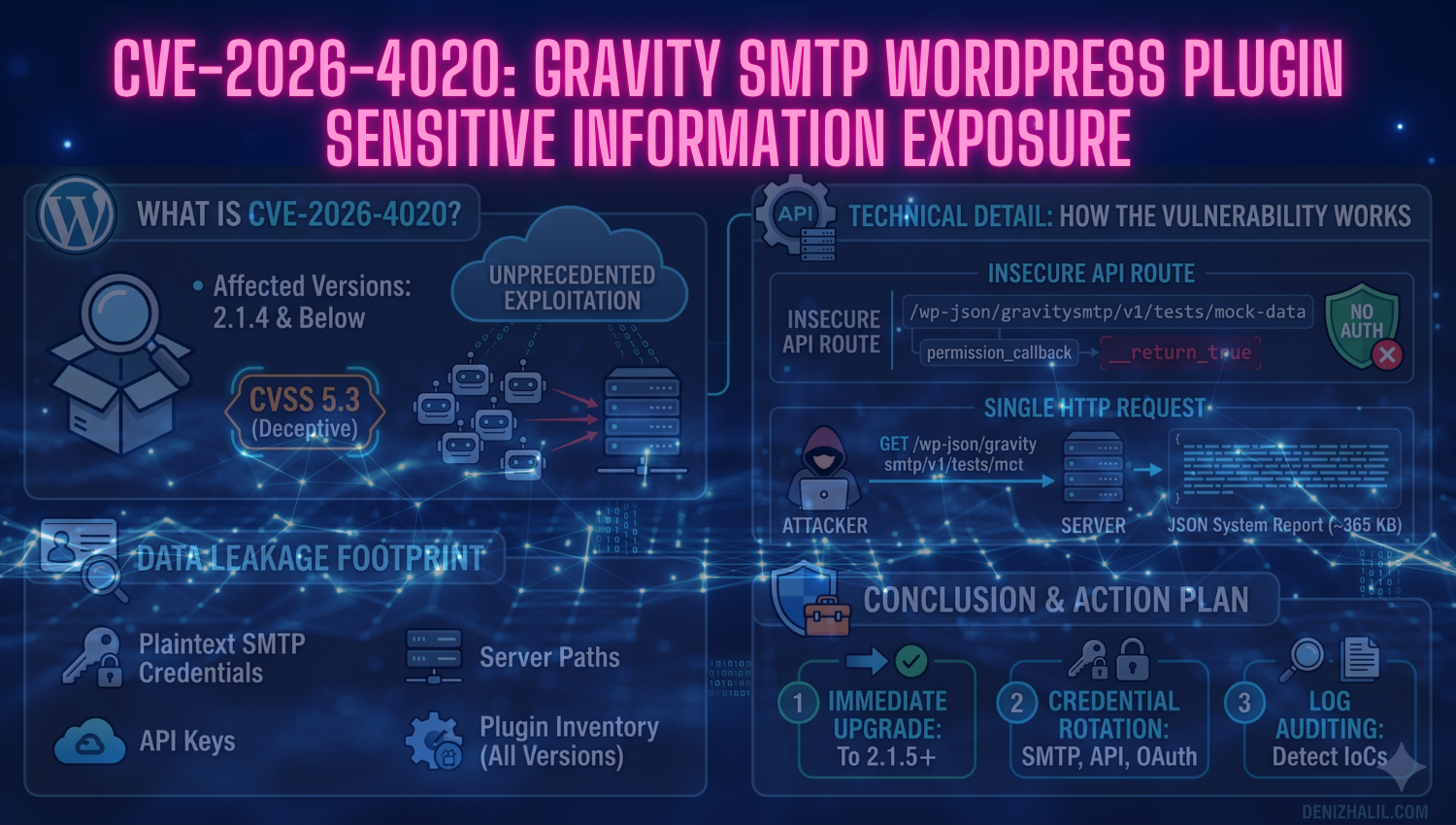
CVE-2026-4020 is a critical sensitive information exposure vulnerability affecting all versions up to and including 2.1.4 of the Gravity SMTP WordPress plugin. While standard scoring metrics have assigned it a CVSS score of 5.3 (Medium), this classification is highly deceptive in real-world scenarios. The low score stems from the fact that the exploit itself does not directly grant remote code execution (RCE) or immediate site takeover; however, the unprecedented scale of automated, in-the-wild exploitation campaigns quickly elevates this flaw to a high-priority threat for any organization relying on the eklenti. The root of the problem lies within the plugin’s internal debugging, testing, and logging framework, which was designed to help administrators troubleshoot mail delivery issues. Because these diagnostic routines handle deeply sensitive operational data, they are supposed to be heavily restricted behind strict authentication walls. Instead, due to a severe logical oversight in the plugin’s REST API configuration, these diagnostic features were accidentally exposed to the public internet, completely eliminating the need for valid user sessions, privileges, or administrative roles.
By exploiting this architectural gap, a completely unauthenticated remote threat actor can force the application to perform a comprehensive system dump with a single, weaponized HTTP request. This process automates the harvesting of proprietary server intelligence and critical integration assets. Rather than blindly testing for entry points, attackers use this vulnerability to systematically map out the target environment, transforming a minor configuration bypass into a massive data leakage pipeline.
The core threats driving the severity of this vulnerability include:
- Massive Automated Attack Scale: Threat groups have heavily weaponized this flaw using automated global scanners, resulting in over 17 million recorded exploitation attempts within a remarkably short time frame.
- High-Value Asset Exposure: The vulnerability acts as an open doorway to the site’s core transactional email systems, completely compromising active API tokens, private keys, and external SMTP credentials.
- Blueprint for Secondary Exploits: Beyond credentials, the leaked metadata provides a granular structural map of the hosting server and all installed plugins, giving attackers the exact intelligence needed to execute precise secondary attacks.
Technical Detail: How the Vulnerability Works
The root cause of this security flaw lies in an insecure and flawed implementation of the WordPress REST API routing logic within the eklenti’s source code architecture. When WordPress initializes plugins, developers can register custom endpoints to handle asynchronous communication or external webhooks. Gravity SMTP uses this mechanism to register a specific, custom endpoint intended strictly for diagnostic testing, system logging, and internal administrative troubleshooting:
/wp-json/gravitysmtp/v1/tests/mock-dataIn standard, secure development practices under the WordPress framework, any API endpoint that exposes system-level diagnostics or sensitive data must restrict access to highly elevated roles (such as a verified administrator) using a strict permission verification routine. However, the plugin developers omitted this validation layer. They incorrectly configured the permission_callback parameter for this specific route to point to the built-in WordPress helper function __return_true. Because this helper function unconditionally returns a boolean true without evaluating cookies, nonces, or user capabilities, it effectively strips away all authentication checks:
// Simplified representation of the flawed routing logic within the plugin
register_rest_route('gravitysmtp/v1', '/tests/mock-data', array(
    'methods'             => 'GET',
    'callback'            => array($this, 'get_mock_data'),
    'permission_callback' => '__return_true', // Critically open to the public!
));Because this wide-open callback always permits request execution, remote threat actors can bypass the traditional authentication barrier entirely. To exploit this flaw, an attacker only needs to append a specific query parameter (?page=gravitysmtp-settings) to the URL string. This parameter tricks the backend routing logic, forcing the initialization of the plugin’s internal register_connector_data() method during the API callback cycle:
GET /wp-json/gravitysmtp/v1/tests/mock-data?page=gravitysmtp-settings HTTP/1.1
Host: target-wordpress-site.com
User-Agent: Mozilla/5.0 (Automated Exploit Scanner)Upon receiving this simple HTTP GET request, the server executes the callback without hesitation and dumps a massive, completely unredacted JSON System Report payload averaging 365 KB in size straight into the attacker’s HTTP response stream. The heavily detailed metadata exposed within this single JSON payload includes:
- Plaintext Credentials & Third-Party Integrations: Active configuration parameters for all transactional email relays integrated with the site, including Amazon SES, Google OAuth/Workspace, Mailjet, Resend, Zoho, and custom corporate SMTP configurations. This exposes active API tokens, private keys, hostnames, ports, usernames, and completely unencrypted, plaintext SMTP passwords.
- Infrastructure Reconnaissance Blueprint: Structural details of the underlying web server stack, including absolute server file paths (
document_root), active PHP versions, loaded PHP extensions, database server types, and an exhaustive inventory of all installed WordPress plugins and active themes along with their exact version numbers.
Once harvested, cybercriminals immediately leverage the stolen SMTP credentials to hijack the organization’s verified mail relays to launch high-volume spam, malware distribution, or targeted phishing campaigns that bypass traditional spam filters. Concurrently, the extracted plugin and theme inventory serves as a highly targeted reconnaissance blueprint, allowing attackers to cross-reference the exact software versions against other known unpatched vulnerabilities to orchestrate a secondary, deep-tier compromise of the hosting server.
Conclusion
CVE-2026-4020 serves as a stark reminder of the critical importance of API security and “secure by default” design frameworks within the modern web ecosystem. A seemingly minor logical oversight in an authorization callback function can completely undermine an organization’s defensive posture, inadvertently exposing its entire external integration network and internal infrastructure map to the public internet. Because modern platforms increasingly rely on interconnected APIs to manage critical business communications, safeguarding these routes with stringent, multi-layered access controls must remain a top priority for security teams and software developers alike. To mitigate this risk immediately, administrators deploying Gravity SMTP across their infrastructure must prioritize updating the plugin to version 2.1.5 or later. This patch fundamentally addresses the core vulnerability by reconfiguring the REST API route permissions to enforce strict authentication checks, blocking unauthenticated remote entities from accessing the diagnostic endpoint. However, implementing the patch only secures the application against future exploitation attempts and does not retroactively neutralize the threat if a compromise has already occurred prior to the upgrade.
Because threat actors have aggressively scanned for this flaw in the wild, organizations that ran a vulnerable version must operate under the assumption that their data has already been harvested. Security teams must immediately execute a comprehensive credential rotation protocol, renewing all SMTP passwords, API keys, and OAuth tokens associated with external mail relays like Amazon SES or Google Workspace. Finally, a thorough log auditing campaign should be conducted, analyzing web server access logs for anomalous requests hitting the diagnostic endpoint to map out historical indicators of compromise while simultaneously monitoring outbound mail volume for spikes that suggest active relay hijacking.